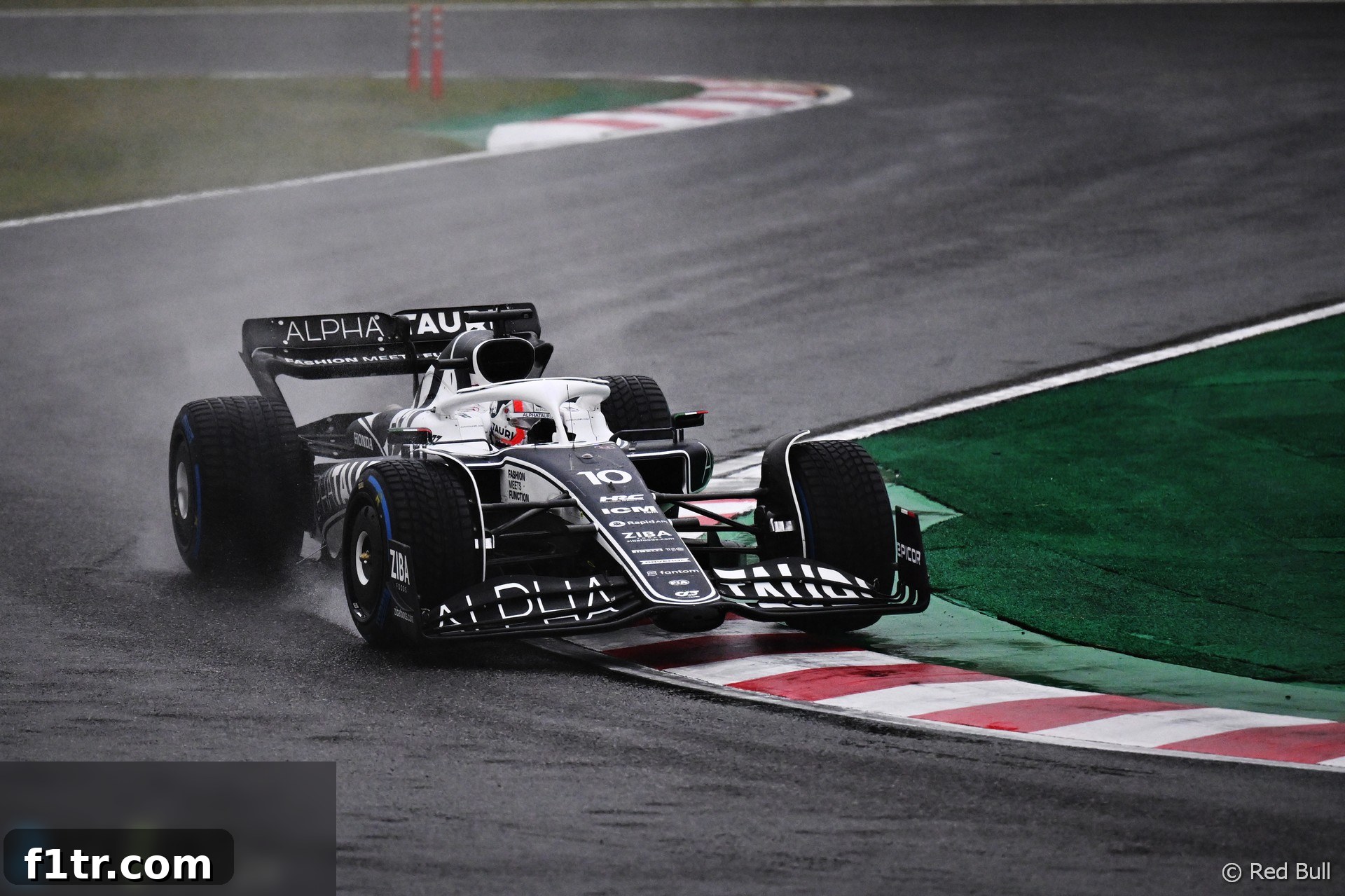
Pierre Gasly’s Suzuka Nightmare: A Close Call and F1 Safety Reckoning
A visibly shaken Pierre Gasly emerged from the cockpit after the Japanese Grand Prix, recounting a terrifying near-miss with a recovery crane that he believes brought him perilously close to death. The AlphaTauri driver’s harrowing experience reignited a fierce debate about safety protocols in Formula 1, echoing the tragic circumstances that claimed the life of Jules Bianchi on the very same track eight years prior.
Advert | Become a Supporter & go ad-free
The Suzuka Incident: A Dangerous Encounter
The incident unfolded during the chaotic opening laps of the rain-soaked Japanese Grand Prix. As the Safety Car was deployed following Carlos Sainz Jnr’s crash, multiple drivers, including Gasly, were shocked to discover recovery vehicles on track. Gasly, in particular, passed one of these large cranes at a speed approaching 200km/h (approximately 124 mph) near the exact moment race control issued a red flag, halting the race entirely.
The crane, one of two deployed between the hairpin and Spoon curve to retrieve Sainz’s stricken Ferrari, represented a monumental hazard. The treacherous conditions, exacerbated by heavy spray and reduced visibility, amplified the danger posed by such a large, static obstacle on the racing line. Drivers reported their alarm over team radio, highlighting the critical lapse in judgment that allowed such a scenario to develop.
Echoes of Jules Bianchi: A Haunting Reminder
For Gasly and many within the Formula 1 community, the sight of a recovery vehicle on track under these conditions was a chilling, almost unbearable reminder of the sport’s darkest day. Eight years earlier, at the 2014 Japanese Grand Prix, Jules Bianchi suffered a fatal accident when his Marussia car aquaplaned off track and collided with a recovery vehicle that was attending another incident. Bianchi succumbed to his injuries nine months later, leaving an indelible scar on the sport.
Gasly’s outrage was palpable as he articulated his disbelief: “We lost Jules. We all lost an amazing guy, an amazing driver, for the reasons that we know. Eight years ago, on the same track, in the same conditions with the crane. How? How today we can see a crane not even in the gravel, on the race track, while we are still on the track? I don’t understand that.” His words underscored a deep-seated frustration that despite past tragedies and subsequent safety reviews, such a perilous situation could reoccur.
A Disrespect to Legacy
The AlphaTauri driver went further, stating that the incident was “disrespectful to Jules, disrespectful to his family and all of us.” He emphasized the inherent dangers of Formula 1 racing, where drivers routinely push the limits of speed and control. While acknowledging the privilege of competing at the highest level, Gasly stressed that basic safety expectations must always be met. “We are risking our lives out there. We are doing the best job in the world but what we are asking is just to at least keep us safe. It’s already dangerous enough,” he asserted.
The memory of Bianchi serves as a constant touchstone for F1 safety discussions. Post-2014, significant changes were implemented, including the Virtual Safety Car (VSC) and stricter protocols for crane deployment. Yet, the Suzuka incident raised uncomfortable questions about whether these lessons had truly been learned, or if complacency had begun to creep back into operational procedures.
Advert | Become a RaceFans supporter andgo ad-free
Gasly’s Raw Emotion and Call for Accountability
Speaking to Sky Sports after the race, Gasly articulated the sheer terror he experienced. “I got scared,” he admitted, recounting how a slight deviation, akin to Carlos Sainz’s earlier aquaplaning incident, would have had fatal consequences. “Obviously if I would have lost the car in a similar way as Carlos lost it the lap before – it doesn’t matter the speed, 200, 100 – I would have just died. As simple as that.” This stark statement encapsulated the gravity of the situation and the immediate danger he faced.
Gasly vehemently argued that the crane’s presence on track was “unnecessary,” especially given that the race was moments away from being red-flagged. He suggested a more patient approach: “We could have waited one more minute to get back in the pit lane and then put the tractors on track.” The immediate cessation of the race would have provided a safer window for recovery operations, allowing drivers to return to the pits at a controlled pace before heavy machinery entered the circuit.
His relief at escaping the incident unscathed was palpable. “I’m just extremely grateful that I’m here and tonight I’m going to call my family and all my loved ones and the outcome is the way that it is, because I passed two metres from that crane and if I would have been two metres to the left, I would have been dead.” This personal account highlighted the razor-thin margin between a near-miss and another potential tragedy, intensifying calls for a thorough investigation and systemic change.
The Penalty and Its Complex Context
Adding another layer of complexity to the incident, Gasly found himself facing a penalty for speeding under red flag conditions. After the red flag was called, as he made his way back to the pit lane, Gasly maintained a relatively fast speed along the long back straight connecting the Spoon Curve and the 130R corner. He briefly breached 250km/h (approximately 155 mph) as he returned to the pit lane, leading the stewards to issue a drive-through penalty, which was later converted to a 20-second time penalty after the race.
Gasly initially defended his actions, insisting he was “respecting my delta lap time” while the race was neutralised under Safety Car conditions before the red flag. He stated, “We got a lap time to respect in the steering and I was still nine seconds slower than delta.” However, the stewards’ findings indicated a different interpretation of the regulations under red flag. They noted that “after passing the scene of the incident, car 10 [Gasly] continued under the red flag situation, at speeds which exceeded 200km/h on multiple occasions, and which reached 251km/h at one point.” Crucially, Gasly “conceded that he now understood that there could have been marshals or obstacles on the track, and admitted that he was too fast.”
Advert | Become a RaceFans supporter andgo ad-free
Mitigation and Broader Implications
In a significant acknowledgment, the stewards accepted that Gasly’s emotional state and shock from seeing the crane on track played a role in his actions. Their official statement noted, “In mitigation of penalty, we take into account that although the speed could not by any measure be regarded as ‘slow’ as required in the regulations, it was slower than the maximum speed that could be achieved under these conditions. We also take into account the shock the driver experienced on seeing a truck on the racing line in the corner of the incident.”
While the penalty addressed a clear breach of regulations, it simultaneously underscored the unique psychological pressure drivers face in such high-stakes, rapidly evolving situations. The incident highlighted a critical tension between strict adherence to rules and the human element of fear and adrenaline. Furthermore, Gasly received two penalty points on his licence, bringing his total to nine and placing him just three points away from an automatic race ban – a consequence that adds further weight to the entire episode.
The Unlearned Lessons: A Call for Future Safety
The core of Gasly’s argument remained unequivocal: “That crane should have not been there. If I would have been dead right now, I would have crashed into that crane, what’s the outcome? I don’t think that any tractor should be on a race track” under active racing conditions, even under a Safety Car. His focus quickly shifted from his personal experience to the broader safety of his colleagues and the future of the sport.
“What I care about is my colleagues, all of us, and that in the future we don’t face this sort of situation,” he added, his voice imbued with a sense of urgency. “Because today, if I would have aquaplaned like Carlos did before, I would not be standing here and there will be another one after Jules. And Jules was already extremely painful. I don’t think it’s respectful towards him and all his family.”
This incident has forced Formula 1 to confront its past and re-evaluate its present safety protocols. The FIA launched an immediate and thorough review into the deployment of recovery vehicles at Suzuka, acknowledging the seriousness of the situation. The outcome of this inquiry is crucial for restoring driver confidence and ensuring that the painful lessons from tragedies like Jules Bianchi’s are not just remembered, but actively and consistently applied to prevent future risks.
Advert | Become a RaceFans supporter andgo ad-free
2022 Japanese Grand Prix: Related Coverage
- From F1 to Formula Ford, 2022 was the year of the championship anti-climax
- Suzuka points confusion didn’t take shine off title win – Verstappen
- FIA to publish findings of inquiry into use of crane during Japanese GP
- Does F1 only need slicks and wets? The case for dropping intermediate tyres
- Hamilton’s work ethic “has not changed at all” in face of difficult 2022 campaign
Browse all 2022 Japanese Grand Prix articles