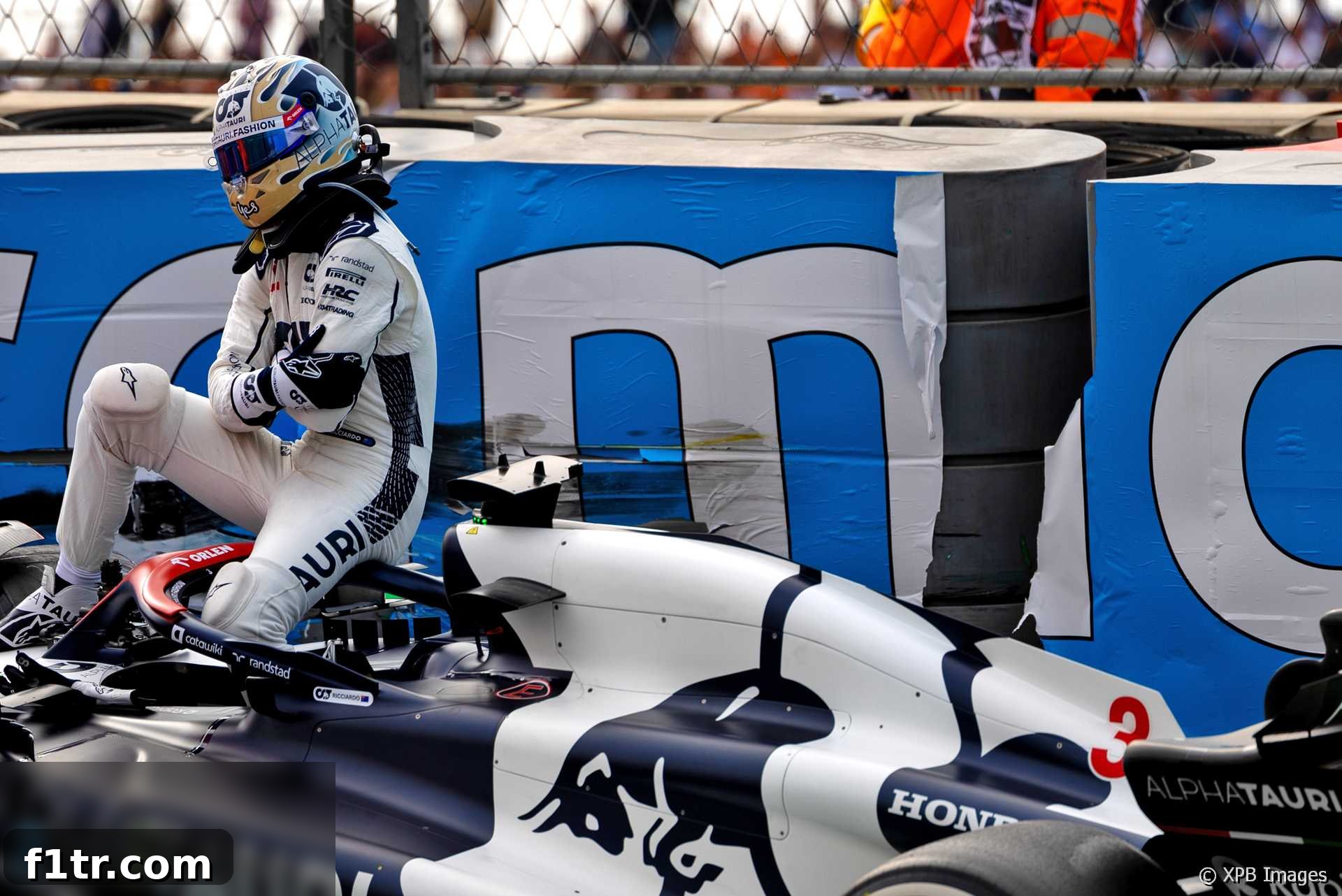
The exhilarating world of Formula 1 has once again witnessed the harsh realities of its demanding nature, as Daniel Ricciardo, the beloved Australian driver, faces an unexpected setback. Just two races into his much-anticipated AlphaTauri comeback, a high-speed crash during practice at the Dutch Grand Prix at Zandvoort has resulted in a broken bone in his left hand, casting a shadow over his renewed F1 journey. Despite the grim prognosis that a similar injury might sideline a ‘normal’ individual for months, Red Bull Team Principal Christian Horner remains optimistic, suggesting Ricciardo could be targeting a return for the physically demanding Singapore Grand Prix in just three weeks’ time.
The incident occurred during Friday’s second practice session at Zandvoort, a circuit notorious for its unforgiving banking and tight corners. Ricciardo, navigating Turn 3, a tricky, fast right-hander, was forced to take evasive action after McLaren’s Oscar Piastri crashed ahead of him. In a cruel twist of fate, Ricciardo’s AlphaTauri veered into the barrier, leading to the impact that caused the fracture in his metacarpal. The immediate pain and subsequent medical checks confirmed the injury, forcing the veteran driver out of the remainder of the Dutch Grand Prix weekend and, potentially, several more races. This unfortunate turn of events saw reserve driver Liam Lawson step into the AlphaTauri cockpit, making his Formula 1 debut under challenging circumstances.
Following the crash, Ricciardo was swiftly transported to a hospital in Barcelona, Spain, to consult with a specialist renowned for treating such injuries in top-tier athletes. Christian Horner, speaking to Sky Sports, detailed the immediate plans: “He’s headed off today to Barcelona. They may even have a little operation on him tomorrow to just tidy up where that break is, it’s quite a clean break.” This swift action underscores the urgency and meticulous approach teams take with driver injuries, aiming to expedite recovery as much as medically possible. While a clean break is generally more straightforward to heal, the intense forces and precision required for Formula 1 driving mean even minor complications can have significant ramifications for a driver’s return timeline and performance.
Horner’s remarks highlighted the unique resilience of motorsport athletes. “Fit or any normal human being will probably be about 10 to 12 weeks, but we know that these guys aren’t normal,” he asserted, acknowledging the extraordinary dedication and physiological advantages that allow F1 drivers to bounce back at an accelerated rate. The recovery process for a professional athlete like Ricciardo involves an aggressive rehabilitation program, meticulously designed by a team of physiotherapists and medical experts. This typically includes targeted exercises to restore strength and flexibility, alongside advanced therapies to promote bone healing. However, the exact duration of this process remains an unpredictable factor, as Horner noted: “Then it’ll all be about the recovery process, how long that will take, is it going to be three weeks, is it a month, is it six weeks? Nobody really knows.”
The timing of this injury is particularly poignant for Ricciardo, who had only just made his highly anticipated return to the F1 grid two races prior, taking over from Nyck de Vries at AlphaTauri. After a challenging two-year stint with McLaren, which culminated in his departure at the end of the 2022 season, Ricciardo had spent the first half of 2023 in a reserve driver role for Red Bull Racing. This period was crucial for him to recharge, rediscover his passion, and regain his competitive edge, or as Horner eloquently put it, “get his mojo back.” The reserve role allowed him to stay embedded within the F1 environment, contribute to simulations, and provide valuable feedback, without the immense pressure of regular competition. His comeback at the Hungarian Grand Prix was met with enthusiasm, and he quickly demonstrated flashes of his vintage form, reigniting hopes for a sustained, successful return.
Horner revealed the depth of Ricciardo’s frustration over the injury, stating, “I think that’s the thing he was most frustrated about, talking with him last night, was that he’d just taken a bunch of time off, just got his mojo back getting back into it, and now he’s on the bench again.” This emotional toll is understandable; Ricciardo had invested significant effort into preparing for this return, showcasing improved confidence and speed. His brief time back in the AlphaTauri had already indicated a positive trajectory, with the team beginning to make some progress on the car’s performance. For a driver who thrives on competition and the thrill of racing, being sidelined again, especially after such a deliberate and successful effort to re-establish himself, is undoubtedly a bitter pill to swallow.
The demanding nature of the 2023 Formula 1 calendar adds another layer of complexity to Ricciardo’s recovery. The Dutch Grand Prix marked the beginning of an intense period, with eight races scheduled over an eleven-week span. This relentless schedule means minimal downtime between events, putting immense pressure on drivers and teams. Following the Dutch Grand Prix, the F1 circus immediately moves to Monza for the Italian Grand Prix, often referred to as the “Temple of Speed.” After Monza, there is a single weekend off before the calendar resumes with the gruelling Singapore Grand Prix, a race that holds significant importance in Horner’s estimation of Ricciardo’s potential return target.
Singapore’s Marina Bay Street Circuit is widely regarded as one of the most physically demanding races on the calendar. Its challenging layout features numerous tight corners, requiring constant steering inputs and immense core strength. The high temperatures and oppressive humidity typical of Southeast Asia further exacerbate the physical toll on drivers, making hydration and endurance critical. For a driver recovering from a hand injury, Singapore presents an even greater hurdle. The repetitive, high-force demands on the hands and wrists, combined with the extreme heat, could put excessive strain on a healing bone, potentially delaying full recovery or even risking re-injury. Horner acknowledged this, stating, “I’m sure at the back of his mind he’s probably got Singapore as a target. But then again, Singapore’s probably one of the most tough circuits on the calendar. But, nature will take its course.” This pragmatic view recognizes Ricciardo’s ambition while also acknowledging the biological realities of healing.
The implications of Ricciardo’s absence extend beyond his personal disappointment. For AlphaTauri, the injury means an unexpected change in their driver lineup. Liam Lawson, a highly-rated Red Bull junior driver, has been thrust into the spotlight. While this presents an incredible opportunity for Lawson to showcase his talent, it also means the team loses the experience and immediate feedback Ricciardo was providing, especially as they strive to improve their car’s performance. The continuity and development momentum gained from Ricciardo’s return will inevitably be disrupted, at least temporarily. For Red Bull, who also manage AlphaTauri, Ricciardo’s injury could affect their long-term plans regarding driver placements, particularly with questions surrounding Sergio Perez’s future and the potential for Ricciardo to return to the senior team.
Ultimately, Daniel Ricciardo’s journey back to full fitness and competitive racing will be a testament to his renowned resilience and determination. His career has been marked by both soaring highs and challenging lows, but his unwavering positive attitude and fighting spirit have always shone through. While the allure of a quick return to the grid is strong, especially for a driver as passionate as Ricciardo, the priority will undoubtedly be a complete and safe recovery. The Formula 1 community will be eagerly awaiting updates on his progress, hoping to see the ‘Honey Badger’ back behind the wheel, smiling and racing with his characteristic flair, as soon as he is safely able. His return, whenever it comes, will be a moment of celebration for fans and a significant boost for AlphaTauri, demonstrating the power of perseverance in the face of adversity.
2023 Dutch Grand Prix & Beyond: Related Insights
- Azerbaijan GP defeat was key to record-equalling run of wins – Verstappen
- “Too early to say” if podium signals return to form for Aston Martin – Alonso
- Verstappen makes history with unbeaten hat-track in first home races
- Perez is ‘doing his job and will be our driver in 2024’, Horner insists
- Ferrari had the “sixth or seventh fastest car” at Zandvoort – Sainz
Browse all 2023 Dutch Grand Prix articles