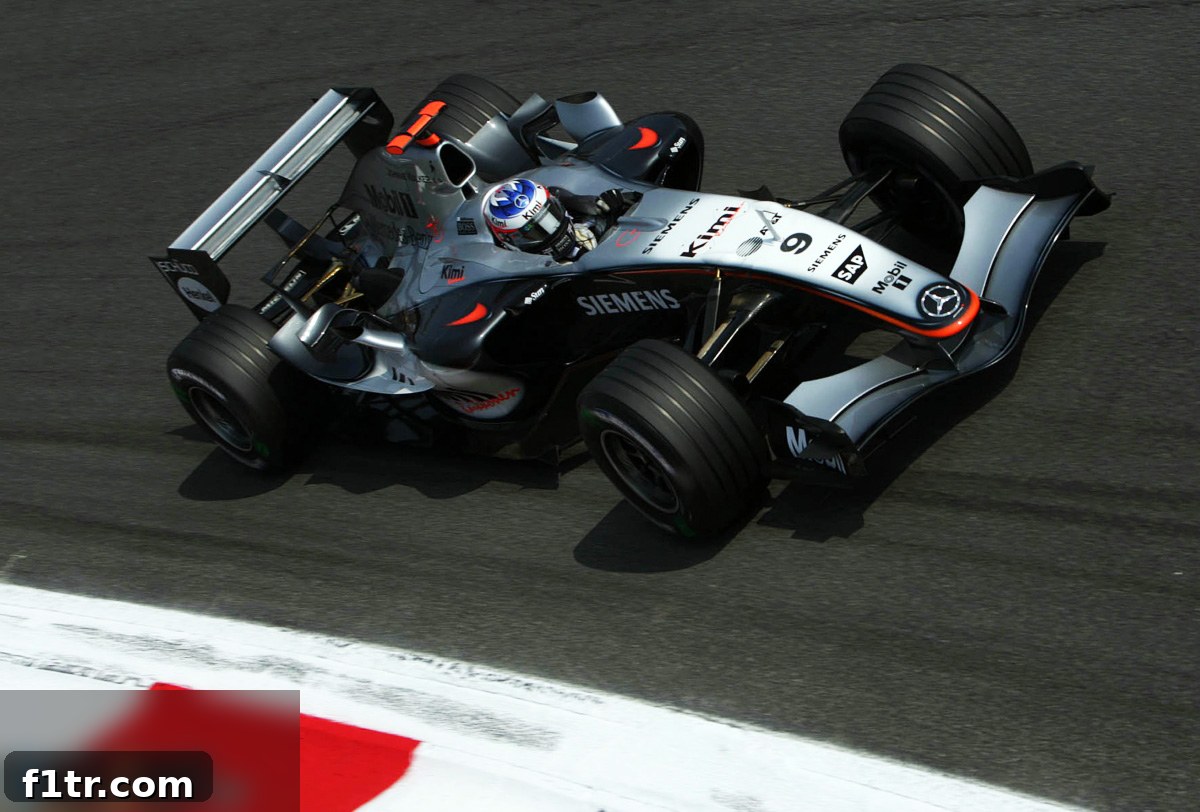
The Great F1 Debate: Are Modern Formula 1 Cars Too Easy to Drive?
In the high-octane world of Formula 1, where technology relentlessly pushes the boundaries of speed and precision, a recurring debate often ignites among drivers and fans alike: Are modern F1 cars truly as challenging to drive as their predecessors? This question recently resurfaced with comments from seven-time world champion Lewis Hamilton, who suggested the current generation of machinery has become “not hard enough to drive.” His remarks sparked a ripple through the paddock, prompting a measured, yet intriguing, response from one of the sport’s most experienced and stoic figures, Kimi Raikkonen.
Lewis Hamilton’s Perspective: A Call for Greater Driver Challenge
Lewis Hamilton, a driver who has witnessed multiple regulatory shifts and car generations throughout his illustrious career, voiced a clear sentiment regarding the current crop of Formula 1 cars. He stated that the vehicles are “not hard enough to drive,” even going so far as to suggest he “could probably do two or three races in a row.” This isn’t merely a casual observation; it reflects a deeper concern about the physical and mental demands placed upon drivers, and whether the sport maintains a sufficient level of challenge to truly differentiate talent at the absolute pinnacle of motorsport. Hamilton’s comments highlight a desire for a more raw, physically punishing driving experience, akin to what many perceive as the ‘golden era’ of Formula 1, where machinery was less forgiving and required Herculean effort to master.
His suggestion implies that a higher degree of difficulty could potentially enhance the spectacle for fans, by making driver errors more prevalent and showcasing the extraordinary skill required to tame these powerful machines. For Hamilton, who has consistently pushed the boundaries of performance and fitness, the current perceived ease of operation might be seen as diluting the essence of what makes F1 drivers exceptional athletes. This perspective often correlates with calls for regulations that prioritize driver skill over aerodynamic sophistication or engine power.
Kimi Raikkonen’s Counterpoint: Adaptation is the Enduring Reality
However, Kimi Raikkonen, a veteran who made his Formula 1 debut six years before Hamilton and recently celebrated his 300th Grand Prix start, offers a more nuanced, and perhaps more pragmatic, view. The ‘Iceman’ is not entirely convinced that the initial F1 cars he drove were significantly more demanding than those of today. His argument hinges on the fundamental human capacity for adaptation and the subjective nature of perceived difficulty in elite sport.
“When you start thinking 10 years back the memory plays games,” Raikkonen wisely noted. “Maybe it’s not the same: If you asked me 10 years ago I’d say ‘no, it’s OK’ because it’s all about [getting] used to it.” This perspective underscores a fundamental truth about high-performance environments: what initially feels incredibly difficult quickly becomes the new normal as the body and mind adjust to the extreme stimuli. Drivers train rigorously to handle the immense G-forces and sustained concentration required, making the extraordinary feel ordinary over time.
Raikkonen elaborated on this process, drawing from his own experiences: “When you come [back] after the winter and you drive you see it’s hard because your neck is basically done after 20 laps and it feels awful. But then at the second test, alright [there’s] a little bit of pain here and there and you get used to it. It’s like any sport you do, you get used to what you do and it doesn’t feel hard.” This physiological adaptation is a hallmark of elite athletes, and F1 drivers are no exception. Their training regimes are intensely focused on preparing them for the immense G-forces and sustained physical effort required over a Grand Prix distance. Therefore, what might appear ‘easy’ from an external viewpoint is, in reality, the culmination of years of dedicated training and continuous adaptation to extreme conditions. The raw challenge may persist, but the driver’s ability to cope evolves.
Ultimately, for Raikkonen, the core challenge remains constant: “I don’t think it felt any different than earlier days. Some races are harder than others and it’s just what you get used to.” This suggests that while the specific characteristics of the cars may change, the fundamental act of extracting maximum performance at the limit is an enduring, demanding, and highly skilled task.
The Evolution of F1 Cars and Driver Demands: A Deeper Look
The debate between Hamilton and Raikkonen touches upon a broader theme: the constant evolution of Formula 1 technology and its impact on the driver’s role. While cars have undeniably become safer, more reliable, and technologically advanced, this doesn’t automatically equate to an easier driving experience when operating at the absolute limit of their capabilities. The nature of the challenge might shift, but its intensity remains.
Physicality and Unyielding G-Forces
Despite advancements in comfort and ergonomics, modern F1 cars generate staggering levels of grip and G-forces that remain a formidable physical test for any driver. Cornering at speeds that defy belief, drivers endure lateral forces exceeding 5G, with braking forces often reaching 6G. This immense and sustained strain is particularly taxing on the neck, core, and arms, demanding exceptional muscular endurance and strength. Even if the cars are more refined and stable, the sheer speed and cornering capabilities mean that the physical demands to maintain peak performance for nearly two hours remain incredibly high. The difference might not be in the absolute ‘difficulty’ but rather in the methods and precision required to extract performance consistently, lap after lap, without faltering.
The Historical and Present Impact of Power Steering
One specific aspect highlighted by Hamilton for potential reform was power steering, a technology Raikkonen directly addressed with personal anecdotes. Hamilton suggested that for future regulations, Formula 1 cars should consider doing away with power steering to significantly increase the physical challenge for drivers. Raikkonen’s firsthand experience provides valuable historical context to this proposition.
“If you go then way back I think without any power steering, any other stuff, it’s different,” he stated, reflecting on a bygone era. He vividly recalled his early career: “The first Sauber I drove in testing in Mugello I had absolutely zero power steering. In 2001 we got it in Monza so we did half a year without power steering.” This historical detail illustrates a tangible shift in driver comfort and physical exertion. Driving an F1 car without power steering would unequivocally increase the physical load on a driver’s arms and shoulders, making precise inputs more arduous and potentially leading to fatigue-induced errors much sooner during a race. While power steering undeniably makes the car easier to maneuver from a raw strength perspective, it also allows drivers to be more consistent and precise over an entire race distance, pushing the limits for longer periods without exhaustion becoming the primary limiting factor.
Aerodynamics, Grip, and Unwavering Precision
Modern F1 cars are aerodynamic marvels, generating immense downforce that effectively glues them to the track at high speeds. While this provides incredible grip and allows for mind-boggling cornering speeds, it also means drivers are operating at extremely high velocities with very narrow margins for error. The complexity of managing intricate aerodynamic flows, powerful hybrid power units with sophisticated energy recovery systems, and advanced braking-by-wire requires a different, yet equally demanding, kind of mental acuity and precision. The “easy” feeling described by some might stem from the car’s inherent stability and prodigious grip; however, pushing that stability to the absolute edge, maintaining perfect lines, and managing sensitive tyre temperatures lap after lap, demands profound skill, unwavering courage, and exceptional mental discipline.
Testing Restrictions: A Missing Link in Driver Adaptation
Raikkonen also drew attention to a significant change in the sport that directly impacts driver acclimatization and skill refinement: the drastic reduction in track testing. “In those days we did a lot of testing and then you just get used to more [driving],” he explained. In the early 2000s, F1 teams conducted extensive private testing, allowing drivers countless laps to fine-tune their cars, understand new components, and, crucially, physically adapt to the demands of the machinery. This continuous seat time accelerated the adaptation process Raikkonen described, allowing drivers to quickly integrate the physical and mental demands into their routine.
Today, pre-season testing is severely limited to just a few days, and in-season testing is almost non-existent. This means drivers have fewer opportunities to get “used to it” in the comprehensive way Raikkonen experienced. While they still undergo rigorous physical training off-track, the lack of extensive track time with the actual car makes the initial few races of a season particularly demanding, especially for rookies or drivers switching teams. The perceived “ease” of modern cars could, therefore, also be an indirect result of drivers having less opportunity to fully exploit the car’s capabilities and reach peak physical integration before competitive action begins, leaving less room for the kind of prolonged adaptation periods that characterized earlier eras.
The Paradox of the “Easy” Car: A Driver’s Inner Monologue
Raikkonen’s reflection on the “easy” car paradox is particularly insightful, revealing the subjective nature of driving perception at the pinnacle of motorsport. He noted, “Sometimes you have pain, sometimes not. If you’re driving it’s always going to be hard to go fast and be on a limit.” This highlights that regardless of how forgiving or stable a car feels, extracting maximum performance from it is an inherently difficult task. Pushing the boundaries of grip, braking points, and acceleration, lap after lap, demands absolute focus, precision, and unwavering commitment from the driver.
He continued: “Some races for sure feel more easy. I remember some times when we had a very good car, everything is absolutely perfect, it feels like nothing you just drive easily and lap time is great, everything is great. It feels a bit too easy. Other times it’s a painful experience to fight. It’s not an awful lot different that’s for sure.” This perfectly encapsulates the driver’s perspective. When a car is perfectly balanced, responsive, and ideally suits the driver’s style and the track conditions, it can indeed feel effortless, allowing the driver to flow seamlessly with the machine. Yet, this “ease” is not an indication of a lack of challenge, but rather a testament to superior engineering and the driver’s unparalleled skill in finding that harmonious balance. Conversely, a challenging or ill-handling car forces the driver into a constant battle, making every lap a struggle for control, pace, and survival.
Implications for Driver Skill and the Sport’s Future
The debate between Hamilton and Raikkonen isn’t just about how cars feel; it has broader implications for how we perceive driver skill and the future direction of Formula 1 regulations. If cars are indeed becoming “easier” in certain aspects, does it diminish the perception of driver heroism and talent in the eyes of the public? Or does it simply shift the emphasis from raw physical struggle to extreme precision, minute technical understanding, strategic thinking, and faultless execution, where even the smallest error can have significant consequences?
Future regulations, such as those initially proposed for 2021 (and subsequently refined and implemented in later years), often aim to address these very concerns. Striking the right balance between technological advancement, paramount safety, cost control, and maintaining a high degree of driver challenge is a complex and continuous task for the sport’s governing bodies. While radical changes like significantly reducing or removing power steering might seem appealing to some advocating for a more “driver-centric” sport, they must be weighed against practical safety implications, the potential impact on racing quality, and the broader appeal of Formula 1 as a cutting-edge technological spectacle. Ultimately, the goal is to create a championship that showcases both revolutionary engineering and the unparalleled talent of the world’s best racing drivers in an exciting and unpredictable manner.
Conclusion: The Enduring Challenge of Formula 1
In conclusion, while Lewis Hamilton yearns for a more physically demanding Formula 1 car, Kimi Raikkonen’s seasoned perspective reminds us of the profound role of human adaptation and the inherently subjective nature of “difficulty” in elite motorsport. Modern F1 cars, with their incredible speed, immense grip, and technological complexity, continue to demand exceptional levels of physical fitness, mental fortitude, and precise skill from their drivers. The perceived “ease” might be a testament to a driver’s remarkable ability to seamlessly integrate with their sophisticated machine, rather than an indication of a diluted challenge.
Whether cars feel “easy” or “hard” at any given moment, the fundamental pursuit of perfection at the limit remains the indelible signature of Formula 1. It is a sport where drivers constantly push themselves and their machines to the absolute edge of performance, a challenge that, despite continuous technological evolution, never truly diminishes. The debate itself is a testament to the sport’s relentless quest for perfection, constantly questioning what it means to be the fastest in the world.
Discover More from the 2019 F1 Season
- Crying in the Melbourne car park at 2019 grand prix was my career low – Ocon
- McLaren Racing reports reduced £71 million loss in 2019
- Kvyat: Hockenheim podium last year was “my biggest achievement” so far
- How the FIA’s new encrypted fuel flow meter targets Ferrari’s suspected ‘aliasing’ trick
- “He smashed my office door”: 23 must-see moments from ‘Drive to Survive’ season two
Browse all 2019 F1 season articles