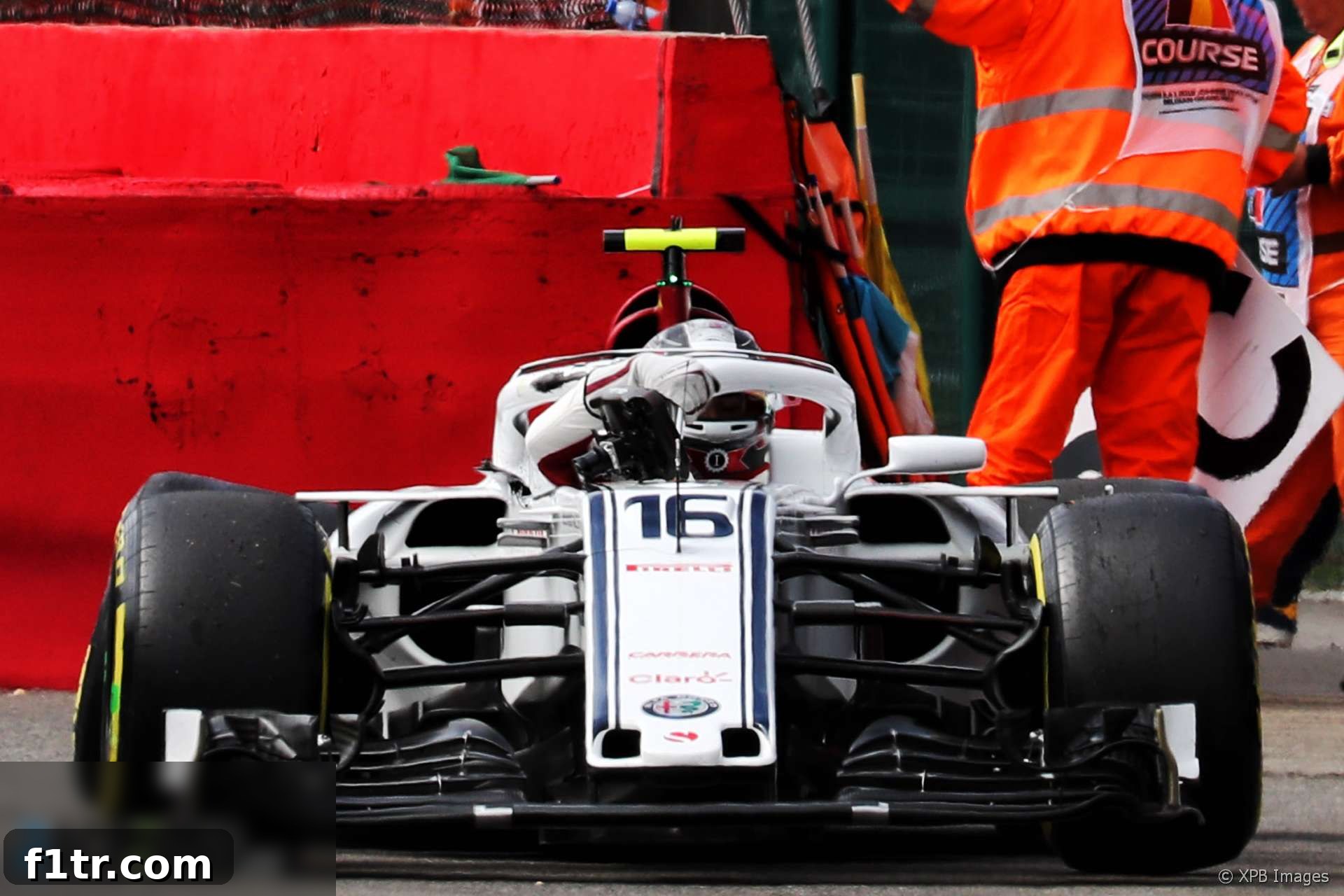
The 2018 Belgian Grand Prix at Spa-Francorchamps delivered a stark reminder of motorsport’s inherent dangers, but also highlighted the pivotal role of advanced safety measures. In a dramatic opening lap incident, the Halo cockpit protection device played a significant, albeit still under full investigation, role in shielding Charles Leclerc from potentially severe injury. While the immediate aftermath saw swift reactions and widespread praise for the device, FIA Race Director Charlie Whiting emphasized that a full understanding of its impact required thorough analysis.
The terrifying collision involved Fernando Alonso’s McLaren launching over the top of Leclerc’s Sauber in a chain reaction initiated by Nico Hulkenberg missing his braking point. Spectators and safety officials alike were shocked by the sight of Alonso’s car literally “surfing” over Leclerc’s, with the McLaren’s front right tyre leaving clear, undeniable marks on the Sauber’s Halo structure. This visual evidence immediately sparked a conversation about the Halo’s efficacy, transforming a long-standing debate into a compelling demonstration of its protective capabilities.
Charlie Whiting, speaking shortly after the incident, acknowledged the gravity of the situation. While cautious about drawing definitive conclusions without a complete investigation, he stated, “It would be a little bit speculative to say at this stage that the Halo, which was introduced this year, saved Leclerc from serious injury. But it doesn’t take much imagination to think that the tyre marks could have actually been on Charles’s head [helmet]. It would be a bit of a miracle if they weren’t had the Halo not been there. There’s a huge extent of the tyre marks.” This carefully worded assessment underscored the FIA’s commitment to data-driven safety improvements, even as the intuitive understanding of the Halo’s benefit was immediately apparent to all.
Advert | Become a Supporter & go ad-free
The incident at Spa instantly quieted many of the Halo’s critics, who had previously voiced concerns over its aesthetics, visibility, and perceived alteration of open-wheel racing’s traditional appeal. The sight of Leclerc emerging largely unscathed from a crash that could have had catastrophic consequences for his head and neck proved a powerful testament to the device’s purpose. Retired 2016 world champion Nico Rosberg was among the first to laud the Halo’s performance, posting on social media: “We can end the Halo discussion now. It will save lives!” This statement, from a respected figure who raced without the Halo for most of his career, resonated strongly within the motorsport community.
Another former F1 driver, Max Chilton, who himself survived a harrowing near-miss with a flying tyre during the 2014 British Grand Prix, added his voice to the chorus of praise. He wrote: “And people still think race cars shouldn’t have them. We could have lost another fantastic talent today without it.” Chilton’s personal experience with the vulnerability of a driver’s head in an open cockpit gave his comments additional weight, reinforcing the message that safety innovations, even visually disruptive ones, are paramount.
The FIA’s commitment to continuous safety development means that every significant incident is treated as a learning opportunity. Following the Belgian GP crash, the governing body initiated a comprehensive investigation into how Leclerc’s Halo withstood the immense impact. Whiting elaborated on the ongoing process: “We’ve had a cursory examination of the parts. It’s a little early to say. The high-speed camera won’t tell us an awful lot. The onboard camera that we’ve seen so far is not particularly clear.” The detailed investigation goes beyond superficial observation, delving into the structural integrity of the Halo and its mounting points.
“What is clear is the significant tyre marks on both the chassis and the Halo. We take lots of photographs and our researchers will be contacting Sauber tomorrow morning just to make sure we understand, for example, when they take the Halo off, try and see if the fixing and the bolts that fix it are in good shape,” Whiting added. “And, more importantly, to see if it’s been distorted. It’s being held in by the bolts at present, but see if it springs into a different shape and we can try and learn whatever we can from that. But it looks like it had a pretty hefty whack.” This meticulous examination seeks to determine if the titanium structure itself suffered any plastic deformation or if the attachment points to the chassis were compromised, providing invaluable data for future designs and material science applications in motorsport safety.
Advert | Become a RaceFans supporter andgo ad-free
The incident at Spa was not the inaugural instance of a Halo enduring significant damage in a crash. Earlier in the 2018 Formula Two season, Japanese driver Tadasuke Makino was involved in a similar terrifying collision at the Circuit de Catalunya, where rival Nirei Fukuzumi’s car made direct contact with his Halo. This prior event provided a foundation for the FIA’s understanding and research. Whiting confirmed that their researchers had already compiled a “fairly detailed internal report” on the F2 incident. These cumulative data points are critical as the FIA continuously refines safety devices. “All we can try to do is to gather as much information as we can, of course. Which helps us as we’re in the process of beginning development of Halo Four, so the more we can get, the better,” Whiting stated, highlighting the progressive nature of their safety advancements.
The implications of such incidents extend beyond Formula 1. In response to questions from RaceFans, Whiting confirmed the FIA’s ongoing commitment to sharing its findings and expertise with other global motorsport categories. Specifically, IndyCar was mentioned, as it actively investigates introducing similar cockpit protection solutions in the wake of high-profile crashes, most notably Robert Wickens’ severe accident at Pocono just the previous weekend. The collaboration underscores a universal drive for enhanced driver safety across different racing disciplines, leveraging the extensive research and real-world data gathered in Formula 1.
The Halo, initially met with resistance, has now firmly established itself as an indispensable safety feature in Formula 1. The visible scars on Charles Leclerc’s device at the Belgian Grand Prix served as a powerful, unambiguous visual demonstration of its protective capabilities. It has shifted the conversation from aesthetic preferences to irrefutable safety benefits. As the FIA continues its detailed analysis and development, incorporating lessons from every incident into future iterations like “Halo Four,” the commitment to driver well-being remains paramount. The Spa incident stands as a landmark moment, cementing the Halo’s place as a life-saving innovation and reaffirming motorsport’s relentless pursuit of safer, yet equally thrilling, racing.
Advert | Become a RaceFans supporter andgo ad-free
2018 F1 season
- F1 feared “death knell” for Drive to Survive after Ferrari and Mercedes snub
- McLaren staff told us we were “totally crazy” to take Honda engines in 2018 – Tost
- ‘It doesn’t matter if we start last’: How Red Bull’s junior team aided Honda’s leap forward
- Honda’s jet division helped F1 engineers solve power unit problem
- McLaren Racing losses rise after Honda split
Browse all 2018 F1 season articles