In the high-stakes drama of Formula 1, where narratives unfold with every race, Valtteri Bottas embarked on a new chapter in 2022, moving to Sauber (then competing as Alfa Romeo). After years of playing a crucial but often overshadowed supporting role, his debut with the Swiss outfit promised a fresh start, a chance to emerge as a central protagonist in the midfield battle.
Discover more about our content and become a Supporter for an ad-free experience.
That opening race in Bahrain was nothing short of sensational. While Kevin Magnussen’s return to F1 and his impressive points finish captured widespread attention, Bottas’s sixth place was an outstanding achievement, signaling a renewed vigor for both driver and team. His rookie teammate, Zhou Guanyu, further amplified the team’s optimism by securing tenth on his debut. This double points finish, netting a total of nine points, instantly thrilled Bottas, who saw it as a powerful statement of intent for the season ahead.
“It is a great way to start the season,” Bottas declared, reflecting the collective enthusiasm. “Everyone did a good job and we are going in the right direction.” Indeed, these words encapsulated the promising dawn of Sauber’s new era, an era expected to be defined by an all-new driver lineup and a clear upward trajectory.
Initially, it appeared the team was on track to fulfill this promise. Through the first nine rounds of the 2022 season, Bottas and Zhou collectively amassed over 50 points, firmly positioning Sauber in a commendable sixth place in the Constructors’ Championship. This strong performance allowed them to maintain that position until the end of the season, even besting Aston Martin on a tiebreaker – a testament to their early consistency and competitiveness. The team showcased a remarkable ability to capitalize on opportunities, often punching above their weight and establishing themselves as genuine midfield contenders. This period felt like a genuine resurgence for the Hinwil-based squad, hinting at a sustainable path to regular points and improved standing.

Sauber’s Decline: From Midfield Mavericks to Moribund
However, the narrative took a stark turn. Over the subsequent three seasons, Sauber’s status underwent a disheartening transformation, regressing from spirited midfield mavericks to merely middling, and ultimately, to a dishearteningly moribund state. The stark reality of their decline was painfully underscored recently, marking one full calendar year since the team last secured a point in a Grand Prix. This extended drought highlights a deeply concerning period for a team with such a rich history and ambitious future plans.
The last glimmer of success came at the 2023 Qatar Grand Prix, a distant memory now, where Bottas and Zhou delivered a double points finish, crossing the line in eighth and ninth positions respectively. Since that weekend in Losail, a staggering 23 Grands Prix and five sprint races have passed without either driver finishing within the top ten even once. This protracted barren spell is not merely an isolated statistic; it paints a grim picture when contrasted with their rivals. Over the same period, every single one of Sauber’s nine competitors has managed to score at least 20 points. Even Williams, often considered a back-of-the-grid contender, has amassed 21 points, ten more than Haas, further emphasizing the depth of Sauber’s current predicament. The inability to convert promising starts or capitalize on race incidents has become a recurring theme, leaving fans and the team alike frustrated.
Navigating the Tumultuous 2023 Season
Following their comparatively positive performance in Losail, Sauber’s form remained wildly inconsistent over the final five rounds of the 2023 season. This volatility made it difficult for the team to build any sustained momentum or pinpoint consistent areas for improvement. At the Circuit of the Americas, they delivered an average showing, neither truly competing for points nor falling completely off the pace. The subsequent Mexican Grand Prix, however, offered a brief moment of hope: both Bottas and Zhou managed to reach Q3, a significant achievement given their season’s trajectory and only their second dual Q3 appearance of 2023. Yet, despite promising starting positions, both drivers struggled with race pace and tire management, fading through the race to finish well outside the points-paying positions. This pattern of strong qualifying not translating into race day performance became a frustrating hallmark of their season, indicative of underlying issues with the car’s long-run capabilities or strategy execution.
Further frustrations mounted at Interlagos, the next round, where both cars suffered a double Q1 elimination, a clear indicator of their qualifying struggles. Ironically, the race itself initially looked far more promising, with both drivers making early gains. However, fate dealt another cruel blow: both cars were forced to abandon the race due to separate overheating problems, necessitating retirements to prevent severe and costly power unit damage. This incident highlighted not just performance deficiencies but also reliability concerns that plagued the team. The Las Vegas Grand Prix brought more misfortune. Bottas, starting from an impressive seventh on the grid, had his race hopes shattered at the first corner when he was caught in a chaotic incident involving Fernando Alonso, who spun, and Sergio Perez, who then collided with Bottas. The severe damage sustained compromised his entire race, turning a potential points-scoring opportunity into a write-off. The season then concluded not with a flourish, but with a whimper in Yas Marina, where the team never genuinely looked capable of challenging for a top-ten finish throughout the entire weekend, reflecting a pervasive lack of pace and competitive edge.
For an optimal viewing experience and to support our journalism, consider becoming a RaceFans supporter and enjoy our content ad-free.
The Challenging Start to 2024 and Ongoing Struggles
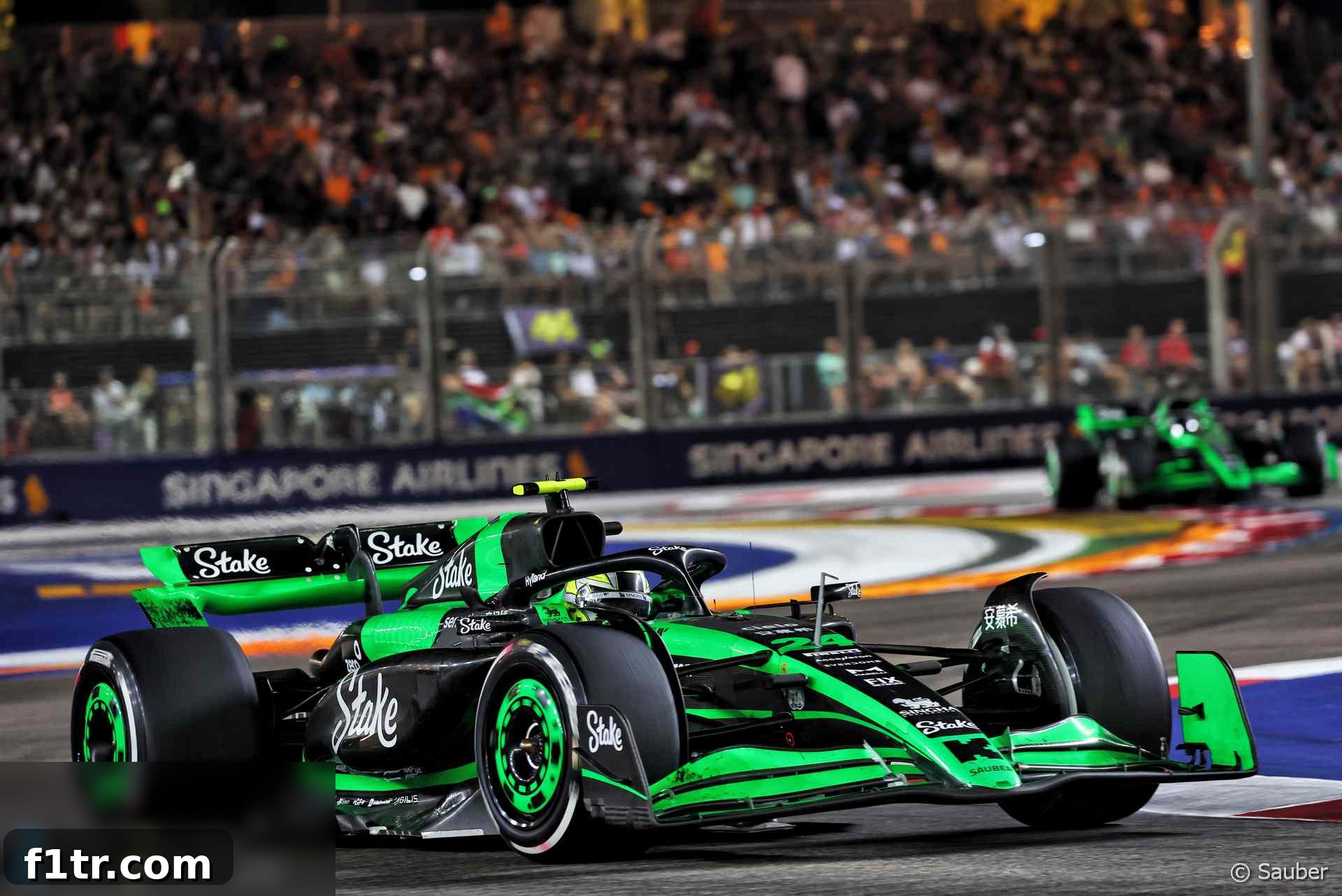
The dawn of 2024 brought with it new expectations, despite retaining the same driver lineup. The team rebranded as Stake F1 Team Kick Sauber, adopting a bold, luminous green livery that symbolized a fresh identity and an aggressive push towards their ultimate evolution into Audi’s factory team in 2026. This period was meant to be a pivotal phase for building momentum and establishing a foundation for future success. However, the season thus far has been less of a kick-start and more of a setback, delivering significant challenges rather than the anticipated surge forward for the team’s ambitious new era.

Perhaps most dishearteningly for Sauber, the very first race of the 2024 season in Bahrain remains their closest encounter with a top-ten finish. Despite both drivers failing to escape Q1, Zhou Guanyu executed a brilliantly strategic race, climbing to tenth position. Yet, hopes were dashed in the closing laps when Lance Stroll managed to overtake him, relegating Zhou to an agonizing 11th place. He finished as the highest-placed car a lap down, approximately 11 seconds shy of securing that elusive point, a bitter pill to swallow for the team.
While the team demonstrated glimpses of respectable race pace, they were severely hampered by a major and frankly embarrassing technical flaw: their pit stops. The issue first reared its head dramatically in Bahrain, where Valtteri Bottas endured a near-minute-long pit stop. The problems persisted and escalated in the second race in Jeddah, affecting Zhou. It soon became clear that the team needed to completely redesign their wheel nuts and wheel guns – a fundamental component of F1 racing. The continued problems in the third round in Australia, where Bottas was running tenth before a crippling 30-second pit stop plummeted him to the back of the field, utterly destroying any chance of battling for points, prompted an official apology from team management to both drivers. This recurring pit stop calamity not only cost them valuable points but also severely eroded driver confidence and team morale, casting a dark shadow over their early season performance.
As the 2024 season progressed, Sauber’s competitive standing unfortunately continued to regress. They slipped further away not only from the front of the field but also from their immediate midfield rivals, exacerbating the challenge of securing points. Apart from a solitary Q3 appearance for Bottas in China, Saturdays proved to be crushingly fruitless for Sauber throughout the initial 19 rounds of the championship. Out of a combined 36 attempts, Bottas and Zhou managed to escape Q1 on only eight occasions between them – a stark statistic that represents the worst qualifying record on the grid by a significant margin. This inability to extract performance in qualifying consistently put them on the back foot for every race. Furthermore, while Sauber’s average performance deficit to the fastest car in the highest session they reached was 1.12% slower during the first five rounds, this gap has alarmingly widened to 1.3% off the ultimate pace over the latest five rounds, indicating a worrying trend of falling further behind their competitors in terms of outright speed and development.
The development race, a crucial aspect of modern Formula 1, also saw Sauber lagging significantly behind their closest rivals – precisely the teams they needed to outperform to have any hope of scoring points. While the team did introduce an upgrade package at the Hungarian Grand Prix, only Valtteri Bottas benefited from it for that weekend and the subsequent race in Spa-Francorchamps. Crucially, these upgrades appeared to have minimal, if any, positive impact on Sauber’s results. Bottas’s finishes of 16th and 15th in those two rounds were virtually identical to his results in the two races preceding the introduction of the upgrades, suggesting either the upgrades were ineffective or the underlying performance deficit was too great to overcome with incremental improvements. This failure to translate development efforts into on-track performance further deepened their competitive woes.
Become a RaceFans supporter and unlock an ad-free browsing experience while supporting our dedicated content.
Into the Summer Break and a Grim Horizon
Entering the summer break, Sauber found themselves comfortably in last place in the Constructors’ Championship, carrying the unenviable distinction of being the only team yet to score a single point. Finding some much-needed momentum for the second leg of the season was deemed absolutely critical for their prospects of breaking their duck before the year’s end. However, the first round back after the break, at Zandvoort, proved to be a stark reminder of their struggles. By the team’s own admission, it was “the most difficult race of the season.” In a race with a remarkably low retirement rate, both Bottas and Zhou inexorably fell away from the 18 cars ahead of them, becoming the only team to finish a disheartening two laps down on race winner Lando Norris. This performance underscored the profound lack of pace and inability to compete even with fellow backmarkers.

Since that challenging weekend, Sauber has unfortunately shown no significant signs of breaking into the top ten, despite the commendable efforts of their drivers. Valtteri Bottas, in particular, has consistently delivered solid, professional performances that, given the severe lack of pace in his car, have been easy for many to overlook. With only six rounds remaining in the championship, Sauber is staring down the grim prospect of becoming the first team to fail to score a point over an entire season since Haas did so with their infamously underdeveloped 2021 car. This would be a historic low point for a team that once boasted considerable potential.
Sauber’s arduous efforts have also not been aided by the record-high reliability rate witnessed in 2024. This season has seen the fewest retirements on average in the sport’s history, significantly reducing the opportunities for ‘lucky’ points finishes that often materialize when front-running cars drop out. Zhou’s 11th place in Bahrain, along with the team’s 13th place finishes in Monaco, Canada, and Spain, could very easily have translated into valuable points in previous seasons, where even a handful of retirements ahead would have propelled them into the top ten. The increased reliability across the grid means that pure pace and performance are more critical than ever, areas where Sauber has struggled to compete.
With Audi harboring lofty ambitions for their long-anticipated entry into Formula 1 in 2026, the German automotive giant will undoubtedly be hoping that their considerable resources, technical prowess, and strategic vision will be enough to propel the team significantly further up the field than where they currently languish, just over a year removed from their moment of truth. However, 2025 is set to be a crucial transitional year for the team. The arrival of Nico Hulkenberg is confirmed, bringing a wealth of experience and a reputation for maximizing performance, but the identity of his teammate remains unconfirmed, adding another layer of uncertainty to the immediate future.
The questions surrounding who will join Hulkenberg, and the precise impact Audi’s bespoke power unit will have when the next regulatory revolution takes place, are matters for the future. For now, the remaining races for the partnership of Valtteri Bottas and Zhou Guanyu are, regrettably, unlikely to be any more productive, or any less frustrating, than the challenging trajectory of the 2024 season has already proven to be. The current period is one of profound challenge and patience, as the team navigates its way towards a hopeful, yet still distant, new era under the Audi banner.
Support us and get an ad-free experience. Become a RaceFans supporter today!
Formula 1 Insights
- F1 returning to India soon after 2027 sounds like wishful thinking
- Verstappen loathes F1’s new generation of cars – but what do his rivals reckon?
- The ‘throwback weekend’ is back in fashion. But it’s a flawed concept – especially for F1
- Is Formula 1’s double race cancellation a blessing in disguise?
- Todt admits Schumacher crashed on purpose – but did it really cost him two titles?
Browse all Formula 1 articles