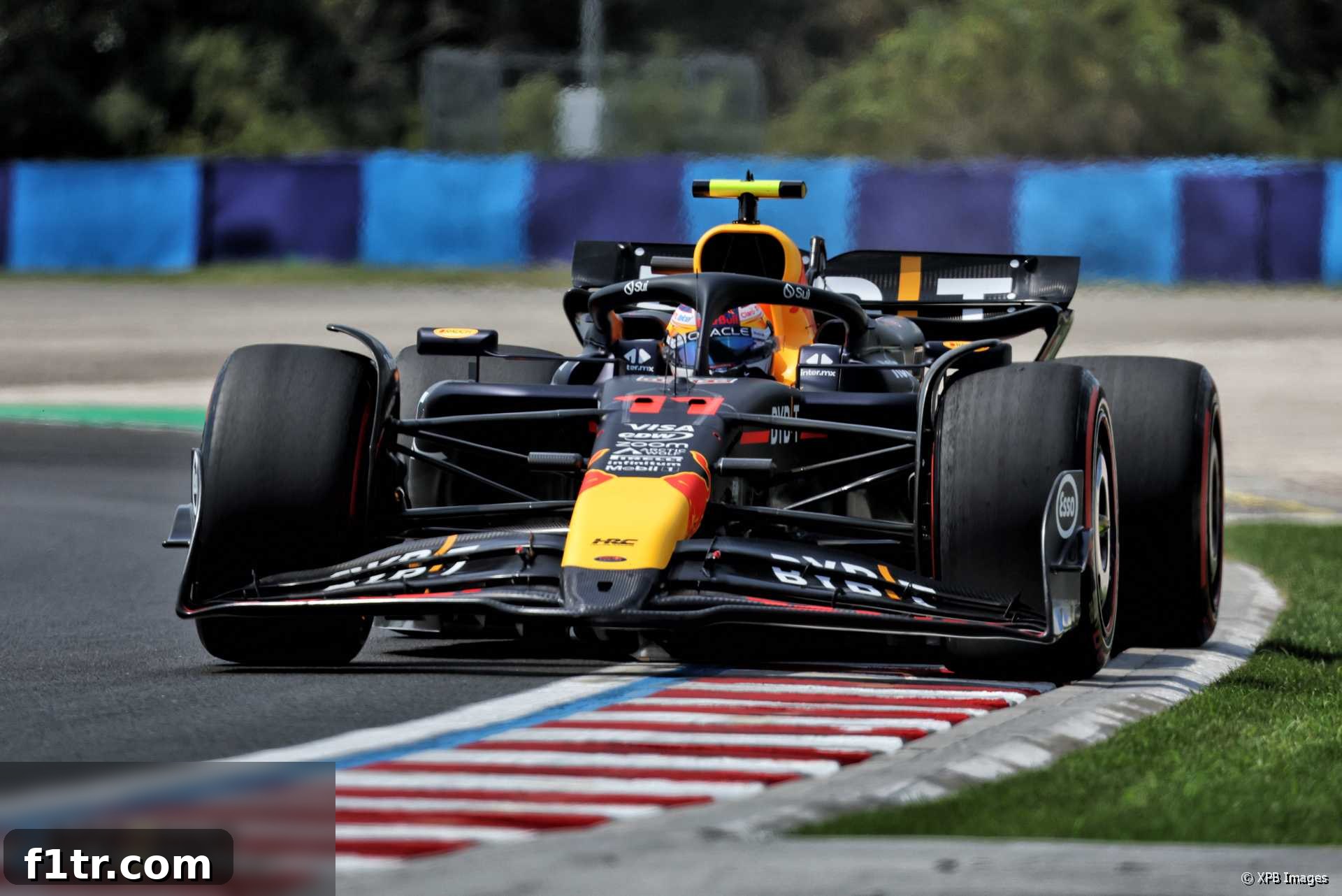
Red Bull Racing, Formula 1’s reigning champions, finds itself at a pivotal juncture, keenly observing the performance of its second driver, Sergio Perez. Team Principal Christian Horner has expressed cautious optimism following recent upgrades to the RB20, suggesting that these enhancements have instilled a much-needed boost of confidence in the Mexican driver. This renewed self-belief is crucial, as the team desperately needs Perez to rediscover his early-season form to maintain their dominant position in the Constructors’ Championship.
Perez’s recent performance has been a significant concern for the Milton Keynes squad. Over the last six races, he has managed to accumulate a mere 15 points, a stark contrast to his teammate Max Verstappen’s consistent high scores. This alarming dip in form has allowed rival teams, most notably McLaren, to close the gap in the Constructors’ standings, intensifying the pressure on Red Bull. The championship is not only about individual glory but also about team prestige and financial rewards, making Perez’s contribution indispensable.
Strategic Upgrade Introduction: A Game-Changer for Red Bull?
In a strategic move to address these performance concerns, Red Bull fast-tracked the introduction of an extensive upgrade package for their formidable RB20 car. Originally slated for deployment after the summer break in late August, the team made the decisive call to bring these crucial developments to the current Grand Prix weekend. This accelerated timeline underscores the urgency within the Red Bull camp to maximize their performance edge and solidify their championship lead.
The upgrade package, a culmination of months of meticulous research and development, was fully integrated into Max Verstappen’s car. For Sergio Perez, a substantial portion of these new components was also fitted, with only the engine cover and sidepod elements differing from Verstappen’s specification. This tactical deployment highlights Red Bull’s commitment to providing both drivers with the best possible machinery, while also acknowledging the practicalities of manufacturing and implementation for such complex, high-performance parts. The aim is clear: to enhance the car’s handling characteristics, improve aerodynamic efficiency, and ultimately extract more pace.
Perez’s Promising Practice: A Glimmer of Hope
The initial signs from Friday’s practice sessions offered a welcome glimmer of hope for Perez and the team. He concluded the day just two-tenths of a second slower than his championship-leading teammate, Max Verstappen. Christian Horner, typically reserved in his praise, openly acknowledged this improvement, declaring it “Checo’s best Friday since possibly China.” This comment, while seemingly straightforward, carries significant weight, indicating a marked improvement compared to recent weekends where Perez has struggled to match Verstappen’s pace from the outset.
A strong Friday performance is often a precursor to a more competitive weekend. It allows the driver to build confidence, fine-tune the car’s setup, and gather crucial data for qualifying and the race. For Perez, who has been battling both car balance issues and psychological pressure, such a positive start could be the catalyst needed to turn his season around. The fact that the gap to Verstappen was only two-tenths suggests a level of comfort and adaptability with the upgraded car that has been conspicuously absent in previous events, offering a tangible basis for Horner’s renewed optimism.
Understanding the Performance Gap: Car Dynamics and Driver Comfort
Horner elaborated on the subtle yet significant differences between the two Red Bull cars, particularly in light of the new upgrades. He confirmed that while both cars benefited from the majority of the package—including the floor and wing elements—Perez’s car was missing only the engine cover and sidepod updates. This slight variance, while minimal on paper, can have nuanced effects on the car’s aerodynamic balance and cooling, potentially influencing driver feel.
Crucially, Horner believes Perez’s struggles in recent races stemmed from the Red Bull car evolving into a more challenging machine to drive. As the development cycle progressed, the car, while incredibly fast, became increasingly “on a bit of a knife’s edge,” requiring a very specific and aggressive driving style. Max Verstappen, with his extraordinary talent and adaptability, has proven exceptionally adept at managing such a demanding setup. However, for Perez, this characteristic made it harder to extract consistent performance, leading to a noticeable deficit. Horner’s assessment is that when the car operates within a comfortable operating window, the gap between the two drivers naturally diminishes, hinting that the current upgrades are aimed at achieving precisely that for Perez.
The intricate dance between car development and driver preference is a constant challenge in Formula 1. Engineers constantly push the boundaries of performance, often resulting in cars that are incredibly quick but demand absolute precision and a high tolerance for instability from the driver. While Verstappen thrives in this environment, Perez, like many drivers, prefers a more stable and predictable platform. The strategic adjustments and upgrades introduced are a direct response to this feedback, attempting to dial in a setup that allows Perez to push the limits without constantly wrestling with an unpredictable machine. This focus on driver comfort is not merely about preference; it directly translates into confidence, consistency, and ultimately, lap time.
The Psychological Battle: Horner’s Candid Conversation with Checo
The mental aspect of Formula 1 is as critical as the technical one, especially when a driver is experiencing a challenging run of form. Perez’s recent struggles, culminating in a third non-score in five races at Silverstone, prompted a direct and candid intervention from Christian Horner. Describing the situation as “unsustainable” at the time, Horner made it clear that a turnaround was imperative. He later revealed details of a personal conversation with Perez, emphasizing the open relationship they share.
During this private discussion, Horner directly asked Perez about the root cause of his difficulties. Perez’s response was telling: he admitted to “overthinking things a bit too much.” This self-awareness is a crucial first step toward recovery. In the intense, high-stakes environment of F1, the pressure to perform, especially alongside a generational talent like Max Verstappen, can be immense. Constantly comparing oneself to a dominant teammate can lead to a spiral of self-doubt and over-analysis, hindering natural driving instincts.
Horner’s advice to Perez was direct and insightful: “almost ignoring what’s going on on the other side of the garage will do him a favour, which is the approach that he’s taking now, just focusing on his own performance.” This strategy is about psychological reframing – shifting focus from external comparisons to internal improvement. By concentrating solely on his own driving, his own setup, and his own race, Perez can regain control and confidence, allowing his inherent talent to shine through without the added burden of external pressures. This personal approach from the team principal highlights the holistic support system Red Bull provides to its drivers, recognizing that peak performance requires both mechanical excellence and mental fortitude.
The Urgent Need for Revival: Constructors’ Championship Implications
The urgency for Sergio Perez to regain his competitive edge extends far beyond individual pride; it directly impacts Red Bull’s pursuit of another Constructors’ Championship. While Max Verstappen has been delivering a masterclass in dominant driving, securing vital points almost single-handedly, the contribution of the second driver is indispensable for a comprehensive team victory. The Constructors’ title is not only a symbol of engineering and strategic supremacy but also carries significant financial implications, influencing prize money distribution and team budget allocation for future seasons.
The recent dip in Perez’s points tally has allowed rivals, particularly McLaren, to make significant inroads. McLaren’s resurgence, driven by strong performances from both Lando Norris and Oscar Piastri, has injected new life into the championship battle, transforming what once seemed like a Red Bull procession into a more contested affair. If Perez continues to struggle, Red Bull could find themselves under increasing pressure from multiple fronts, with Ferrari and Mercedes also capable of delivering strong results on their day. Every point becomes critical in this high-stakes game, and a consistent second car is paramount to maintaining a healthy lead.
Christian Horner’s repeated emphasis on the team “desperately” needing Perez to find his form underscores the gravity of the situation. While Verstappen’s brilliance often overshadows the performance of other drivers, the strategic importance of a reliable second driver cannot be overstated. A strong two-car attack enables more flexible race strategies, puts greater pressure on competitors, and provides a crucial safety net for points in the event of unforeseen circumstances affecting the lead car. The team’s investment in upgrades and psychological support for Perez is a testament to their understanding that a fully firing duo is the only path to a comfortable championship victory.
Perez’s Potential and Future with Red Bull
Despite the recent dip, Christian Horner and the Red Bull management remain convinced of Sergio Perez’s underlying talent and potential. Horner referenced Perez’s stellar start to the season, where he displayed formidable pace and consistency, suggesting that the current struggles are an anomaly rather than a true reflection of his capabilities. “We all want Checo to realise the potential that he did in the first four or five races,” Horner reiterated, emphasizing the team’s belief in his ability to reclaim that form.
The team’s confidence in Perez was solidified by their decision to take up his option for the following year relatively early in the season. This move was not just a vote of confidence but a strategic attempt to “settle him,” providing him with security and alleviating any contractual pressures that might have been contributing to his “headspin” in recent races. A settled driver, free from the anxieties of job security, is often a more confident and effective one. This long-term commitment from Red Bull signals that they see Perez as an integral part of their future success, despite the current challenges.
The support from Red Bull is comprehensive, extending beyond technical upgrades to include psychological and emotional backing. Horner affirmed that “the team are working very hard with him to support him and make sure that he does re-find his form because we desperately need it.” This collective effort, involving engineers, strategists, and team leadership, is geared towards helping Perez unlock his full potential once again. The stakes are high, but with the latest car enhancements, a clear mental strategy, and unwavering team support, the signs suggest that Sergio Perez is poised for a significant resurgence. His performance in the upcoming races will be a critical barometer for both his personal comeback and Red Bull’s continued dominance in Formula 1.
2024 Hungarian Grand Prix
- Verstappen names Hungarian GP the most stressful moment of his title-winning year
- McLaren team orders “a new situation we’re inexperienced at handling” – Piastri
- Verstappen dismisses critics of “vocal” radio messages and late-night simracing
- Norris’ former McLaren team mates say he was right to give up win
- Mercedes surprised Hamilton’s car was “completely unscathed” in Verstappen clash
Browse all 2024 Hungarian Grand Prix articles