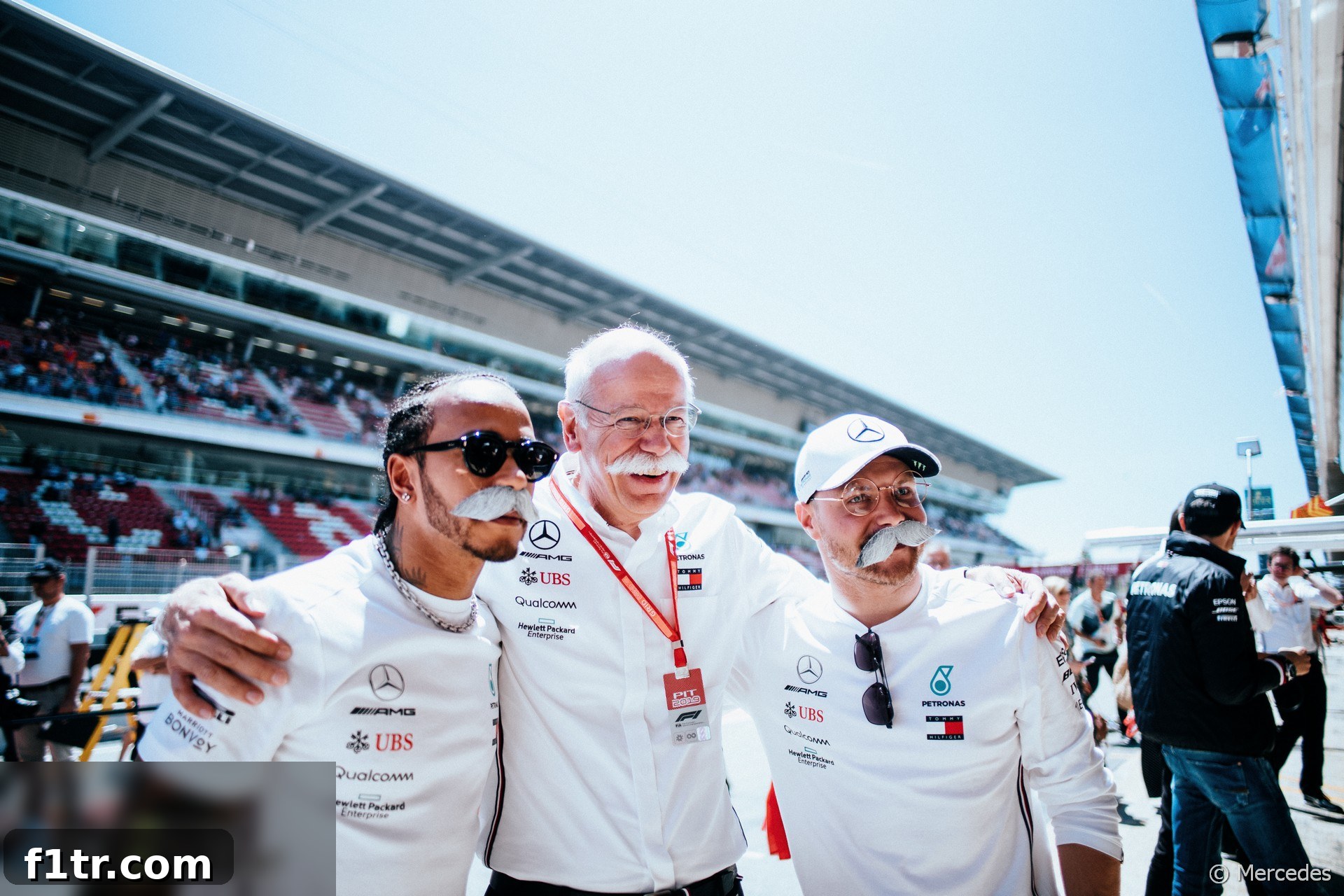
In the aftermath of another commanding performance by the reigning champions, Mercedes team principal Toto Wolff delivered a heartfelt tribute to the outgoing CEO of the parent company, Dieter Zetsche. The Spanish Grand Prix served not only as a testament to Mercedes’ unwavering dominance but also as a significant waypoint, marking Zetsche’s final official appearance before his retirement, underscoring a leadership era that profoundly shaped the team’s Formula 1 legacy.
7:30am: The Dawn of Race Day in Barcelona
The morning of the Spanish Grand Prix weekend unfurled in its familiar rhythm. Waking at the usual time, the anticipation of a high-octane race day filled the air. The vibrant energy of Barcelona was palpable, yet from the quiet confines of the apartment, the promise of the circuit beckoned. With preparations complete, the departure for the Circuit de Barcelona-Catalunya commenced a little over an hour later, signaling the start of another immersive day in the heart of Formula 1.
9:30am: Paddock Encounters and Sponsorship Insights
Upon arrival at the circuit, a surprising lack of traffic greeted the journey, an observation that would later subtly hint at broader attendance dynamics. The immediate destination was the welcoming embrace of the Ferrari hospitality suite, a traditional starting point for many paddock regulars. Here, amidst a spread of fresh fruit and pastries, an insightful conversation unfolded with Simon Dowding, who spearheads communications for Ferrari’s key partner, Philip Morris International (PMI).
Simon elaborated on PMI’s strategic approach to its Ferrari partnership, emphasizing that there are no current intentions to actively promote individual tobacco brands. Instead, the focus remains on displaying the ‘Mission Winnow’ livery in markets where regulations permit, or opting for alternative branding such as ‘Ferrari 90 Years’ or bespoke driver messages in more ‘sensitive’ territories. A noteworthy revelation was the plan for driver messages to adorn both Ducati bikes during the upcoming French Moto GP round, a direct substitution for the standard Mission Winnow branding. This raised a pertinent question: would Ferrari adopt a similar strategy when Formula 1 descends upon Paul Ricard, potentially signaling a broader trend in sports sponsorship adaptation?
11am: Unearthing Paddock Whispers and Regulatory Foresight
The mid-morning hours were dedicated to the quintessential paddock ritual: roaming the bustling avenues in pursuit of the latest gossip and insider information. This particular weekend, the chatter was predominantly focused on the eagerly anticipated 2021 technical and sporting regulations. Whispers grew louder regarding their official publication at the end of June, a timeline consistent with the FIA International Sporting Code and initial revelations from the previous year. While there had been some casual discussions about potential publication delays—possibly pushing the announcement to October or even December—any deviation from the ISC’s schedule would necessitate an extraordinary level of consensus. Such a change would require unanimous approval from all participating teams, the FIA, and Liberty Media – a feat almost as elusive in modern Formula 1 as finding a non-Mercedes race winner.
The political landscape of F1 is often as intricate and competitive as the on-track action itself. The 2021 regulations represent a pivotal moment for the sport’s future, aiming to create a more level playing field and enhance competition. The challenge of securing unanimous agreement on such transformative changes highlights the inherent complexities and diverse interests within the F1 ecosystem, making the impending June deadline a point of intense speculation and strategic positioning for every team.
1pm: The Shifting Sands of the F1 Calendar and Promoter Predicaments
A crucial discussion took place with Jorn Teske, Head of Marketing at Hockenheim, focusing on the precarious future of the German Grand Prix and the broader implications for the 2020 F1 calendar. One undeniable truth emerged from the conversation: the impending return of Zandvoort to the F1 schedule, anticipated to be officially announced at noon on Tuesday, held significant ramifications for all established European circuits. This impact would be particularly felt by venues like Germany and Spa-Francorchamps, which face increasing pressure in a competitive market.
The “Max Factor” is a powerful force. Assuming Zandvoort successfully attracts a massive crowd of 80,000 race-day spectators – predominantly clad in orange, fervent supporters of Max Verstappen – this represents a substantial contingent of fans who might traditionally have frequented other European races. Given the razor-thin margins upon which F1 race promoters operate, there is a palpable concern that long-standing events could face existential threats if Liberty Media, in its haste to capitalize on driver-specific appeal, overlooks the delicate balance of the calendar. The conversation with Jorn vividly underscored the profound dependence of promoters on individual drivers. A little over a decade ago, Germany routinely filled two circuits to capacity, riding the wave of Michael Schumacher’s unparalleled successes. Today, despite – or perhaps ironically, because of – Mercedes’ current dominance and Sebastian Vettel’s four world titles, the country stands on the brink of losing its sole remaining Grand Prix. This stark contrast illustrates a significant shift in F1’s economic and fan engagement dynamics.
2pm: Decoding Attendance Figures and Empty Grandstands
As preparations for the race intensified, official reports circulating spoke of a grand total of 87,000 spectators for the race day, with the overall weekend attendance projected to surpass 150,000. However, a glance towards the grandstand directly opposite the Media Centre painted a different picture: it appeared largely empty. This visual discrepancy prompted a cynical internal query: were the majority of those reported spectators simply disguised as unoccupied seats, perhaps draped in the vibrant red of Ferrari or the silver of Mercedes? The undeniable reality was that the venue felt emptier than at any other Spanish Grand Prix attended since the turn of the millennium. A vivid memory resurfaced of the raucous energy and infamous traffic jams of 2007, a year when 140,000 race-day visitors truly packed the circuit to its limits. The contrast highlighted a concerning trend in attendance figures at this historic venue.
2:30pm: Grid Walk Revelations and Contract Optimism
The pre-race grid walk offered a privileged opportunity to traverse the hallowed asphalt, providing direct access to the atmosphere and, crucially, allowing for a firsthand assessment of the spectator turnout at the first and final corners. This direct observation offered no compelling reason to revise the earlier, more conservative estimate of a maximum of 60,000 attendees. Yet, amidst the vibrant chaos of the grid, a chance encounter with Vincenç Algueira, the respected president of the hosting club RACC, introduced a note of unexpected optimism. Algueira revealed that he had just concluded a highly successful meeting regarding the extension of the circuit’s contract to host the Grand Prix. His assessment was unequivocally positive: “92 per cent [chance] of retaining the grand prix,” he declared, his confidence unwavering. By a slight margin, this indicated an even greater assurance than our previous conversation, when the prospects for a new Spanish GP deal for 2020 were pegged at a ‘90% chance’. The ongoing negotiations underscore the critical importance of this race for the region and its enduring place on the Formula 1 calendar.
5pm: Post-Race Reflections, Ricciardo’s Frustration, and a CEO’s Farewell
With the checkered flag waved, signaling the conclusion of the race, it was time to navigate the post-race dynamics, beginning in the newly introduced ‘mix zone’. This innovation, designed for the current season, aimed to provide easier access for journalists to obtain immediate sound bites and reactions from the drivers. Among the first to articulate his thoughts was Renault’s Daniel Ricciardo, who openly expressed his profound frustration at his inability to score points, particularly against a McLaren operating with comparable power. He attributed this setback to his team’s overly conservative strategy calls.
A pointed question was posed to Ricciardo: should his frustration not be directed more towards his decision to depart Red Bull for Renault, especially given that his former teammate had just secured a podium finish? Ricciardo’s response was firm and immediate: “No,” he asserted, “I don’t expect them to be in seventh or eighth…” This exchange offered a rare glimpse into the mindset of a top driver grappling with career decisions and the realities of team performance.
Following Ricciardo’s session, attention shifted to Toto Wolff’s debrief. It was during this session that Dieter Zetsche, the distinguished CEO of Mercedes-Benz Passenger Cars and one of the few figures in the automotive industry whose impressive mustache could rival Chase Carey’s, made a notable appearance. His purpose was clear: to personally congratulate the Mercedes team on achieving their remarkable fifth one-two finish in just five races of the season. Wolff then took a moment to highlight the significance of the occasion, noting that this race marked Zetsche’s final official appearance as he prepared to retire at the end of May, with Olla Källenius poised to succeed him.
Wolff paused his answers to the assembled press, pivoting to deliver a heartfelt and powerful tribute to Zetsche. “There’s not many CEOs who empowered a group of people as you did,” Wolff began, his voice imbued with genuine respect, “leading us on a long leash, letting us represent this fantastic brand, and we did it with pride and greater responsibility.” He further recalled the challenging times, stating, “You went through a storm in 2010, ’11 and ’12 when the car was going backwards and even ’13 was not always great. And sticking to Formula 1 as a CEO of Daimler AG like no corporate has ever done. And now we are harvesting this, and it’s great to see you up there. You deserve all the credit; you have built the structure.” The sincerity of Wolff’s words resonated throughout the room, highlighting Zetsche’s enduring commitment and visionary leadership that laid the foundation for Mercedes’ unparalleled success. Earlier in the day, in a lighter moment of camaraderie and tribute, Mercedes team members had gathered for a group photo, playfully sporting stick-on mustaches – a gesture that elicited chuckles and added a touch of humor to the paddock atmosphere.
6pm: The Future of Testing and a Multi-Continental Journey Concludes
The day’s final official session brought an opportunity to speak with Red Bull team principal Christian Horner. The conversation revolved around the potential future of Barcelona as a testing venue for Formula 1, even if the circuit’s race contract ultimately falls through. Horner expressed his strong hope that F1 would retain Barcelona for testing purposes, emphasizing its value as a known quantity. While this might initially seem contradictory, given that testing often seeks new challenges, it’s important to remember historical precedents. Jerez and Valencia, for instance, were regularly utilized for testing despite Jerez not having featured on the F1 calendar since 1997, and Valencia never having hosted a Grand Prix circuit configuration. The familiarity and established infrastructure of Barcelona make it an invaluable asset for pre-season and in-season testing, regardless of its race hosting status.
Thereafter, it was a surprisingly light traffic journey to the airport, a welcome change from the usual post-race congestion. The rental car was returned, and the faithful suitcase – a seasoned traveler that had accompanied on an incredible journey spanning Moscow, Baku, Dubai, Johannesburg, Durban, and Barcelona on this single trip – was checked in. A relaxing dinner of tapas in the airport lounge preceded the 9:25 pm flight to Brussels, drawing a close to an eventful race weekend and an even more eventful global itinerary.
11:30pm: The Eleventh-Hour Luggage Scare
The day’s journey, however, wasn’t quite over without one final moment of drama. Panic briefly set in at the luggage carousel in Brussels. My trusted suitcase, a loyal companion through a decade of thick and thin, failed to appear. Immediate flashbacks to previous travel travails, particularly a harrowing experience in Baku, flooded the mind. Surely, lightning couldn’t strike twice? A hasty sprint to Lost Luggage ensued, where a quick check of the system provided a merciful reprieve. It turned out the bag had simply been delivered to a different luggage belt, a common but heart-stopping mix-up. The wave of relief that washed over me was profound – a feeling that words can barely begin to describe, bringing an exhausting but ultimately successful day to a proper close.
2019 Spanish Grand Prix: Further Insights and Analysis
- 2019 Spanish Grand Prix Star Performers
- Top ten pictures from the 2019 Spanish Grand Prix
- Another Mercedes one-two sets up Hamilton vs Bottas title fight
- Paddock Diary: Spanish Grand Prix day four
- Mercedes’ return to dominance makes Schumacher’s wins record realistic for Hamilton
Browse all 2019 Spanish Grand Prix articles