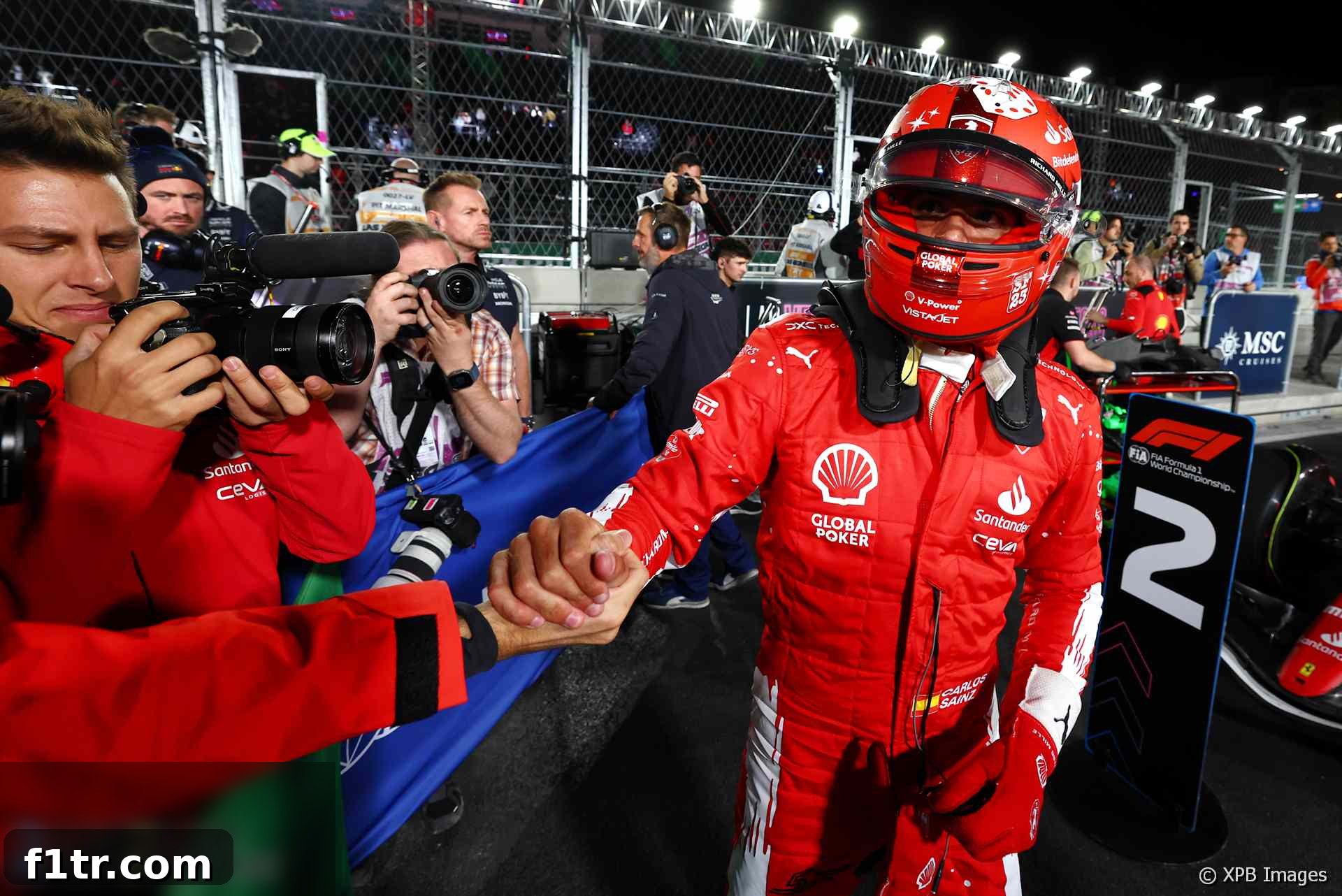
The highly anticipated Las Vegas Grand Prix, an event envisioned as a glittering spectacle, was unexpectedly marred early on by an unfortunate incident that profoundly impacted Carlos Sainz Jnr’s race weekend. A freak accident during the inaugural practice session led to a controversial 10-place grid penalty for the Ferrari driver, igniting a widespread debate among drivers, teams, and fans about the rigidity of Formula 1’s sporting regulations. This incident, occurring on a brand-new street circuit, not only compromised Sainz’s chances for a front-row start but also highlighted a critical flaw in how F1 handles ‘no-fault’ mechanical failures, drawing significant criticism from his peers, including those who directly benefited from his misfortune.
Advertisement | Become a Supporter & go ad-free
The drama unfolded during the first practice session when Sainz’s Ferrari SF-23 struck a loose water valve cover at high speed on the freshly laid Las Vegas Strip Circuit. The impact was severe and immediate, causing extensive damage to the underside of his car, specifically to the chassis, floor, and crucial power unit components. Among the parts Ferrari had no option but to replace was the energy store. Formula 1 regulations impose strict limits on the number of power unit components, including the energy store, that can be used by a driver throughout a season. Exceeding this allocation automatically triggers a grid penalty, irrespective of the circumstances leading to the replacement.
Despite the undeniable fact that the damage was caused by an external factor entirely beyond the team’s or driver’s control, Ferrari’s appeal for an exemption from the penalty was swiftly denied by the race stewards. The stewards, while acknowledging the exceptional nature of the incident and expressing sympathy for Sainz, stated unequivocally that they did not possess the authority or regulatory framework to waive such a penalty under the current rules. This legalistic adherence to the letter of the law, even in the face of an unprecedented ‘force majeure’ event, set the stage for widespread discontent within the paddock and sparked questions about the sport’s capacity for common-sense application of its own rulebook.
Adding insult to injury, Sainz demonstrated remarkable resilience and skill by qualifying an outstanding second on the grid, placing his Ferrari SF-23 alongside Max Verstappen on what should have been the front row. However, due to the mandatory 10-place penalty, he was unjustly forced to line up a disheartening 12th for the start of the Grand Prix. This effectively negated his exceptional qualifying performance and drastically altered his race prospects and strategy. This immediate and tangible consequence brought the issue of F1’s rigid penalty system into sharp focus, transforming a track infrastructure failure into a contentious sporting integrity debate that overshadowed much of the weekend’s racing narrative.
F1’s Power Unit Regulations: A Double-Edged Sword in Practice
Formula 1’s power unit regulations, designed primarily to control escalating costs and promote reliability among competitors, stipulate a finite number of key components each driver can use per season. These critical elements include the Internal Combustion Engine (ICE), Turbocharger (TC), Motor Generator Unit-Heat (MGU-H), Motor Generator Unit-Kinetic (MGU-K), Control Electronics (CE), and the Energy Store (ES). Exceeding the permitted allocation for any of these components, for whatever reason, typically results in an automatic grid penalty. While the intention behind these rules is undeniably sound – preventing teams from continuously introducing new, potentially more powerful or fresher components to gain an unfair advantage – their rigid application in ‘no-fault’ scenarios like Sainz’s incident has frequently led to calls for greater flexibility and common sense.
The incident in Las Vegas vividly exposed a significant lacuna in the current sporting regulations, which appear to lack specific provisions or discretionary powers for truly extraordinary circumstances. When a component replacement is necessitated by an external, uncontrollable event – such as track debris, unexpected environmental factors, or, as in this case, a faulty infrastructure element – the automatic penalty mechanism seems unduly punitive and counter to the spirit of fair competition. Ferrari argued vehemently that this was a classic ‘force majeure’ situation, where a driver or team should not be penalised for circumstances entirely outside their influence. The stewards’ hands-tied response underscored that the existing rulebook provides no discretion for such unique situations, sparking widespread calls for a formal review and amendment to prevent similar injustices in the future and to better balance strict adherence with sporting integrity.
Widespread Discontent: Drivers Speak Out Against Inflexibility
The perceived injustice of Carlos Sainz’s penalty resonated deeply across the paddock, prompting several prominent drivers to voice their strong objections. Remarkably, some of these drivers directly benefited from his grid drop, underscoring the collective frustration with the inflexibility of F1’s current rule set. Their unified condemnation highlighted a desire for more nuanced judgment in the sport.
Fernando Alonso, a veteran of the sport and one of the drivers who gained a position on the grid as a direct result of Sainz’s penalty, succinctly captured the prevailing sentiment. “It’s a little bit harsh,” commented the Aston Martin driver, acknowledging the profound unfairness of penalising a competitor for an incident that was entirely out of their control. Alonso’s empathy, despite his personal gain, underscored the perceived sporting injustice and the need for a more equitable approach.
Nico Hulkenberg described the situation as “super unfortunate” and a “bad” outcome for Sainz and Ferrari. The Haas driver was particularly vocal about the perceived absurdity and lack of foresight in the regulation. “The rules, that loophole, it’s just silly that he loses a power unit and everything if it’s not the team’s or the driver’s fault,” Hulkenberg stated emphatically. His direct call for a “cleanup” of the rules reflects a strong desire for the sport to incorporate more nuanced judgment for freak occurrences, rather than applying a blanket punishment that feels inherently unfair.
Daniel Ricciardo of AlphaTauri drew clear parallels to a previous incident involving himself and Oscar Piastri at the Brazilian Grand Prix, where a strict application of rules led to an equally unfair outcome. In that instance, a crash during the formation lap resulted in both drivers being a lap down for the race restart, with no opportunity to regain the lead lap, unlike under Safety Car rules. “It’s a bit like Brazil,” Ricciardo explained. “They stick to the rulebook for Oscar and I, but it’s like, you know, come on. That one you would think they would take some common sense. So no, I don’t agree with that one, not at all.” Ricciardo’s comparison powerfully articulated the sentiment that F1 sometimes prioritizes rigid rule adherence over practical common sense and fairness, particularly in unpredictable scenarios that undermine competitive integrity.
Even Max Verstappen, who ironically inherited Sainz’s coveted front-row starting position, added his powerful voice to the chorus of criticism. The reigning world champion also criticised the rule, underscoring the widespread agreement among drivers that the current regulations lacked the necessary flexibility and fairness. Verstappen’s stance was particularly impactful, coming from a driver who directly benefited, further solidifying the argument that the rule itself was flawed, not just its application in this specific instance. His criticism highlighted that even success under such rules felt tainted by the underlying injustice.
Surprisingly, despite the strong consensus and widespread concern among the drivers, the issue of Sainz’s penalty and the underlying rule was reportedly not discussed during their regular drivers’ meeting at the track. This apparent omission raised eyebrows, suggesting either a failure to prioritize a crucial discussion or perhaps a belief that individual protests would be more effective than a collective formal approach in this context. Regardless, the public outpouring of support for Sainz underscored a genuine desire within the F1 community for a review and potential revision of rules that penalize drivers for circumstances entirely beyond their control.
Advertisement | Become a RaceFans supporter andgo ad-free
The Broader Implications for F1’s Sporting Integrity and Future Rulemaking
The Carlos Sainz incident at the Las Vegas Grand Prix serves as a crucial case study in the ongoing debate about sporting fairness versus rigid regulatory frameworks in Formula 1. While strict rules are undoubtedly essential for maintaining a level playing field and ensuring competitive balance, especially concerning costly and performance-critical power unit components, the lack of discretion for ‘no-fault’ incidents can fundamentally undermine the very integrity the rules are designed to protect. Penalizing a driver for damage caused by external track infrastructure, which is a failing of the event organizers rather than the competitor, not only feels inherently unfair but can also detract significantly from the spectacle of the sport, as fans witness a deserving performance negated by bureaucratic rigidity rather than on-track prowess.
The collective outcry from a significant portion of the F1 grid, including drivers who directly benefited from the penalty, cannot and should not be easily dismissed. It signals a clear and urgent need for the sport’s governing bodies – the FIA and Formula 1 Management – to revisit the relevant sections of the sporting regulations with a view to introducing greater flexibility. A practical solution could involve incorporating specific clauses for ‘force majeure’ events, allowing stewards a limited but crucial degree of discretion to waive penalties when component damage is unequivocally proven to be caused by external, uncontrollable factors. Such judicious amendments would ensure that while the core principles of cost control and reliability remain firmly intact, the spirit of fair competition is also robustly upheld, preventing future instances where a driver’s weekend and championship hopes are unfairly jeopardized by circumstances entirely beyond their command.
Ultimately, the Las Vegas incident offered a stark reminder that even with the most meticulously crafted rulebooks, unforeseen and exceptional circumstances will inevitably arise. The challenge for Formula 1 lies in finding a delicate balance between enforcing regulations to maintain competitive integrity and allowing for flexibility to ensure fairness in truly exceptional situations. The dialogue initiated by Sainz’s penalty and his rivals’ strong reactions must translate into tangible discussions and, eventually, progressive rule adjustments to safeguard the sport’s credibility and ensure that pure racing merit, rather than unfortunate accidents and inflexible rules, dictates the outcomes on the track. This commitment to evolving regulations in light of real-world incidents will be crucial for F1’s long-term appeal and its reputation for sporting justice.
2023 Las Vegas Grand Prix: Related Articles
- Tost blames track inspection oversight for Sainz’s damage in Las Vegas
- Hard to repeat “rare” combination of factors behind Vegas shunt – Norris
- Las Vegas Grand Prix “got a lot more hate than it deserved” – Sargeant
- Williams’ “incredible” Vegas qualifying made us “poor” in race – Vowles
- Piastri is first rookie to take two fastest laps in a season since Hamilton
Browse all 2023 Las Vegas Grand Prix articles