Oliver Bearman’s High-Speed Suzuka Crash: Unraveling the Colapinto Controversy and F1’s New Era Challenges
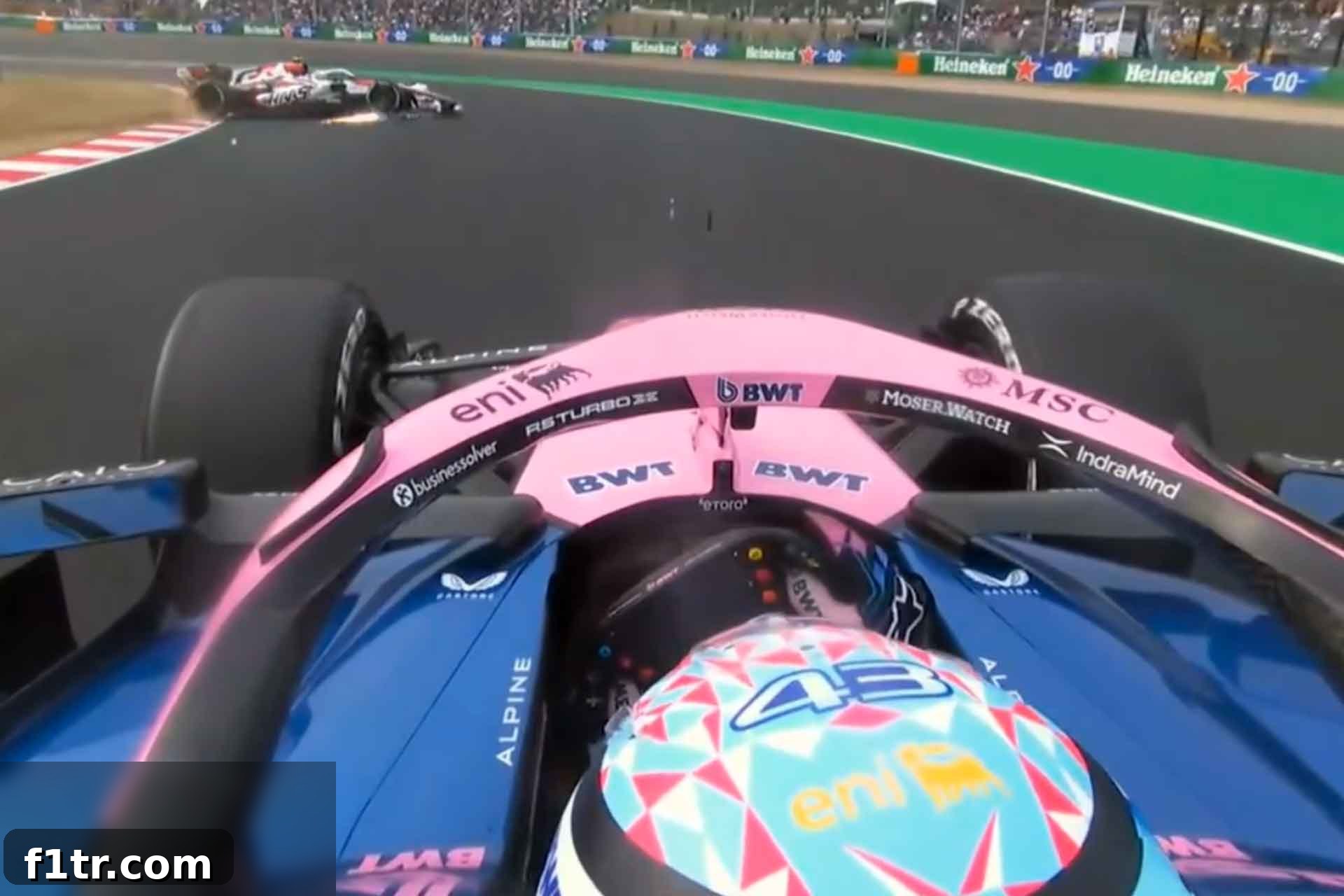
The Suzuka Circuit, known for its challenging high-speed corners and thrilling racing, became the scene of a dramatic incident on Sunday when Haas driver Oliver Bearman suffered a massive crash. The incident, involving Franco Colapinto’s Alpine, quickly sparked debate and highlighted the complex challenges presented by Formula 1’s new power unit regulations. While Haas team principal Ayao Komatsu was swift to defend Colapinto, Bearman himself offered a different perspective, suggesting he was not afforded adequate space.
Advert | Become a Supporter & go ad-free
The Suzuka Spoon Curve Incident: A High-Speed Scare
The crash unfolded at a terrifying 308 kilometres per hour (191 mph) as Bearman approached the demanding Spoon curve. He was forced to swerve sharply left onto the grass after suddenly encountering Colapinto’s car. The sheer speed and the suddenness of the maneuver resulted in a monumental impact, leaving Bearman’s VF-26 in significant wreckage. Fortunately, Bearman emerged from the car with only a bruised knee, a testament to the safety advancements in modern Formula 1.
In the immediate aftermath, Haas Team Principal Ayao Komatsu addressed the media, sidestepping any direct blame on Colapinto. Komatsu, when questioned by Sky commentator David Croft, attributed the incident primarily to the “huge closing speed” between the two cars. “He just had huge closing speed against the car in front, so he had to take avoiding action and he went on the grass and crashed,” Komatsu explained. “The main thing was just the closing speed, I think, it’s just huge.” This perspective emphasizes the inherent difficulty drivers face in reacting to rapidly diminishing gaps, especially at such high velocities.
Bearman’s Perspective: A Plea for More Space
However, Bearman himself was less willing to simply chalk the incident up to unavoidable circumstances. From his vantage point in the cockpit, the young British driver felt a critical element was missing: space. He highlighted the significant speed differential, a staggering 50 kilometres per hour (31 mph) overspeed, as a key factor demanding more consideration from his rival.
“It was a massive overspeed, 50kph, which is a part of these new regulations that I guess we have to get used to,” Bearman stated. “But also I felt like I wasn’t really given much space, given the huge excess speed that I was carrying.” While not explicitly naming Colapinto, the implication was clear: Bearman believed Colapinto should have anticipated his rapid approach and adjusted his line or speed accordingly to provide a safer racing environment. This sentiment underscores the ongoing debate about driver etiquette and the responsibility of the leading car when facing an approaching opponent with superior pace.
Advert | Become a RaceFans supporter andgo ad-free
The ‘Super-Clipping’ Conundrum and Piastri’s Observation
Adding another layer of complexity to the incident was the question of ‘super-clipping’ – a phenomenon where F1 cars, particularly with the new power units, harvest energy at their maximum rate, leading to a sudden and significant reduction in speed. When this occurs, the car’s rear lights flash to alert following drivers, a crucial safety mechanism.
Mercedes driver Oscar Piastri, renowned for his analytical approach, pointed out that Colapinto’s car did not display these flashing lights. “From what I saw there was no flashing light from Colapinto, so I don’t even think he was super-clipping either, which is obviously a bit of a concern,” Piastri observed. This detail is vital because it suggests Colapinto’s slower speed was not due to the expected energy harvesting protocol, raising questions about the nature of his deceleration. Had it been super-clipping, following drivers would be explicitly warned.
A stark contrast was provided by an earlier incident involving George Russell on lap 37 at the very same point on the track. Russell’s Mercedes abruptly slowed, but crucially, his red lights flashed prominently. This immediate warning allowed Charles Leclerc, who was following closely, to react decisively and dodge past the Mercedes without incident. Interestingly, Russell’s car decelerated far more dramatically than Colapinto’s, dropping to 206 kph (128 mph) approaching Spoon, compared to Colapinto’s 261 kph (162 mph). The key differentiator here was the clear warning provided by Russell’s flashing lights, which were absent from Colapinto’s Alpine. This distinction highlights the critical role of car signaling in driver safety, especially with the variable performance characteristics of the new power units.
Colapinto’s Approach: Experimentation with New Power Units
As F1 embarks on its first year with the revolutionary new power units, drivers are constantly experimenting and refining their techniques to extract maximum performance, both when attacking and defending. It appears Colapinto was engaged in precisely this experimentation when Bearman rapidly closed in behind him. Analyzing Colapinto’s approach to Spoon curve over the three laps preceding the crash provides valuable insight into his evolving strategy.
On lap 19, Colapinto executed what has become a conventional line through Spoon, reaching 272 kph (169 mph) on the approach before easing off slightly at the turn-in point and then decelerating more sharply as he navigated the corner.
The following lap, lap 20, saw Colapinto subtly alter his speed, topping out at 265 kph (165 mph) on the approach. His braking and cornering technique remained largely consistent with the previous lap, indicating a slight, but not drastic, change in pace.
Advert | Become a RaceFans supporter andgo ad-free
However, it was on lap 21 – the fateful lap of Bearman’s crash – that Colapinto introduced two significant deviations in his approach. Firstly, he initiated his first downshift before the corner far earlier than his previous attempts. On all laps prior to the 21st, Colapinto consistently performed his first downshift only upon reaching the 100-metre board before the corner, often waiting until he was closer to the 50-metre marker to drop a gear. On lap 21, in contrast, he downshifted to sixth gear almost immediately after selecting seventh, a maneuver executed well before the 200-metre board, perhaps several hundred metres earlier than his usual reference point. This pre-emptive downshift occurred approximately five seconds earlier than on his previous laps.
This early downshift had a profound impact: it entirely halted his acceleration and sent his engine revs significantly higher than on preceding laps. Despite these dramatic changes, its immediate effect on his overall speed into the corner was relatively minor, reducing his speed by no more than 4 kph (2.5 mph) compared to the previous lap, and 11 kph (7 mph) slower than two laps earlier. Crucially, Bearman, behind him, appeared to have already committed to an aggressive attack at this point, deploying more of his energy reserves. By the time they reached the 200-metre board, Bearman was visibly pulling out to initiate an overtake.
Secondly, Colapinto’s line into the corner also varied significantly on lap 21. He allowed his Alpine to drift noticeably further wide, effectively covering off the inside line for Spoon. This tactical adjustment appeared to be a direct reaction to Bearman’s attacking posture, an attempt to defend his position and make an overtake more difficult.
Advert | Become a RaceFans supporter andgo ad-free
Stewards’ Decision and F1 Precedents
These two modifications in Colapinto’s driving – the unusually early downshift and the wider defensive line – appear to be the core of Bearman’s objection. Ultimately, whether Colapinto’s actions constituted an infringement or simply aggressive, but legal, racing is a matter for the race stewards to determine. Historically, drivers have been penalized for unexpectedly decelerating in a manner that causes a following car to crash. A notable instance occurred two years prior in Melbourne, where Fernando Alonso was punished for a similar incident, creating an unexpected braking point for a competitor.
However, the circumstances surrounding the Bearman-Colapinto incident are distinctly different from Alonso’s. Colapinto’s deceleration was considerably less severe and immediate than Alonso’s deliberate “two hits on the brake pedal.” Furthermore, the strategic change in Colapinto’s racing line, combined with the nuances of energy harvesting and deployment under the new power unit regulations, differentiate these two outwardly similar cases. It is also worth noting that Bearman himself was involved in a similar incident the previous year with Yuki Tsunoda, albeit at much lower speeds, indicating that such closing speed dynamics are not entirely unprecedented for him.
Given the complexity introduced by the new rules and the unique context of driver experimentation, any ruling by the stewards on this matter would have established a significant precedent. The stewards ultimately chose not to investigate the incident. This non-action can be interpreted at face value as an implicit acceptance of Colapinto’s driving, suggesting they found no fault in how he varied his speed and line while Bearman was gaining behind him.
Implications for F1 Safety and Future Regulations
Despite the stewards’ non-investigation, the sheer ferocity and high-speed nature of Bearman’s crash have undoubtedly raised alarm bells within the Formula 1 community. The incident has intensified pressure on the FIA to proactively seek solutions to prevent similar crashes caused by the extreme closing speeds that are becoming more prevalent with the new power unit architecture. While engineering solutions to fundamentally alter the engines’ characteristics might be challenging to implement in the short term, the FIA is keenly aware of the safety implications.
Consequently, the governing body may find itself compelled to re-evaluate and potentially adapt its racing regulations to address a problem that may not have immediate engineering fixes. This could involve clearer guidelines on defensive driving in high-speed zones, stricter interpretations of unexpected deceleration, or enhanced warning systems beyond the current flashing lights. The incident at Suzuka serves as a stark reminder that as technology pushes the boundaries of performance, so too must the regulatory framework evolve to ensure driver safety remains paramount.
Advert | Become a RaceFans supporter andgo ad-free
2026 Japanese Grand Prix
- Alpine denies “sabotaging” Colapinto and criticises social media “hate” posts
- Verstappen starts season with lowest score over three rounds since his debut in F1
- Poor starts a ‘very high priority’ for Mercedes as drivers lose 21 places in four races
- “Two balls of steel!” How Leclerc won his battery battle with Hamilton and Russell
- Was Bearman right to question Colapinto’s role in his huge Suzuka crash?
Browse all 2026 Japanese Grand Prix articles