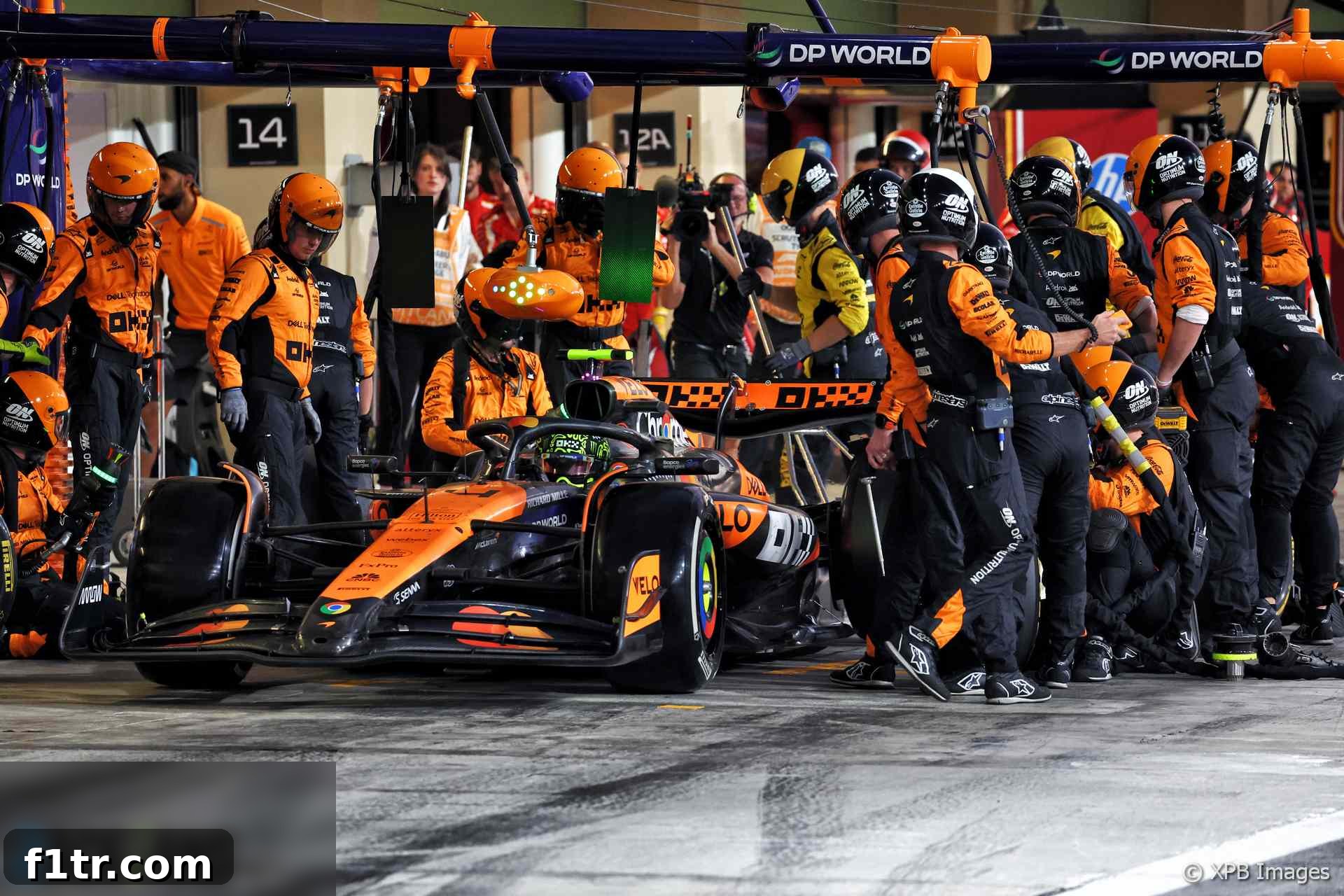
In a nail-biting conclusion to the Formula 1 season, McLaren Racing CEO Zak Brown lauded his team’s pit stop crew for their exemplary performance under immense pressure, a pivotal moment that ultimately secured the constructors’ championship for the Woking-based squad. This historic victory, marking McLaren’s first constructors’ title in 26 years, was sealed by Lando Norris’s masterful win at the Abu Dhabi Grand Prix, a triumph underscored by a meticulously executed pit stop.
McLaren’s Resurgent Glory: A Championship Two Decades in the Making
The 2024 Formula 1 season culminated in a dramatic showdown at the Yas Marina Circuit, where McLaren not only celebrated Lando Norris’s victory but also clinched the coveted Constructors’ Championship. This achievement represents a monumental comeback for one of Formula 1’s most iconic teams, ending a quarter-century wait since their last constructors’ title. The journey back to the top has been arduous, marked by periods of rebuilding and relentless development. This championship is not merely a trophy; it symbolizes the successful culmination of years of strategic investment, technological innovation, and unwavering dedication from every member of the McLaren team, from the factory floor to the pit wall.
Lando Norris’s triumph in Abu Dhabi, where he crossed the finish line 5.8 seconds ahead of Carlos Sainz Jnr, was the defining moment. However, the victory was far from straightforward, as the strategic decisions and the execution of the pit stops introduced an element of high drama that kept fans on the edge of their seats until the very last moment. The final race of any Formula 1 season carries amplified pressure, but when a championship hangs in the balance, every action, every decision, and every millisecond is scrutinized, making the collective effort of the team paramount.
The Abu Dhabi Grand Prix: A High-Stakes Strategic Battle
The Abu Dhabi Grand Prix was a race of strategic chess, particularly between McLaren and Ferrari. As Norris held a commanding lead, the threat from Carlos Sainz Jnr became acutely apparent on lap 25 when the Ferrari driver made his crucial pit stop. This early stop by Sainz immediately put pressure on McLaren, signaling an attempt at an ‘undercut’ – a tactical move where a driver pits before their rival to benefit from fresher tires and gain track position once the rival also pits. The undercut is a potent weapon in modern F1, capable of turning the tide of a race in a matter of laps.
Zak Brown vividly recalled the tension, confessing that he, much like the pit crew, was “a bundle of nerves” as Norris headed into the pits on the very next lap. The stakes couldn’t have been higher; the outcome of the constructors’ championship hinged on the precision and speed of this single pit stop. “I would not have wanted to be on the pit crew who needed to deliver a two-second pit stop,” Brown admitted, highlighting the immense psychological burden on the mechanics who operate under the most intense global spotlight. Yet, they delivered, executing a flawless stop that would ultimately define their season.
Precision Under Pressure: McLaren’s Pit Crew Delivers
The pivotal moment arrived when Norris entered the pit lane. Sainz, having benefited from a lap on fresh tires, was rapidly closing the gap. McLaren’s pit stop needed to be nothing short of perfect to negate the undercut threat and ensure Norris emerged ahead. And perfect it was. The pit crew, composed of highly trained individuals, performed their intricate ballet of tire changes and adjustments with breathtaking speed and accuracy. Their 2.2-second stop was not just fast; it was the fastest of the entire race for a complete tire change, marginally quicker even than Sainz’s already impressive stop by a mere four-thousandths of a second.
This miniscule difference underscores the brutal precision demanded at the pinnacle of motorsport. Brown’s admiration was palpable: “Imagine: Carlos comes in, he does a 2.2-second pit stop, you know you need to better that. What pressure. They stepped up, delivered the best pit stop of the race, and that’s what the team has been doing all year. It’s amazing.” This wasn’t an isolated incident of brilliance; it was the culmination of a season-long commitment to excellence and practice, where McLaren had consistently demonstrated their prowess in pit lane operations, even holding a world record for the fastest stop.
Zak Brown’s Insight: Seven-Tenths From Losing the Title
The gravity of that pit stop becomes even clearer through Zak Brown’s retrospective analysis. He revealed that McLaren was precariously close to losing the championship, estimating they were “about seven-tenths [of a second] away” from a different outcome. Norris emerged from his pit stop 1.6 to 1.7 seconds ahead of Sainz, a seemingly comfortable margin. However, Brown explained the critical dangers of modern F1’s aerodynamic complexities.
“Carlos was fast,” Brown stated. “And I think with the dirty air there, even though I think Lando had a little bit left in the tank, had he been in DRS, I don’t think we would have been able to defend it: The Ferrari’s very quick in a straight line, Lando gets in the dirty air…” This scenario paints a vivid picture of the razor’s edge McLaren walked. Dirty air, caused by the turbulence created by a leading car, significantly reduces the aerodynamic performance of the trailing car, making overtaking incredibly difficult. Conversely, if Norris had rejoined behind Sainz, or even just within DRS (Drag Reduction System) activation range, Ferrari’s straight-line speed coupled with the DRS advantage could have easily allowed Sainz to pass and secure the lead, thereby snatching the championship from McLaren’s grasp.
The Championship Decided by a Hair’s Breadth
The constructors’ championship battle between McLaren and Ferrari was incredibly tight, with McLaren ultimately winning by a slim margin of 14 points. However, the scenario surrounding Norris’s pit stop reveals just how fragile that lead was. Had Norris fallen to second place behind Sainz and maintained that position, the championship standings would have been dramatically different. Both teams would have ended the year tied on 659 points.
In Formula 1, tie-breakers are resolved by comparing the number of Grand Prix victories achieved over the season. In a hypothetical scenario where Ferrari had secured more race wins, they would have claimed the constructors’ title despite the points parity. This rule emphasizes that every race win, every podium, and indeed, every single point is crucial. The pit stop’s four-thousandths-of-a-second difference was not just about winning the race; it was about ensuring Norris stayed ahead to secure enough points to avoid this tie-breaker scenario, underscoring the profound impact of the pit crew’s performance on the entire championship outcome.
Zak Brown’s Leadership Philosophy: “Business As Usual” Under Pressure
Amidst the immense pressure of a championship decider, Zak Brown adopted a pragmatic and reassuring leadership approach. He emphasized the importance of treating the final pit stops of the year no differently from any other race. “It’s got to be business as usual,” Brown stated, acknowledging the difficulty of this mindset in practice. “It’s easy to say, and of course it’s not exactly: everyone knows it’s not business as usual.”
Despite the inherent stress, Brown resisted the temptation to implement any special measures or convey additional urgency to his crew. He explained, “I had a lot of people asking me ‘what are you going to do different for this race or the last couple of races’. I think you’ve got to keep doing what got you in the position you are in.” This philosophy speaks volumes about trust and consistency within the team. Brown believed that introducing new protocols or explicitly reminding the crew of the stakes would only create unnecessary anxiety and potentially disrupt their well-honed routines. “The minute you start changing your game, it’s like, wait a minute, we’ve been doing great pit stops all year, we’ve got the world record, we don’t need to tell them what’s on the line. I think they knew that.” This unwavering belief in his team’s capabilities allowed the pit crew to perform at their peak, unburdened by additional external pressure, and ultimately contribute to McLaren’s historic championship win.
The Broader Impact: A Blueprint for Future Success
McLaren’s constructors’ championship victory is more than just a win; it’s a testament to the power of meticulous preparation, strategic acumen, and the exceptional human element within motorsport. The Abu Dhabi Grand Prix served as a microcosm of the entire season, where fine margins, critical decisions, and flawless execution converged to define success. The pit crew’s heroic effort under unimaginable pressure highlights the often-underestimated contributions of the unsung heroes behind the scenes.
This triumph sets a robust foundation for McLaren’s future aspirations. It reinforces the team’s commitment to excellence and provides a clear blueprint for continued success. The synergy between drivers like Lando Norris, astute strategists on the pit wall, and the lightning-fast mechanics demonstrates that Formula 1 remains a true team sport. As McLaren looks forward, this championship will undoubtedly serve as a source of inspiration and a benchmark for the relentless pursuit of perfection in the competitive world of Grand Prix racing.
2024 Abu Dhabi Grand Prix Insights
- Did Tsunoda ‘destroy’ his team mates – and are Red Bull wrong to pick Lawson over him?
- McLaren were ‘0.7 seconds away from losing the title’ in Abu Dhabi – Brown
- Another name change for RB and new driver numbers revealed in 2025 F1 entry list
- Ranked: The Formula 1 cars of 2024, from slowest to fastest
- McLaren are world champions with fewest grand prix wins in 25 years
Browse all 2024 Abu Dhabi Grand Prix articles