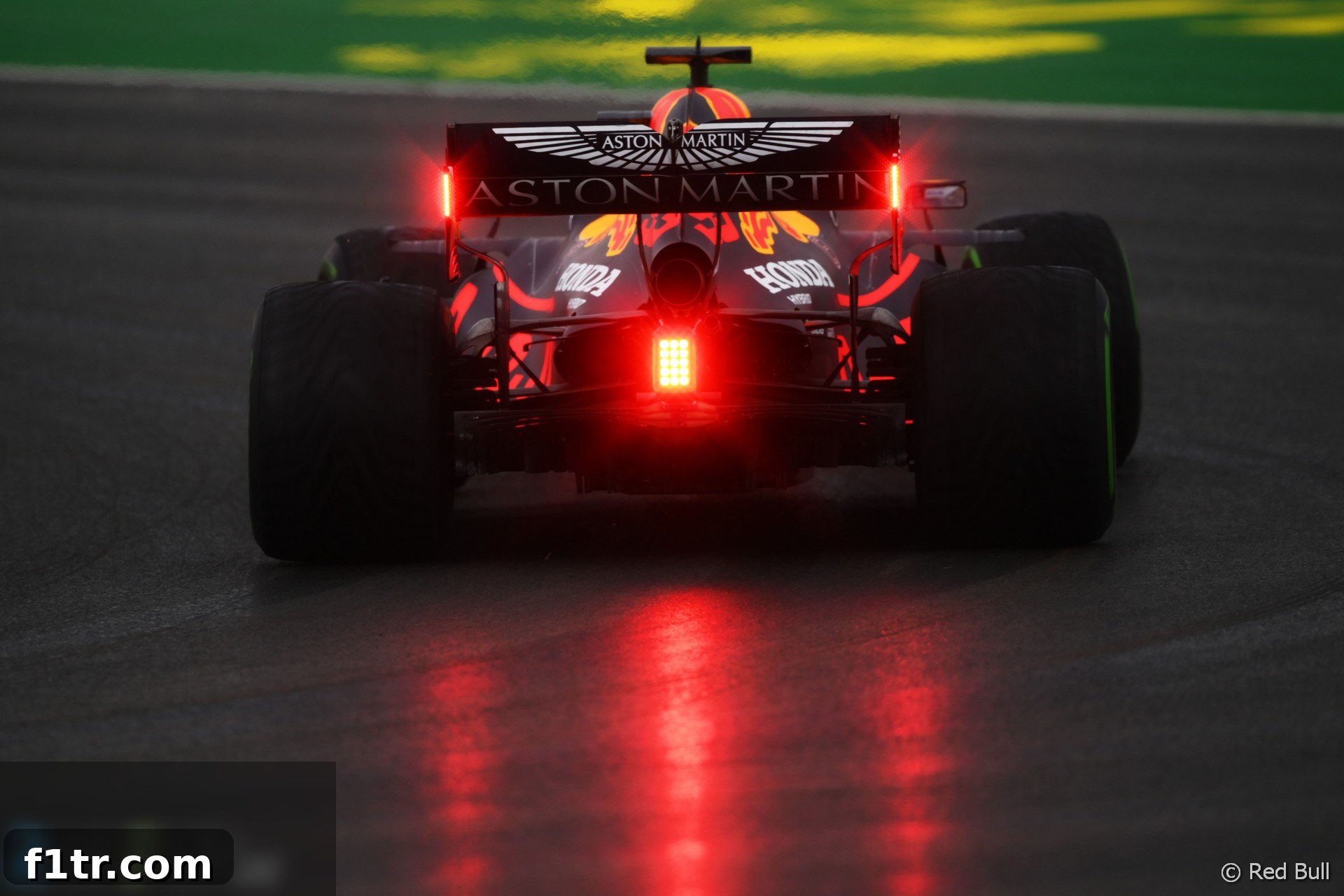
The 2020 Turkish Grand Prix weekend at Istanbul Park presented a dramatic spectacle even before qualifying, with Max Verstappen asserting his dominance by topping all three practice sessions. The final free practice (FP3) proved to be a particularly treacherous affair, as persistent rain transformed the already notoriously low-grip track surface into an ice rink, challenging every driver on the grid to their absolute limits.
Advert | Become a Supporter & go ad-free
The recently resurfaced Istanbul Park circuit had already been a talking point among drivers, who found an alarming lack of grip on Friday’s dry sessions. This new asphalt, combined with low track temperatures, created conditions where cars struggled to generate adequate tyre temperature and adhesion. As Saturday’s FP3 commenced, the heavens opened, unleashing steadily increasing rain that further exacerbated these challenging circumstances, making the circuit progressively more treacherous throughout the crucial final hour of preparation.
Verstappen Masters the Opening Minutes as Rain Begins
As the session began, the rain was at its lightest, making intermediate tyres the preferred choice for most drivers. This brief window of relatively manageable conditions allowed for the quickest lap times of the session to be set. It was here that Max Verstappen, once again showcasing his exceptional talent in adverse conditions, laid down a benchmark lap of 1 minute 48.485 seconds. This time, while significantly slower – a staggering 20 seconds off his dry pace from Friday – was still enough to keep him firmly at the top of the leaderboard, underscoring his adaptability and the Red Bull-Honda package’s performance in mixed conditions.
Close behind Verstappen, Charles Leclerc, driving for Ferrari, secured second place. Despite being almost a full second slower than the Dutchman, his performance highlighted Ferrari’s potential in the challenging environment. Alexander Albon, Verstappen’s teammate at Red Bull, completed the top three, further demonstrating the team’s strong command over the difficult track. Esteban Ocon, in his Renault, finished fourth, though his session included a moment of drama when he was inadvertently tapped into a spin by Leclerc at Turn 12 – an early sign of the testing conditions to come.
Escalating Challenges: As Rain Intensifies, Control Becomes a Luxury
As the rain intensified, maintaining control of the high-powered Formula 1 machinery became an increasingly formidable task. The drivers, already struggling with the slick new tarmac, found themselves fighting their cars through virtually every corner. One after another, cars snapped out of control, twitching and sliding across the vast run-off areas. While thankfully no car made contact with the barriers, the sheer volume of off-track excursions painted a vivid picture of the extreme conditions. The challenge wasn’t just about speed; it was about sheer survival and keeping the car on the racing line.
The frustration among drivers was palpable. Carlos Sainz Jnr of McLaren, after experiencing a spin, vocalized his exasperation: “I just don’t understand what we’re doing with these tyre temperatures.” His comment underscored a critical issue: the inability to generate and maintain optimal tyre temperature in the cold, wet conditions, further diminishing the already limited grip available.
Despite the perilous conditions, some drivers adopted a pragmatic approach, choosing to remain on track in the hope of gathering crucial data and experience. With further rain forecast for Sunday’s race, understanding the car’s behavior and tyre degradation in such extreme wet weather could prove invaluable. Charles Leclerc, for instance, articulated this strategy, stating, “It’s very slippery for sure, but if we have this in the race we need to train and you know I want some practice in these conditions.” This sentiment revealed the fine line between risk and reward that teams and drivers had to navigate during FP3.
The Session Nears a Standstill: A Brief Reprieve and Final Deluge
However, as the rain continued to grow heavier and the spray from other cars drastically reduced visibility, the utility of staying out diminished rapidly. Around the halfway point of the one-hour session, a significant number of drivers returned to the pits, effectively bringing the track action to a temporary halt. The conditions were deemed too dangerous and unproductive by many. Carlos Sainz’s stark assessment, “The session should be red-flagged; it’s not even possible to stay on the track on these tyres,” perfectly captured the prevailing mood of concern and frustration in the paddock.
A brief easing of the downpour towards the end of the hour offered a glimmer of hope, prompting a few brave drivers to venture back out, this time equipped with full wet-weather tyres. This decision, however, proved to be short-lived. The momentary lull quickly gave way to an even more intense deluge, transforming Istanbul Park into a truly waterlogged battlefield. This final, furious downpour triggered yet another spate of spins and off-track excursions, with Antonio Giovinazzi notably spinning off the circuit twice in quick succession, highlighting the near-impossible task of keeping the cars straight.
Several prominent drivers, including championship leader Lewis Hamilton, opted against setting a lap time altogether, recognizing the futility and risk of running in such conditions. Hamilton briefly emerged from his garage before the fresh downpour, only to swiftly return to the pits, remarking, “It’s impossible out here.” Kimi Raikkonen echoed this sentiment, telling his team upon returning to the garage, “that was a waste of time,” a clear indication of the utterly unrepresentative and hazardous nature of the session’s closing stages. These seasoned drivers understood that pushing the limits in such conditions offered little in the way of beneficial data and significant risk of damage.
Implications for Qualifying and Race Day
Max Verstappen’s consistent performance across all practice sessions, culminating in his FP3 sweep, firmly positions him as a strong contender for pole position and the race victory. His ability to find grip and maintain control in the most challenging circumstances sets him apart. However, the extreme conditions of FP3 mean that many teams and drivers have limited genuine running in representative conditions, potentially leading to a highly unpredictable qualifying session and race. Tyre strategy will be paramount, and the ability to switch between intermediates and full wets at the right moment could be the deciding factor. The lack of grip on the new tarmac, even in the dry, combined with the forecasted intermittent rain, guarantees that the Turkish Grand Prix will be a stern test of skill, strategy, and nerve for everyone involved.
2020 Turkish Grand Prix Third Practice Result
| Pos. | No. | Driver | Car | Best lap | Gap | Laps |
|---|---|---|---|---|---|---|
| 1 | 33 | Max Verstappen | Red Bull-Honda | 1’48.485 | 6 | |
| 2 | 16 | Charles Leclerc | Ferrari | 1’49.430 | 0.945 | 9 |
| 3 | 23 | Alexander Albon | Red Bull-Honda | 1’50.059 | 1.574 | 5 |
| 4 | 31 | Esteban Ocon | Renault | 1’53.897 | 5.412 | 9 |
| 5 | 4 | Lando Norris | McLaren-Renault | 1’53.995 | 5.510 | 7 |
| 6 | 5 | Sebastian Vettel | Ferrari | 1’54.490 | 6.005 | 14 |
| 7 | 11 | Sergio Perez | Racing Point-Mercedes | 1’55.577 | 7.092 | 6 |
| 8 | 77 | Valtteri Bottas | Mercedes | 1’55.666 | 7.181 | 4 |
| 9 | 20 | Kevin Magnussen | Haas-Ferrari | 1’55.878 | 7.393 | 4 |
| 10 | 18 | Lance Stroll | Racing Point-Mercedes | 1’56.824 | 8.339 | 5 |
| 11 | 3 | Daniel Ricciardo | Renault | 1’58.475 | 9.990 | 6 |
| 12 | 55 | Carlos Sainz Jnr | McLaren-Renault | 1’59.548 | 11.063 | 7 |
| 13 | 99 | Antonio Giovinazzi | Alfa Romeo-Ferrari | 2’02.325 | 13.840 | 10 |
| 14 | 10 | Pierre Gasly | AlphaTauri-Honda | 2’02.473 | 13.988 | 7 |
| 15 | 8 | Romain Grosjean | Haas-Ferrari | 2’04.748 | 16.263 | 5 |
| 16 | 7 | Kimi Raikkonen | Alfa Romeo-Ferrari | 2’06.351 | 17.866 | 13 |
| 17 | 26 | Daniil Kvyat | AlphaTauri-Honda | 2’09.368 | 20.883 | 8 |
| 18 | 63 | George Russell | Williams-Mercedes | |||
| 19 | 6 | Nicholas Latifi | Williams-Mercedes | |||
| 20 | 44 | Lewis Hamilton | Mercedes |
Advert | Become a RaceFans supporter andgo ad-free
Third Practice Visual Gaps: A Picture of Disparity
Max Verstappen – 1’48.485
+0.945 Charles Leclerc – 1’49.430
+1.574 Alexander Albon – 1’50.059
+5.412 Esteban Ocon – 1’53.897
+5.510 Lando Norris – 1’53.995
+6.005 Sebastian Vettel – 1’54.490
+7.092 Sergio Perez – 1’55.577
+7.181 Valtteri Bottas – 1’55.666
+7.393 Kevin Magnussen – 1’55.878
+8.339 Lance Stroll – 1’56.824
+9.990 Daniel Ricciardo – 1’58.475
Drivers more than ten seconds off the pace omitted from this visual representation.
Comprehensive Weekend Practice Performance: FP1, FP2, and FP3 Analysis
Analyzing the combined practice data from Friday and Saturday offers a more complete picture of each driver’s adaptation and raw pace across varying conditions. The significant ‘Fri/Sat diff’ column highlights the dramatic shift in lap times from dry to increasingly wet conditions. Max Verstappen’s consistent chart-topping performance, even with a 20-second increase in lap time from his FP2 best to his FP3 best, underscores his strong form. Charles Leclerc also demonstrated strong wet-weather prowess, consistently in the top tier.
Conversely, the Mercedes drivers, particularly Lewis Hamilton, who did not set a lap time in FP3, face a steeper challenge in adapting to the potential wet conditions for qualifying and the race, having foregone valuable wet track time. This decision could either be a calculated risk based on their car’s inherent performance or a strategic disadvantage if Sunday indeed turns out to be a wet race. The wide variance in total laps completed also indicates differing strategies among teams regarding how much risk to take versus gathering data in the unrepresentative conditions. Drivers like Sebastian Vettel, with 84 laps, maximized their track time, which could pay dividends in a challenging race environment.
| Pos | Driver | Car | FP1 | FP2 | FP3 | Fri/Sat diff | Total laps |
|---|---|---|---|---|---|---|---|
| 1 | Max Verstappen | Red Bull-Honda | 1’35.077 | 1’28.330 | 1’48.485 | +20.155 | 71 |
| 2 | Charles Leclerc | Ferrari | 1’35.507 | 1’28.731 | 1’49.430 | +20.699 | 79 |
| 3 | Valtteri Bottas | Mercedes | 1’37.629 | 1’28.905 | 1’55.666 | +26.761 | 68 |
| 4 | Lewis Hamilton | Mercedes | 1’40.225 | 1’29.180 | 53 | ||
| 5 | Alexander Albon | Red Bull-Honda | 1’35.318 | 1’29.363 | 1’50.059 | +20.696 | 73 |
| 6 | Daniil Kvyat | AlphaTauri-Honda | 1’36.738 | 1’29.689 | 2’09.368 | +39.679 | 77 |
| 7 | Pierre Gasly | AlphaTauri-Honda | 1’35.543 | 1’29.944 | 2’02.473 | +32.529 | 75 |
| 8 | Sebastian Vettel | Ferrari | 1’35.620 | 1’30.022 | 1’54.490 | +24.468 | 84 |
| 9 | Lance Stroll | Racing Point-Mercedes | 1’39.484 | 1’30.297 | 1’56.824 | +26.527 | 63 |
| 10 | Lando Norris | McLaren-Renault | 1’37.216 | 1’30.907 | 1’53.995 | +23.088 | 67 |
| 11 | Sergio Perez | Racing Point-Mercedes | 1’38.612 | 1’31.104 | 1’55.577 | +24.473 | 65 |
| 12 | Esteban Ocon | Renault | 1’38.428 | 1’31.380 | 1’53.897 | +22.517 | 67 |
| 13 | Antonio Giovinazzi | Alfa Romeo-Ferrari | 1’37.503 | 1’31.493 | 2’02.325 | +30.832 | 69 |
| 14 | Carlos Sainz Jnr | McLaren-Renault | 1’46.462 | 1’31.498 | 1’59.548 | +28.05 | 59 |
| 15 | Daniel Ricciardo | Renault | 1’45.156 | 1’31.660 | 1’58.475 | +26.815 | 60 |
| 16 | Kimi Raikkonen | Alfa Romeo-Ferrari | 1’41.035 | 1’31.932 | 2’06.351 | +34.419 | 78 |
| 17 | George Russell | Williams-Mercedes | 1’49.256 | 1’32.302 | 56 | ||
| 18 | Romain Grosjean | Haas-Ferrari | 1’40.025 | 1’32.570 | 2’04.748 | +32.178 | 62 |
| 19 | Kevin Magnussen | Haas-Ferrari | 1’41.854 | 1’32.807 | 1’55.878 | +23.071 | 61 |
| 20 | Nicholas Latifi | Williams-Mercedes | 1’38.508 | 1’33.488 | 58 |
Advert | Become a RaceFans supporter andgo ad-free
2020 Turkish Grand Prix
Browse all 2020 Turkish Grand Prix articles