In the relentless pursuit of Formula 1 supremacy, innovation is not merely an advantage; it is an absolute necessity. The Formula 1 landscape demands constant evolution, and the Mercedes-AMG Petronas F1 Team has consistently demonstrated its commitment to pushing aerodynamic boundaries. For the highly anticipated Austrian Grand Prix, a crucial mid-season race, Mercedes unveiled a suite of significant upgrades for their championship challenger, the W09. These modifications were designed not just to fine-tune performance but to fundamentally enhance the car’s aerodynamic efficiency, signaling a potent declaration of intent in the fiercely competitive 2018 season.
The core of these advancements revolved around two critical areas: the revised sidepod aerodynamics and a subtly but significantly updated rear wing design. These changes, meticulously engineered and rigorously tested, represented Mercedes’ strategic response to the evolving technical challenges and the relentless pressure from rivals like Ferrari and Red Bull. The focus was on optimizing airflow, reducing drag, and maximizing downforce – the holy trinity of F1 aerodynamics.
Revolutionary Sidepod Aerodynamics: A New Approach to Airflow Management
Among the most striking and technically intriguing changes introduced to the Mercedes W09 were the extensively revised sidepod aerodynamics. This area of an F1 car is paramount for managing airflow around the vehicle, feeding crucial components like the engine’s cooling system, and conditioning the air that flows towards the rear wing and diffuser. Mercedes’ approach for the Austrian Grand Prix involved not just a redesign but a reimagining of how these structures interact with the airflow.
Integrated Wing Mirrors: A Masterstroke of Aerodynamic Design
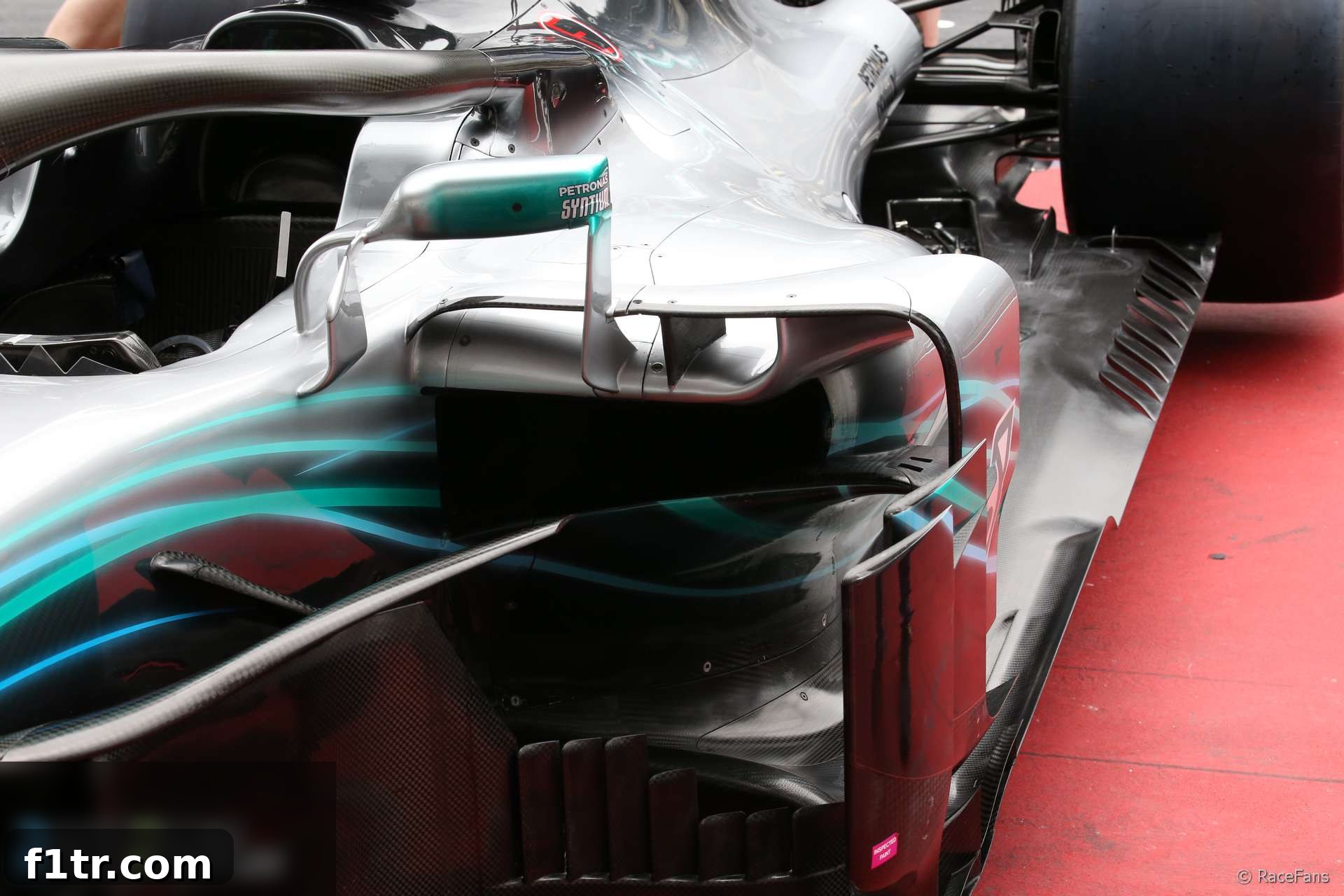
A novel and highly discussed aspect of the W09’s sidepod upgrade was the innovative integration of the wing mirrors. While competitors like Ferrari had explored attaching their wing mirrors to the Halo safety device – a design choice often sparking debate about its primary purpose being aerodynamic rather than purely observational – Mercedes forged a distinct path. The Silver Arrows opted to incorporate their mirrors more deeply and seamlessly within the sidepod construction itself. This wasn’t merely an aesthetic choice; it was a calculated aerodynamic play.
Instead of a conventional, relatively isolated mirror stalk, Mercedes engineered a new system where a substantial, aerodynamically profiled stalk emerged from the outside edge of the mirrors, attaching them directly to the top surface of the sidepod. This integration was far from incidental. The very profile of this new attachment indicated its deliberate use in conditioning the flow of air. By effectively channeling and shaping the turbulent air generated around the mirrors and the front of the sidepods, Mercedes aimed to reduce drag and ensure a cleaner, more efficient flow of air over the car’s bodywork and towards the crucial rear aerodynamic elements. This sophisticated approach highlighted the granular level of detail F1 teams delve into to extract even marginal gains.
Streamlining the Sidepod: Reshaping for Enhanced Efficiency
Beneath the innovatively mounted wing mirrors, Mercedes further refined the sidepod architecture by strategically redesigning the mandatory side impact protection bar. This critical safety component, typically a fixed element, was now cleverly integrated as part of a separate, more compact internal structure. This intelligent engineering solution had a profound impact on the external bodywork: it allowed the rest of the sidepod to be significantly reduced in size, creating a far more svelte and aerodynamically efficient profile.
This trend of minimizing sidepod volume was not entirely new in Formula 1; it was a philosophy pioneered and successfully implemented by Ferrari in the previous season. Ferrari’s ‘bathtub’ sidepod concept had demonstrated the significant benefits of tighter packaging, which Mercedes now sought to emulate and potentially even surpass. A smaller sidepod presents less frontal area to the oncoming air, thereby reducing aerodynamic drag. Furthermore, a tighter sidepod profile helps to improve the ‘undercut’ – the void created between the sidepod and the floor of the car – which is crucial for maximizing the efficiency of the underfloor aerodynamics and the diffuser. This synergy between various aerodynamic elements is what truly defines advanced F1 car design, and Mercedes’ W09 upgrades were a testament to this integrated approach.
Rear Wing Revisions: Drawing Inspiration for Downforce and Drag Efficiency
Beyond the intricate sidepod architecture, Mercedes also brought a significant evolution to the rear of the W09, specifically targeting the rear wing design. This crucial component is responsible for generating a substantial portion of the car’s downforce, pressing the tires onto the tarmac and enabling higher cornering speeds. Simultaneously, it contributes significantly to aerodynamic drag, which can limit straight-line speed. Finding the optimal balance is a perpetual challenge for F1 engineers.
The revised rear wing on the W09 appeared to draw considerable inspiration from McLaren’s design philosophy. Since the introduction of the current aerodynamic regulations at the beginning of the 2017 season, McLaren had adopted a distinct rear wing shape, characterized by specific endplate geometries and main plane profiles designed to maximize downforce while efficiently managing the drag penalty. Mercedes’ adoption of a similar conceptual design for the Austrian Grand Prix suggested a belief that McLaren’s approach offered an advantageous compromise or even an outright improvement in overall aerodynamic performance.
While specific details of the changes were not immediately available, such revisions typically involve optimizing the main plane’s angle of attack, refining the upper flap profiles, and redesigning the endplates. Endplates, in particular, play a crucial role in controlling the vortex shedding from the tips of the wing, which, if managed effectively, can reduce drag and enhance the efficiency of the entire wing assembly. By mimicking or evolving McLaren’s successful design cues, Mercedes aimed to unlock additional grip through faster corners and potentially gain crucial tenths of a second on tracks like the Red Bull Ring, which features a blend of high-speed straights and challenging corners.
The Relentless Pursuit of Performance: F1 Development Philosophy
These comprehensive aerodynamic upgrades underscore the core philosophy driving Formula 1 teams: the ceaseless, high-stakes arms race for technological superiority. Every fraction of a second gained on track can be the difference between victory and defeat, between a championship title and a runner-up finish. The development cycle in F1 is brutal, with teams constantly feeding data from track performance, computational fluid dynamics (CFD) simulations, and extensive wind tunnel testing back into the design process. The W09’s new components were undoubtedly the culmination of countless hours of dedicated research and development, a testament to the engineering prowess within the Mercedes-AMG Petronas F1 Team.
The decision to introduce such significant changes at the Austrian Grand Prix, mid-way through a fiercely contested championship, highlights the strategic importance of every race weekend. Teams don’t just bring upgrades; they bring them with a specific purpose for specific track characteristics or to address perceived weaknesses against their rivals. The Red Bull Ring, with its undulating layout, fast corners, and long straights, demands a finely balanced aerodynamic package. The revised sidepods aimed to improve overall efficiency and airflow quality, while the new rear wing sought to optimize the downforce-to-drag ratio for this specific circuit, ensuring maximum performance through both the high-speed sections and the technical corners.
Furthermore, these updates are not developed in isolation. They are part of a holistic aerodynamic concept that evolves throughout the season. The integration of wing mirrors, the slimming of sidepods, and the subtle changes to the rear wing collectively contribute to a complex dance of air around the entire car. The goal is to ensure that each component works harmoniously with the others, preventing any single element from creating detrimental turbulence or drag that could compromise overall performance. This intricate balancing act requires an unparalleled understanding of fluid dynamics and an unwavering commitment to innovation.
Impact on the 2018 F1 Championship Battle
The 2018 Formula 1 season was shaping up to be a thrilling contest, with Mercedes and Ferrari often trading blows at the front of the pack. Such significant upgrades, especially mid-season, can be pivotal in tilting the balance of power. By bringing these advancements to the Austrian Grand Prix, Mercedes aimed to gain a competitive edge, hoping to translate these aerodynamic gains into tangible performance improvements on track. The expectation was that the W09 would exhibit enhanced stability, better tire management due to optimized downforce, and potentially higher top speeds thanks to reduced drag.
Ultimately, the true measure of these innovations would be their performance under race conditions. However, the introduction of such sophisticated changes underscored Mercedes’ intent to leave no stone unturned in their quest for the constructors’ and drivers’ championships. It exemplified the high-stakes engineering battle that runs parallel to the on-track racing, where every curve, every surface, and every flow of air is meticulously scrutinized and optimized in the relentless pursuit of ultimate speed. These W09 upgrades were a bold statement, reflecting the relentless innovation that defines Formula 1’s cutting edge.