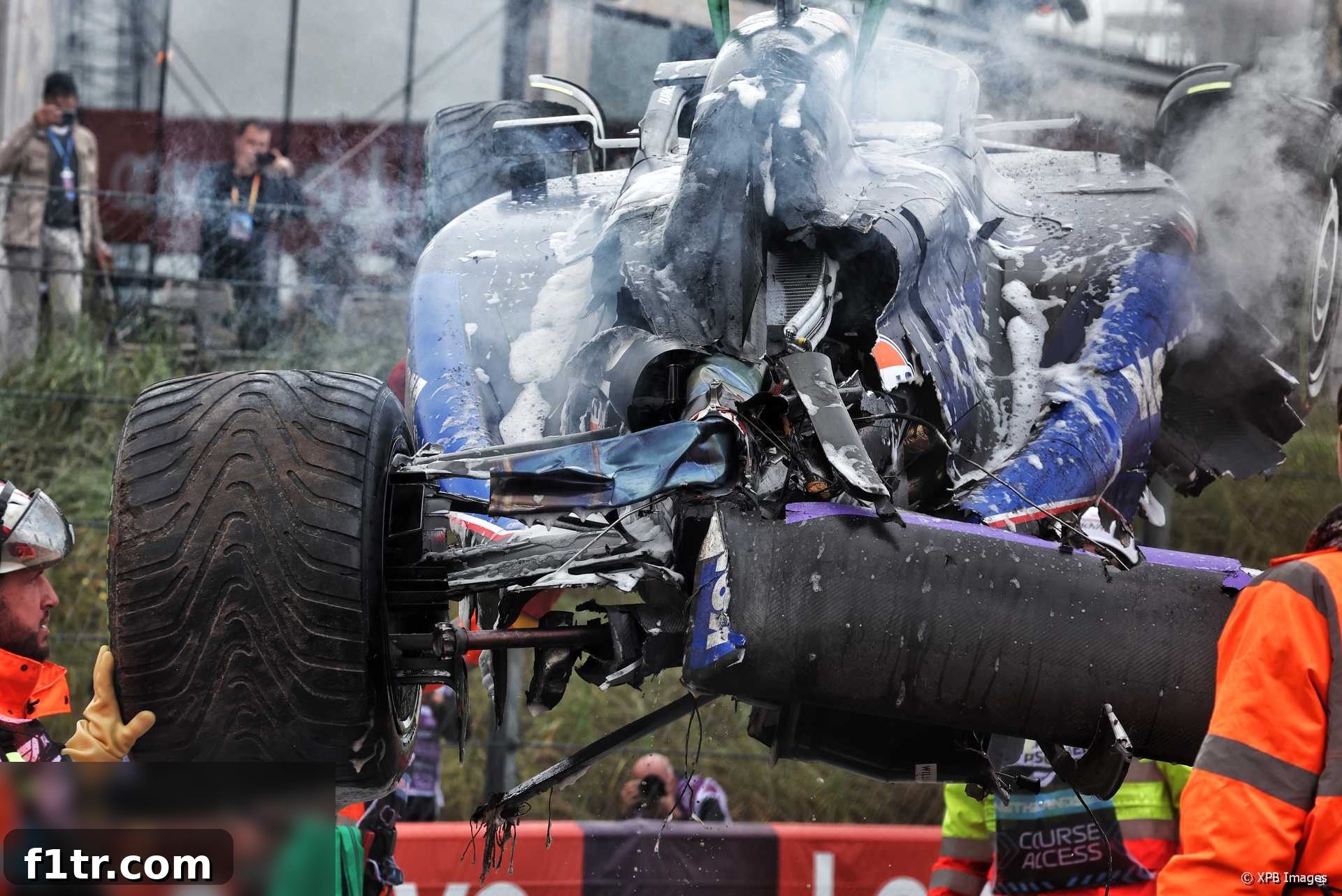
In the high-stakes world of Formula 1, every practice session is a delicate balance of pushing limits and preserving precious machinery. For the Williams Racing team, this balance was brutally disrupted during the final practice session ahead of a crucial race weekend, as driver Logan Sargeant suffered a significant crash. The incident, which occurred just 14 minutes into the final hour of practice, has sent ripples of concern through the team, prompting immediate strategic dilemmas and raising questions about resource management and driver performance.
Advert | Become a Supporter & go ad-free
Sargeant’s FW46 dramatically lost control when he ventured onto the grass at the exit of turn three, sending the car into an uncontrolled spin that culminated in a violent impact with the barrier. While mercifully uninjured, the car sustained extensive damage, a sight that immediately signaled a monumental challenge for the Williams crew. Adding to the gravity of the situation, a fire erupted at the rear of the car after it came to a halt, which marshals quickly extinguished. This fiery conclusion underscored the severity of the incident and the potential for long-term implications for the team.
The timing of this particular incident could not have been worse for Williams. This weekend marked the introduction of the team’s first major upgrade package of the season, a crucial development rolled out on both Alexander Albon’s and Sargeant’s cars. Such upgrades represent hundreds of hours of painstaking research, development, and manufacturing, coupled with significant financial investment. As team principal James Vowles articulated with evident frustration, “There’s hundreds of hours spent on the update, it looks like it’s working, but there’s few of them in the world. Really, the worst time is when you’ve just introduced it with small amounts of bits and put it into the wall at the circuit.” This statement perfectly encapsulates the profound disappointment and the strategic setback faced by Williams.
The Upgrade Dilemma: Scarcity and Strategy
The core of Williams’ immediate challenge lies in the scarcity of these newly upgraded components. Unlike larger, more established teams with deeper pockets and extensive manufacturing capabilities, Williams operates with a tighter budget and a more limited supply chain. When a major upgrade is introduced, spare parts are often at a premium, making any damage disproportionately impactful. The crash has forced the team into a difficult decision-making process: should they replace Sargeant’s damaged parts with new specification pieces, thereby depleting their already limited stock, or revert to older hardware?
This is not merely a question of repair but a strategic gamble with ramifications for both drivers. Vowles indicated that the team would seriously consider equipping Sargeant’s car with older specification parts. The rationale is clear: preserving the new-spec spares in case they are needed for Alexander Albon’s car. In Formula 1, especially under parc ferme conditions (where cars are largely locked down after qualifying), having sufficient spares for both cars is paramount. “There’s a limited amount,” Vowles explained, highlighting the delicate balance required. “So if something happens now to the other car, you need to make sure in parc ferme you have enough spares. That’s more what I want to evaluate now, when we’re under parc ferme conditions, can we service both cars to a sufficient standard.” This strategic foresight is crucial for minimizing the risk of further disruption and ensuring competitive readiness for race day.
Advert | Become a RaceFans supporter andgo ad-free
The immediate consequence of the crash is the serious doubt cast over Sargeant’s participation in qualifying. The extent of the damage to his car “looks pretty serious,” Vowles admitted, further suggesting that it “could result in a chassis change.” A chassis change is one of the most drastic repairs in Formula 1, demanding significant time and resources, and often incurring penalties if done outside regulated parameters. This uncertainty adds immense pressure to Sargeant and the team, who must work tirelessly to ready a car for the critical qualifying session, which determines starting grid positions and is vital for any chance of scoring points.
Sargeant’s Resilience Under Scrutiny
The crash comes at an particularly sensitive time for Logan Sargeant. Prior to this weekend’s race, Williams confirmed that Sargeant would not remain with the team next year, as he is set to be replaced by the highly regarded Carlos Sainz Jnr. This news, while not entirely unexpected given the season’s developments, adds another layer of emotional and psychological complexity to Sargeant’s current situation. Yet, amidst the pressures and public scrutiny, Vowles has consistently praised Sargeant’s impressive mental fortitude.
“One of the strengths that’s underrated in his regard is he has a huge mental resilience,” said Vowles. “He takes punishment in the media, in the world, really, almost weekend-on-weekend. But when it comes the following weekend, he’s cleared his mind of that. And he’s here just to perform, fundamentally, and he builds up to the weekend in the way it needs to be.” This acknowledgement of Sargeant’s inner strength highlights the brutal demands placed on Formula 1 drivers, who must consistently perform under immense pressure while enduring relentless public criticism. To be able to compartmentalize such external noise and refocus on the task at hand is a testament to an athlete’s mental toughness, a quality that is often overlooked but essential for survival in elite motorsport.
Signs of Progress Amidst Setbacks
Despite the recent setback and the news of his departure, Vowles maintains that Sargeant has shown tangible signs of progress throughout his tenure with Williams. While yet to score a point this year, the underlying metrics tell a story of gradual improvement. “If you look across the last 18 months, you can clearly see that from where he was to where he is now in terms of number of mistakes, proximity to Alex, where he’s qualifying and where he achieves, how many seconds behind he’s finishing now. It is all on the right journey,” Vowles elaborated. This progress isn’t always immediately visible in headline results, but in the intricate data points that F1 teams meticulously analyze: reducing errors, narrowing the performance gap to a highly rated teammate like Albon, and consistently improving lap times and race pace.
A key area of development highlighted by Vowles is Sargeant’s approach to building into a race weekend. “What he’s very good at doing now, which was a weakness beforehand, was building up into the weekend, fundamentally. So finding the limit, but approaching it from a bottom up perspective rather than top down. Because top-down, when you make one mistake, you lose a session and you start to put yourself at risk.” This ‘bottom-up’ approach signifies a more measured and analytical way of finding the car’s limit, gradually pushing the boundaries rather than aggressively seeking the maximum pace from the outset. This systematic method minimizes the risk of early errors that can derail an entire weekend, a crucial skill for any F1 driver looking to maximize their potential and deliver consistent performance for their team.
Advert | Become a RaceFans supporter andgo ad-free
The Broader Impact for Williams
Beyond the immediate implications for Logan Sargeant, this crash presents a broader challenge for the Williams team. Operating as one of the smaller outfits on the grid, every incident of this magnitude strains resources. The financial cost of repairing such extensive damage, especially to an upgraded car, can be substantial. Furthermore, the diversion of engineering and mechanic time away from fine-tuning the cars for optimal performance, to instead focus on emergency repairs, impacts the entire team’s preparation. This could affect not only Sargeant’s car but potentially Albon’s performance as well, if shared resources become stretched. The incident underscores the relentless pressure and logistical complexities that even a single mistake can unleash upon a Formula 1 team, particularly one striving to climb its way back to prominence.
In conclusion, Logan Sargeant’s significant crash in final practice was indeed a blow to Williams Racing, striking at the worst possible moment as the team introduced crucial upgrades. It ignited a complex strategic dilemma regarding spare parts, cast doubt on his qualifying participation, and added another layer to his challenging final season with the team. However, Vowles’ comments illuminate Sargeant’s commendable mental resilience and an underlying trajectory of progress, even as the harsh realities of Formula 1 continue to test him. The Williams team now faces a race against time and resources, navigating critical decisions that will shape their performance for the remainder of this pivotal race weekend, demonstrating once again that success in Formula 1 is as much about managing adversity as it is about outright speed.
Miss nothing from RaceFans
Get a daily email with all our latest stories – and nothing else. No marketing, no ads. Sign up here:
2024 Dutch Grand Prix
- Previous technical hires no obstacle to Newey joining Aston Martin – Krack
- Mercedes still unsure whether Spa floor upgrade is working
- McLaren’s Dutch GP upgrade “nowhere near” as significant as Miami package
- “Very hard to pinpoint” why car has become harder to drive – Verstappen
- Only one F1 driver is making worse starts than Norris in 2024
Browse all 2024 Dutch Grand Prix articles