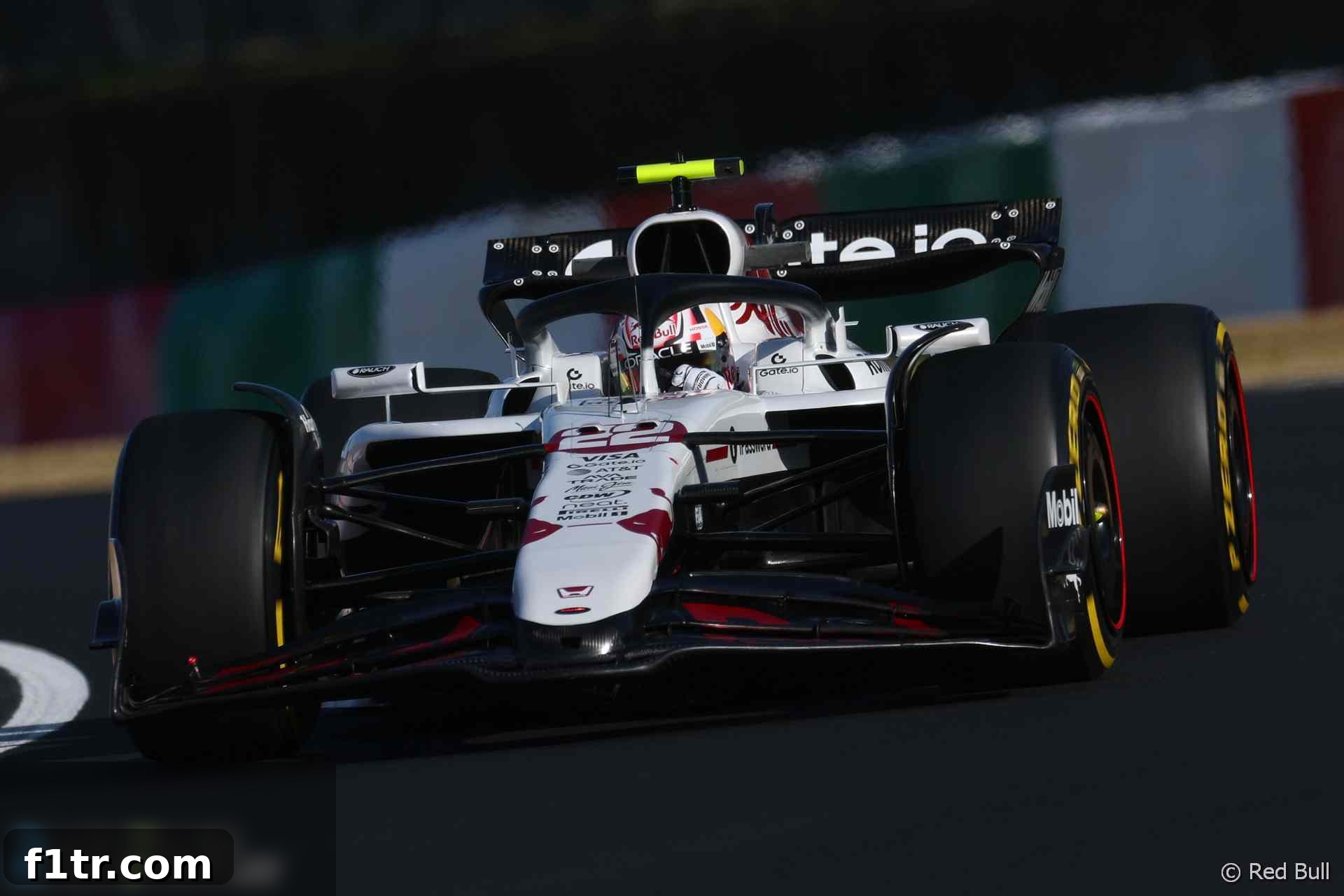
The exhilarating Suzuka International Racing Course set the stage for the highly anticipated 2025 Japanese Grand Prix free practice sessions, offering Formula 1 enthusiasts an early glimpse into the season ahead. Red Bull Racing, ever under the spotlight, introduced Yuki Tsunoda to its main line-up for the weekend, replacing Liam Lawson. This marked a pivotal moment for the young Japanese driver, whose performance was keenly observed as he tackled the formidable Red Bull challenger for the first time in a competitive setting. However, his initial experience revealed a common challenge for drivers: the distinct difference between the virtual world of the simulator and the raw reality of the racetrack.
Tsunoda candidly admitted that the Red Bull car felt significantly trickier to command in real-life conditions compared to its digital counterpart in the simulator. This sentiment, though understandable, highlighted the immense leap drivers must make when translating theoretical understanding into physical mastery at the highest echelon of motorsport. Despite these initial handling nuances, Tsunoda quickly demonstrated his inherent talent and adaptability during the first practice session (FP1). His pace was remarkably close to that of his seasoned teammate, Max Verstappen, trailing by a mere tenth of a second. This impressive showing immediately fueled optimism, suggesting a seamless integration into the championship-winning team’s machinery was well within his grasp.
The second practice session (FP2), however, proved to be a disrupted affair, denying Tsunoda the opportunity to set a representative lap time. The session’s interruptions meant he ended the day 18th on the timesheets, significantly behind Verstappen. “FP1 was better than expected, a good start for myself,” Tsunoda reflected, acknowledging the promising initial outing. “But in FP2, I didn’t set a lap time. I think lots of work to do. Maybe I slightly struggled, or there’s something that we have to look through data in FP2. But so far, overall, it’s okay. I just have to build up confidence more.” His words underscored the need for further analysis and track time to fully unlock the car’s potential and his own comfort behind the wheel.
The transition from simulator to real car is a critical aspect of modern Formula 1 driver development, yet Tsunoda’s experience at Suzuka served as a potent reminder of its inherent complexities. Having only driven Red Bull’s 2025 challenger in the simulator before this weekend, the reality of the car’s dynamics presented a tangible difference. “It’s a bit different to the simulator, what I felt, to be honest, maybe a little bit more than I expected in terms of car feeling,” he confided to the official F1 channel. He elaborated, “But I knew anyway it’s always going to be a bit different in the real car, and it was just a little more exaggerated in the car, feeling a bit more tricky.” This nuanced feedback offers valuable insights into the ongoing challenge of bridging the gap between virtual and physical driving experiences, a gap that even advanced simulations cannot entirely erase.
For Tsunoda, this weekend represents a significant audition. Stepping into the prestigious Red Bull seat, even for a practice session, places him under immense scrutiny. His immediate pace in FP1 against a driver of Verstappen’s caliber speaks volumes about his raw speed and potential. However, the subsequent challenges in FP2 highlight the constant battle for consistency and the need for ample track time to fine-tune both car and driver. The intricacies of the Suzuka circuit, with its high-speed esses, challenging corners like Spoon and 130R, and rapid changes in elevation, demand absolute precision and unwavering confidence. Any slight deviation in car feel or setup can be magnified, making the driver’s connection to the machine paramount.
Interestingly, it wasn’t just Tsunoda who faced challenges. Even the reigning world champion, Max Verstappen, expressed a degree of discomfort with his machine. Verstappen concluded the day’s running in eighth position, half a second off the leading pace, indicating that the team was still grappling with optimal car setup. “Today’s been quite difficult for me, just trying a lot of different things with the car, but it seems like a lot of things are not really clicking at the moment,” Verstappen admitted. His comments offered a rare glimpse into the difficulties even a driver of his exceptional skill can encounter when a car setup isn’t perfectly balanced. “It’s quite difficult just to put the lap down. You need a lot of confidence and commitment around here, and at the moment I don’t feel like I can use that, so we still have a bit of work to do.”
Verstappen’s observations underscore the team’s ongoing efforts to fine-tune the 2025 challenger. His experience, even with his prodigious talent, emphasizes that the car’s fundamental characteristics might still be undergoing significant development. Suzuka, known for its demanding and unforgiving nature, is a true test of a car’s aerodynamic efficiency and mechanical grip. A driver’s ability to attack its iconic corners with full commitment is directly tied to their confidence in the car’s stability and responsiveness. When a car isn’t “clicking,” it suggests a fundamental imbalance or an unpredictable characteristic that prevents the driver from pushing to the absolute limit. This could range from issues with front-end grip, rear stability, or how the car reacts through high-speed transitions. For Red Bull, known for its meticulously engineered and dominant vehicles, these early struggles, even in practice, signal areas for immediate improvement.
Free practice sessions are not merely about setting fast lap times; they are crucial testbeds for car development, setup optimization, and driver acclimatization. Teams use FP1 and FP2 to evaluate different aerodynamic packages, suspension settings, and tire compounds. For a new driver like Tsunoda, these sessions are invaluable for understanding the car’s behavior, building a rapport with the engineers, and pushing the limits safely. The heavily disrupted FP2 session was therefore a significant setback, particularly for Tsunoda, as it limited his crucial track time and the amount of data the team could collect on his driving style and the car’s performance under varying conditions. This makes the data gathered from FP1 even more critical for Red Bull’s engineers as they prepare for qualifying and the race.
Looking ahead to the remainder of the Japanese Grand Prix weekend, both Yuki Tsunoda and Max Verstappen, along with the entire Red Bull Racing team, face an intense period of analysis and adjustment. The engineering team will meticulously comb through the telemetry data from both practice sessions to identify the root causes of their drivers’ discomfort and to formulate effective setup changes. For Tsunoda, the goal will be to further close the gap to Verstappen and solidify his confidence, aiming for a strong qualifying performance. For Verstappen, the challenge lies in regaining that characteristic “click” with the car, enabling him to unleash its full potential and challenge for pole position, as is expected of him. The Suzuka circuit rewards bravery and precision, and only a car that inspires absolute confidence can truly master its challenging layout. The forthcoming sessions promise to be a captivating display of engineering prowess and driving skill as Red Bull strives to optimize its package for the 2025 season ahead.
Become a RaceFans supporter andgo ad-free
Miss nothing from RaceFans
Get a daily email with all our latest stories – and nothing else. No marketing, no ads. Sign up here:
Go ad-free for just £1 per month>> Find out more and sign up
2025 Japanese Grand Prix Articles
- McLaren has to accept upsetting either of its drivers sometimes – Stella
- Verstappen ‘can test our car, I look forward to seeing his disappointment’ – Norris
- Verstappen insists McLaren domination claim was ‘no joke’ after Piastri’s doubt
- Extra mandatory pit stop won’t create more passing at tracks like Suzuka – Sainz
- Mercedes took note of Verstappen’s out-lap tactics after stunning Suzuka pole position
Browse all 2025 Japanese Grand Prix articles