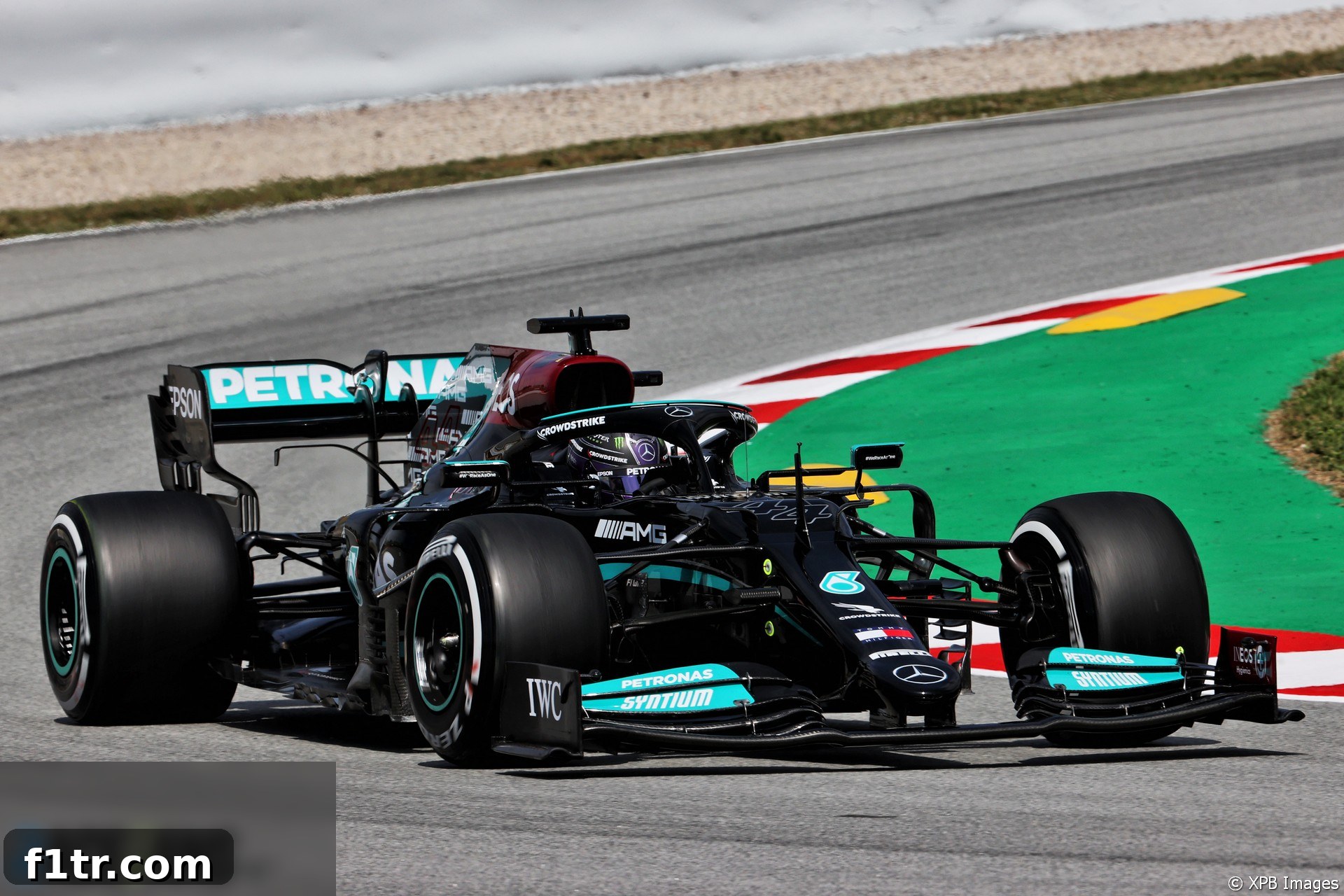
Mercedes Sets the Pace: Hamilton Leads One-Two in Spanish Grand Prix FP2
The second practice session for the Spanish Grand Prix saw Mercedes-AMG Petronas F1 Team firmly assert its dominance, with seven-time world champion Lewis Hamilton topping the timing sheets. His impressive pace led a comfortable Mercedes one-two, signaling a strong start to the weekend at the Circuit de Barcelona-Catalunya and putting the championship leaders in a commanding position over their closest rivals, Red Bull Racing.
Barcelona has historically been a stronghold for Mercedes, a track that rewards aerodynamic efficiency and strong tyre management—qualities their W12 challenger seems to possess in abundance. Hamilton’s quickest lap of 1’18.170 showcased not only the car’s raw speed but also his exceptional ability to extract performance under varied conditions. Teammate Valtteri Bottas was just over a tenth of a second behind, completing a perfect session for the Silver Arrows and highlighting their formidable competitive edge.
Red Bull’s Strategic Long Runs: A Deeper Look at Their FP2 Approach
In contrast to Mercedes’ outright pace, Red Bull Racing appeared to have a more understated session, with Max Verstappen and Sergio Perez finishing ninth and tenth respectively. On the surface, these positions might suggest a struggle, especially given their fierce championship battle with Mercedes. However, a closer examination of their practice strategy, supported by revealing radio messages, indicates a deliberate focus on race simulations rather than headline-grabbing qualifying runs.
Throughout what at times looked like a somewhat ‘scruffy’ session for the Red Bull drivers, the team consistently reiterated their satisfaction with the data gathered during their long runs. Max Verstappen was notably informed that the front-left tyre would be a critical factor for management during the race—a crucial insight for a track renowned for its high-speed corners that stress the front-left. As the chequered flag fell, Sergio Perez received confirmation that their race simulation times were precisely on target when compared to Mercedes’ data. This strategic emphasis suggests Red Bull might be holding back some pace, prioritizing optimal race performance over single-lap glory in practice, which is a common and often effective approach for the Milton Keynes-based squad. The data gathered on tyre degradation and race fuel loads will be invaluable for Sunday’s Grand Prix, where strategy often dictates the outcome.
The Midfield Heats Up: Ferrari, Alpine, and AlphaTauri Show Strong Form
While the top two teams wrestled for supremacy, the midfield battle proved equally enthralling, showcasing impressive performances from several outfits. Leading this competitive pack was Charles Leclerc of Ferrari, who demonstrated exceptional pace to slot in just a few hundredths of a second behind Bottas’s time, securing a remarkable third position. This performance is a testament to Ferrari’s continuous improvement and their genuine potential to challenge for podiums in the 2021 season. Leclerc’s ability to extract such speed from the SF21 bodes well for the Scuderia’s prospects, especially with teammate Carlos Sainz Jnr also showing strong form in eighth place at his home race.
Alpine’s Consistent Threat: Ocon and Alonso Impress
The Alpine cars once again looked strong and consistently competitive, particularly thriving in the changeable conditions that characterized the afternoon session. Esteban Ocon led the charge, securing an impressive fourth position, closely followed by his veteran teammate Fernando Alonso in fifth. Alpine’s steady progress throughout the season has been evident, and their performance in Barcelona underscores their growing confidence and understanding of the A521 chassis. The blend of Ocon’s youthful speed and Alonso’s extensive experience provides the team with a potent combination, making them serious contenders for points this weekend.
AlphaTauri Defies Expectations: Unexpected Strength in Barcelona
AlphaTauri had initially anticipated a more challenging weekend at Barcelona, largely due to the track’s low-speed final sector, which was expected to expose some of their car’s weaknesses. However, the team defied these predictions, with both drivers performing admirably. Pierre Gasly secured sixth place, while Yuki Tsunoda closely matched his teammate’s time, a significant improvement from the morning session where their paces diverged more considerably. Their strong showing, particularly when the Red Bull cars were strategically out of their usual top-tier positions, saw AlphaTauri climb higher up the order than they might have otherwise expected, highlighting their development and the competitive nature of their AT02 car.
Tyre Strategy and Track Evolution: Critical Factors for the Weekend
Tyre strategy played a pivotal role in the Friday practice sessions, offering crucial insights into team preparations for qualifying and the race. In first practice (FP1), drivers primarily focused on collecting data on the hard compound tyres, with only a limited number of teams venturing out on the medium-walled compound. This conservative approach in FP1 allowed teams to establish a baseline under stable conditions.
However, the afternoon’s second practice (FP2) saw a significant shift in strategy. Every driver completed at least two runs on the yellow-walled medium compound, gathering essential data on its performance and degradation characteristics. While mediums were widely tested, the fastest qualifying simulation laps were exclusively set on the soft tyres. This progression from hard to medium to soft tyres is standard procedure, but the data collected on each compound will be vital for determining optimal race strategies, especially considering Barcelona’s demanding nature on tyres and the varying fuel loads that will affect degradation throughout Sunday’s Grand Prix.
Battling the Elements: The Impact of Wind and Weather on Performance
The conditions during second practice were notably more challenging than in the morning. While the ambient temperature was slightly warmer, stronger winds frequently changed direction over the course of the session. These variable gusts had a distinct and measurable impact on car performance, particularly for teams whose cars are highly sensitive to aerodynamic changes.
Williams Racing provided a clear example of this sensitivity. In the morning session, Roy Nissany and Nicholas Latifi had shown promising pace, at times placing higher up the order (16th and 17th fastest). However, the afternoon’s shifty winds saw their performance drop significantly. George Russell, who took over from Nissany in FP2, finished a distant 17th, seven tenths of a second behind Kimi Räikkönen in 16th, with Latifi also dropping to 18th. This stark contrast underscores how critical stable aerodynamic platforms are, and how even subtle changes in wind direction can disrupt a car’s balance and shave precious tenths off lap times. Such conditions make it challenging for engineers to optimize setups and will require adaptability from all drivers throughout the weekend.
The Wider Field: McLaren, Aston Martin, Alfa Romeo, and Haas
Beyond the top contenders and the impressive midfield pack, other teams also focused on data gathering and fine-tuning their setups. Sebastian Vettel placed 11th for Aston Martin, just outside the top ten, with teammate Lance Stroll in 14th, indicating that the team still has work to do to unlock the full potential of their AMR21. McLaren, with Lando Norris in 12th and Daniel Ricciardo in 15th, also appeared to be searching for more pace, perhaps focusing more on long-run stability than single-lap speed in this session. Alfa Romeo, represented by Antonio Giovinazzi in 13th and Kimi Räikkönen in 16th, showed flashes of potential, while Haas continued to grapple at the back of the grid, with Mick Schumacher and Nikita Mazepin occupying the final two positions. The tight margins in the midfield mean that even small improvements can yield significant gains in track position, setting the stage for an intense qualifying session.
What Does FP2 Mean for the Weekend Ahead in Barcelona?
Friday’s second practice session for the Spanish Grand Prix provided a compelling preview of what promises to be a thrilling weekend of Formula 1 action. Mercedes’ clear advantage in single-lap pace, spearheaded by Lewis Hamilton, positions them as strong favorites for pole position. Their comfortable one-two finish in FP2 highlights the W12’s suitability for the Circuit de Barcelona-Catalunya’s demands, a track where pole position is often crucial for race victory.
However, Red Bull’s strategic focus on race simulations, coupled with their post-session satisfaction regarding long-run pace, suggests they could be a much stronger force on Sunday than their qualifying positions indicate. The championship battle is far from over, and Red Bull’s ability to manage their tyres effectively could be their trump card. Meanwhile, the rejuvenated Ferrari, the consistently strong Alpine, and the surprisingly quick AlphaTauri all add layers of excitement to the midfield, promising close racing and intense battles for valuable points.
As teams analyze the extensive data collected from these crucial practice sessions, the focus will now shift to qualifying. The fluctuating wind conditions and the intricacies of tyre management will continue to be central themes. With the championship narrative intensifying with each passing race, the Spanish Grand Prix is set to deliver another captivating chapter in the 2021 Formula 1 season. All eyes will be on Saturday’s qualifying to see if Mercedes can maintain their Friday advantage or if Red Bull can unlock hidden pace to challenge for pole.
2021 Spanish Grand Prix Second Practice Results
| Pos. | No. | Driver | Car | Best lap | Gap | Laps |
|---|---|---|---|---|---|---|
| 1 | 44 | Lewis Hamilton | Mercedes | 1’18.170 | 32 | |
| 2 | 77 | Valtteri Bottas | Mercedes | 1’18.309 | 0.139 | 31 |
| 3 | 16 | Charles Leclerc | Ferrari | 1’18.335 | 0.165 | 28 |
| 4 | 31 | Esteban Ocon | Alpine-Renault | 1’18.466 | 0.296 | 29 |
| 5 | 14 | Fernando Alonso | Alpine-Renault | 1’18.518 | 0.348 | 30 |
| 6 | 10 | Pierre Gasly | AlphaTauri-Honda | 1’18.593 | 0.423 | 32 |
| 7 | 22 | Yuki Tsunoda | AlphaTauri-Honda | 1’18.619 | 0.449 | 30 |
| 8 | 55 | Carlos Sainz Jnr | Ferrari | 1’18.674 | 0.504 | 30 |
| 9 | 33 | Max Verstappen | Red Bull-Honda | 1’18.785 | 0.615 | 26 |
| 10 | 11 | Sergio Perez | Red Bull-Honda | 1’18.918 | 0.748 | 23 |
| 11 | 5 | Sebastian Vettel | Aston Martin-Mercedes | 1’18.947 | 0.777 | 30 |
| 12 | 4 | Lando Norris | McLaren-Mercedes | 1’19.092 | 0.922 | 28 |
| 13 | 99 | Antonio Giovinazzi | Alfa Romeo-Ferrari | 1’19.122 | 0.952 | 29 |
| 14 | 18 | Lance Stroll | Aston Martin-Mercedes | 1’19.134 | 0.964 | 29 |
| 15 | 3 | Daniel Ricciardo | McLaren-Mercedes | 1’19.195 | 1.025 | 28 |
| 16 | 7 | Kimi Raikkonen | Alfa Romeo-Ferrari | 1’19.213 | 1.043 | 30 |
| 17 | 63 | George Russell | Williams-Mercedes | 1’19.957 | 1.787 | 29 |
| 18 | 6 | Nicholas Latifi | Williams-Mercedes | 1’20.046 | 1.876 | 26 |
| 19 | 47 | Mick Schumacher | Haas-Ferrari | 1’20.326 | 2.156 | 30 |
| 20 | 9 | Nikita Mazepin | Haas-Ferrari | 1’20.753 | 2.583 | 27 |
Visual Gaps from Spanish Grand Prix FP2
Lewis Hamilton – 1’18.170
+0.139 Valtteri Bottas – 1’18.309
+0.165 Charles Leclerc – 1’18.335
+0.296 Esteban Ocon – 1’18.466
+0.348 Fernando Alonso – 1’18.518
+0.423 Pierre Gasly – 1’18.593
+0.449 Yuki Tsunoda – 1’18.619
+0.504 Carlos Sainz Jnr – 1’18.674
+0.615 Max Verstappen – 1’18.785
+0.748 Sergio Perez – 1’18.918
+0.777 Sebastian Vettel – 1’18.947
+0.922 Lando Norris – 1’19.092
+0.952 Antonio Giovinazzi – 1’19.122
+0.964 Lance Stroll – 1’19.134
+1.025 Daniel Ricciardo – 1’19.195
+1.043 Kimi Raikkonen – 1’19.213
+1.787 George Russell – 1’19.957
+1.876 Nicholas Latifi – 1’20.046
+2.156 Mick Schumacher – 1’20.326
+2.583 Nikita Mazepin – 1’20.753
Drivers more than ten seconds off the pace omitted.
Related Articles: 2021 Spanish Grand Prix Insights
- Two reasons why Catalunya may not predict the championship – at least this year
- McLaren to keep “drip-feeding” updates onto 2021 car
- Working group tackling F1’s track limits problem
- ‘We’ll discuss what went wrong’: Hamilton and Verstappen team radio transcript analysis
- 2021 Spanish Grand Prix Star Performers
Browse all 2021 Spanish Grand Prix articles