Romain Grosjean’s Remarkable Recovery: A Testament to Resilience and F1 Safety
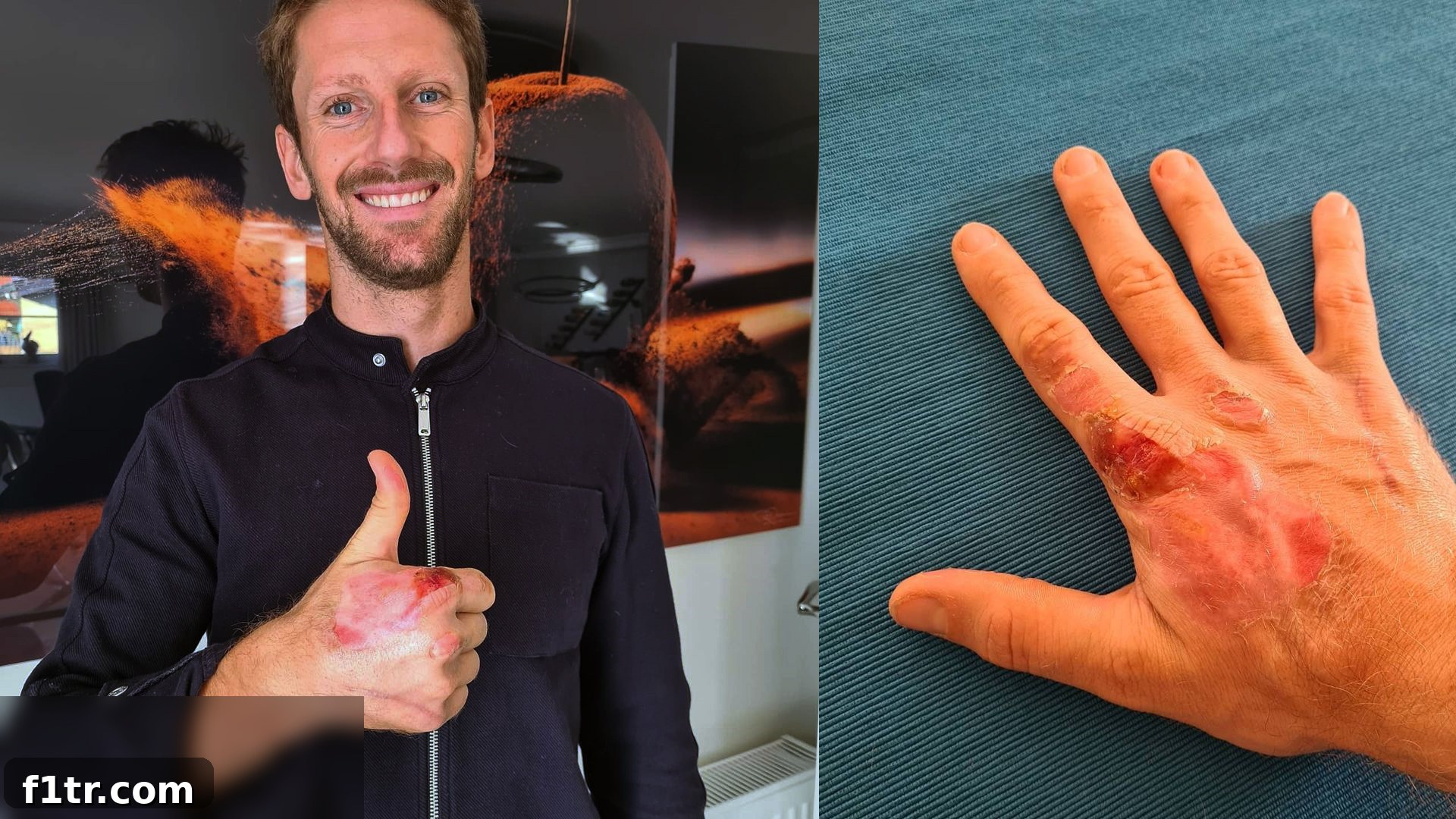
The harrowing events of the Bahrain Grand Prix left the world of Formula 1 in shock, as Romain Grosjean endured a horrifying crash that saw his Haas VF-20 pierce a barrier and erupt into a fireball. Miraculously, after 28 terrifying seconds trapped in the inferno, Grosjean emerged from the wreckage, a testament to the incredible advancements in motorsport safety. However, his escape was not without consequence, as he suffered significant burns to both hands, injuries that have since put his immediate racing career on hold. Now, 11 days after the incident, Grosjean has provided a crucial update on his recovery, revealing the extent of the burns and the inspiring progress he has made, particularly with his right hand.
The French driver’s ordeal resonated deeply across the globe, highlighting both the inherent dangers of Formula 1 and the extraordinary courage of its competitors. His dramatic exit from the flaming car, aided by the swift actions of marshals and medical teams, cemented his name in the annals of F1 history. As the season finale in Abu Dhabi approached, the question of Grosjean’s participation loomed large, but his injuries, particularly to his left hand, ultimately made a return to the cockpit impossible for this final race with Haas.
The Road to Recovery: Grosjean’s Battle with Burns
Initial reports from the Bahrain International Circuit medical center indicated that Grosjean had sustained burns to his hands and ankles, alongside a sprained ankle. While the physical pain was undoubtedly immense, the relief that his life was not in immediate danger was palpable. The focus quickly shifted from the crash itself to his path to recovery, a journey Grosjean has shared openly with fans, demonstrating remarkable transparency and fortitude.
The severity of the burns varied between his hands. His right hand, though impacted, has shown significant progress. In a recent social media post, Grosjean shared an uplifting update, expressing immense joy at having the dressings removed from his right hand. “Bloody hell, makes me super happy to have my right hand free from dressings,” he exclaimed, his words conveying a deep sense of relief and optimism. “It feels [so] good to see it in such good shape. Waiting for my left hand to recover now.” This simple statement underscored the significant milestone in his healing process and offered a glimpse into his resilient spirit.
The distinction between his hands is crucial: while the right hand is mending well, his left hand bore the brunt of the fire, sustaining more serious damage. It was the condition of his left hand, requiring more extensive healing, that ultimately necessitated his withdrawal from the Abu Dhabi Grand Prix. This decision, though undoubtedly difficult for a racer of Grosjean’s caliber, reflected a pragmatic approach to his long-term health and a recognition of the demanding physical nature of Formula 1 racing. His recovery is not just about physical healing but also about regaining full functionality and strength, essential for the precision and control required behind the wheel of a Grand Prix car.
Beyond the physical aspect, Grosjean’s recovery journey has also involved a significant psychological component. The trauma of the crash, the intense pain, and the uncertainty of his future career could have easily overwhelmed many. However, Grosjean has consistently displayed an inspiring determination, focusing on small victories like the removal of dressings, and communicating openly with his supporters. His candidness has allowed fans to connect with his human experience, turning a terrifying incident into a narrative of extraordinary resilience and hope. This commitment to his recovery, prioritizing health over a symbolic final race, speaks volumes about his character and his understanding of the demands of elite sport.
Pietro Fittipaldi Steps In: An Unexpected Opportunity
With Grosjean sidelined, the Haas F1 Team faced the immediate challenge of finding a suitable replacement for the final race of the 2020 season. Stepping into the breach for the second consecutive race weekend was Pietro Fittipaldi, the team’s reserve driver. Fittipaldi had made his Formula 1 debut at the Bahrain Outer Circuit, a sudden and high-pressure call-up following Grosjean’s accident. His initial outing, where he finished last, was a steep learning curve, but one that provided invaluable experience.
For the Abu Dhabi Grand Prix, Team Principal Guenther Steiner expressed more confidence in Fittipaldi’s readiness. Steiner highlighted Fittipaldi’s familiarity with the Yas Marina circuit, a factor that should significantly aid his performance compared to his last-minute debut. “He tested a few times there in an F1 car so he feels that he knows it more,” Steiner noted, emphasizing the advantage of prior experience on a complex track. “Obviously it’s a longer race track so it’s more difficult also to learn about it.” This familiarity, combined with the experience gained in Bahrain, positioned Fittipaldi to potentially deliver a stronger performance.
Steiner’s expectations for Fittipaldi remained grounded in the realities of the situation and the car’s performance. “My expectations are still the same: Do your best,” he stated. “I know the car he has got, it is what it is and as long as he can stay close to Kevin [Magnussen], that’s the only benchmark we can give him. And he’s determined to get closer and to learn more and progress.” This pragmatic approach from the team principal underscored the challenging environment Fittipaldi was operating in, replacing an experienced driver mid-season in a car that was not a front-runner. His primary objective was to minimize the gap to his teammate, Kevin Magnussen, and to continue his own development as a Formula 1 driver.
Despite finishing at the back in his debut, Steiner affirmed the team’s satisfaction with Fittipaldi’s initial efforts. “We couldn’t ask more from his first race,” he remarked, acknowledging the immense pressure and lack of preparation Fittipaldi faced. The Abu Dhabi Grand Prix presented another opportunity for Fittipaldi to demonstrate his capabilities under slightly less rushed circumstances, with a clearer understanding of the car and the team’s operations. His unexpected call-up transformed into a genuine opportunity to showcase his potential on the world stage, a critical moment for any aspiring Formula 1 driver.
Haas F1 Team Navigates a Challenging Finale
The 2020 Formula 1 season had already proven to be a tough one for the Haas F1 Team, grappling with performance issues and a competitive midfield. Grosjean’s crash added an unforeseen and emotional layer of complexity to their final races. Guenther Steiner’s leadership was crucial during this period, guiding the team through the shock of the accident and the practicalities of adjusting their driver lineup. His calm and direct communication style helped to stabilize the team amidst the turmoil, allowing them to focus on supporting Grosjean’s recovery while preparing for the remaining races.
The human element of Grosjean’s crash was deeply felt throughout the Haas garage. Drivers and team members alike were visibly shaken by the incident, a stark reminder of the inherent dangers of their sport. Supporting Grosjean’s recovery became a central priority, and the team’s decision to ensure he had the time and space to heal properly, rather than rushing him back for a farewell, spoke volumes about their commitment to their driver’s well-being. This empathetic approach helped foster a strong team spirit during a trying time.
Adding to the emotional weight of the season finale was the impending departure of both Romain Grosjean and Kevin Magnussen. The Abu Dhabi Grand Prix marked the end of an era for Haas, as their established driver pairing moved on, making way for an entirely new lineup in 2021. For Grosjean, it was a particularly poignant moment, as his planned final race for the team was replaced by an involuntary absence. This confluence of events — a terrifying crash, a driver replacement, and the farewell to two key figures — made the Abu Dhabi weekend a significant emotional landmark for the American squad. Despite the challenges, the team aimed to finish the season with dignity and a renewed focus on their future prospects, hoping to turn the page towards a more competitive 2021.
The 2020 Abu Dhabi Grand Prix: More Than Just a Race
The Yas Marina Circuit in Abu Dhabi is renowned for its spectacular setting, unique pit lane exit, and challenging mix of slow and fast corners. As the traditional venue for the Formula 1 season finale, it often hosts races that are not just about championship outcomes but also about emotional farewells, final opportunities, and the culmination of an entire year of effort. For the 2020 season, the Abu Dhabi Grand Prix carried an even greater weight, largely due to the aftermath of Grosjean’s crash.
While the drivers’ and constructors’ championships had largely been decided, the race still held significance for many. Teams battled for crucial championship points that could influence prize money and prestige, and drivers sought to end their seasons, or their tenures with current teams, on a high note. For Pietro Fittipaldi, it was a second chance to prove himself. For Kevin Magnussen, it was his final race with Haas, and for several other drivers across the grid, it marked the end of a chapter. However, overshadowing much of the usual season-ending narratives was the continued discussion surrounding Grosjean’s accident and the incredible safety measures that saved his life.
The fact that Grosjean was able to update fans on his recovery, mere days after such a catastrophic incident, served as a powerful reminder of how far Formula 1 safety had come. His absence from the grid was a visible void, but it simultaneously highlighted the profound impact of the halo device, the advanced crash structures, and the impeccable response of the medical and fire marshal teams. The Abu Dhabi Grand Prix, therefore, became a celebration not just of racing skill but also of human resilience and the relentless pursuit of driver safety that defines modern Formula 1.
A Legacy of Safety: Grosjean’s Crash and Formula 1
Romain Grosjean’s Bahrain crash will undoubtedly be remembered as a pivotal moment in Formula 1 history, not just for its terrifying visuals but for its profound implications on safety. It served as the ultimate stress test for many of the safety innovations introduced over the past decades. The most prominent of these was the halo device, a titanium structure designed to protect the driver’s head. Without the halo, it is almost universally agreed that Grosjean’s helmet would have made direct contact with the barrier, with potentially catastrophic consequences.
Beyond the halo, the integrity of the monocoque, the fire suppression systems, the advanced driver overalls, and the rapid deployment of the medical car all played critical roles. Dr. Ian Roberts and Alan van der Merwe, the F1 Medical Car team, along with the local marshals, demonstrated exemplary professionalism and speed, extracting Grosjean from the flames in record time. Their actions were instrumental in preventing further injury and possibly saving his life.
Grosjean himself has become a living testament to the efficacy of these safety measures. His willingness to speak about the crash and his recovery provides invaluable data and perspective for future safety developments. The incident spurred further analysis into barrier designs, fuel cell integrity, and cockpit egress, ensuring that lessons are learned and improvements continue to be made. Formula 1’s commitment to continuous safety evolution means that every major incident, however devastating, contributes to making the sport safer for future generations of drivers.
While his immediate racing future in Formula 1 ended with the 2020 season, Grosjean’s spirit of resilience suggests he will undoubtedly return to motorsport in some capacity. His journey back to health and potentially back to competitive racing (perhaps in series like IndyCar) will continue to inspire. His experience serves as a powerful symbol of overcoming adversity and the enduring passion for racing, even after facing its most severe challenges. His legacy will not only be defined by his racing career but also by his courageous survival and his contribution to the ongoing narrative of F1 safety.
As the final checkered flag fell on the 2020 Formula 1 season in Abu Dhabi, it closed a chapter filled with unprecedented challenges, both on and off the track. Romain Grosjean’s incredible recovery stands as a beacon of hope and a powerful reminder of human resilience. His journey, alongside Pietro Fittipaldi’s unexpected opportunity and the Haas team’s dignified farewell, encapsulated the spirit of a sport that constantly pushes boundaries, embraces change, and prioritizes the safety and well-being of its heroes.
Image: Romain Grosjean via Instagram
Advert | Become a RaceFans supporter andgo ad-free
2020 F1 season
- Grosjean to make F1 test return tomorrow for first time since Bahrain horror crash
- Pictures: Wrecked chassis from Grosjean’s Bahrain fireball crash to go on display
- Bottas vs Rosberg: Hamilton’s Mercedes team mates compared after 78 races each
- F1 revenues fell by $877 million in Covid-struck 2020 season
- Hamilton and Mercedes finally announce new deal for 2021 season
Browse all 2020 F1 season articles