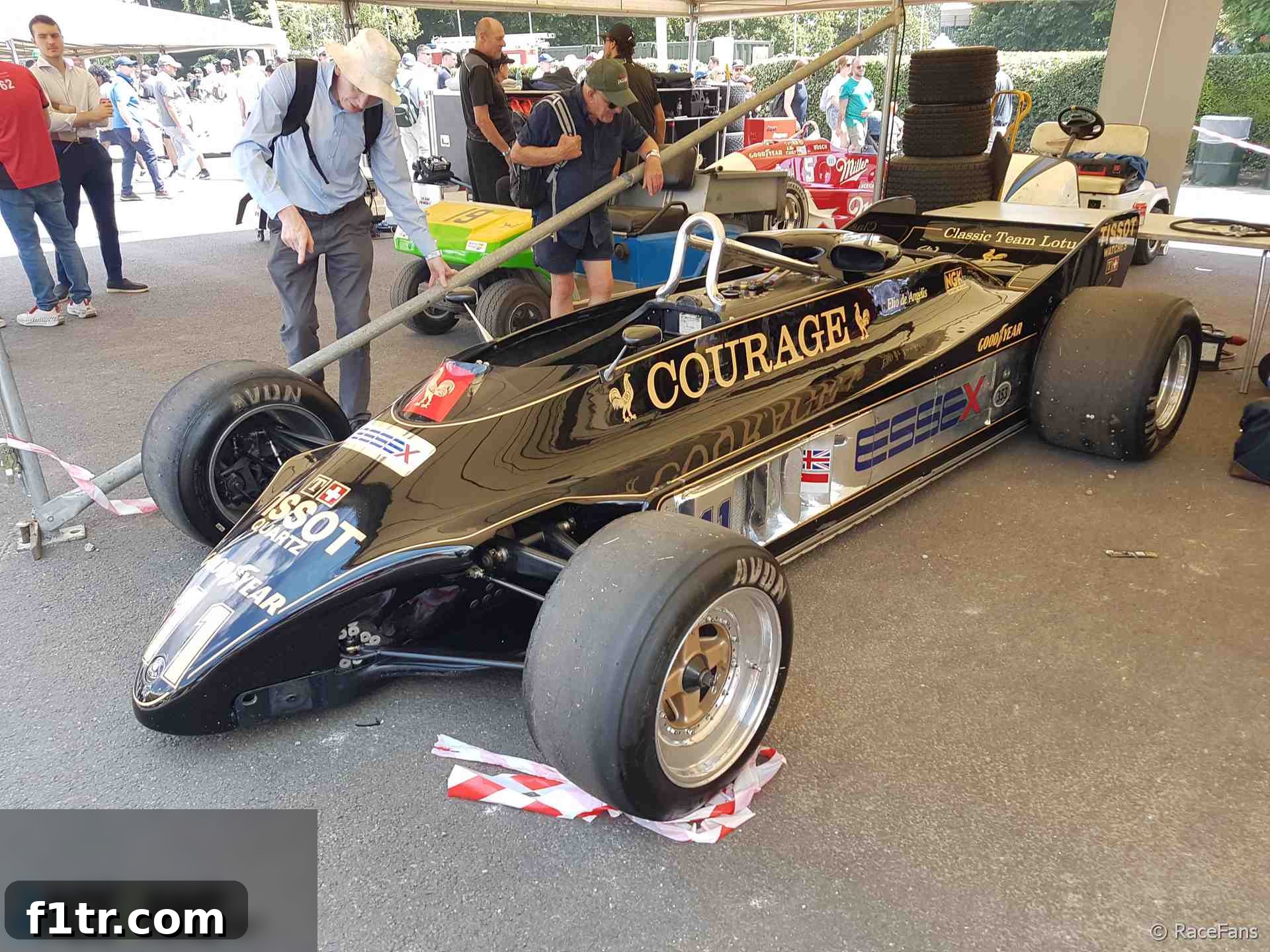
The Banned Marvel: Unpacking the Revolutionary Story of Colin Chapman’s Lotus 88
Formula 1 has always been a battleground of innovation, a relentless pursuit of speed where engineers push the boundaries of what’s possible, often to the chagrin of regulators. Debates over controversial design elements, from hot-blown diffusers to flexible wings, are a recurring theme in the sport’s rich history. However, what if the regulatory bodies decided to ban an entire car, a machine deemed too revolutionary or perhaps, too disruptive? This very scenario unfolded dramatically with Colin Chapman’s radical Lotus 88, a car that promised a quantum leap in F1 design but ultimately succumbed to the strictures of the FIA, leaving behind a legacy of what-ifs and fierce contention.
The Genesis of Ground Effect and Chapman’s Unyielding Vision
The late 1970s marked a pivotal era in Formula 1, dominated by the groundbreaking concept of ground effect aerodynamics. This revolutionary approach, championed by Lotus founder Colin Chapman, harnessed the airflow beneath the car to create immense downforce, effectively sucking the vehicle to the track and allowing for unprecedented cornering speeds. The Lotus 79, introduced in 1978, was the undisputed master of this technology, sweeping to championship glory and forever changing the landscape of F1 design.
Yet, Chapman was never one to rest on his laurels. His relentless pursuit of perfection led to the even more extreme Lotus 80 in 1979. This ambitious design aimed to generate all its downforce from the underbody, completely eliminating conventional front and rear wings to minimize drag. While wind tunnel tests showed astonishing downforce figures, twice that of its predecessor, the 80 proved almost untameable on track. Its aggressive ground effect led to severe “porpoising,” where the car would violently oscillate, alternately sucking itself to the ground and then bouncing back up. The car was raced only three times before Lotus reverted to the reliable 79 for most of the season, a rare misstep for Chapman but one that only fueled his determination.
Undaunted, Chapman continued to explore the limits of ground effect. For the 1980 season, the more conventional Lotus 81 took to the grid. However, in the background, a new test car, the 86, was taking shape. Built upon an 81 monocoque, the 86 was a direct evolution of the radical ideas first explored with the 80. Its design drew heavily on an innovative concept from Lotus aerodynamicist Peter Wright: a “twin-chassis” system. In this design, the car’s external aerodynamic structures, including the crucial ground-effect skirts, were mounted independently via springs directly to the wheel uprights. The core chassis, housing the engine, fuel, and driver, was isolated from these downforce-generating components. This ingenious separation aimed to allow the aerodynamic elements to operate optimally and consistently, regardless of the core chassis’s movement, thereby ensuring constant downforce without the unpredictable behavior seen in the 80.
The Twin-Chassis Innovation and the Regulatory Minefield
The Lotus 88, born from the 86’s pioneering concept, was the ultimate expression of Chapman’s vision. Lotus engineers proudly referred to it as having a “twin-chassis.” At its heart was a fully functional racing car – the inner chassis – encompassing the driver, engine, and essential components. Wrapped around this core was a second, external chassis, essentially the car’s aerodynamic “skin,” which connected to the inner structure through three robust titanium cross-members. A key design departure from previous iterations was the adoption of straight side-skirts, moving away from the curved profiles that had proven problematic on the 80 and 86, aiming for more stable and predictable ground effect performance.
However, F1’s regulatory landscape was rapidly evolving. Jean-Marie Balestre, the influential president of FISA (the precursor to the FIA), was increasingly concerned by the escalating speeds brought about by ground effect aerodynamics. Safety became a major talking point, with critics arguing that ground effect made cars too fast and too dangerous. In response, Balestre announced strict new regulations for 1981, aiming to curb ground effect by outright banning flexible skirts and mandating a minimum ground clearance of 6cm for all cars. This was a direct challenge to the very foundation of ground effect design.
Ever the master of exploitation, Chapman and his team devised a clever system to circumvent these new rules. The Lotus 88 featured an innovative hydropneumatic suspension that allowed the car to maintain the required 6cm ground clearance when stationary or at low speeds, typically during scrutineering or in the pits. However, once on track and at speed, the system would automatically lower the car, effectively bringing the skirts back into play and maximizing ground effect. This was Chapman’s signature move: identifying a loophole and exploiting it with audacious engineering.
The Long Beach Controversy: A Legal Battle Unfolds
The stage for the inevitable showdown was set at Long Beach, California, for the first championship race of the 1981 season (following the politically fraught non-championship South African Grand Prix). From the moment the Lotus 88 arrived, it immediately ignited a firestorm of protest from rival teams, who viewed its innovative twin-chassis and lowering system as a clear violation of the new regulations. Despite the controversy, the FIA scrutineers initially passed the car as legal, allowing Elio de Angelis to take it out for Friday practice. De Angelis completed several laps, giving a tantalizing glimpse of the car’s potential.
However, the reprieve was short-lived. That very evening, following a vehement protest lodged by McLaren, Williams, and Brabham – three of the sport’s most powerful teams – the race stewards overturned the initial decision, declaring the Lotus 88 illegal. The opposition was fierce and vocal. Frank Williams, head of the eponymous team, articulated the sentiment prevalent among many competitors: “From our understanding of the regulations, the Lotus 88 is not legal by the letter of the law, let alone the spirit. If it is accepted as legal finally, then we shall all have to build similar cars to remain competitive, and the costs will be enormous.” Williams’s statement not only highlighted the legal technicalities but also underscored the underlying political and economic concerns of teams unwilling to invest in copying another of Chapman’s potentially game-changing, and expensive, breakthroughs.
A furious Chapman immediately appealed the stewards’ decision, determined to defend his creation. Initially, he was informed that the car could continue to compete pending the outcome of the appeal. Yet, the very next day, in a dramatic escalation, the Lotus 88 was black-flagged during morning practice, unequivocally banned from further participation. Chapman, sensing an all-out legal and political war, bolstered his defense by hiring Robert Hinerfeld, a prominent lawyer renowned for his previous defense of former US President Richard Nixon, signaling the gravity with which he approached the confrontation with the FIA.
Echoes of Rebellion: Brabham, Silverstone, and the Enduring Legacy
Chapman’s ire only intensified when, at the subsequent Argentinian Grand Prix, Bernie Ecclestone’s Brabham team arrived with their BT49C. This car also featured a clever hydropneumatic suspension system, similar in principle to the Lotus 88, designed to circumvent the ban on skirts and the 6cm ground clearance rule by lowering the car at speed. Crucially, and to Chapman’s utter disbelief, the Brabham passed scrutineering without incident and went on to dominate the race with Nelson Piquet, winning convincingly. This stark inconsistency fueled Chapman’s frustration, highlighting what he perceived as a politically motivated double standard against his innovative design.
Despite losing an FIA appeal court hearing against the banning of the car, Chapman remained defiant. He made one final, audacious attempt to get the 88 onto the grid, bringing a mildly revised “B”-version to his home race, the British Grand Prix at Silverstone. The public reaction was strong, with many fans displaying banners proclaiming “We want Lotus 88,” a testament to Chapman’s enduring popularity and reputation for innovation. The Royal Automobile Club (RAC), the national sporting authority, initially sided with Chapman, declaring the car legal for the event. However, Jean-Marie Balestre quickly retaliated, threatening to strip the British Grand Prix of its coveted world championship status if the Lotus 88 was allowed to race. Faced with such a severe ultimatum, the RAC was forced to back down, marking the definitive end of the Lotus 88’s racing aspirations.
Throughout this turbulent period, Nigel Mansell and Elio de Angelis logged the only recorded laps for the car in timed sessions. Mansell’s lap of 1 minute 15.992 seconds at Silverstone was the quicker of the two, but it was still 3.8 seconds slower than René Arnoux’s pole-sitting Renault. These limited data points leave a tantalizing question unanswered: Would the Lotus 88 have truly been another of Chapman’s revolutionary designs that changed the face of the sport, ushering in a new era of aerodynamic efficiency and speed? Or was it, despite its ingenious concept, a technological cul-de-sac, fundamentally flawed and destined to struggle for performance? Without a proper race debut, this remains a subject of endless speculation among F1 historians and enthusiasts.
The Lotus 88 stands as a powerful symbol of the perennial tension between innovation and regulation in Formula 1. It represents Colin Chapman’s final, audacious attempt to redefine the sport’s technical boundaries, a testament to his genius and his willingness to challenge the status quo. Though it never officially competed, its story is a compelling chapter in F1 history, reminding us that sometimes, the most revolutionary ideas are also the most fiercely contested, ultimately becoming legendary not for their victories, but for the very fact that they were forbidden.