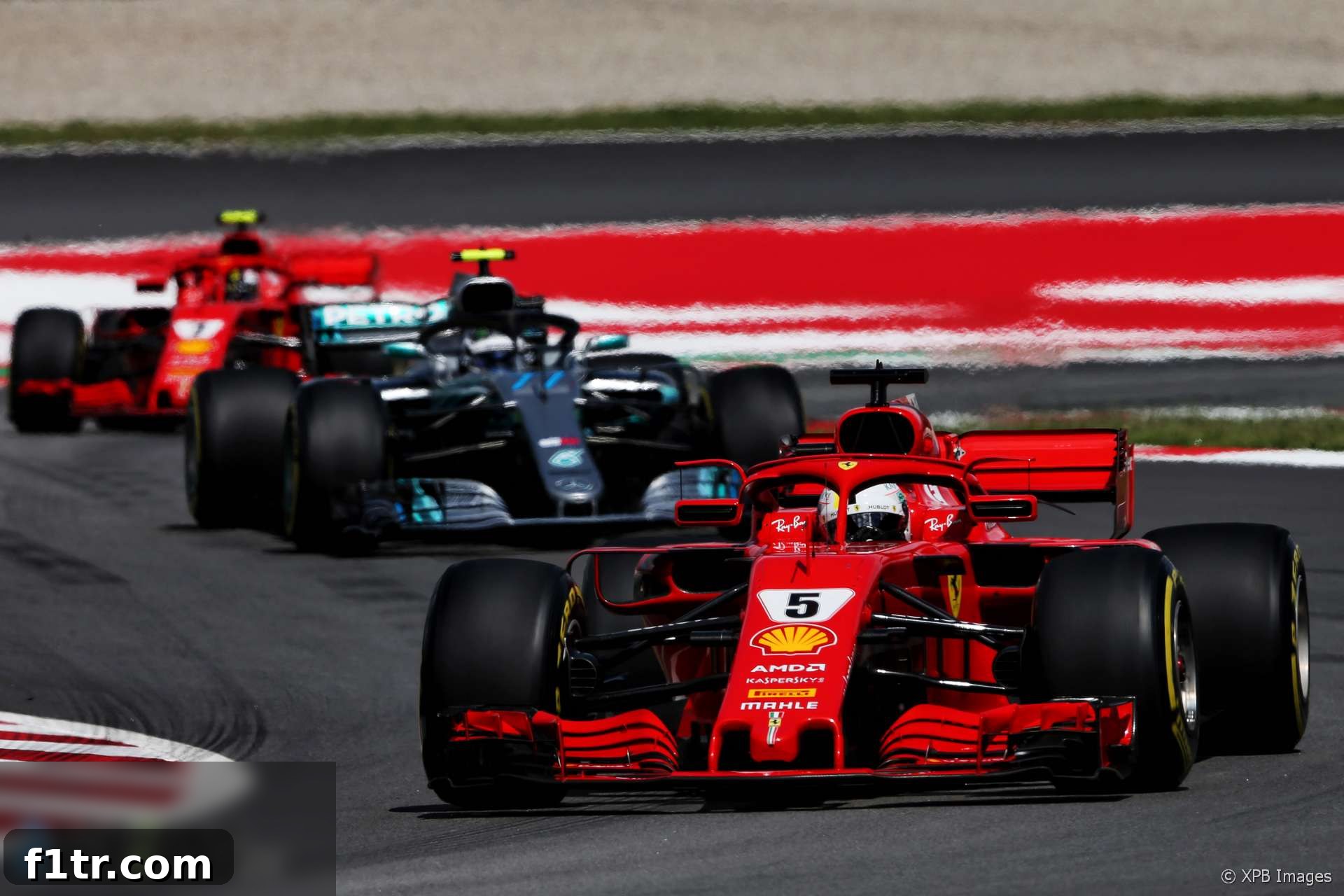
The highly anticipated Spanish Grand Prix unveiled an unforeseen challenge for Scuderia Ferrari, as star driver Sebastian Vettel vocalized concerns that Pirelli’s revised tyre specifications might have disproportionately hindered the Italian squad compared to their main Formula 1 rivals. This mid-season adjustment by the official tyre supplier, which saw the thickness of its tyre treads reduced by 0.4 millimeters for the Barcelona event, sparked considerable debate and speculation within the paddock.
Pirelli’s rationale behind this seemingly minor alteration was to mitigate the blistering issues that had plagued various teams on circuits with high energy loads. While the external dimensions of the tyres remained identical due to the use of existing molds, the internal change in compound mass and structure evidently had a significant impact on performance dynamics. Vettel, a four-time world champion, was quick to suggest that this subtle yet crucial modification effectively made the tyre compounds “harder,” a characteristic he believes fundamentally undermined Ferrari’s competitiveness during what proved to be their most challenging outing of the season so far.
Post-race, a visibly frustrated Vettel articulated his struggles, stating, “I think we struggled all weekend with sliding around a little bit more.” He went on to challenge Pirelli’s insistence that the compounds themselves were unchanged. “Obviously we’ve heard many times that they are the same compounds and they are not harder. But I don’t think you need to be a genius to work out that if you skim the tyre, it ends up being harder. It’s one or the other, we may as well have just run harder tyres. So maybe it didn’t suit our car as good as other cars.” This candid assessment highlighted a critical divergence in understanding between the driver and the tyre manufacturer regarding the practical effects of the design change.
The reduction in tyre tread thickness, while intended to prevent overheating and blistering, fundamentally alters the tyre’s carcass stiffness and its thermal properties. A thinner tread might heat up faster but could also be less compliant, leading to reduced mechanical grip and a narrower operating window. For a car like Ferrari’s SF71H, which had previously demonstrated superb balance and tyre management, especially in cooler conditions or on tracks with less aggressive surfaces, this change could indeed disrupt its optimal performance envelope. The increased “sliding around” described by Vettel suggests a difficulty in generating and maintaining the necessary grip, particularly through high-speed corners, leading to premature tyre degradation and a general lack of confidence.
Advert | Become a Supporter & go ad-free
Despite his critique, Vettel acknowledged that the onus remained on Ferrari to adapt and overcome this new technical hurdle. “It has to suit our car better than other cars,” he asserted, reflecting the competitive ethos ingrained in Formula 1. “That’s the way we want it.” This statement underscores the relentless pursuit of perfection in F1, where teams must continuously evolve their understanding and setup to maximize performance, regardless of external factors like tyre changes. The ability to quickly comprehend and exploit new tyre characteristics often distinguishes championship contenders from the rest of the pack. Ferrari’s engineers and strategists faced an immediate and pressing task to decipher the nuances of the revised Pirelli rubber and tailor the SF71H accordingly.
When asked by RaceFans about the suitability of the new tyres for his car, Vettel’s teammate, Kimi Raikkonen, offered a more cautious response. The enigmatic Finn stated it was “impossible to say” what exact effect the change might have had, perhaps indicating the complexity of isolating a single variable in the intricate web of Formula 1 car performance. Raikkonen’s comments, while less direct than Vettel’s, did not necessarily contradict his teammate’s observations but rather highlighted the difficulty in pinpointing the precise impact without extensive data analysis and testing.
Beyond the tyre issue, Sebastian Vettel also hinted at a potential stagnation in Ferrari’s development pace compared to their adversaries. “The last couple of races we were a bit closer in terms of pace,” he noted, contrasting their previous competitive showings with the Spanish Grand Prix’s outcome. “I think we had a car fighting, having a winning pace. We didn’t have a winning pace today, that’s also the reason why we didn’t win, simple as that.” This honest appraisal highlighted a worrying trend if Ferrari was indeed falling behind in the relentless upgrade battle that defines modern F1 seasons.
The championship narrative frequently revolves around which team brings the most effective upgrade packages to each race. Vettel elaborated on this, suggesting, “There are a couple of things, probably in the short term we all had our updates for this race, maybe the others have brought more than us. On top of that we had different tyres that maybe suited others better than us.” This layered explanation points to a confluence of factors contributing to their setback in Barcelona: potentially less impactful upgrades and the detrimental effect of the new tyre specifications. Mercedes, in particular, appeared to flourish on the revised tyres, demonstrating strong pace and consistency throughout the weekend, which only amplified Ferrari’s woes.
However, Vettel swiftly pivoted from offering potential excuses to emphasizing accountability. His pragmatic approach shone through as he questioned the utility of dwelling on disadvantages: “But then again what does it help, why find excuses? The bottom line is we are not quick enough today to win and that needs to be addressed – not ‘do we have a disadvantage here?’, ‘was this the case, that the case?’, ‘did the Safety Car help or not?’. To the end we weren’t quick enough and our tyres didn’t last as long as others.” This powerful statement encapsulated the core philosophy of a top-tier racing team: ultimately, performance dictates results, and any shortcomings must be met with decisive action and improvement rather than seeking external validation for poor results.
The Spanish Grand Prix served as a stark reminder that in Formula 1, even minor technical adjustments can have profound impacts on competitive order. For Ferrari, it was a wake-up call, emphasizing the need for quick adaptation and an accelerated development rate. The battle for the championship is not just about raw speed but also about the agility to interpret and master ever-changing technical regulations and specifications. The challenge for Ferrari was now clear: understand the new tyres, refine their car’s setup, and ensure their development curve matched or surpassed that of their rivals to reclaim their winning pace.
Advert | Become a RaceFans supporter andgo ad-free
Further Insights into the 2018 F1 Season
- Unpacking the “Death Knell” Fears for Drive to Survive After Key Team Snubs
- McLaren’s Bold Move: The “Crazy” Decision to Partner with Honda in 2018
- Red Bull’s Junior Team: The Unsung Hero in Honda’s F1 Power Unit Revolution
- From Aerospace to F1: How Honda’s Jet Division Optimized Their Power Unit
- Post-Honda Era: Analyzing McLaren Racing’s Financial Performance After the Split
Explore More Articles from the 2018 F1 Season