In the fiercely competitive world of Formula 1, the Haas F1 Team emerged as a distinctive challenger. By 2018, they had proven their capability, often showcasing the fourth-quickest car on the grid, trailing only the established giants: Mercedes, Ferrari, and Red Bull Racing. Yet, despite this impressive underlying pace, a myriad of operational issues and on-track incidents repeatedly hampered their ability to convert potential into tangible results. Simultaneously, their unconventional approach to F1, built on strategic partnerships and a lean operational model, drew significant scrutiny and “sniping” from rival teams.
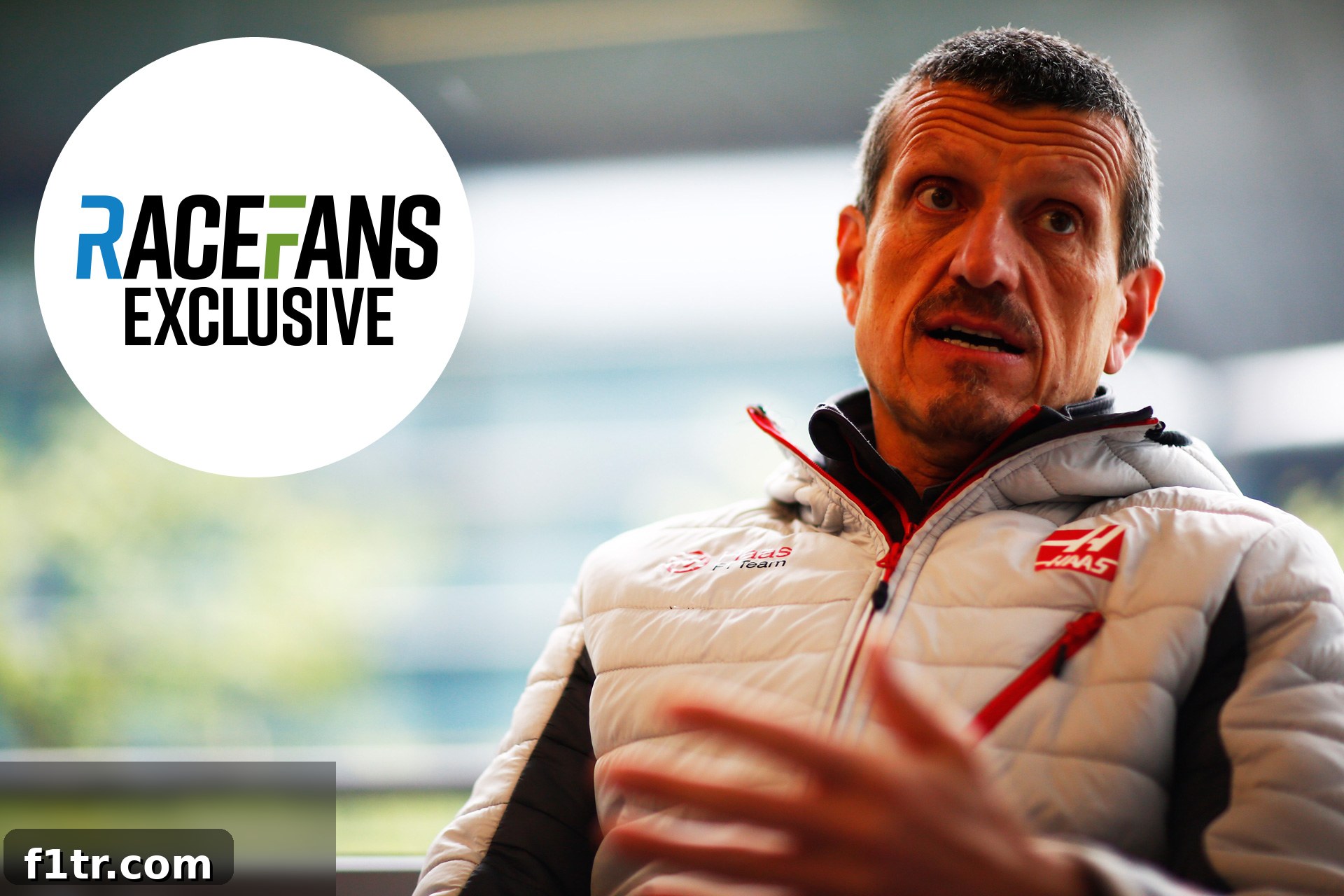
At the helm, navigating these turbulent waters, is Guenther Steiner. In his third year as team principal, Steiner exudes a steely resolve, confidently asserting that F1’s newest team possesses the inherent strength and determination to bounce back stronger from every single setback. His leadership defines Haas F1’s resilient spirit, positioning them not just as a participant, but as a tenacious force committed to making its mark.
Guenther Steiner: An Unconventional Path to F1 Leadership
Mention the name “Guenther Steiner” in the Formula 1 paddock, and initial impressions often incorrectly label him as “German” or “Austrian,” frequently alongside mentions of NASCAR. While his distinctive accent might suggest Teutonic roots, the 53-year-old is proudly Italian, hailing from the German-speaking Southern Tyrol region. His professional journey is equally diverse and far-reaching, encompassing a significant portion of his early career in European motorsport before branching out into global racing disciplines.
Steiner’s motorsport odyssey began in the gritty, demanding world of rallying. He started as a mechanic with the Mazda Rally Team Europe, meticulously learning the intricacies of vehicle performance and the pressures of competition from the ground up. This hands-on experience laid a crucial foundation, equipping him with practical knowledge that would later prove invaluable in managing a complex F1 operation. He steadily climbed the ranks, moving through esteemed teams like Jolly Club, Prodrive, and M-Sport (Ford), where his talent for technical management quickly became apparent. At M-Sport, he rose to the pivotal role of Technical Director during the golden era of rallying, working with legends like Colin McRae and Carlos Sainz. This period honed his skills in developing championship-winning machinery and managing high-calibre talent under immense pressure.
His career took a significant turn when Ford, then owners of the Jaguar Racing Team in F1, seconded him to their Formula 1 operation as Managing Director. Working under the legendary Niki Lauda, Steiner gained his first direct exposure to the pinnacle of circuit racing. When Ford restructured the team after Lauda’s departure in 2002, Steiner, though offered alternative employment within the organisation, chose a different path. He transitioned to Opel, taking on the role of Technical Director for their DTM (Deutsche Tourenwagen Masters) project, immersing himself in touring car racing.
A few years later, Steiner found himself reunited with former Jaguar colleagues after Red Bull acquired the team in 2005, transforming it into Red Bull Racing. Following Adrian Newey’s arrival at the nascent F1 team, Steiner was strategically deployed to the United States. His mission: to assist in establishing Red Bull’s ambitious NASCAR team, where he again served as Technical Director. This transatlantic move significantly broadened his understanding of American racing culture and logistics, a critical element for his future endeavors.
Steiner departed Red Bull in 2008 to establish his own composites company, Fibre Works. This entrepreneurial venture unexpectedly provided his indirect return ticket to Formula 1. The founders of the ill-fated USF1 project contracted Fibre Works for composite work. While USF1 ultimately failed to launch, Steiner was perhaps the only contractor to genuinely benefit from the stillborn venture. He gleaned invaluable insights into *how not* to embark on an F1 project, meticulously studied the sport’s intricate rulebook, and crucially, forged connections with Gene Haas and his racing lieutenant, Joe Custer, who eventually declined to partner with USF1.
Armed with this unique blend of experience and a newfound understanding of F1’s pitfalls, Steiner vowed he could succeed where others had failed. From that moment, every spare moment was dedicated to the audacious goal of founding a genuinely competitive US F1 team. He explored various avenues, from toying with the idea of running a third Ferrari car when such concessions were mooted, to considering running customer Ferraris if regulations permitted. All the while, he meticulously cultivated his relationship with Gene Haas and Joe Custer, keeping them engaged with his evolving vision.
The Birth of Haas F1: A Revolutionary Model
The breakthrough came with the confirmation of the 2013-2020 eligibility regulations, which were largely based on the ‘listed parts’ clauses of the 2010-2012 Concorde Agreement. These regulations allowed teams to purchase a significant number of components from other manufacturers, rather than designing and producing every single part in-house. Steiner immediately seized upon this opportunity. He enquired whether Ferrari, the sport’s most iconic marque, would be willing to supply a comprehensive kit of non-listed parts – including engines, gearboxes, and suspension components – and provide access to their state-of-the-art wind tunnel facilities. The answer was a resounding affirmative, albeit subject to irrevocable commercial and technical guarantees.
With the Ferrari partnership secured, the next crucial step was finding a partner for the ‘listed parts’ – those components for which a team must hold the design rights or intellectual property, such as the chassis. Steiner’s next stop was Dallara Automobili, located in Varano de’ Melegari, Italy. Dallara, the world’s largest constructor of racing car chassis, had spare capacity and a strong desire to prove its F1 capabilities after its less-than-successful dalliance with Campos/HRT in previous years. They too affirmed their willingness to design and manufacture Haas’s chassis, again contingent on satisfactory commercial arrangements.
The final hurdle was convincing Gene Haas and Joe Custer to fully invest in Steiner’s innovative concept. Impressed by Steiner’s meticulously crafted plans, his unwavering persistence, and his unique understanding of F1’s commercial and sporting landscape, they agreed to fund what would become the first serious American Formula 1 effort since Carl Haas’s (no relation) Lola entry in 1985. For Gene Haas, the venture served as a global marketing platform for his highly successful Haas Automation CNC machine tools empire. An application for entry, lodged with the FIA in early 2014, received approval shortly thereafter, paving the way for a new chapter in American motorsport.
The rest, as they say, is history. The Haas F1 Team made its unforgettable debut at the 2016 Australian Grand Prix, with Romain Grosjean securing a remarkable sixth-place finish – an unheard-of achievement for a brand-new team. That inaugural season saw Haas finish eighth out of 11 teams in the Constructors’ Championship, a truly commendable feat. They repeated this eighth-place finish in 2017, consistently punching above their weight. Heading into the 2018 season, pre-season testing hinted that their new car, the VF-18, possessed the raw speed to challenge for best-of-the-rest honors, potentially positioning them as the fourth-fastest team after Mercedes, Ferrari, and Red Bull.
2018: A Season of Unfulfilled Potential and Learning Curves
Despite the promising pace of the VF-18, the early races of 2018 proved to be a harsh lesson in F1’s unforgiving nature. The season opener in Australia saw both Haas cars retire with identical wheel nut issues during pit stops, costing the team a potential double points finish. In Bahrain, Kevin Magnussen delivered a scintillating drive to finish fifth, demonstrating the car’s true potential, while Romain Grosjean unfortunately failed to score. China yielded only a single point for Magnussen, keeping the team’s tally frustratingly low. The Baku Grand Prix proved particularly chaotic and embarrassing: Grosjean inexplicably crashed under a Safety Car period, while Magnussen drew significant criticism and a 10-second penalty for forcing Pierre Gasly into a wall.
By the time the paddock arrived in Barcelona, Haas found itself languishing in eighth place in the Constructors’ Championship, a stark contrast to their pre-season aspirations of challenging McLaren (who were then on 34 points) for fourth. Magnussen had accumulated 11 points, but Grosjean remained frustratingly on zero, his season plagued by errors. Despite these setbacks, Guenther Steiner appeared remarkably composed when interviewed in the team motorhome on Barcelona Thursday. His unique Austro-Italo-American-accented English was measured, and his responses to tricky questions were firm and direct, reflecting a leader who had seen it all.
As the Barcelona race weekend unfolded, it delivered another mixed bag for Haas. Magnussen once again drove superbly, leading the midfield home with a strong points finish. However, Grosjean unfortunately reprised the kind of antics that had earned him the notorious label ‘first-lap nutcase’ early in his career, leaving the team with yet another damaged car and zero points.
Steiner’s Philosophy: Resilience and Learning from Mistakes
Reflecting on the team’s challenging start to the 2018 season, particularly after the tantalising promises of pre-season testing, Steiner’s perspective is grounded in pragmatism. “It hurts, but you cannot do anything different, because it happened, it’s in the past,” he stated firmly. “What you have to focus on, for sure I’m not happy about it, but being unhappy and upset about it, that doesn’t help you going forwards. It’s water under the bridge, we know we lost some points, we didn’t collect them, but the car is strong. We were not in a position where you say we were lucky in one race, and missed it. No, the car is good. We just need to try to execute good, and then we are fine again.” This philosophy underscores a crucial aspect of F1: the relentless forward momentum required to succeed. Dwelling on past errors is unproductive; instead, the focus must immediately shift to analysis and improvement.
The key to longevity and success in Formula 1 lies in benefiting from mistakes by returning stronger. When asked if the team had learned from what some considered unnecessary incidents, Steiner readily affirmed, revealing a touch of his Germanic heritage: “Ja, exactly. I think the team learned when we had the mistakes in Australia. We analysed what we did wrong, and focused on not doing it wrong again. We got it right. We missed it, we shouldn’t have missed it.” He then took full responsibility, a hallmark of his leadership: “I feel responsible for that, I have no problem to say that. But what you can do? The only thing you can do, you have to have a good car every weekend, you need to focus and try not to make mistakes. Again, to try not to make any new mistakes, because you’re not trying hard to make mistakes, but they happen.”
The natural follow-up question revolved around process changes to eliminate errors. Steiner’s response highlighted the established nature of their operations: “We always had this process, there was nothing that changed in our process. You know, we’re racing now the third year; we never had… we once had a pit stop problem in the two years and then we had two in one race. What can you do?” While acknowledging that pit stop errors weren’t the only issues that year, he maintained a confident stance. “No, no, overall I think we are pretty good for being still a young team, not to make mistakes,” he countered, emphasizing that the team’s youth contributes to the occasional misstep, but their core processes are sound. “We just need to execute the process we have in place, we don’t need any new ones. We put in place good processes here, they just sometimes go wrong. Like when Kevin, when Ericsson ran into him, what can he do about it? We should have qualified better, that’s what we should do.” This underscores his belief in their fundamental structure, while acknowledging external factors and the need for optimal performance across all areas, including qualifying.
Team Strengths and the Challenge of Youth
When probed about the Haas F1 Team’s greatest strengths, Steiner paused, then articulated a core tenet of their identity: “I think that we always get up again. If you’re knocked down, you always come back, we come back better. I think all of these guys, they come back better. Nobody has their head down low. You go out there, you see them, they are going. They haven’t forgotten about last week, but they got over it. It’s not a problem. We keep on going. That is the biggest strength.” This emphasis on unwavering resilience and a forward-looking mindset highlights the powerful team culture he has fostered, essential for navigating the highs and lows of Formula 1.
Conversely, when asked about weaknesses, Steiner was equally candid. “I think the weakness is still we are young and the possibility to make mistakes is higher than when you are more mature. It’s like when you’re young, in something you make more mistakes. You make more mistakes when you are 20 than you make now. And the same is for a team. That is what we are. But I think that we are so young is not bad, but you always can be better. If you say that’s a weakness, but only time will fix this weakness. And we cannot buy time. We just need to go through this, to get stronger.” His analogy perfectly captures the challenge: experience is earned, not acquired instantly. This ‘youth’ manifests in various ways, from handling pressure situations on track to refining complex operational procedures, making the learning curve steeper but also building a foundation for future maturity and excellence.
One remarkable characteristic of Haas F1, distinguishing it from many previous start-up teams that struggled to coalesce, is how quickly the team seemed to arrive “together.” Steiner reflected on whether he leads a true team or merely a collection of individuals. “There is always [a] way to go in a team. You can never be strong enough. But I think in general we are good. But would I say we have reached [where] there is no margin to get better? No, no, there is always margin. But I think even the best teams, there is margins to get better in that area.” This acknowledgment of perpetual improvement highlights his commitment to excellence, understanding that even strong foundations require continuous refinement.
Steiner’s Leadership and Driver Management
Given his relatively recent ascendancy to an F1 team principal role, Steiner’s seamless integration has been impressive. He attributes this to the breadth of his motorsport experience. “It’s experience. You know, I’m doing motorsport 30 years, in different roles. I never had the role of team principal before, but I’ve done all the jobs which combine the team principal. I think I’ve got one advantage here. I could do most of the jobs the guys do in the team, most of them.” His journey from mechanic to logistics expert, and even co-driver in rallying, has provided him with an unparalleled understanding of every facet of a racing operation. “I started as a mechanic… I did logistics as well, I co-drove in rallying, I did them all. And that I think you just learn. But it’s just experience, nothing else. And 30 years, it’s a long time to do this.” This deep, practical knowledge gives him credibility and an intimate perspective on the challenges faced by his team members, allowing him to connect with them on a different level. When asked about his own driving ambitions, he laughed loudly, “No. And I don’t want to. I will be dangerous!”
On the subject of his driver pairing, Romain Grosjean and Kevin Magnussen, particularly given their recent incidents, Steiner’s assessment was unequivocally positive. “I rate them highly,” he stated, “I think they’re the best we can get in our position. I think for where we are we have got the perfect drivers. The drivers are better than we are, in my opinion. In the beginning we got lucky that they believed us, because after what happened with the other teams, they started and went nowhere. It was a risk to come to us and we have to respect them for that as well.” He acknowledged their considerable talent but also their career trajectories. “I know that they both have great talent. And somehow they both had, I wouldn’t say ‘problems’, there were always something in their careers, you see ups and downs. Both of them, they were in, out, in [at other teams].”
When pressed on their sometimes-rocky reputations, Steiner remained unfazed. “Yeah, but that is one of the things that I am not afraid of. I just can do my best. If they don’t like it, then we find another way. But they had the talent, and the biggest thing you look at in a driver is his talent. I don’t want to have the nicest guy and the sweetest guy and the best guy. I have no problem with having somebody [with] a reputation. I can deal with that. There is a point where I tell them what to do. That’s my job, that is what I have to do. And I’m not afraid of anybody. If something is wrong, it’s wrong.” This candid approach highlights his direct communication style. “I think they respect that with me. I actually think they quite like it. Sometimes they don’t like to hear what I have to say, but I still say it. It’s the same with me. Sometimes they say something that I don’t like. But I think we get on pretty well. Like in every relationship with a driver there are ups and downs, but in the end you always come to the same end, that we need to perform for the team. That is what we want to do.”
The Future: Defending the Haas Model and Navigating F1’s Evolution
Looking ahead, the conversation shifted to the crucial topic of Haas F1’s long-term future, particularly in light of the significant regulatory and commercial changes anticipated for Formula 1 post-2020. This period of uncertainty would impact everything, including their innovative ‘listed parts’ model and their pivotal relationship with Ferrari. Steiner highlighted the contractual realities: “Everything expires end of 2020. In the moment there is no Formula One after 2020, because nobody’s got a contract. It could be longer, but if there’s no F1 in ’21, we have no Ferrari contract… How can you do a contract after 2020 if you don’t know what is happening?” This neatly encapsulates the precarious planning environment for all F1 teams during periods of regulatory flux.
During testing, the Haas F1 team endured a barrage of criticism from rival teams concerning their business model. Guenther Steiner, leaning forward, his jaw set, was visibly prepared to defend his team’s modus operandi. “I think you have to divide here between the model we are using and what people are criticising,” he responded. “People are saying we are using Ferrari aero data, which we don’t. So that is wrong. The listed parts, I think nobody is really against that one. Some people are accusing us, falsely, that we are using last year’s Ferrari. Which is complete nonsense. It’s nonsense. So, again, we are the first one to say we wouldn’t do it and we shouldn’t do it, because we don’t.” He fiercely debunked the accusations, emphasizing the team’s strict adherence to regulations and the distinct design of their own car. The “listed parts” model, while allowing the purchase of many non-critical components, still mandates that each team designs and builds its own aerodynamic surfaces and chassis. The criticism, particularly from teams like Force India and McLaren, often stemmed from concerns about the ‘spirit of the rules’ and the perceived advantages of Haas’s close ties with Ferrari.
In Steiner’s opinion, the current balance for ‘listed parts’ within F1 was appropriate. “No, no, I think at the moment it’s where it’s the right… at the moment it works for us,” he asserted. “If there are changes… I don’t want change at the moment because we have got a good system going. For sure some people want changes because they think that we shouldn’t be doing what we’re doing. That is why they want the changes. Because they have to cover their incompetence.” His direct assertion that rivals’ calls for changes might be rooted in their own failings, rather than genuine fairness concerns, reflects his combative spirit and unwavering belief in the Haas model’s legitimacy. “It works. In the moment we wouldn’t change. If everything stays the same, if Formula One stays like it is now, in the moment we wouldn’t change. Why would we? There is not good enough reason to take a risk to change it. Because if you change it, you take a big risk. And why would we do that?”
The inevitable question then became: what if the FIA and commercial rights holder enforce changes after 2020? “I guess then we would have to change. Or we go and race somewhere else. But that’s not my decision, it’s Gene’s, but I don’t think the sporting regulations [will change to that degree],” Steiner mused. The threat of looking elsewhere for racing opportunities underscores the seriousness with which Haas views its operational model and its place in F1. However, he also acknowledged the pervasive uncertainty. “First of all, we don’t know what is happening in ’21. We don’t know what is changing, and why. You [all] assume it’s changing. In the moment, if you know more than me that something is changing… there is a plan to change something, but it’s not done yet. I think there’s a plan to change it, but I don’t know exactly what will change and I don’t know if this regulation changes. If they change, we will consider what to do.”
A Legacy of Resilience and Pragmatism
With that, Guenther Steiner, the lean son of a South Tyrolean butcher, transitioned from team boss to a more reflective individual. His journey from the foothills of the Italian Alps in Bozen, driven by an unyielding motorsport passion, to becoming a leading figure in Formula 1 is truly remarkable. The Haas F1 Team, under his pragmatic yet passionate leadership, has not only carved out a unique space in F1 but has also proven that resilience, strategic thinking, and a willingness to challenge conventions can yield significant results. Despite the inevitable setbacks and controversies, Steiner’s vision ensures that Haas F1 remains a tenacious and compelling force, consistently striving to convert its potential into sustained success on the world’s biggest motorsport stage. His story is a testament to the power of experience, directness, and an unwavering belief in one’s chosen path, cementing his place as one of Formula 1’s most distinctive and enduring personalities.