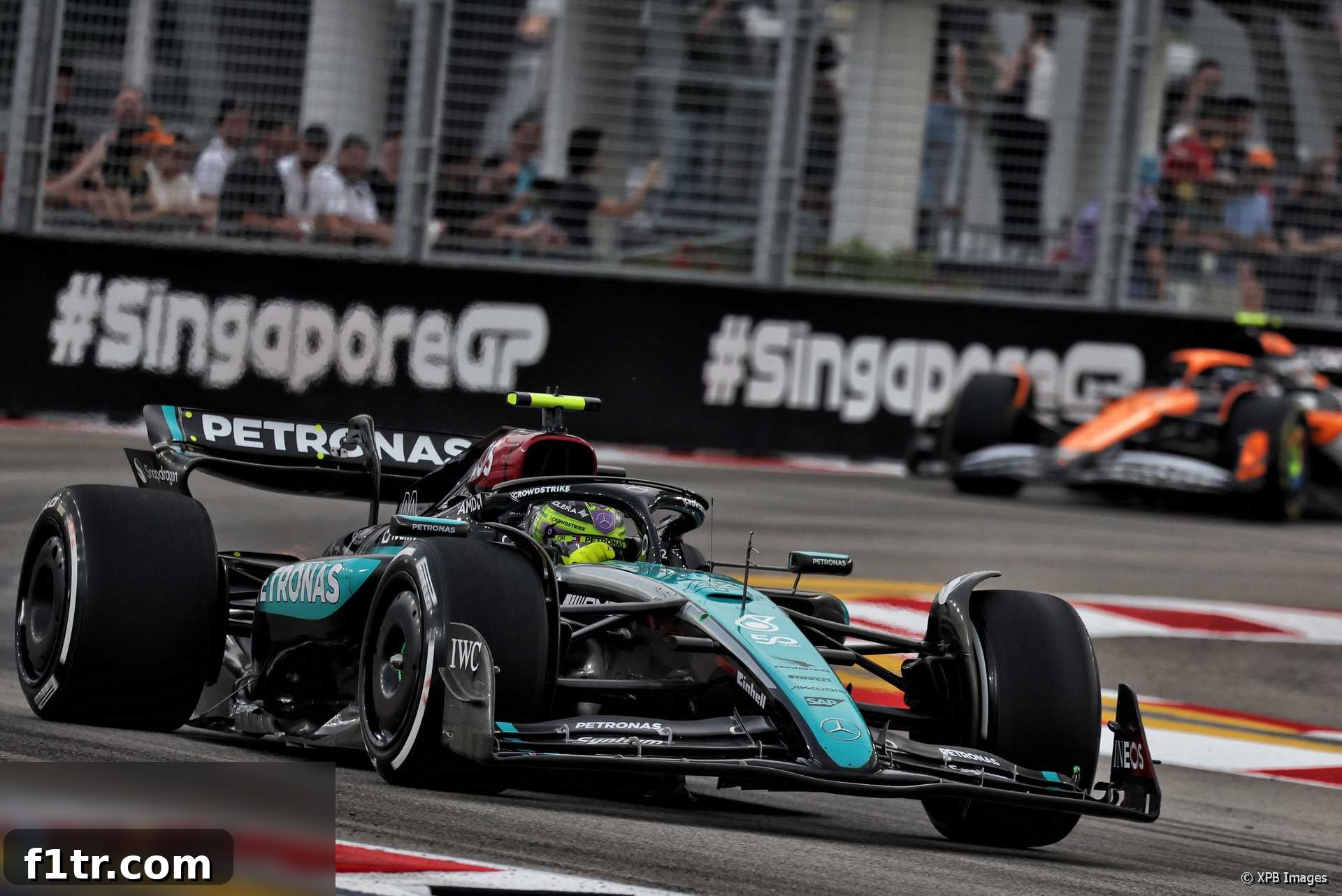
Mercedes Drivers Downcast After Challenging Singapore Grand Prix Practice
The mood in the Mercedes garage was noticeably somber following the opening day of practice for the Singapore Grand Prix. Both Lewis Hamilton and George Russell expressed profound disappointment and concern regarding their car’s performance and the team’s immediate prospects on the demanding Marina Bay Street Circuit.
Lewis Hamilton’s Candid Assessment: “We’re a Little Bit Lost”
Seven-time world champion Lewis Hamilton did not mince words when reflecting on a difficult Friday. Concluding the day with only the 11th-fastest time, nearly a full second adrift of pace-setter Lando Norris, Hamilton painted a grim picture for the Silver Arrows’ qualifying ambitions.
“At the moment, we won’t be going into Q3,” Hamilton stated bluntly, highlighting the significant gap to the front-runners. His assessment underscored a fundamental issue with the car’s handling and overall performance package for the challenging street circuit.
Speaking to the official F1 channel, Hamilton elaborated on his frustration: “It’s very difficult. A very challenging day.” He detailed the team’s extensive efforts to find a workable solution, revealing, “We tried everything set-up wise and nothing seems to work with the set-up. So definitely very challenging.” The unique demands of the Singapore circuit, with its tight corners, unforgiving walls, and high humidity, often amplify setup deficiencies, leaving drivers struggling for confidence and pace.
The stark reality of their situation was not lost on Hamilton. “We’re really giving it everything and then you find out you’re a second off,” he lamented. Such a substantial deficit, particularly in practice, suggests deep-seated issues that are difficult to resolve overnight. “I think ultimately we’re just a little bit lost and I’m not really sure where to put the car.” This sentiment speaks volumes about the lack of balance and predictability Hamilton was experiencing, making it impossible to extract competitive lap times.
George Russell’s Incident and Echoed Concerns
While George Russell managed to lap two-tenths of a second quicker than his teammate, his session was not without incident. Towards the end of the second practice session, Russell understeered into a barrier at Turn 8, sustaining damage to his Mercedes. This mishap further compounded the team’s woes, potentially limiting valuable track time for analysis and repair.
Russell, echoing Hamilton’s candid remarks, articulated similar concerns about the car’s behavior. “It was a really challenging Friday for us,” he conceded. “We were really off the pace today, we need to understand why that is. I’m sure we’ll find some answers tonight.” The urgency in his tone highlighted the critical need for a breakthrough before the crucial qualifying session.
The young Briton also noted a significant shift in the car’s feel compared to previous outings. “We made some big changes from FP1 into FP2. But the car’s just not really feeling that well connected as it was this time 12 months ago and in recent races. So we need to try to get to the bottom of it.” The concept of a “well-connected” car is paramount in Formula 1; it refers to the driver’s ability to confidently predict the car’s responses, particularly through high-speed corners and under braking. A lack of this connection undermines a driver’s confidence and limits their ability to push the car to its absolute limit.
The Unpredictable Singapore Landscape: Rivals’ Surprises
Beyond Mercedes’ own struggles, Russell pointed out the unexpected pecking order that emerged during practice. He spoke of “a lot of surprises” among their rival teams, a factor that only complicated Mercedes’ assessment of their own performance. Remarkably, Russell found himself quicker than both Red Bulls – a rare occurrence given their recent dominance – but trailed behind their sister team, RB.
“You’ve got the [RBs] really quick, the Williams is really quick, Red Bull seemed to be off the pace and there seems to be a big gap to the McLarens and the Ferraris,” Russell observed. This chaotic midfield, combined with the apparent strength of McLaren and Ferrari at the front, suggested a highly competitive and unpredictable weekend. The strong performance of teams like RB and Williams, often seen as midfield contenders, added another layer of complexity to Mercedes’ challenge. Typically, Mercedes would aim to be firmly within the top tier, competing directly with McLaren and Ferrari. However, their current pace suggests they are battling for position within a very tight and competitive midfield group.
Russell encapsulated Mercedes’ immediate target and the scale of the task ahead: “So as a minimum we hope to be in between that midfield gap and the front four but right now we’ve got a lot of work on our hands.” This goal, a far cry from their usual aspirations for pole position and race victories, underscores the profound difficulties they encountered on Friday.
Analyzing Mercedes’ Setup Woes at Marina Bay
The Singapore Grand Prix is renowned for being one of the most physically and technically demanding races on the F1 calendar. Its street circuit nature, characterized by 23 corners, requires a unique blend of downforce for cornering grip and strong mechanical traction for exiting tight bends. Furthermore, the relentless heat and humidity place immense stress on both drivers and machinery, making optimal cooling and tire management crucial.
Mercedes’ declaration that “nothing seems to work with the set-up” suggests a fundamental disconnect between their car’s design philosophy and the specific requirements of the Marina Bay circuit. Finding the sweet spot for setup involves intricate adjustments to aerodynamics, suspension, ride height, and differential settings. When a car feels “lost” or “not well connected,” it typically points to issues with balance through corners, unpredictable behavior over bumps, or difficulty generating consistent tire temperature.
A second off the pace is an alarming margin in Formula 1, especially in practice. It implies that Mercedes might be struggling with a complex array of problems rather than a single, easily rectifiable issue. They might be grappling with understeer in some corners and oversteer in others, or perhaps failing to switch on their tires effectively, leading to a lack of grip. The team’s engineers will face an arduous night analyzing vast amounts of telemetry data, correlating it with driver feedback, and attempting to simulate solutions to unlock performance.
The Road Ahead: Qualifying and Race Implications
The importance of qualifying well at a street circuit like Singapore cannot be overstated. Overtaking opportunities are notoriously scarce, making grid position absolutely critical. If Mercedes indeed fails to progress into Q3, as Hamilton fears, it would severely compromise their prospects for the race.
Starting outside the top ten would force both Hamilton and Russell into a damage limitation exercise, relying heavily on strategy, safety cars, or inclement weather to make significant progress. For a team with Mercedes’ championship pedigree, such a scenario is deeply concerning and indicative of a wider performance slump on specific track types.
The team will be working tirelessly overnight, burning the midnight oil in an attempt to pinpoint the precise issues and implement drastic changes for Saturday’s practice and qualifying sessions. Their ability to make a significant step forward will not only determine their starting positions but also set the tone for the remainder of their weekend in Singapore. The pressure on the engineers to deliver a tangible improvement will be immense, as both drivers are clearly pushing the car to its limits but receiving little reward.
Conclusion: A Steep Climb for the Silver Arrows
Friday’s practice sessions for the Singapore Grand Prix left Mercedes facing a formidable challenge. The candid admissions from both Lewis Hamilton and George Russell underscore a fundamental struggle with their car’s setup and overall performance. While the unpredictable nature of the street circuit and the surprising pace of some rivals add to the complexity, Mercedes must now embark on a rapid and decisive turnaround to salvage their weekend. The next 24 hours will be critical in determining whether they can climb out of their current predicament and find the pace required to compete at the sharp end of the grid.
2024 Singapore Grand Prix
- Ricciardo’s brake woe and why Perez thought he had an engine problem: Singapore GP radio
- ‘Perez is only quicker when he has DRS’: How Hulkenberg’s Haas beat a Red Bull – again
- Mercedes explain “clear mistake” strategy call which left Hamilton “so angry”
- “Sometimes I wonder why I do this”: How Hamilton endured a slog to sixth in Singapore
- F1’s rules need surgery as well as sticking plaster after fastest lap controversy
Browse all 2024 Singapore Grand Prix articles