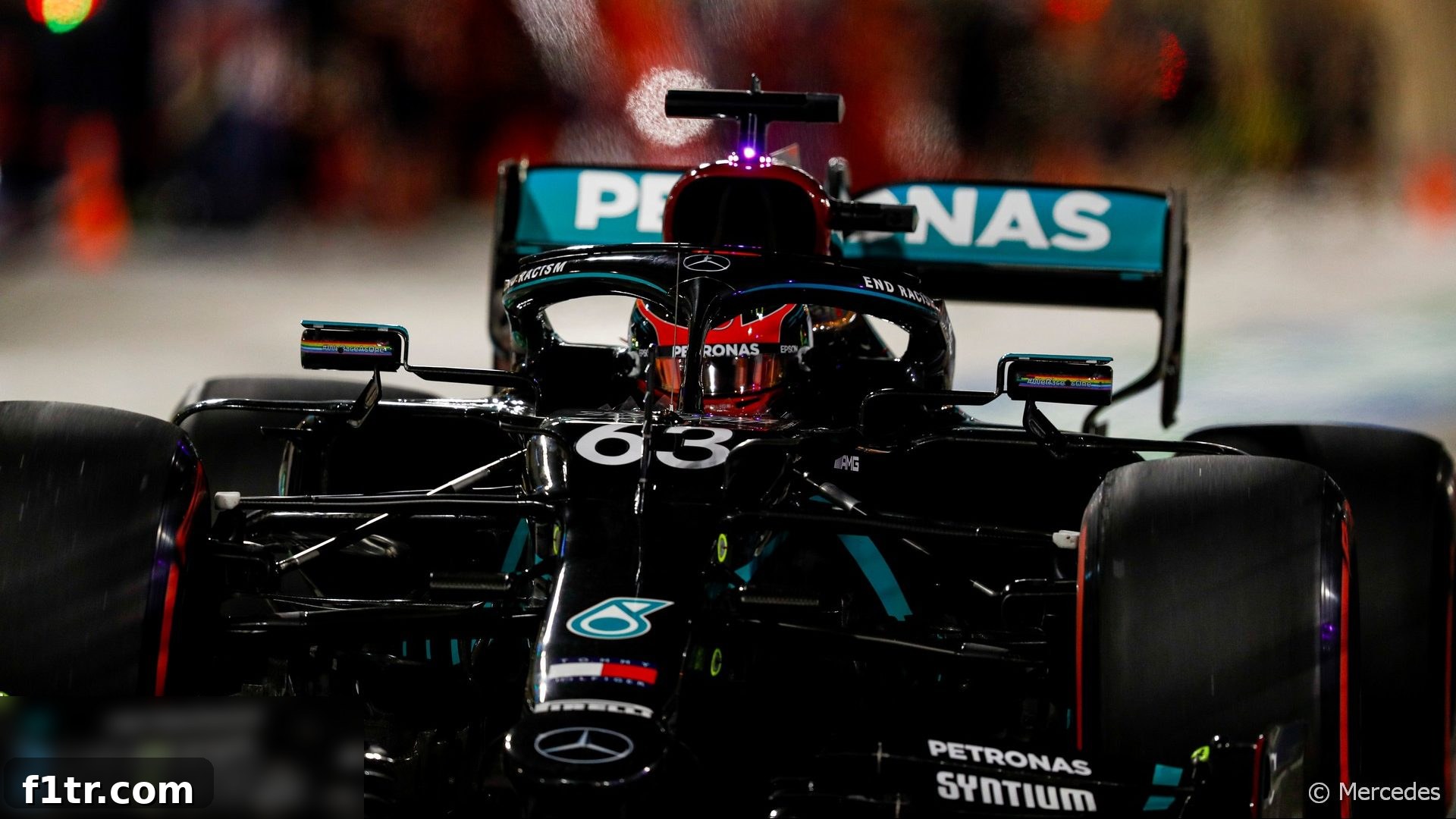
In a dramatic turn of events at the Sakhir Grand Prix, George Russell successfully retained the first crucial points of his burgeoning Formula 1 career. This decision came after the FIA stewards meticulously reviewed a significant pit stop error by Mercedes, ultimately imposing a substantial fine on the team rather than a sporting penalty that could have led to Russell’s disqualification.
Advert | Become a Supporter & go ad-free
The Unforeseen Pit Stop Error: A Race-Defining Moment
The incident that gripped the Formula 1 paddock and fans alike occurred during a pivotal safety car period at the Sakhir Grand Prix. Mercedes faced a €20,000 fine following an unprecedented mistake where tyres allocated to Valtteri Bottas were inadvertently fitted to Russell’s car. This error, stemming from a critical radio communication breakdown, had immediate and far-reaching consequences for both Mercedes drivers.
Russell’s Stellar Performance Overshadowed by Pit Lane Drama
George Russell, stepping in for the reigning world champion Lewis Hamilton who was sidelined due to COVID-19, had delivered an outstanding performance throughout the weekend. Having qualified second and leading a significant portion of the race, Russell was on track for a remarkable maiden victory, showcasing the immense talent that had been evident during his time at Williams. His drive was a testament to his potential, marking him as a future star of the sport. The pit stop error, however, threatened to cast a shadow over this impressive display, highlighting the fine margins and immense pressure inherent in Formula 1.
A Double Stack Gone Wrong: The Mechanism of the Error
The chaotic scene unfolded during a double-stacked pit stop, a high-risk manoeuvre where both team cars enter the pit lane one after the other to minimize time loss. Mercedes’ explanation, which was accepted by the stewards, pointed to a technical glitch in their radio communications system. Specifically, the pit wall’s crucial instruction to the pit crew—that Car 63 (Russell) would enter the pits *before* Car 77 (Bottas)—failed to reach the crew assigned to Russell’s car. This failure occurred because Russell himself transmitted a message at the exact same moment, causing the pit wall’s vital communication to be obscured or entirely missed.
The direct consequence of this communication blackout was that the front tyres designated for Valtteri Bottas’s car were mistakenly fitted to George Russell’s W11. This error necessitated an immediate correction, forcing Russell to make a second unscheduled pit stop just one lap later to rectify the issue and get the correct set of tyres on his car. This subsequent stop significantly hampered his race, dropping him down the classification and costing him valuable track position.
The impact wasn’t limited to Russell alone. Valtteri Bottas’s race was also severely compromised. When Bottas subsequently entered the pit lane for his own stop, his crew discovered that the front tyres they were supposed to fit were already on Russell’s car. This led to a considerable delay as the team scrambled, ultimately sending Bottas back out on track with the same set of tyres he had come in on, effectively wasting his pit stop and severely impacting his final classification. The incident underscored the intricate dependencies and the ripple effect that even a minor error can have within a finely tuned Formula 1 operation.
The Stewards’ Deliberation: Mitigating Factors Prevent Disqualification
The FIA stewards acknowledged that the fitting of incorrect tyres to a car is a clear breach of the Formula 1 Sporting Regulations, specifically Article 24.4 b). They emphasized that such an infringement “would normally involve a sporting penalty up to disqualification,” a severe sanction that would have stripped Russell of his points and Mercedes of their constructor points from the race.
Advert | Become a RaceFans supporter andgo ad-free
However, the stewards also recognized and meticulously documented several “mitigating circumstances” that ultimately led them to apply a financial penalty rather than a sporting one. Their decision was a carefully balanced judgment, taking into account the specifics of the incident and its broader implications.
Immediate Rectification and Team Response
A key factor in the stewards’ decision was Mercedes’ immediate response to the error. The team recognized the mistake almost instantly and brought Russell back into the pits on the very next lap to fit the correct tyres. This swift action demonstrated the team’s commitment to rectifying the breach without delay, preventing any prolonged or unfair advantage. The stewards noted that this quick correction, while costing Russell track position, was a crucial display of adherence to sporting integrity.
Dual Impact on Both Mercedes Cars
Another significant mitigating circumstance was the fact that the error severely impacted the races of both Mercedes drivers. Russell was forced into an extra pit stop, losing significant time and positions. Simultaneously, Bottas’s race was compromised by the delayed and ineffective pit stop, as his designated tyres were unavailable. This dual impact ensured that Mercedes gained no strategic advantage from the mix-up. The stewards explicitly stated that this also “impacted the final classification of car 77,” reinforcing that the team as a whole suffered, rather than benefited, from the incident.
Tyre Specifications vs. Allocation: A Nuance in the Rules
The stewards also considered the specific nature of the tyre infringement. They highlighted that Russell’s car was not fitted with tyres of “differing specifications,” which is explicitly forbidden by the rules. Instead, it was fitted with a set of front tyres that belonged to his teammate, Valtteri Bottas. Crucially, these tyres were of the same compound as Russell’s rear tyres, meaning there was no performance advantage gained from using a softer or harder compound incorrectly. While still a breach of allocation rules, it was distinct from using a different *specification* of tyre, which the rules often treat with less tolerance. The stewards considered this situation “similar in nature” to instances covered under the “three-lap tolerance” referred to in the second paragraph of Article 24.4 b), which typically deals with tyres of differing specifications. This subtle distinction played a vital role in their ultimate ruling.
The Unprecedented Nature of the Breach
A significant point raised by the stewards was the unique character of the incident. They noted, “It is noted that this type of breach has not previously been experienced in Formula 1.” This unprecedented nature meant that there was no direct precedent for applying a penalty, compelling the stewards to evaluate the situation based on its unique merits and the spirit of the regulations rather than strict historical application.
Acceptance of the Technical Radio Issue
Finally, the stewards accepted Mercedes’ explanation that the error was primarily caused by a technical radio communications issue. This factor shifted the blame from deliberate negligence or gross incompetence to an unforeseen technical fault within a highly complex operational environment. While acknowledging that “the responsibility to fit tyres in compliance with the regulations still rests with any team,” the presence of a genuine technical malfunction was deemed a significant mitigating factor.
Advert | Become a RaceFans supporter andgo ad-free
Implications and Future Amendments to F1 Regulations
Beyond the immediate penalty, the stewards’ report included an important recommendation to the FIA. They advised that “the FIA consider amending Article 24.4 b) to accommodate this type of breach when it is rectified without delay.” This recommendation underscores the dynamic nature of Formula 1 regulations, which must continually evolve to address new and unforeseen circumstances arising from the sport’s ever-increasing complexity and technological advancements.
The incident highlighted a gap in the existing rulebook, particularly concerning unintentional errors that are quickly rectified and do not confer a lasting advantage. Amending Article 24.4 b) would provide clearer guidelines for similar future incidents, ensuring consistency and fairness in penalty application. It emphasizes the FIA’s commitment to maintaining sporting integrity while also acknowledging the inevitability of human and technical errors in a high-pressure environment.
George Russell’s Enduring Legacy from the Sakhir Grand Prix
Despite the controversy surrounding the pit stop, George Russell’s performance at the Sakhir Grand Prix remains one of the standout moments of his early career. He demonstrated exceptional skill, maturity, and race craft, proving unequivocally that he belongs at the pinnacle of motorsport. The retention of his first Formula 1 points, while not a victory, was a significant milestone, validating his talent and the belief Mercedes had placed in him for that weekend.
The incident also served as a stark reminder of the immense pressures and complexities involved in Formula 1 pit stops, where milliseconds and perfect coordination are critical. It showcased how even the most meticulously prepared teams can fall victim to unforeseen circumstances. Ultimately, the stewards’ measured response ensured that a spectacular drive was not unfairly negated by a technical error, allowing Russell to keep a tangible reward for his exceptional efforts.
The Sakhir Grand Prix of 2020 will long be remembered not just for the dramatic tyre mix-up but for George Russell’s breathtaking performance, his valiant fight for victory, and the measured, considered judgment of the FIA stewards. This event further cemented his reputation as a future champion and prompted a crucial discussion on the adaptability and fairness of Formula 1’s intricate rulebook.
2020 F1 season
- Grosjean to make F1 test return tomorrow for first time since Bahrain horror crash
- Pictures: Wrecked chassis from Grosjean’s Bahrain fireball crash to go on display
- Bottas vs Rosberg: Hamilton’s Mercedes team mates compared after 78 races each
- F1 revenues fell by $877 million in Covid-struck 2020 season
- Hamilton and Mercedes finally announce new deal for 2021 season
Browse all 2020 F1 season articles