The exhilarating atmosphere of the United States Grand Prix at the Circuit of the Americas often brings with it high expectations, and for Pierre Gasly and the Alpine team, those ambitions soared even higher. Despite securing a highly promising starting position, the checkered flag ultimately found Gasly in a disappointing 12th place. “We had much higher ambitions than finishing outside the points,” a visibly frustrated Pierre Gasly admitted after the race, encapsulating the team’s dashed hopes in what proved to be a strategically challenging and often chaotic event.
Advert | Become a Supporter & go ad-free
The weekend had begun with genuine optimism for Alpine. A significant car upgrade, combined with Gasly’s exceptional qualifying performance, saw him secure an impressive sixth position on the grid – Alpine’s best starting slot of the season so far. This achievement was further aided by an early incident involving George Russell, which reshuffled the field. The team’s prospects of finally breaking their points drought received another unexpected boost when Lewis Hamilton spun out in the other Mercedes on the second lap, introducing an element of unpredictability to the race and seemingly opening doors for those further down the grid. With a strong starting position and early race drama playing out, the stage was set for Alpine to capitalize and convert potential into a tangible points finish, a commodity that had eluded them for several races.
However, the carefully laid plans for Gasly’s race began to unravel significantly once he made his crucial pit stop on lap 18. Swapping his starting medium compound tires for a set of hard compounds marked the turning point. This strategic move, one lap after his close competitor, Kevin Magnussen, executed an identical tire change, highlighted a critical misjudgment by both Alpine and Haas regarding the race dynamics. The assumption heading into the race was that a two-stop strategy would be optimal. This expectation was largely based on observations from the sprint race, where the medium compound tires showed considerable degradation, coupled with the hotter track temperatures forecast for race day. Teams meticulously planned for two tire changes, aiming to manage wear and maintain pace throughout the grueling 56-lap event.
Yet, Formula 1 often delivers surprises, and the 2024 United States Grand Prix was no exception. Contrary to pre-race predictions, the tires demonstrated remarkable durability, holding up much better than anticipated. This unexpected longevity dramatically shifted the strategic landscape. Furthermore, the early Safety Car period, triggered by Hamilton’s spin, played a pivotal role. It allowed many teams to extend their opening stints beyond what was initially thought possible, effectively making a one-stop strategy not just feasible, but increasingly advantageous. As the race progressed, a clear consensus began to emerge among the strategists up and down the pit lane: a single pit stop was the faster and more efficient path to the finish line.
It was against this backdrop of evolving strategy that Alpine’s race truly went awry. Following Haas’s decision to pit Magnussen, and Alpine bringing Gasly in on consecutive laps, there was a noticeable lull in pit lane activity, confirming that many teams had committed to or were strongly considering a one-stop race. Haas eventually brought Magnussen in for a second stop later in the race, though this decision was reportedly influenced by a pit wall miscommunication, highlighting the fine margins and potential for error in high-pressure F1 strategy. For Gasly, however, his first stop was plagued by a critical issue: a slow pit stop that cost him approximately four crucial seconds. In a sport where milliseconds can make or break a race, a four-second delay is catastrophic. This extended stop dropped him directly behind Magnussen and crucially cost him the opportunity to emerge from the pits ahead of both Lance Stroll and Alexander Albon. He found himself ensnared in a frustrating midfield battle, losing even more valuable time as he struggled to overtake. By the time he eventually cleared these competitors, Magnussen had already pulled out a significant 10-second advantage up the road, making any immediate recovery incredibly difficult.
The challenges for Gasly didn’t end there. After the race, he openly confessed to “lacking pace on the hard tyre.” This performance deficit on the chosen compound, combined with the earlier pit stop issues and being stuck in traffic, painted a bleak picture. Despite having a fresh set of medium tires available in the pits, Alpine made the perplexing decision to keep Gasly out on the hard compound, sticking to their one-stop strategy. This choice was a high-stakes gamble, potentially hoping for a late-race Safety Car to bunch up the field and offer a lifeline – a phenomenon that can drastically alter race outcomes. Unfortunately for Alpine, no such opportunity materialized. Instead, Gasly watched as he was passed by the one-stopping Franco Colapinto, and then again by Magnussen, who, despite his own team’s strategic errors, managed to recover after his second stop. These overtakes cemented Gasly’s fate, leaving him to cross the finish line in a deeply disappointing 12th position, well outside the points-scoring positions.
Advert | Become a RaceFans supporter andgo ad-free
Reflecting on the race, Gasly’s frustration was palpable. “We had too many sub-optimal situations throughout the race,” he lamented, pointing to a series of compounding issues that derailed what had started as a promising weekend. He also acknowledged the harsh reality of their current competitive standing: “It looks like our rivals are just that bit quicker at the moment.” This race marked the fourth consecutive Grand Prix where Alpine failed to score any championship points, extending a worrying trend for the French team. However, they did manage a minor strategic victory, preventing Williams from significantly extending their lead in the Constructors’ Championship. As the race entered its final stages, Franco Colapinto held the fastest lap – a valuable point if he finished in the top ten. To counter this, Alpine strategically brought Esteban Ocon in for a fresh set of soft tires, specifically to challenge and snatch the fastest lap point away from Colapinto. While Ocon succeeded in setting the fastest lap, he ultimately finished 18th, well outside the points himself, meaning Alpine did not gain the fastest lap point. Nevertheless, this calculated move highlighted the team’s determination to fight for every competitive edge, even when points seemed out of reach for their primary contender.
The 2024 United States Grand Prix ultimately served as a stark reminder of the unforgiving nature of Formula 1, where strategic miscalculations, operational errors, and unpredictable race conditions can swiftly turn a promising start into a disappointing finish. For Pierre Gasly and Alpine, the potential for a strong points haul vanished under the Texan sun, leaving them to regroup and analyze where their race truly went wrong, hoping to learn crucial lessons for the remaining races of the season.
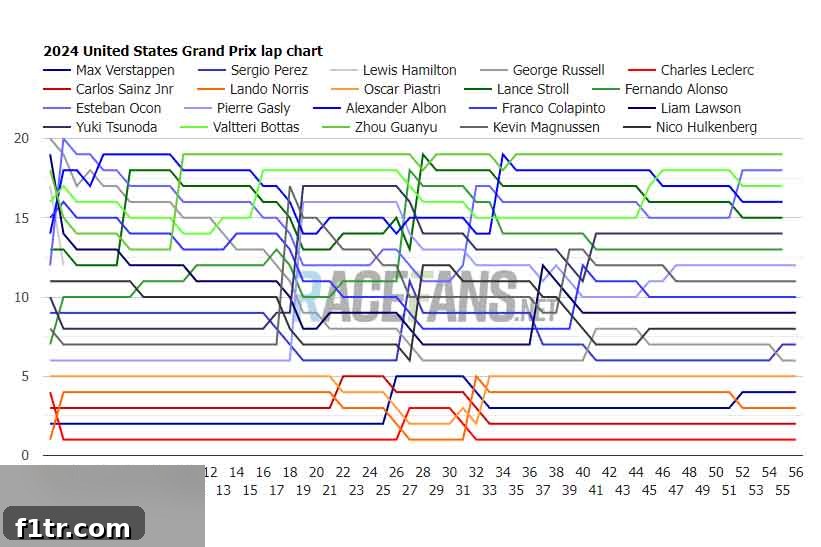
2024 United States Grand Prix Lap Chart
The positions of each driver on every lap. Click name to highlight, right-click to reset. Toggle drivers using controls below:
Advert | Become a RaceFans supporter andgo ad-free
2024 United States Grand Prix Race Chart
The gaps between each driver on every lap compared to the leader’s average lap time. Very large gaps omitted. Scroll to zoom, drag to pan and right-click to reset. Toggle drivers using controls below:
2024 United States Grand Prix Lap Times
All the lap times by the drivers (in seconds, very slow laps excluded). Scroll to zoom, drag to pan and toggle drivers using the control below:
Advert | Become a RaceFans supporter andgo ad-free
2024 United States Grand Prix Fastest Laps
Each driver’s fastest lap during the race:
| Rank | # | Driver | Car | Lap time | Gap | Avg. speed (kph) | Lap no. |
|---|---|---|---|---|---|---|---|
| 1 | 31 | Esteban Ocon | Alpine-Renault | 1’37.330 | 203.91 | 53 | |
| 2 | 43 | Franco Colapinto | Williams-Mercedes | 1’37.611 | 0.281 | 203.33 | 46 |
| 3 | 63 | George Russell | Mercedes | 1’37.656 | 0.326 | 203.23 | 42 |
| 4 | 4 | Lando Norris | McLaren-Mercedes | 1’37.679 | 0.349 | 203.18 | 55 |
| 5 | 55 | Carlos Sainz Jnr | Ferrari | 1’37.763 | 0.433 | 203.01 | 42 |
| 6 | 16 | Charles Leclerc | Ferrari | 1’37.834 | 0.504 | 202.86 | 39 |
| 7 | 81 | Oscar Piastri | McLaren-Mercedes | 1’37.883 | 0.553 | 202.76 | 42 |
| 8 | 30 | Liam Lawson | RB-Honda RBPT | 1’38.091 | 0.761 | 202.33 | 54 |
| 9 | 1 | Max Verstappen | Red Bull-Honda RBPT | 1’38.117 | 0.787 | 202.28 | 42 |
| 10 | 20 | Kevin Magnussen | Haas-Ferrari | 1’38.210 | 0.880 | 202.09 | 56 |
| 11 | 10 | Pierre Gasly | Alpine-Renault | 1’38.311 | 0.981 | 201.88 | 55 |
| 12 | 27 | Nico Hulkenberg | Haas-Ferrari | 1’38.404 | 1.074 | 201.69 | 51 |
| 13 | 11 | Sergio Perez | Red Bull-Honda RBPT | 1’38.514 | 1.184 | 201.46 | 45 |
| 14 | 23 | Alexander Albon | Williams-Mercedes | 1’39.084 | 1.754 | 200.3 | 54 |
| 15 | 22 | Yuki Tsunoda | RB-Honda RBPT | 1’39.193 | 1.863 | 200.08 | 54 |
| 16 | 18 | Lance Stroll | Aston Martin-Mercedes | 1’39.214 | 1.884 | 200.04 | 54 |
| 17 | 14 | Fernando Alonso | Aston Martin-Mercedes | 1’39.261 | 1.931 | 199.95 | 52 |
| 18 | 24 | Zhou Guanyu | Sauber-Ferrari | 1’39.272 | 1.942 | 199.92 | 53 |
| 19 | 77 | Valtteri Bottas | Sauber-Ferrari | 1’40.575 | 3.245 | 197.33 | 53 |
| 20 | 44 | Lewis Hamilton | Mercedes | 1’48.064 | 10.734 | 183.66 | 1 |
Advert | Become a RaceFans supporter andgo ad-free
2024 United States Grand Prix Tyre Strategies
The detailed tire strategies employed by each driver throughout the Grand Prix:
Advert | Become a RaceFans supporter andgo ad-free
2024 United States Grand Prix Pit Stop Times
An overview of how long each driver’s pit stops took during the race, including crucial seconds gained or lost:
| Rank | # | Driver | Team | Complete stop time (s) | Gap to best (s) | Stop no. | Lap no. |
|---|---|---|---|---|---|---|---|
| 1 | 11 | Sergio Perez | Red Bull | 23.58 | 1 | 26 | |
| 2 | 4 | Lando Norris | McLaren | 23.731 | 0.151 | 1 | 31 |
| 3 | 16 | Charles Leclerc | Ferrari | 23.817 | 0.237 | 1 | 26 |
| 4 | 30 | Liam Lawson | RB | 23.839 | 0.259 | 1 | 36 |
| 5 | 55 | Carlos Sainz Jnr | Ferrari | 23.963 | 0.383 | 1 | 21 |
| 6 | 20 | Kevin Magnussen | Haas | 23.966 | 0.386 | 1 | 17 |
| 7 | 43 | Franco Colapinto | Williams | 23.971 | 0.391 | 1 | 39 |
| 8 | 20 | Kevin Magnussen | Haas | 24.087 | 0.507 | 2 | 38 |
| 9 | 81 | Oscar Piastri | McLaren | 24.107 | 0.527 | 1 | 32 |
| 10 | 31 | Esteban Ocon | Alpine | 24.156 | 0.576 | 1 | 31 |
| 11 | 22 | Yuki Tsunoda | RB | 24.193 | 0.613 | 1 | 18 |
| 12 | 1 | Max Verstappen | Red Bull | 24.228 | 0.648 | 1 | 25 |
| 13 | 14 | Fernando Alonso | Aston Martin | 24.247 | 0.667 | 1 | 26 |
| 14 | 23 | Alexander Albon | Williams | 24.391 | 0.811 | 2 | 33 |
| 15 | 24 | Zhou Guanyu | Sauber | 24.433 | 0.853 | 1 | 13 |
| 16 | 77 | Valtteri Bottas | Sauber | 24.439 | 0.859 | 1 | 15 |
| 17 | 27 | Nico Hulkenberg | Haas | 24.5 | 0.92 | 1 | 27 |
| 18 | 24 | Zhou Guanyu | Sauber | 24.89 | 1.31 | 2 | 35 |
| 19 | 31 | Esteban Ocon | Alpine | 26.175 | 2.595 | 2 | 51 |
| 20 | 18 | Lance Stroll | Aston Martin | 26.399 | 2.819 | 1 | 27 |
| 21 | 10 | Pierre Gasly | Alpine | 28.228 | 4.648 | 1 | 18 |
| 22 | 63 | George Russell | Mercedes | 29.327 | 5.747 | 1 | 40 |
| 23 | 23 | Alexander Albon | Williams | 34.983 | 11.403 | 1 | 3 |
Miss nothing from RaceFans
Get a daily email with all our latest stories – and nothing else. No marketing, no ads. Sign up here:
More on the 2024 United States Grand Prix
- McLaren insist stewards made ‘provable error’ after losing bid for review of Norris’ penalty
- Why McLaren’s focus on Verstappen’s driving failed to overturn Norris’ penalty
- Stewards reject McLaren’s request to review Norris’ United States GP penalty
- McLaren know Norris’ penalty is likely to stand – so what do they hope to gain?
- McLaren request review of Norris’ penalty for off-track pass on Verstappen
Browse all 2024 United States Grand Prix articles