F1 Penalty Wars: Why McLaren Might Push for Harsher Sanctions on Max Verstappen
In the relentlessly competitive arena of Formula 1, where every decision, every point, and every position holds immense weight, the repercussions of on-track incidents often extend far beyond the immediate race result. Recent events have thrust the intricate world of driver penalties and the contentious ‘Right of Review’ process into a critical spotlight, setting the stage for a compelling strategic battle between fierce championship rivals, McLaren and Red Bull Racing.
The saga began with McLaren’s fervent challenge against a time penalty imposed on their star driver, Lando Norris, at the United States Grand Prix. Convinced of a procedural error or misjudgment, McLaren pursued a formal review of the stewards’ decision with considerable determination. However, their efforts were ultimately unsuccessful, highlighting the exceptionally stringent criteria that govern such appeals, particularly the imperative to present a “significant and relevant new element” that was genuinely unavailable at the time of the original ruling.
Advert | Become a Supporter & go ad-free
Mere days later, the focus shifted dramatically to Norris’s principal championship challenger, Max Verstappen. The Red Bull ace found himself on the receiving end of the stewards’ wrath, accumulating penalties that amounted to a staggering 20 seconds – a sanction four times greater than Norris’s earlier one in Austin. Predictably, Verstappen’s Red Bull team echoed McLaren’s earlier sentiments, expressing profound dissatisfaction and publicly disputing the stewards’ judgment, underscoring the universal frustration teams feel when facing punitive measures.
However, a crucial distinction lies in the timing and nature of these penalties. Verstappen’s pair of 10-second penalties were issued and served during the early stages of Sunday’s race, executed during his mandatory pit stop. This ‘served’ characteristic renders them fundamentally irreversible through a review process. Conversely, Norris’s infraction at the United States Grand Prix occurred much later, resulting in a penalty added directly to his total race time. Had McLaren’s review of Norris’s penalty succeeded, this ‘time-added’ sanction could have been entirely expunged, potentially altering his final classification and, critically, his championship points haul. This fundamental difference in penalty application significantly influences the strategic options available to each team.
While Red Bull’s immediate avenues for overturning Verstappen’s served penalties appear constrained, the unique circumstances surrounding Verstappen’s recent incidents might paradoxically open up an extraordinary new tactical opportunity for McLaren. Intriguingly, McLaren could find themselves in a position to advocate for *more* severe sanctions against their rival – a bold and potentially unprecedented maneuver in the tense climate of a championship fight, aimed at gaining a pivotal strategic advantage.
Dissecting Verstappen’s Controversial Incidents and Penalties
Max Verstappen’s eventful race was punctuated by penalties stemming from two distinct incidents involving Lando Norris, each presenting its own complexities and implications for stewarding consistency. The first flashpoint occurred at Turn 4, where the stewards initially issued a decision that controversially omitted any penalty points for Verstappen. This oversight was subsequently identified, necessitating a rare recall and revision of the ruling to include the appropriate penalty points on Verstappen’s super license. This corrected decision brought the outcome more in line with established precedents, where drivers deemed to have forced a rival off track typically accrue license points, signifying a culpable infringement.
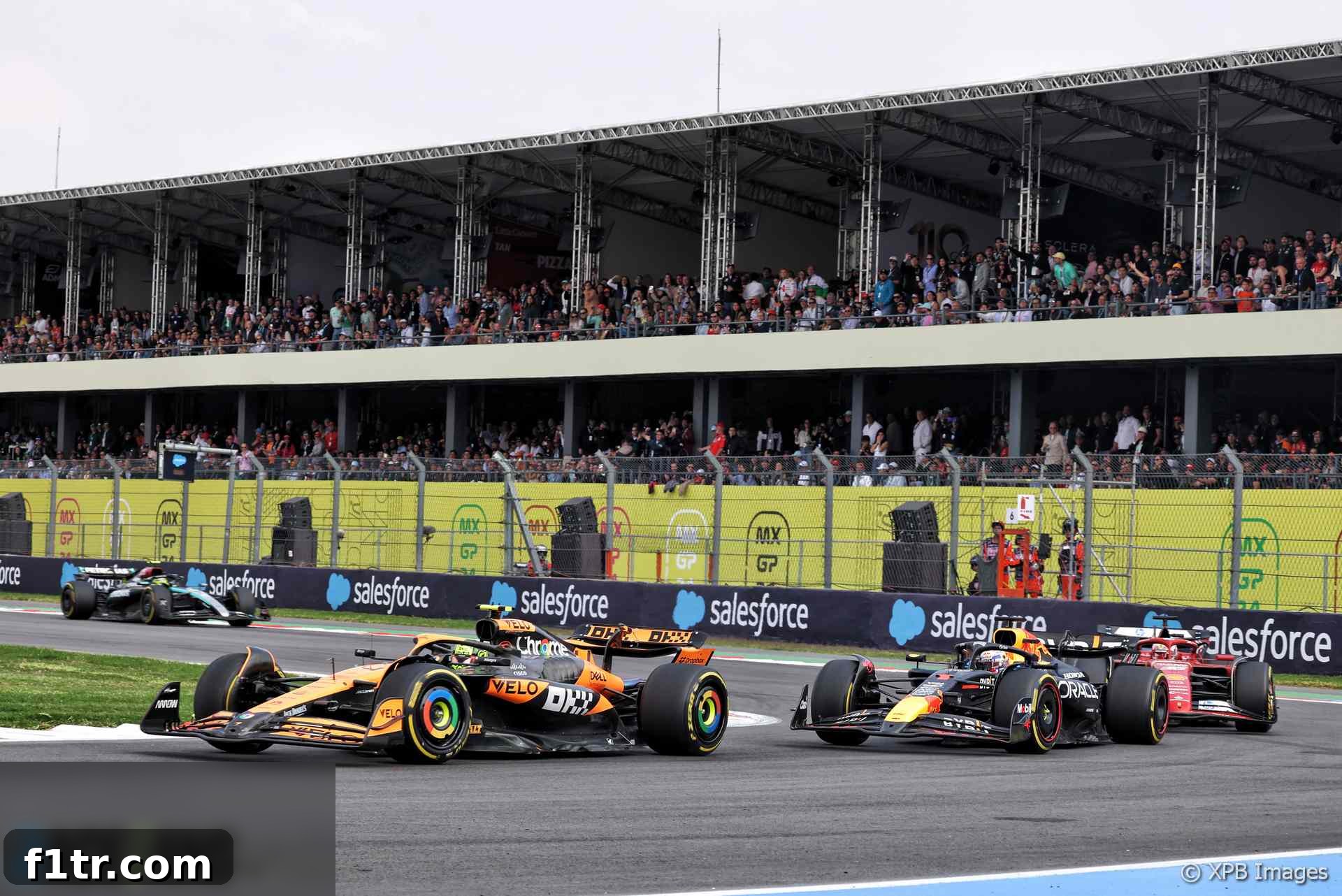
The second, and arguably more contentious, incident unfolded across Turns 7 and 8. Here, Verstappen executed an intensely aggressive maneuver, running wide at Turn 7 while attempting to overtake Norris. This audacious move sent both cars significantly off the designated track limits, allowing Charles Leclerc to swiftly capitalize by passing both entangled rivals. The stewards’ final verdict on this incident stated that Verstappen “left the track and kept the lasting advantage gaining the position, incidentally forcing Norris off the track.”
It is precisely this specific phrasing – “incidentally forcing Norris off the track” – that McLaren might identify as a critical vulnerability in the stewards’ ruling. From McLaren’s perspective, Verstappen’s ‘dive-bomb’ from a considerable distance, executed with undeniable speed and a highly aggressive trajectory, strongly suggests a deliberate, rather than accidental, action. The intent, they might argue, was to aggressively gain track position, even if it meant risking contact or compelling Norris to take evasive action off the circuit. The sheer audacity of the move made it genuinely remarkable that Norris managed to avoid a significant collision, highlighting the fine line between aggressive racing and dangerous driving.
The ‘Right of Review’: A Strategic Weapon in F1’s High-Stakes Game
The ‘Right of Review’ is not a casual appeal but a highly regulated mechanism within Formula 1’s sporting regulations, designed to address genuine errors or new evidence. Its purpose is to allow teams to petition for a reconsideration of a stewarding decision. However, this process is famously challenging, demanding that the requesting party present “a significant and relevant new element” that was demonstrably unavailable to them at the time the original decision was rendered. This exceptionally high threshold means that successful reviews are exceedingly rare, yet their potential to reshape a championship narrative can be profound.
Following Sunday’s controversial race, Red Bull team principal Christian Horner publicly shared telemetry data with journalists, aiming to substantiate his claim that Verstappen did not deliberately force Norris off track at Turn 4. However, it is improbable that this specific data could form the basis of a successful review for Red Bull’s benefit. The stewards’ initial ruling on the Turn 4 incident explicitly noted their consultation of “positioning/marshalling system data,” implying that pertinent data was already factored into their original assessment. Under the strict rules of review, additional telemetry might not be considered a truly “new element” if similar data was already available to the stewards.
The situation for McLaren regarding the Turn 7/8 incident, however, appears to offer a distinct opportunity. Crucially, in their decision for this second incident, the stewards made no explicit mention of consulting extensive telemetry or positioning data, relying primarily on video footage as the basis for their judgment. This perceived gap creates a compelling opening for McLaren. They could potentially demand a review, presenting previously unaverred telemetry data from Verstappen’s car – or even comprehensive data from Norris’s vehicle – as compelling new evidence. This data could be used to demonstrate conclusively that Verstappen’s action was not merely “incidental,” but a deliberate and aggressive maneuver calculated to force Norris off the racing line. Such detailed, quantitative evidence could significantly influence the stewards to reconsider the severity and intent of the infringement, potentially leading to a harsher verdict.
The Strategic Payoff: Points, Pressure, and Precedent
Should McLaren successfully persuade the stewards that Verstappen’s Turn 7/8 offense was more egregious than initially judged, the ramifications for Red Bull and the championship standings could be profound. A stiffer penalty, most likely in the form of additional time added to Verstappen’s race result, could demote him further down the classification. This scenario might see him drop behind drivers such as Kevin Magnussen or even McLaren’s own Oscar Piastri. Such a shift would not only strip Verstappen of valuable championship points but also provide a critical boost to McLaren in the fiercely contested constructors’ championship, especially if Piastri moves up a position or two.
Beyond the immediate points impact, an upgraded penalty for Turn 7/8 could result in additional penalty points being levied against Verstappen’s super license. Having already accrued two points from the Turn 4 incident, placing him halfway towards an automatic race ban, any further points would significantly intensify the pressure on the reigning champion. Verstappen, celebrated for his aggressive and uncompromising racing style, would be forced to exercise extreme caution across the remaining five races (including any sprint events). This heightened awareness of potential suspension could subtly influence his on-track approach, potentially leading to a more conservative style that could, in turn, benefit his rivals who are pushing the limits.
An Unprecedented Tactical Chess Match in Formula 1
The notion of a rival team actively seeking a harsher penalty for a competitor might appear audacious or even unsportsmanlike, but it is a tactic rooted in the intense realities of championship battles. While perhaps unprecedented in its direct intent, the spirit of such a move has historical parallels. Red Bull themselves, embroiled in their epic 2021 championship duel with Mercedes, famously pursued a tougher penalty for Lewis Hamilton following his high-profile collision with Verstappen at the British Grand Prix, although their attempt was ultimately unsuccessful. This historical context underscores the extraordinary lengths to which teams are prepared to go when the ultimate prize is at stake.
McLaren will undoubtedly be acutely aware that the probability of successfully securing a more severe penalty for Verstappen remains low, given the rigorously high bar for review requests. Nevertheless, the strategic value of initiating such a move extends far beyond merely altering a race result. It serves as a potent psychological tool, maintaining relentless pressure on their championship rivals, drawing increased public and official scrutiny to Verstappen’s aggressive driving tactics, and potentially influencing future stewarding decisions by setting a precedent for what is deemed acceptable on track. This long-term strategic play could prove invaluable in a tightly contested championship.
In a championship battle as intense and finely balanced as the current season, both teams are meticulously scrutinizing every available opportunity to gain even the slightest advantage. We could genuinely be on the verge of witnessing an extraordinary and possibly unprecedented scenario: both McLaren and Red Bull Racing filing ‘Right of Review’ requests, each pursuing diametrically opposing outcomes for the same or related incidents. The underlying rationale would be clear – in such a high-stakes environment, if one side is anticipated to challenge a ruling, the other must also formally present its case to safeguard its interests and control the narrative. This dual challenge would elevate the off-track drama to unprecedented levels, captivating fans and pundits alike.
The clock is rapidly ticking down for these pivotal decisions, with the Formula 1 calendar moving swiftly. The world eagerly awaits to see if the championship contenders will engage in yet another significant off-track confrontation that could profoundly impact the title fight. The outcome of these potential reviews holds the power to significantly reshape the remainder of the season, adding another fascinating and unpredictable layer to an already captivating championship narrative. The next chapter of this intricate legal and sporting chess match is expected to unfold very soon, potentially altering the very course of the 2024 Formula 1 season.
2024 Mexican Grand Prix & Related F1 News
- McLaren have no regrets over pitting Norris shortly before red flag came out
- Leclerc fined, avoids same penalty as Verstappen after apologising for swearing
- Leclerc not in the clear over swearing as Verstappen claims he went unpunished
- Majority of drivers wanted racing rules to change “straight away” – Russell
- Verstappen was “over the limit” with Norris but others would do same – Leclerc
Browse all 2024 Mexican Grand Prix articles