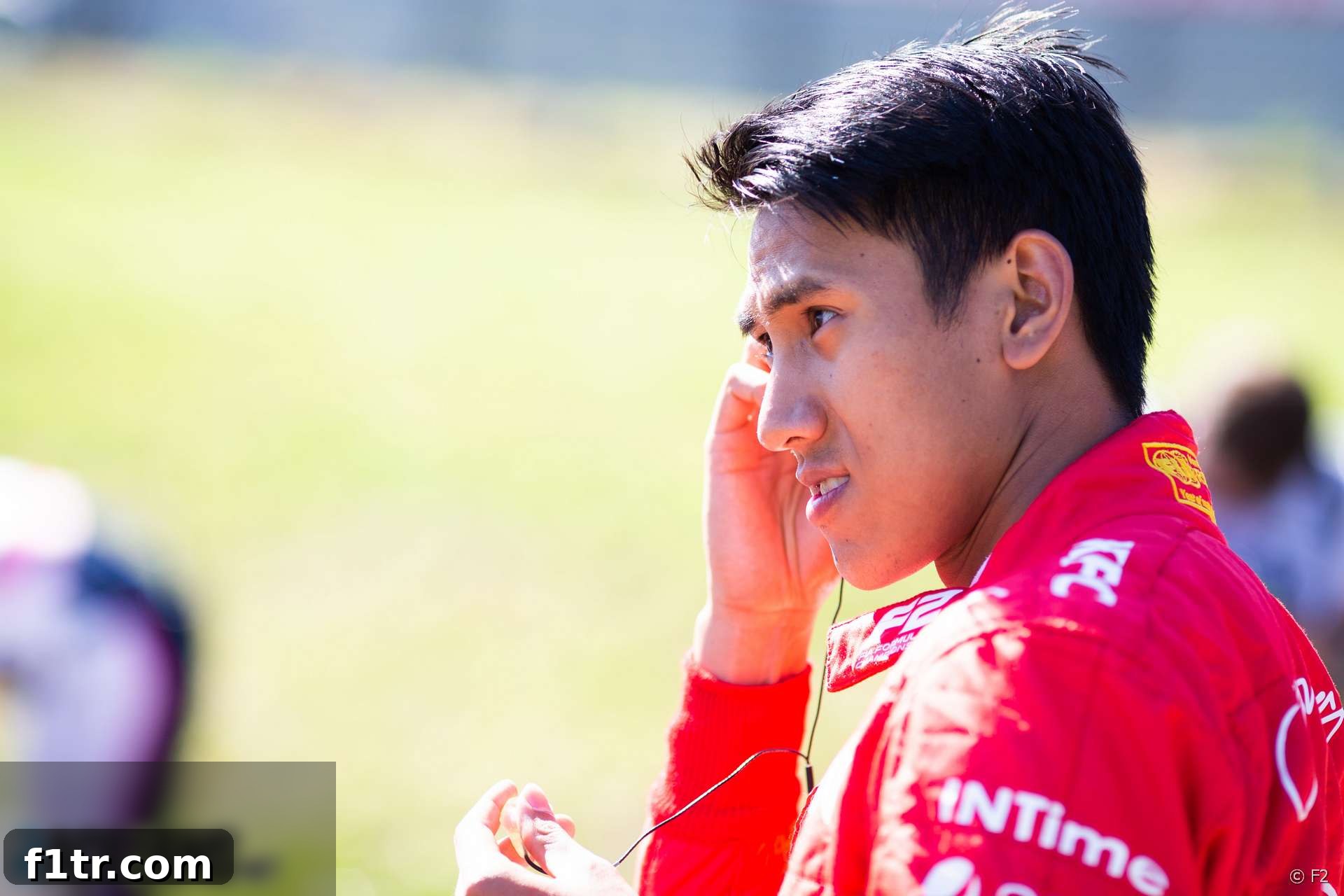
Sean Gelael’s Controversial Silverstone Withdrawal: On the Brink of an F2 Ban
The intense competition and unforgiving regulations of Formula 2, often hailed as the primary stepping stone to Formula 1, frequently place drivers under immense pressure. At the 2019 Silverstone round, Prema Racing driver Sean Gelael found himself at the epicenter of a significant controversy, ultimately leading to his withdrawal from both scheduled races. The decision came as Gelael moved perilously close to an automatic one-race ban, accumulating 10 penalty points on his Super Licence after a revised stewards’ decision following an incident during practice. This episode not only highlighted the stringent nature of F2 penalties but also sparked a debate regarding the timing and fairness of crucial race-day rulings.
Gelael’s predicament began with an on-track collision involving fellow competitor Louis Deletraz during the Friday practice session at the iconic Silverstone Circuit. While initial assessments led to a licence endorsement, a subsequent, last-minute revision by the stewards added a three-place grid penalty to Gelael’s sanctions. This unexpected escalation propelled the Indonesian driver to within just two points of the 12-point threshold that triggers a mandatory suspension. Facing the almost certain risk of a future ban with any minor infraction, Gelael and his team made the pragmatic, albeit difficult, choice to sit out the weekend, prioritizing his eligibility for subsequent rounds of the championship over a potentially compromised Silverstone performance.
The Silverstone Incident: A Penalty Revised, A Weekend Upended
The chain of events leading to Sean Gelael’s withdrawal commenced during the Formula 2 practice session on Friday. A racing incident involving Louis Deletraz resulted in a collision that immediately drew the attention of the race stewards. Following their initial review, a decision was issued at 13:55 local time on Friday. This initial ruling included an endorsement of Gelael’s Super Licence, adding penalty points to his record. At this stage, while accumulating points, the situation did not immediately force a withdrawal, as no grid penalty was levied that would drastically alter his starting position for the upcoming races.
However, the narrative took a dramatic turn less than 24 hours later. A mere three-and-a-half hours before the lights were set to go out for the first race on Saturday, the stewards released a revised decision at 11:55. This updated ruling included a critical additional sanction: a three-place grid penalty. For Gelael, who had originally qualified in 18th position, this meant a demotion to 20th and dead last on the grid. While a three-place drop in itself might not always be season-defining, its combination with Gelael’s existing penalty points created an untenable situation that forced his hand.
The timing of this revised penalty was a significant point of contention. In the high-stakes environment of motorsport, teams and drivers meticulously plan their strategies, setup adjustments, and mental preparation based on established facts, including grid positions. A substantial change to a driver’s starting position, communicated just hours before a race, creates an impossible scenario for effective preparation. More critically for Gelael, this last-minute revision meant that entering the Silverstone races, he stood at 10 penalty points. Any further on-track incident – be it a minor collision, a track limits infringement, or an unsafe release – could have easily added the two crucial points needed to reach the 12-point threshold, leading to an automatic suspension from the next event. The risk of jeopardizing future participation proved too great, making his withdrawal a necessary, albeit painful, strategic retreat.
Bruno Michel Voices Sympathy and Regret
The controversy surrounding Sean Gelael’s withdrawal quickly garnered attention from the highest levels of the Formula 2 championship. Bruno Michel, the CEO of Formula 2, publicly expressed his understanding and regret over the handling of the matter, particularly the timing of the revised penalty. In an interview with the official Formula 2 website, Michel began by acknowledging the constraints of his role, stating, “It’s never the promoter’s place to give an opinion on the steward’s decisions.” This initial remark highlights the inherent independence of the FIA stewards and the respect the championship promoter must show for their judicial processes.
Despite this diplomatic preamble, Michel did not hold back in conveying his concern. He went on to articulate his disappointment, stating, “However, I can only regret the way Sean’s penalty was revised at the last minute just ahead of the feature race.” This direct expression of regret from the series CEO is noteworthy, as it suggests a recognition within the championship’s leadership that the late timing of the ruling created an unfair burden for Gelael. Such public comments from a figure of Michel’s stature are rare and often indicative of genuine concern about how procedural decisions impact the sport’s participants and its overall image.
Michel further emphasized his empathy for Gelael’s position, remarking, “I can fully understand Sean’s frustration and reaction.” This statement provides a crucial human element to the story, acknowledging the immense psychological and professional pressure that such a situation places on a driver. Concluding his remarks, Michel also offered a vote of confidence and support for Gelael’s continued presence in the series: “I can only hope that he will return to the grid to finish the season as he and his family have been an important part of this category for the past four years.” This plea not only underscores Gelael’s long-standing commitment and value to Formula 2 but also signals the championship’s desire for him to overcome this setback and continue his career, reinforcing the personal investment involved in junior single-seater racing.
A History of Incidents: Gelael’s Growing Penalty Tally
The Silverstone incident, while pivotal, was not an isolated event but rather the latest in a series of challenges that had accumulated penalty points for Sean Gelael throughout the 2019 Formula 2 season. This pattern of infractions played a critical role in bringing him to the precarious position he faced at Silverstone. Earlier in the year, Gelael was involved in a notable collision with his Prema Racing teammate, Mick Schumacher, during the opening lap of the feature race in France. Incidents of this nature, particularly those involving intra-team contact, often attract the attention of stewards and can result in penalty points that contribute to a driver’s overall Super Licence tally.
Even more severe was an incident at the Azerbaijan Grand Prix, where Gelael faced a significant sanction. He was disqualified from qualifying for dangerously knocking over two marshals who were assisting him in restarting his car on the track. The safety of marshals is an absolute priority in motorsport, and any actions that endanger them are met with the utmost seriousness by the FIA. Disqualification from a session is a severe penalty in itself, but the associated penalty points from such a grave breach would have substantially inflated Gelael’s total, placing him under increasing scrutiny and closer to the threshold for a ban.
Collectively, these incidents resulted in Sean Gelael reaching a total of 10 penalty points on his Super Licence. According to Formula 2 regulations, the accumulation of 12 penalty points within a 12-month period leads to an automatic one-race ban. With just two points separating him from this mandatory suspension, Gelael’s decision to withdraw from the Silverstone races becomes entirely logical. Any minor racing incident, even one not resulting in significant damage or a full investigation, could have easily tipped him over the 12-point limit, forcing him to miss the subsequent event and severely hindering his championship prospects. This scenario vividly illustrates the razor-thin margin for error that drivers navigate, where past transgressions can have significant future consequences.
The Precedent Set: Mahaveer Raghunathan’s Recent Ban
The threat of a one-race ban for accumulating 12 penalty points is not merely a theoretical clause in the Formula 2 rulebook; it is a very real consequence that had already impacted another driver just prior to Gelael’s situation. Mahaveer Raghunathan, a competitor in the same championship, had recently returned to the grid at Silverstone after serving a one-race ban he incurred at the Paul Ricard circuit. Raghunathan’s case served as a stark and immediate reminder of the strict enforcement of the penalty point system.
Notably, Raghunathan accumulated a significant nine penalty points during a single race weekend at Paul Ricard, underscoring how rapidly a driver can reach the ban threshold if multiple infractions occur. His suspension clearly demonstrated that the FIA and Formula 2 authorities were resolute in enforcing the regulations without exception, irrespective of a driver’s performance or team affiliation. This precedent would undoubtedly have been a major factor in Sean Gelael’s and Prema Racing’s considerations. Witnessing a fellow driver sidelined for accumulating points reinforced the tangible reality of Gelael’s own precarious position, making the strategic withdrawal at Silverstone a pragmatic, albeit difficult, decision to prevent a similar fate at a potentially more critical juncture of the championship season.
Implications for Prema Racing and The Road Ahead for Gelael
Sean Gelael’s absence at Silverstone carried tangible implications for his highly regarded team, Prema Racing. As one of the most successful outfits in junior motorsport, Prema relies on consistent points contributions from both its drivers to compete for the prestigious Constructors’ Championship. While Prema Racing did not issue a public statement or respond to RaceFans’ requests for comment regarding Gelael’s situation, their silence could be interpreted in various ways – from respecting the judicial process to engaging in internal discussions about how to best manage such a challenging scenario. The loss of a driver, even for a single event, directly translates to a significant reduction in potential points scored, thereby impacting their standing in the championship.
Following the Silverstone round, the Formula 2 calendar provided a brief respite. The series did not support Formula 1 at the subsequent German Grand Prix, offering a crucial break for teams and drivers. This hiatus meant that the championship would resume at the Hungaroring next month. For Sean Gelael, this interval provided an invaluable opportunity for reflection and preparation, allowing him to regroup away from the immediate pressures of competition, while still acutely aware that he carried 10 penalty points. His eventual return at the Hungaroring would be closely scrutinized, as he would need to demonstrate impeccable conduct on track to avoid crossing the dreaded 12-point threshold. The focus for both Gelael and Prema Racing would undeniably shift towards effective risk management, ensuring clean, disciplined races while simultaneously striving for competitive performance in the remaining rounds of the season.
The entire controversy surrounding Sean Gelael’s revised penalty and subsequent withdrawal at Silverstone stands as a potent reminder of the intricate balance between sporting justice, driver welfare, and the high-pressure environment inherent in top-tier junior motorsport. It underscores the critical importance of clear, timely, and consistent application of regulations, not only for the integrity and fairness of the sport but also for the aspiring careers of the young talents who dedicate their lives to reaching the pinnacle of Formula 1.
Related Formula 2 Articles
- Formula 2 to debut in Miami and Montreal after Iran war cancellations
- Ex-McLaren junior Dunne’s move to Alpine finally confirmed
- Schumacher says his IndyCar feels like ‘an F2 car, just with better tyres’
- The Formula 2 team with an older driver line-up than almost half the F1 grid
- FIA to award more F1 superlicence points to Indycar drivers from 2026
Browse all Formula 2 articles