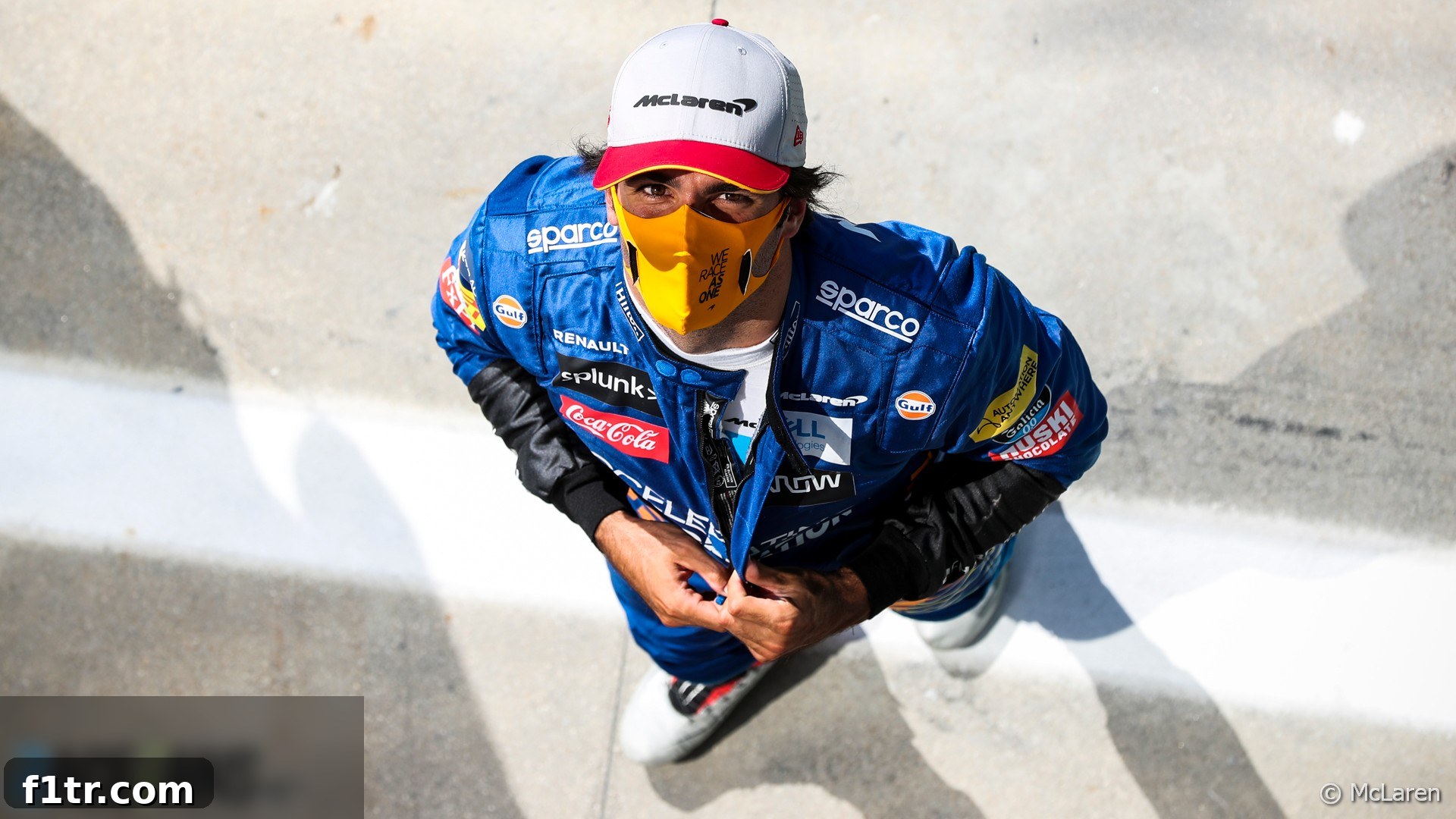
Carlos Sainz Jnr: A Defining 2020 Formula 1 Season of Resilience and Remarkable Performance
The 2020 Formula 1 season proved to be a pivotal year for Carlos Sainz Jnr, serving as a powerful testament to his talent and determination. Finishing sixth in the Drivers’ Championship, just as he did in 2019, Sainz’s performance should have given Red Bull Racing significant cause for reflection. The Spanish driver, whom Red Bull introduced to Formula 1 through their junior team Toro Rosso, was famously overlooked for a promotion to the senior squad. Instead, he forged his own path, ultimately securing a coveted seat at Ferrari. The irony was not lost on many when Sainz concluded his 2020 campaign with the exact same points tally as Alexander Albon, Red Bull’s latest driver to struggle in the challenging second seat alongside Max Verstappen.
Sainz’s 2020 championship position, however, barely scratched the surface of his true potential and the quality of his drives. Throughout the season, he consistently delivered exceptional results for McLaren, often extracting more performance from his MCL35 than many believed possible. His journey was also frequently marred by bad luck and unforeseen circumstances, suggesting that his final points total and championship standing could have been significantly higher had fortune been on his side.
Advert | Become a Supporter & go ad-free
Early Season Adversity: Misfortune Strikes Silverstone
The season began with promising signs for Sainz. He secured a strong fifth-place finish in the opening Austrian Grand Prix, immediately demonstrating McLaren’s competitive pace. This was followed by a superb qualifying performance in treacherous wet conditions at the Styrian Grand Prix, where he sensationally put his McLaren third on the grid. Hopes were high, but fate had other plans as the championship moved to Silverstone.
The British Grand Prix marked the beginning of Sainz’s streak of misfortune. With only two laps remaining, he was comfortably running in fifth position, poised to score valuable points. However, a sudden tyre failure on his car dramatically dashed his hopes, forcing him out of the points-scoring positions. This was a bitter pill to swallow, robbing him of a strong result through no fault of his own.
The challenges continued into the second race weekend at Silverstone, the 70th Anniversary Grand Prix. It became increasingly clear that Sainz’s car was suffering from a straight-line speed deficit compared to his teammate Lando Norris’s. Despite his best efforts, he recorded his second consecutive 13th-place finish, a frustrating outcome given his earlier promise. Recognizing the issue, McLaren fitted a new power unit for Sainz’s home race, the Spanish Grand Prix. This change had an immediate positive impact, as he duly delivered a fine sixth-place finish, expertly navigating his way behind the dominant Mercedes duo, Max Verstappen, and the two Racing Points.
The Thrills and Spills of Mid-Season: Monza’s Near-Victory
The subsequent few races presented a dramatic mixture of highs and lows for Sainz, encapsulating the unpredictable nature of Formula 1. His newly fitted power unit, which had performed well in Spain, unfortunately developed a problem before the Belgian Grand Prix, preventing him from even starting the race at Spa. This heartbreaking setback further compounded his early season frustrations, denying him another opportunity to score points.
However, the Italian Grand Prix at Monza provided one of the standout moments of his career and the entire 2020 season. At the Temple of Speed, Sainz pulled off another brilliant qualifying performance, securing third place on the grid, once again behind the formidable Mercedes cars. In the race, he rapidly climbed to second, showcasing exceptional pace and race management. A chaotic race, including a Safety Car period and a red flag, shuffled the order dramatically. Crucially, the timing of the red flag benefited Pierre Gasly, who had pitted just before the stoppage. This stroke of luck allowed Gasly to take the lead. Sainz, refusing to give up, mounted a relentless charge in the closing laps, chasing the AlphaTauri driver down to the very finish line. He ultimately crossed the line just four-tenths of a second behind Gasly, securing a superb second place. Had circumstances been slightly different, this might very well have been Sainz’s maiden Formula 1 victory, a moment that underscored his formidable talent.
Advert | Become a RaceFans supporter andgo ad-free
Sainz’s miserable luck, however, made an unwelcome return at the Tuscan Grand Prix at Mugello. In a race punctuated by multiple incidents, he was one of several drivers eliminated in a multi-car pile-up following a Safety Car restart. This was another race where a promising start quickly turned into a disappointing DNF. Yet, not all misfortunes could be attributed to external factors. At the Russian Grand Prix in Sochi, Sainz was accountable for his own retirement, misjudging his braking into turn two on the very first lap, taking himself out of the race. These incidents, while frustrating, highlighted the fine margins and intense pressure under which Formula 1 drivers operate.
Unwavering Consistency: The Statistical Picture of Sainz’s 2020
Carlos Sainz Jnr |
|
|---|---|
| Beat team mate in qualifying | 8/17 |
| Beat team mate in race | 7/13 |
| Races finished | 14/17 |
| Laps spent ahead of team mate | 581/864 |
| Qualifying margin | -0.05s |
| Points | 105 |
While statistics never tell the full story, the raw data from Carlos Sainz Jnr’s 2020 season paints a picture of a remarkably consistent and competitive driver. He finished 14 of the 17 races, a testament to his ability to bring the car home even under challenging circumstances, though his three DNFs were costly. His head-to-head record against teammate Lando Norris was closely contested, beating him in qualifying 8 out of 17 times and in races 7 out of 13 completed events. The minuscule qualifying margin of -0.05 seconds against his teammate underlines just how closely matched the McLaren pair were, pushing each other to higher levels of performance.
More impressive was his ability to spend 581 out of 864 laps ahead of his teammate, demonstrating strong race pace and strategic execution. His 105 points were a solid return for a driver in a midfield team, showcasing his capacity to capitalize on opportunities and convert strong positions into valuable championship points. These numbers, combined with the detailed race narratives, solidify the argument that Sainz was consistently performing at an elite level, often exceeding the machinery at his disposal and proving his credentials as a top-tier F1 talent.
A Powerful Finish: Climbing the Championship Ladder
Following the mid-season turbulence, Carlos Sainz Jnr mounted an extraordinary comeback towards the end of the season, showcasing his resilience and exceptional race craft. This powerful run-in saw him climb from 11th to an impressive sixth place in the Drivers’ Championship, a significant achievement for a midfield driver. His determination to rebound from adversity was evident in every race.
At the Eifel Grand Prix held at the Nürburgring, Sainz secured a commendable fifth-place finish, proving his adaptability to challenging track conditions. The Portuguese Grand Prix at Algarve provided another memorable performance. Starting from seventh on the grid, Sainz executed a brilliant start on the slippery circuit, vaulting an astonishing six positions in just two laps to take the lead. Although starting on the softer compound tyres ultimately proved to be a strategic disadvantage as the race progressed and grip levels changed, leading to him dropping back to sixth, his initial charge was a masterclass in aggressive yet controlled driving. McLaren’s capabilities around this time were realistically illustrated by his seventh-place finish at Imola, indicating that he was consistently extracting the maximum from the package.
Perhaps most remarkable were his back-to-back fifth-place finishes in the following two races, despite qualifying a lowly 15th for both events. At the Turkish Grand Prix in Istanbul, Sainz navigated the treacherous, low-grip conditions with extreme care and effectiveness, meticulously working his way through the field to claim a well-deserved fifth. A week later, at the Bahrain Grand Prix, he again demonstrated his ability to rebound. After a brake-by-wire problem severely hampered his qualifying session, confining him to 15th on the grid, Sainz once more showcased incredible recovery driving in the race. He then capped off his McLaren career with an emphatic performance at the Sakhir Grand Prix. A terrific start propelled him forward, and he expertly managed the race to secure a superb fourth place, marking his ninth top-six finish of the season. This final flourish was a perfect way to sign off from a team where he had truly flourished.
Advert | Become a RaceFans supporter andgo ad-free
Sainz’s Driving Prowess: Resilience, Racecraft, and Adaptability
The 2020 season cemented Carlos Sainz Jnr’s reputation as one of Formula 1’s most complete and cerebral drivers. His consistent ability to perform under pressure, recover from setbacks, and deliver strong results—even when luck was against him—spoke volumes about his resilience. He is renowned for his exceptional race craft, demonstrated by his uncanny ability to make overtakes stick, manage tyre degradation, and navigate complex race situations with a calm and strategic approach. His starts, particularly at Algarve and Sakhir, were often spectacular, allowing him to gain crucial positions early in the race. Furthermore, his adaptability to varying track conditions, from the wet qualifying at Styria to the slippery conditions in Turkey, showcased a driver who could quickly find the limit and extract performance regardless of the environment. His nickname, “Smooth Operator,” was well-earned, reflecting his precise driving style and composed demeanor both on and off the track. These qualities made him an invaluable asset to McLaren and undoubtedly played a significant role in his subsequent move to Ferrari.
Red Bull’s Reflection: A Missed Gem?
Carlos Sainz Jnr’s exceptional 2020 season inevitably reignited discussions about Red Bull’s driver management strategy. Having been part of their junior program and competed for Toro Rosso, the decision to promote Pierre Gasly and then Alexander Albon over Sainz for the senior Red Bull seat now appears, in retrospect, to be a significant missed opportunity. Sainz consistently demonstrated the speed, consistency, and mental fortitude that Red Bull had been seeking in a teammate for Max Verstappen. His ability to score 105 points in a McLaren, directly matching Albon’s tally in the seemingly superior Red Bull car, provided a stark comparison. This performance highlighted Sainz’s readiness for a top team and underscored the challenges faced by drivers in Red Bull’s high-pressure environment, while simultaneously validating Sainz’s decision to seek success away from the Red Bull umbrella.
Setting the Stage for Ferrari: The Legacy of 2020
Carlos Sainz Jnr’s stellar 2020 campaign was more than just a successful year; it was a powerful audition for his future at Ferrari. His strong results, unwavering consistency, and demonstrated ability to lead a team’s charge against formidable rivals proved that he possessed the necessary qualities to thrive in a top-tier environment. The experience gained in battling for third in the Constructors’ Championship with McLaren, coupled with his personal growth as a driver, laid a robust foundation for his move to Maranello. He arrived at Ferrari not just as a competent driver, but as a proven leader and point-scorer, ready to contribute immediately to the Scuderia’s ambitions. The legacy of his 2020 season was the solid confidence it instilled in him and the F1 paddock that he was truly ready for the biggest challenge of his career.
Conclusion: A Champion’s Spirit in a Competitive Year
Carlos Sainz Jnr’s 2020 Formula 1 season was a remarkable display of talent, resilience, and consistent performance. Despite frequent encounters with bad luck and racing incidents, he consistently extracted outstanding results from his McLaren MCL35, a car that was statistically the fourth-quickest of the year. His ability to bounce back from adversity, deliver sensational drives, and play a crucial role in McLaren’s fight for third in the Constructors’ Championship underscored his status as one of the sport’s most impressive drivers. The season not only solidified his reputation but also paved the way for his highly anticipated move to Ferrari, proving that Sainz was indeed a “smooth operator” destined for the sport’s biggest stages.
2020 F1 Season Review: Further Driver Rankings
- 2020 F1 season driver rankings #1: Lewis Hamilton
- 2020 F1 driver rankings #2: Max Verstappen
- 2020 F1 driver rankings #3: Charles Leclerc
- 2020 F1 driver rankings #4: Carlos Sainz Jnr
- 2020 F1 driver rankings #5: Daniel Ricciardo
Browse all 2020 F1 season review articles