2019 Spanish Grand Prix: Mercedes Dominates, Ferrari Grapples with Strategy and Pit Stop Errors
The 2019 Formula 1 season delivered another captivating chapter at the Circuit de Catalunya for the Spanish Grand Prix. This event proved to be a pivotal moment, further solidifying Mercedes’ early-season dominance while highlighting the persistent challenges faced by Ferrari in their quest for championship contention. From controversial driver swaps to critical pit stop errors and impressive midfield battles, the Spanish Grand Prix offered a wealth of talking points for Formula 1 enthusiasts and strategists alike.
Located near Barcelona, the Circuit de Catalunya is renowned for being one of the most challenging tracks for overtaking on the Formula 1 calendar. Its long straights are often insufficient to compensate for the high-speed corners that make following another car extremely difficult, even with the aid of DRS. This characteristic typically translates into races where grid position holds paramount importance, and strategic brilliance, or lack thereof, can dramatically alter a driver’s fortunes. Indeed, the 2019 edition largely followed this trend, with most drivers finishing close to their starting positions, underscoring the circuit’s inherent nature to favor track position over outright pace differences.
Ferrari’s Strategic Quandaries and Operational Setbacks
For Ferrari, the 2019 Spanish Grand Prix presented a mixed bag of strategic decisions and operational challenges that ultimately hampered their performance. Following a similar incident in China earlier in the season, the Scuderia once again found themselves under scrutiny for their handling of driver order. This time, however, the rationale behind their decisions was arguably clearer, yet still sparked considerable debate amongst fans and pundits.
Throughout the race, Ferrari opted to swap the running order of Sebastian Vettel and Charles Leclerc twice. Early in the Grand Prix, Vettel, starting from P3, had a slow getaway, allowing his teammate Charles Leclerc to move ahead. Ferrari then controversially ordered Leclerc to let Vettel pass, believing Vettel possessed better pace on his fresh tires. This initial swap, while aiming to optimize overall team performance, reignited discussions about team orders and the perceived favoritism towards Vettel. Later, as tire strategies diverged, Leclerc was eventually pitted earlier and found himself on a different compound, which ultimately led to him regaining track position over Vettel after his second stop. These complex maneuvers, though intended to maximize the team’s points haul, led many to question if the switches should have occurred even sooner to more effectively challenge the dominant Mercedes cars.
Adding significantly to Ferrari’s woes were critical issues during their initial pit stops. Both Sebastian Vettel and Charles Leclerc experienced delays, losing approximately two seconds each due to cross-threaded wheel nuts. In the high-stakes environment of Formula 1, where milliseconds can determine race outcomes and championship points, such operational delays are incredibly costly. While the team managed to rectify these problems for their subsequent pit stops, which were notably among the fastest of the race, the damage from the first stops was already done. These operational glitches undoubtedly hampered their ability to challenge the formidable Mercedes cars and likely cost them valuable track positions, contributing to a frustrating Sunday for the Italian squad.
Mercedes’ Unstoppable Form: Hamilton and Bottas Deliver Another Clinical One-Two
While Ferrari grappled with internal challenges, Mercedes continued their stellar run of form, securing yet another commanding one-two finish. Lewis Hamilton, starting from second on the grid, executed a brilliant start to overtake pole-sitter Valtteri Bottas, effectively seizing control of the race from the opening lap. Hamilton’s performance was flawless, demonstrating exceptional pace, masterful tire management, and unwavering control throughout the Grand Prix, ultimately extending his lead in the Drivers’ Championship.
Valtteri Bottas, despite losing the lead at the start, drove a solid and controlled race to secure second place, ensuring maximum points for the Silver Arrows. The Mercedes W10 chassis once again proved to be perfectly suited to the demands of the Circuit de Catalunya, showcasing its superior aerodynamic efficiency and remarkable tire management capabilities. Their strategic calls were also spot on, allowing both drivers to manage their tires effectively and maintain a comfortable gap to the chasing pack. This relentless performance from Mercedes underscored their undeniable advantage in the early stages of the 2019 season, leaving competitors like Ferrari and Red Bull struggling to keep pace.
Midfield Drama: Heroics, Pitfalls, and Strategic Blunders
Beyond the front-runners, the 2019 Spanish Grand Prix was rich with compelling narratives from the highly competitive midfield. One of the most remarkable drives came from Nico Hulkenberg. After a disappointing crash in qualifying that forced him to start from the pit lane, the Renault driver mounted an incredible recovery. Hulkenberg skillfully navigated through the field with a well-executed strategy, gaining an impressive seven places – more than any other driver – to finish within sight of his teammate. His tenacious drive offered significant redemption after Saturday’s incident and highlighted his resilience and excellent car control.
Conversely, for his teammate Daniel Ricciardo and the Renault team, the race proved to be another strategic disappointment. Ricciardo made one of the few on-track overtakes seen during the early phase of the race, skillfully passing Carlos Sainz Jnr. However, Renault’s decision to put Ricciardo on the hard compound tires (C1) for his second stint did not yield the desired results. While Sainz pressed on to secure a valuable points finish for McLaren, Ricciardo’s pace significantly faded on the harder compound, causing him to slip down to 12th position, just outside the points. This marked another instance where Renault’s race strategy left much to be desired, echoing Ricciardo’s reported dissatisfaction with their tactics in Bahrain earlier in the season. The team’s inability to consistently extract optimal performance through strategic calls became a recurring theme, hindering their progress in the Constructors’ Championship.
Max Verstappen, driving for Red Bull Racing, continued to impress with a stellar performance, securing a well-deserved podium finish. Starting from fourth, Verstappen capitalized on Ferrari’s issues and drove a consistent, error-free race to claim third place. His ability to maintain strong pace and manage his tires effectively, combined with a robust strategy from Red Bull, placed him firmly ahead of both Ferraris. This performance further cemented his reputation as a formidable force in Formula 1, consistently challenging the top teams.
Visualizing Race Dynamics: Understanding Lap and Race Charts
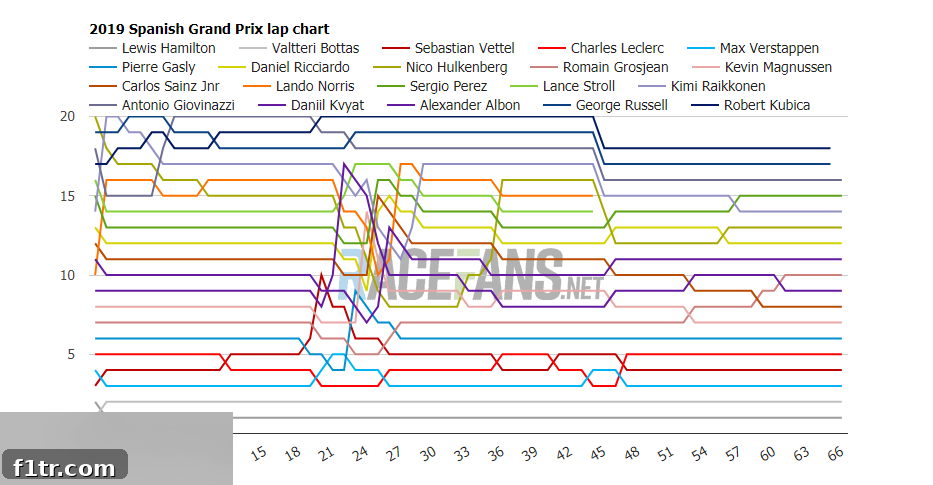
While dynamic interactive charts are typically used to convey race progress in real-time, we can interpret the invaluable data they represent for a comprehensive race analysis. A conventional 2019 Spanish Grand Prix Lap Chart would visually track each driver’s position on every single lap of the race. Such a chart vividly illustrates overtakes, the immediate impacts of pit stops, and overall progress through the field. For instance, one could easily identify Nico Hulkenberg’s steady climb through the ranks or any driver experiencing significant losses after a slow pit stop or a strategic misstep, offering clear graphical evidence of fluctuating track positions.
Similarly, a 2019 Spanish Grand Prix Race Chart provides a crucial visualization of the time gaps between each driver relative to the leader’s average lap time. This type of chart helps spectators and analysts understand how gaps fluctuate, identify who is consistently gaining or losing time relative to their rivals, and assess the effectiveness of different tire strategies over long stints. It highlights periods of intense pressure or comfortable cruising for various drivers, offering deeper insights into the competitive dynamics of the race, with very large gaps often omitted to maintain clarity and focus on relevant battles.
Position Changes: Analyzing the Movers and Shakers
The Circuit de Catalunya’s notorious reputation for difficult overtaking means significant position changes from start to finish are rare, making those that do occur all the more noteworthy. The table below details how each driver fared from their starting grid position to their position at the end of lap one, and then their final race position. This data provides a clear snapshot of initial race gains or losses, as well as overall performance and efficiency throughout the Grand Prix.
| Driver | Start position | Lap one position change | Race position change |
|---|---|---|---|
| Lewis Hamilton | 2 | 1 | 1 |
| Valtteri Bottas | 1 | -1 | -1 |
| Sebastian Vettel | 3 | -1 | -1 |
| Charles Leclerc | 5 | 0 | 0 |
| Max Verstappen | 4 | 1 | 1 |
| Pierre Gasly | 6 | 0 | 0 |
| Daniel Ricciardo | 13 | 1 | 1 |
| Nico Hulkenberg | 20 | 2 | 7 |
| Romain Grosjean | 7 | 0 | -3 |
| Kevin Magnussen | 8 | 0 | 1 |
| Carlos Sainz Jnr | 12 | 1 | 4 |
| Lando Norris | 10 | -6 | |
| Sergio Perez | 15 | 2 | 0 |
| Lance Stroll | 16 | 2 | |
| Kimi Raikkonen | 14 | -6 | 0 |
| Antonio Giovinazzi | 18 | 3 | 2 |
| Daniil Kvyat | 9 | 0 | 0 |
| Alexander Albon | 11 | 1 | 0 |
| George Russell | 19 | 0 | 2 |
| Robert Kubica | 17 | 0 | -1 |
As clearly observed from the data, Nico Hulkenberg’s incredible seven-place gain from a pit lane start stands out as the most significant positive movement of the race, highlighting his exceptional performance and Renault’s effective strategy for his car. Carlos Sainz Jnr also demonstrated strong race craft and consistent pace, climbing four positions to secure a valuable points finish for McLaren. At the very front, Lewis Hamilton improved by one position from his start to take the lead, while Valtteri Bottas and Sebastian Vettel each lost one, largely due to initial race dynamics and strategic plays. Conversely, Lando Norris and Kimi Raikkonen experienced notable drops in position during the initial phase, indicating challenges on lap one that they struggled to recover from.
Understanding Lap Times: The Pace Battlefield Unveiled
Detailed lap time data for every driver across the 2019 Spanish Grand Prix provides critical insights into consistent pace, tire degradation, and the overall effectiveness of different race strategies. An interactive chart, if available, would typically allow users to visualize these fluctuations, highlighting periods of strong performance, struggles, or strategic pushes. Analyzing these times would reveal precisely how drivers managed their tires, when they chose to push the limits, and the overall rhythm of their race stints. It often correlates directly with tire strategy and pit stop timing, with faster laps typically occurring on fresher, softer compounds or as fuel loads lighten towards the end of a stint.
Fastest Laps: Who Unlocked the Ultimate Pace?
The fastest lap of a Grand Prix is a coveted achievement, often demonstrating a car’s ultimate performance potential or a driver’s ability to extract maximum pace at a crucial moment. The table below outlines each driver’s single fastest lap time achieved during the 2019 Spanish Grand Prix, along with the gap to the quickest lap of the race and the specific lap number on which it was achieved. This data helps assess pure speed, car efficiency, and the moments drivers truly pushed their machines.
| Rank | Driver | Car | Fastest lap | Gap | On lap |
|---|---|---|---|---|---|
| 1 | Lewis Hamilton | Mercedes | 1’18.492 | 54 | |
| 2 | Valtteri Bottas | Mercedes | 1’18.737 | 0.245 | 55 |
| 3 | Max Verstappen | Red Bull-Honda | 1’19.769 | 1.277 | 57 |
| 4 | Sebastian Vettel | Ferrari | 1’19.820 | 1.328 | 64 |
| 5 | Charles Leclerc | Ferrari | 1’20.002 | 1.510 | 57 |
| 6 | Pierre Gasly | Red Bull-Honda | 1’20.536 | 2.044 | 57 |
| 7 | Daniel Ricciardo | Renault | 1’20.615 | 2.123 | 56 |
| 8 | Daniil Kvyat | Toro Rosso-Honda | 1’20.726 | 2.234 | 64 |
| 9 | Kevin Magnussen | Haas-Ferrari | 1’20.770 | 2.278 | 66 |
| 10 | Carlos Sainz Jnr | McLaren-Renault | 1’20.859 | 2.367 | 59 |
| 11 | Alexander Albon | Toro Rosso-Honda | 1’21.028 | 2.536 | 65 |
| 12 | Romain Grosjean | Haas-Ferrari | 1’21.057 | 2.565 | 64 |
| 13 | Nico Hulkenberg | Renault | 1’21.282 | 2.790 | 65 |
| 14 | Kimi Raikkonen | Alfa Romeo-Ferrari | 1’21.382 | 2.890 | 66 |
| 15 | Antonio Giovinazzi | Alfa Romeo-Ferrari | 1’21.833 | 3.341 | 64 |
| 16 | Sergio Perez | Racing Point-Mercedes | 1’21.859 | 3.367 | 65 |
| 17 | George Russell | Williams-Mercedes | 1’22.382 | 3.890 | 64 |
| 18 | Lando Norris | McLaren-Renault | 1’22.561 | 4.069 | 28 |
| 19 | Robert Kubica | Williams-Mercedes | 1’23.202 | 4.710 | 65 |
| 20 | Lance Stroll | Racing Point-Mercedes | 1’23.226 | 4.734 | 28 |
Unsurprisingly, Lewis Hamilton recorded the fastest lap of the race, further demonstrating Mercedes’ superior pace and control over the field. Valtteri Bottas was a very close second, solidifying Mercedes’ top-tier performance on the circuit. Max Verstappen’s third fastest lap, impressively ahead of both Ferraris, underscored Red Bull’s competitive edge on this particular Sunday and Verstappen’s ability to extract maximum performance. It’s interesting to note that many of the fastest laps were set towards the very end of the race (laps 54-66), indicating drivers pushing hard on newer or more durable tire compounds as fuel loads decreased and track conditions evolved.
2019 Spanish Grand Prix Tyre Strategies: The Battle of Compounds
Tyre strategy is often the defining factor in modern Formula 1 races, and the 2019 Spanish Grand Prix was certainly no exception. Teams carefully planned their pit stops and tire compound choices (C1 Hard, C2 Medium, C3 Soft for this event) to optimize grip, manage degradation, and maintain crucial track position. The table below details the specific tire choices and stint lengths for each driver, providing a crucial overview of how different teams approached the tactical battle on the track.
| Stint 1 | Stint 2 | Stint 3 | |
|---|---|---|---|
| Lewis Hamilton | C3 (27) | C2 (19) | C3 (20) |
| Valtteri Bottas | C3 (26) | C2 (19) | C3 (21) |
| Max Verstappen | C3 (20) | C3 (23) | C2 (23) |
| Sebastian Vettel | C3 (19) | C2 (21) | C2 (26) |
| Charles Leclerc | C3 (25) | C1 (21) | C2 (20) |
| Pierre Gasly | C3 (22) | C2 (24) | C3 (20) |
| Romain Grosjean | C3 (26) | C2 (20) | C3 (20) |
| Kevin Magnussen | C3 (23) | C2 (22) | C3 (21) |
| Daniil Kvyat | C3 (21) | C2 (24) | C2 (21) |
| Alexander Albon | C3 (25) | C2 (20) | C2 (21) |
| Carlos Sainz Jnr | C3 (24) | C2 (22) | C3 (20) |
| Daniel Ricciardo | C3 (24) | C1 (21) | C2 (21) |
| Sergio Perez | C3 (24) | C2 (21) | C3 (21) |
| Antonio Giovinazzi | C3 (6) | C1 (35) | C3 (25) |
| Nico Hulkenberg | C2 (35) | C3 (31) | |
| Kimi Raikkonen | C2 (28) | C1 (17) | C3 (21) |
| Robert Kubica | C2 (31) | C3 (13) | C2 (21) |
| George Russell | C2 (32) | C3 (12) | C2 (21) |
| Lance Stroll | C2 (22) | C3 (22) | |
| Lando Norris | C3 (26) | C2 (18) |
Most front-runners, including Mercedes and Red Bull, opted for a relatively standard two-stop strategy, typically starting on the soft (C3) compound, then switching to mediums (C2), and potentially back to softs for a final push, or staying on a harder compound for durability, depending on track conditions and tire wear. Ferrari, with Charles Leclerc, notably tried a C1 (Hard) stint during the middle phase of the race, showcasing a different strategic approach in their attempt to find an advantage. Nico Hulkenberg’s impressive drive from the pit lane was greatly aided by a long first stint on the C2 (Medium) tires, which allowed him to gain significant track position before switching to the softer C3. The variety in strategies, especially in the midfield, underscored the importance of tire management and adaptability at Circuit de Catalunya, where tire degradation can be a major factor.
2019 Spanish Grand Prix Pit Stop Times: Crucial Seconds Lost and Gained
Pit stops are fundamental to modern Formula 1, capable of winning or losing races in mere seconds. The efficiency and precision of a pit crew can profoundly influence a driver’s race outcome, sometimes more so than raw pace on track. The following table provides a detailed breakdown of each driver’s pit stop times during the 2019 Spanish Grand Prix, highlighting both exceptional performances and costly delays that shaped the race.
| Driver | Team | Pit stop time | Gap | On lap | |
| 1 | Carlos Sainz Jnr | McLaren | 21.468 | 24 | |
| 2 | Carlos Sainz Jnr | McLaren | 21.545 | 0.077 | 46 |
| 3 | Lando Norris | McLaren | 21.579 | 0.111 | 26 |
| 4 | Charles Leclerc | Ferrari | 21.638 | 0.170 | 46 |
| 5 | Sebastian Vettel | Ferrari | 21.643 | 0.175 | 40 |
| 6 | George Russell | Williams | 21.846 | 0.378 | 44 |
| 7 | Robert Kubica | Williams | 21.954 | 0.486 | 31 |
| 8 | Valtteri Bottas | Mercedes | 22.018 | 0.550 | 45 |
| 9 | Kevin Magnussen | Haas | 22.025 | 0.557 | 23 |
| 10 | Valtteri Bottas | Mercedes | 22.034 | 0.566 | 26 |
| 11 | Daniil Kvyat | Toro Rosso | 22.049 | 0.581 | 21 |
| 12 | Pierre Gasly | Red Bull | 22.095 | 0.627 | 46 |
| 13 | Robert Kubica | Williams | 22.142 | 0.674 | 44 |
| 14 | Nico Hulkenberg | Renault | 22.193 | 0.725 | 35 |
| 15 | Lewis Hamilton | Mercedes | 22.265 | 0.797 | 27 |
| 16 | Kimi Raikkonen | Alfa Romeo | 22.342 | 0.874 | 28 |
| 17 | Daniel Ricciardo | Renault | 22.379 | 0.911 | 24 |
| 18 | Romain Grosjean | Haas | 22.379 | 0.911 | 26 |
| 19 | Antonio Giovinazzi | Alfa Romeo | 22.381 | 0.913 | 6 |
| 20 | Max Verstappen | Red Bull | 22.417 | 0.949 | 20 |
| 21 | George Russell | Williams | 22.442 | 0.974 | 32 |
| 22 | Lewis Hamilton | Mercedes | 22.511 | 1.043 | 46 |
| 23 | Max Verstappen | Red Bull | 22.540 | 1.072 | 43 |
| 24 | Kimi Raikkonen | Alfa Romeo | 22.549 | 1.081 | 45 |
| 25 | Pierre Gasly | Red Bull | 22.563 | 1.095 | 22 |
| 26 | Daniel Ricciardo | Renault | 22.702 | 1.234 | 45 |
| 27 | Romain Grosjean | Haas | 22.732 | 1.264 | 46 |
| 28 | Sergio Perez | Racing Point | 22.781 | 1.313 | 24 |
| 29 | Sergio Perez | Racing Point | 22.896 | 1.428 | 45 |
| 30 | Kevin Magnussen | Haas | 22.992 | 1.524 | 45 |
| 31 | Lance Stroll | Racing Point | 23.321 | 1.853 | 22 |
| 32 | Antonio Giovinazzi | Alfa Romeo | 23.507 | 2.039 | 41 |
| 33 | Alexander Albon | Toro Rosso | 23.591 | 2.123 | 25 |
| 34 | Charles Leclerc | Ferrari | 23.646 | 2.178 | 25 |
| 35 | Sebastian Vettel | Ferrari | 23.746 | 2.278 | 19 |
| 36 | Daniil Kvyat | Toro Rosso | 33.821 | 12.353 | 45 |
| 37 | Alexander Albon | Toro Rosso | 37.345 | 15.877 | 45 |
McLaren notably demonstrated excellent pit stop execution, with Carlos Sainz Jnr and Lando Norris consistently recording some of the fastest stops of the race. This efficiency highlights McLaren’s operational improvements and the critical role of their pit crew in securing valuable track time. Ferrari’s initial pit stop struggles are starkly evident in the longer times recorded for Charles Leclerc (23.646s) and Sebastian Vettel (23.746s) early in the race, which were among the slowest overall. These contrasting performances underscore the critical role of the pit crew in Formula 1. Furthermore, the extremely long pit stops for Daniil Kvyat and Alexander Albon later in the race, likely due to unforeseen technical issues or double stacking in the pit lane, further illustrate how quickly a race can be compromised by events outside of direct driving performance.
Conclusion: A Race of Domination and Crucial Lessons Learned
The 2019 Spanish Grand Prix at the Circuit de Catalunya was a clear demonstration of Mercedes’ formidable strength, securing a dominant one-two finish and further extending their considerable championship lead. For Ferrari, it proved to be a race that exposed strategic ambiguities and operational inconsistencies, particularly with their driver swaps and initial, costly pit stop execution. While their car’s underlying pace was competitive, their inability to execute a flawless race undermined their potential to truly challenge Mercedes.
The midfield provided ample excitement and compelling narratives, with Nico Hulkenberg’s heroic recovery drive standing out as a testament to perseverance and strategic intelligence. In contrast, Renault continued to grapple with strategic decisions that ultimately cost Daniel Ricciardo valuable championship points. Max Verstappen’s consistent and error-free performance for Red Bull allowed him to capitalize effectively on Ferrari’s missteps, securing a crucial podium finish and solidifying his position as a consistent threat. As the 2019 season progressed, all teams would undoubtedly analyze the data and lessons learned from Barcelona, striving for perfection in strategy, performance, and execution in the challenging and unforgiving world of Formula 1.
Further Reading on the 2019 Spanish Grand Prix
- 2019 Spanish Grand Prix Star Performers
- Top ten pictures from the 2019 Spanish Grand Prix
- Another Mercedes one-two sets up Hamilton vs Bottas title fight
- Paddock Diary: Spanish Grand Prix day four
- Mercedes’ return to dominance makes Schumacher’s wins record realistic for Hamilton
Browse all 2019 Spanish Grand Prix articles
Interested in ad-free content and supporting independent Formula 1 journalism? Become a supporter today and enjoy an uninterrupted experience for just £1 per month.