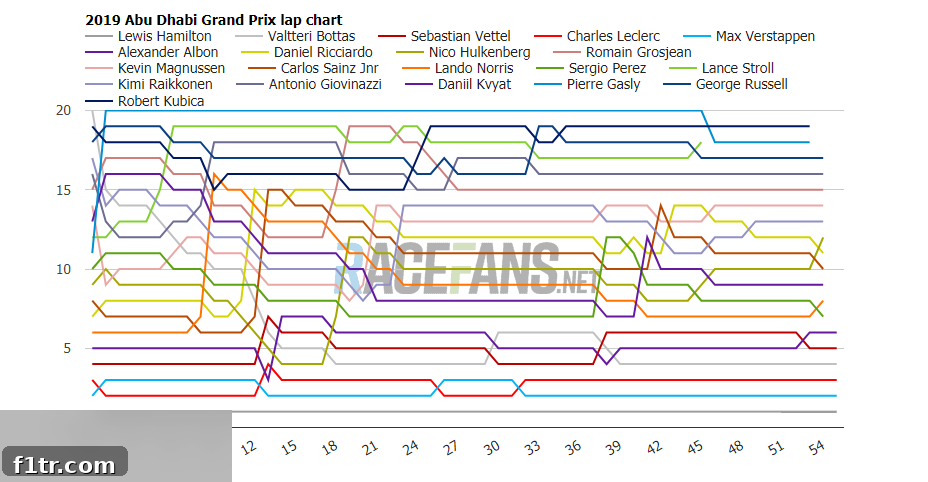
The 2019 Formula 1 season drew to a spectacular close at the Yas Marina Circuit, with Lewis Hamilton delivering a masterclass performance at the Abu Dhabi Grand Prix. Securing a dominant victory from pole position, Hamilton led every single lap of the race and even set the fastest lap, completing a rare and impressive ‘grand slam’. This commanding win served as a fitting end to a championship-winning season for the Briton, underscoring his unparalleled dominance and sealing his status as a modern-day F1 legend. The Abu Dhabi GP was more than just a celebratory drive for Hamilton; it was a testament to Mercedes’ unwavering performance and strategic prowess throughout the year, culminating in a faultless weekend that left his rivals struggling to keep pace.
While Hamilton cruised to an unchallenged victory at the front, the action unfolding behind him was anything but straightforward, particularly in the strategic department. The notoriously challenging Pirelli tyre compounds, especially the softer options, presented significant headaches for several teams. Many drivers found themselves on the knife-edge of a one-stop or two-stop strategy, constantly battling tyre degradation on the high-energy Yas Marina track. This strategic complexity added an intriguing layer to the season finale, forcing teams to make critical decisions under pressure that ultimately dictated the outcome for many contenders.
Among the teams grappling with tyre strategy, Ferrari’s approach stood out for its unconventional nature and ultimately, its questionable effectiveness. The Scuderia opted for a two-stop strategy for both their drivers, Charles Leclerc and Sebastian Vettel, implementing the highly unusual tactic of bringing them in for pit stops on the very same laps. The initial instance of this double-stack pit stop occurred when Vettel, then running in fourth, desperately needed to switch from his starting soft tyres. This move, however, triggered a defensive reaction from Red Bull, prompting them to pit Max Verstappen, who was running ahead of Vettel. In response, Ferrari was compelled to bring Leclerc in as well, sacrificing his medium tyre stint duration.
This early pit stop significantly shortened Leclerc’s first stint on the more durable medium compound tyres, a decision that proved detrimental to his race against Verstappen. Verstappen, with the advantage of a longer first stint, was able to extend his run before pitting. He subsequently emerged from his pit stop directly behind Leclerc, armed with significantly fresher tyres. The Dutchman then made swift work of passing Leclerc, solidifying his position. Ferrari’s gamble had backfired, leaving Leclerc vulnerable. The situation might have been even more difficult for Leclerc had a technical glitch that disabled DRS for the first 17 laps of the race not been resolved. The return of DRS allowed Verstappen to execute his overtake with greater ease, highlighting how crucial even seemingly minor technical issues can be in determining race dynamics.
Sebastian Vettel’s race was similarly hampered by strategic missteps and execution errors. A particularly slow first pit stop cost him valuable track position, pushing him into heavy traffic upon rejoining the circuit. This meant he lost crucial time battling through backmarkers, further compromising his ability to challenge for a higher finish. Despite these setbacks, Vettel managed to stage a late recovery, successfully overtaking Alexander Albon for fifth position in the closing stages of the race. However, he was unable to withstand the relentless charge of his former teammate, Valtteri Bottas. The Mercedes driver, starting from the back of the grid due to penalties, mounted one of the most impressive recovery drives of the season, climbing an astonishing 16 places to finish fourth. Bottas’s performance was a masterclass in aggressive yet controlled driving, demonstrating the sheer pace of the Mercedes W10 and his own formidable skill.
The midfield battle, a perennial highlight of the Formula 1 season, also delivered intense action in Abu Dhabi. For the second consecutive year, the driver who started highest on the grid using a new set of tyres emerged victorious in this fiercely contested segment. In 2018, it was Carlos Sainz Jnr who claimed the ‘best of the rest’ title. This year, it was Sergio Perez who replicated the feat, showcasing the strategic advantage of a fresh tyre start. Many of his midfield rivals, particularly the McLaren and Renault drivers, found their races compromised by having to start on older, used tyres. This disadvantage stemmed from their inability to complete Q2 on the harder compound rubber, a luxury enjoyed by the faster front-running teams who could comfortably advance to Q3 without sacrificing a fresh set of softer tyres for the race start. This subtle but significant strategic choice often dictates fortunes within the competitive midfield.
Lando Norris, in particular, demonstrated remarkable resilience and pace throughout the race, holding onto the coveted ‘best of the rest’ position for the vast majority of the Grand Prix. His performance was a testament to McLaren’s significant progress in 2019. However, in a cruel twist of fate on the very final lap, Norris fell victim to a daring and aggressive lunge from Sergio Perez. Perez, driving with characteristic tenacity, executed a superb overtake to snatch seventh place from Norris, denying the young Briton a well-deserved higher finish and underscoring the relentless competition that defines the midfield in Formula 1. The closing stages of the race, especially the fight for these crucial points, were a microcosm of the intense competition that characterized the 2019 season.
2019 Abu Dhabi Grand Prix Position Change
An overview of how each driver’s position evolved from the start of the race, including their first lap gains or losses and their overall change by the checkered flag. This table highlights those who made significant progress or fell back through the field.
| Driver | Start position | Lap one position change | Race position change |
|---|---|---|---|
| Lewis Hamilton | 1 | 0 | 0 |
| Valtteri Bottas | 20 | 5 | 16 |
| Sebastian Vettel | 4 | 0 | -1 |
| Charles Leclerc | 3 | 1 | 0 |
| Max Verstappen | 2 | -1 | 0 |
| Alexander Albon | 5 | 0 | -1 |
| Daniel Ricciardo | 7 | -1 | -4 |
| Nico Hulkenberg | 9 | -1 | -3 |
| Romain Grosjean | 15 | -2 | 0 |
| Kevin Magnussen | 14 | 5 | 0 |
| Carlos Sainz Jnr | 8 | 1 | -2 |
| Lando Norris | 6 | 0 | -2 |
| Sergio Perez | 10 | -1 | 3 |
| Lance Stroll | 12 | 0 | |
| Kimi Raikkonen | 17 | 3 | 4 |
| Antonio Giovinazzi | 16 | 3 | 0 |
| Daniil Kvyat | 13 | -3 | 4 |
| Pierre Gasly | 11 | -9 | -7 |
| George Russell | 18 | -1 | 1 |
| Robert Kubica | 19 | 1 | 0 |
2019 Abu Dhabi Grand Prix Fastest Laps
This table details the fastest lap recorded by each driver during the 2019 Abu Dhabi Grand Prix. Lewis Hamilton’s position at the top of this list further cemented his dominant performance, showcasing not just his race management but also his sheer outright pace even in the latter stages of the event. The gaps between the drivers highlight the performance differences across the grid and the ultimate speed potential of their respective cars on this particular circuit.
| Rank | Driver | Car | Fastest lap | Gap | On lap |
|---|---|---|---|---|---|
| 1 | Lewis Hamilton | Mercedes | 1’39.283 | 53 | |
| 2 | Valtteri Bottas | Mercedes | 1’39.715 | 0.432 | 31 |
| 3 | Sebastian Vettel | Ferrari | 1’40.128 | 0.845 | 55 |
| 4 | Charles Leclerc | Ferrari | 1’40.442 | 1.159 | 44 |
| 5 | Max Verstappen | Red Bull-Honda | 1’41.119 | 1.836 | 55 |
| 6 | Daniel Ricciardo | Renault | 1’41.190 | 1.907 | 51 |
| 7 | Carlos Sainz Jnr | McLaren-Renault | 1’41.294 | 2.011 | 43 |
| 8 | Alexander Albon | Red Bull-Honda | 1’42.219 | 2.936 | 49 |
| 9 | Daniil Kvyat | Toro Rosso-Honda | 1’42.222 | 2.939 | 42 |
| 10 | Pierre Gasly | Toro Rosso-Honda | 1’42.414 | 3.131 | 53 |
| 11 | Sergio Perez | Racing Point-Mercedes | 1’42.639 | 3.356 | 39 |
| 12 | Lando Norris | McLaren-Renault | 1’43.026 | 3.743 | 50 |
| 13 | George Russell | Williams-Mercedes | 1’43.074 | 3.791 | 50 |
| 14 | Kimi Raikkonen | Alfa Romeo-Ferrari | 1’43.142 | 3.859 | 25 |
| 15 | Antonio Giovinazzi | Alfa Romeo-Ferrari | 1’43.256 | 3.973 | 28 |
| 16 | Nico Hulkenberg | Renault | 1’43.274 | 3.991 | 52 |
| 17 | Lance Stroll | Racing Point-Mercedes | 1’43.326 | 4.043 | 25 |
| 18 | Romain Grosjean | Haas-Ferrari | 1’43.666 | 4.383 | 33 |
| 19 | Kevin Magnussen | Haas-Ferrari | 1’43.790 | 4.507 | 22 |
| 20 | Robert Kubica | Williams-Mercedes | 1’44.500 | 5.217 | 51 |
2019 Abu Dhabi Grand Prix Tyre Strategies
Understanding tyre strategy is paramount in Formula 1, and this table lays out the choices made by each driver and team during the Abu Dhabi Grand Prix. The different compounds (C3, C4, C5 representing hard, medium, soft) and the number of laps completed on each stint reveal the varying approaches to managing degradation and optimizing performance. Ferrari’s multi-stop strategy for both cars, contrasting with the more conventional two-stop for many front-runners, is a key point of analysis from this data.
| Stint 1 | Stint 2 | Stint 3 | |
|---|---|---|---|
| Lewis Hamilton | C4 (26) | C3 (29) | |
| Max Verstappen | C4 (25) | C3 (30) | |
| Charles Leclerc | C4 (12) | C3 (26) | C5 (17) |
| Valtteri Bottas | C4 (29) | C3 (26) | |
| Sebastian Vettel | C5 (12) | C3 (26) | C4 (17) |
| Alexander Albon | C4 (13) | C3 (42) | |
| Sergio Perez | C4 (37) | C3 (17) | |
| Lando Norris | C5 (8) | C3 (46) | |
| Daniil Kvyat | C3 (40) | C4 (14) | |
| Carlos Sainz Jnr | C5 (12) | C3 (29) | C4 (13) |
| Daniel Ricciardo | C5 (11) | C3 (31) | C5 (12) |
| Nico Hulkenberg | C5 (18) | C4 (36) | |
| Kimi Raikkonen | C4 (22) | C3 (32) | |
| Kevin Magnussen | C4 (20) | C3 (34) | |
| Romain Grosjean | C4 (18) | C3 (36) | |
| Antonio Giovinazzi | C5 (8) | C3 (18) | C4 (28) |
| George Russell | C3 (32) | C4 (22) | |
| Pierre Gasly | C4 (1) | C3 (52) | |
| Robert Kubica | C3 (24) | C4 (29) | |
| Lance Stroll | C4 (5) | C3 (18) | C5 (22) |
2019 Abu Dhabi Grand Prix Pit Stop Times
Pit stops are a critical element of any Grand Prix, and even fractions of a second can make a huge difference to a driver’s race. This table chronicles the precise time taken for each driver’s pit stops during the 2019 Abu Dhabi Grand Prix. A quick stop can elevate a driver, while a slow one, like Sebastian Vettel’s early stop, can dramatically alter their race trajectory and cost valuable track position. Analyzing these times reveals which teams performed flawlessly under pressure and which struggled with their operations, highlighting another facet of performance in Formula 1.
| Driver | Team | Pit stop time | Gap | On lap | |
| 1 | Max Verstappen | Red Bull | 21.023 | 25 | |
| 2 | Valtteri Bottas | Mercedes | 21.145 | 0.122 | 29 |
| 3 | Charles Leclerc | Ferrari | 21.274 | 0.251 | 38 |
| 4 | Carlos Sainz Jnr | McLaren | 21.466 | 0.443 | 41 |
| 5 | Daniil Kvyat | Toro Rosso | 21.496 | 0.473 | 40 |
| 6 | Kevin Magnussen | Haas | 21.531 | 0.508 | 20 |
| 7 | Nico Hulkenberg | Renault | 21.578 | 0.555 | 18 |
| 8 | Daniel Ricciardo | Renault | 21.624 | 0.601 | 42 |
| 9 | Robert Kubica | Williams | 21.688 | 0.665 | 24 |
| 10 | Charles Leclerc | Ferrari | 21.697 | 0.674 | 12 |
| 11 | Lance Stroll | Racing Point | 21.778 | 0.755 | 23 |
| 12 | Sebastian Vettel | Ferrari | 21.858 | 0.835 | 38 |
| 13 | Daniel Ricciardo | Renault | 21.904 | 0.881 | 11 |
| 14 | Carlos Sainz Jnr | McLaren | 21.928 | 0.905 | 12 |
| 15 | Romain Grosjean | Haas | 21.968 | 0.945 | 18 |
| 16 | Antonio Giovinazzi | Alfa Romeo | 21.977 | 0.954 | 8 |
| 17 | Alexander Albon | Red Bull | 22.028 | 1.005 | 13 |
| 18 | Lewis Hamilton | Mercedes | 22.178 | 1.155 | 26 |
| 19 | Antonio Giovinazzi | Alfa Romeo | 22.188 | 1.165 | 26 |
| 20 | Sergio Perez | Racing Point | 22.230 | 1.207 | 37 |
| 21 | George Russell | Williams | 22.272 | 1.249 | 32 |
| 22 | Kimi Raikkonen | Alfa Romeo | 22.410 | 1.387 | 22 |
| 23 | Lando Norris | McLaren | 22.974 | 1.951 | 8 |
| 24 | Sebastian Vettel | Ferrari | 25.771 | 4.748 | 12 |
| 25 | Lance Stroll | Racing Point | 28.842 | 7.819 | 5 |
| 26 | Pierre Gasly | Toro Rosso | 77.467 | 56.444 | 1 |
More on the 2019 Abu Dhabi Grand Prix
Explore further insights and analyses from the exhilarating 2019 Abu Dhabi Grand Prix, the grand finale of a memorable Formula 1 season:
- 2019 Abu Dhabi Grand Prix Star Performers
- Leclerc would welcome Hamilton as Ferrari team mate
- Vettel aiming for small improvements and fewer mistakes in 2020
- Perez praises Norris’s driving after last-lap pass
- Dominant Hamilton shows F1’s new generation the way in 2019 finale
Browse all 2019 Abu Dhabi Grand Prix articles