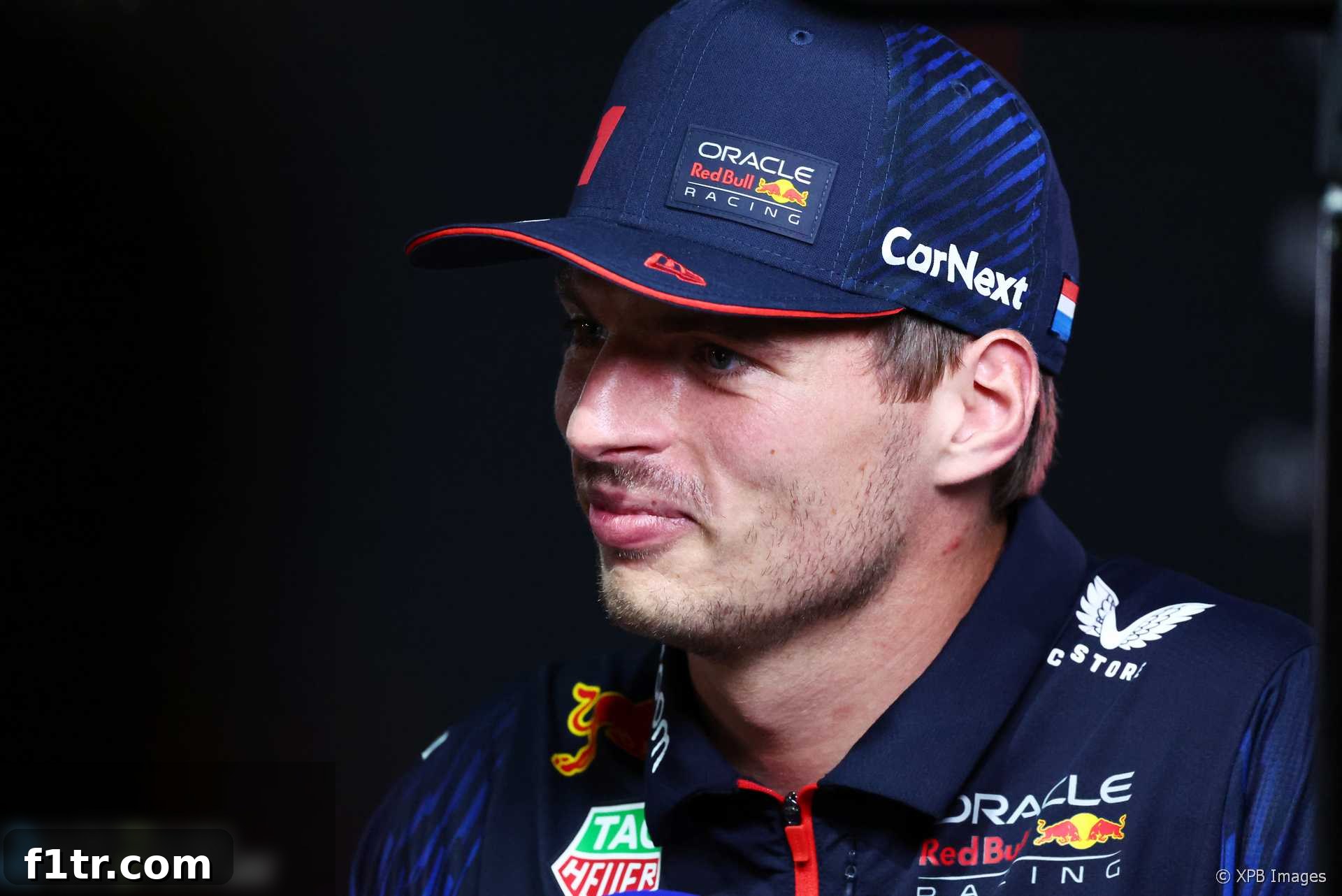
Max Verstappen, the reigning Formula 1 champion, has indicated that Red Bull Racing may be compelled to adopt a bolder approach with their car set-ups for the upcoming Qatar Grand Prix. This strategic imperative stems from the severely curtailed practice time available during a sprint race weekend, a format that poses unique challenges for all teams on the grid.
Formula 1 makes its highly anticipated return to the Losail International Circuit this weekend, marking only the second time the sport has graced this Qatari venue since its inaugural, one-off race in 2021. However, unlike that initial event, this year’s Grand Prix will operate under the demanding sprint weekend format. This means teams will be afforded just a single, critical hour of practice before their cars are locked into stringent parc ferme conditions, effectively freezing their set-ups for the remainder of the racing spectacle.
Speaking to the media, including RaceFans, on Thursday at Losail, Verstappen emphasized the immense importance of nailing the Red Bull car set-up within this condensed timeframe. “I think we normally should be quick here,” Verstappen stated with characteristic confidence, “but again, it’s only one practice session, so it’s about making sure that once we hit the ground running, the car’s in a good place, a good window.” He concluded, “But normally, it should be a nice track for us, and we just want to have a good weekend.”
The Intense Pressure of a Sprint Weekend: Limited Practice, High Stakes
The sprint weekend format is a double-edged sword for Formula 1 teams. While it aims to inject more excitement and unpredictability into the race weekend, it simultaneously places immense pressure on engineers and drivers. With just 60 minutes of Free Practice 1 (FP1) before qualifying, teams have precious little opportunity to fine-tune their complex machinery, understand tyre degradation, and gather crucial data on track conditions. This limited track time forces teams to arrive at the circuit with highly refined simulation models and educated guesses, as real-world adjustments are severely constrained.
The parc ferme regulations, which come into effect after FP1 for the sprint format, further amplify this challenge. Once these conditions are active, major components of the car, including suspension, aerodynamics, and engine settings, cannot be altered. This means any fundamental set-up issues identified during FP1 could severely compromise a team’s performance for both the sprint race and the main Grand Prix. Teams must therefore balance the need for aggressive, performance-optimizing set-ups with the inherent risk of getting it wrong and being stuck with a suboptimal configuration.
Navigating Losail: The Day-to-Night Transition Dilemma
Adding another layer of complexity to the Qatar Grand Prix is its unique scheduling as a night round. Both Saturday’s sprint race and Sunday’s main Grand Prix will unfold under the floodlights, a scenario that presents a significant challenge for set-up optimization. Verstappen is acutely aware that the hot, sunny conditions anticipated for Friday’s solitary free practice session will be vastly different from the cooler, more stable temperatures encountered during the evening races. This disparity makes it incredibly difficult for teams to prepare their cars for the actual racing conditions.
“It’s never going to be very straightforward for anyone out there,” he admitted. “Of course, if you hit the ground running and the car feels amazing – then great, perfect. But it’s very rare that it’s like that with one session.” The primary concern lies in how tyre performance, aerodynamic balance, and engine cooling characteristics change drastically with temperature fluctuations. A set-up that feels optimized in the hot afternoon sun might become ill-suited when the track temperature drops by several degrees under the artificial lights. This transformation demands a precise understanding of the car’s behavior across a wide range of environmental factors, which is hard to achieve in a single, unrepresentative practice session.
Verstappen’s Perspective: The “Proper Guessing Game”
Verstappen eloquently described the situation as a “proper guessing game.” He elaborated on the dilemma: “Then again, it’s too hot [in FP1]. So then you go to qualifying with different conditions. It makes it a proper guessing game about, ‘okay, well, we did FP1, we might be quite happy, but then what would we do for qualifying?’, because it’s a lot colder and the balance and the tyres – everything changes.” The subtle nuances of car balance, brake bias, and aerodynamic trim become critical under these fluctuating conditions. Teams must project how their car will behave hours later, making adjustments in FP1 that anticipate the track evolution and temperature drop.
The Red Bull driver acknowledges that some teams will inevitably manage this transition better than others. “So there’s a lot that you have to get right, and for sure some teams will be better than others. Of course, I hope that we are on the better side, but I guess we’ll find out.” This sentiment underscores the intense competition in Formula 1, where even marginal gains from a superior set-up can translate into significant performance advantages on the track. The Losail International Circuit itself, known for its flowing, medium to high-speed corners, also places a premium on aerodynamic efficiency and tyre management, making precise set-up even more crucial.
A Championship Beckons: Max Verstappen’s Third Consecutive Title
This weekend in Qatar is poised to be a landmark event for Max Verstappen, as he stands on the precipice of clinching his third consecutive Formula 1 World Championship title. With an immense and virtually unassailable lead in the drivers’ standings, the probability of him securing the title in Saturday’s sprint race is exceptionally high. Despite the near certainty of this achievement, Verstappen reiterated his long-standing preference for the traditional Grand Prix format over the newer sprint format.
“It’s not like it came out of the blue that I was going to win the championship here or next week, so I don’t think it really changes a lot,” said Verstappen, downplaying the immediate impact of the impending title. His focus, however, remains squarely on the purist aspects of racing. “But it’s more – I think, for the drivers as well – I prefer just the normal racing format. I think it’s just a bit more exciting, and especially in qualifying, you could go more to the limit because you know more of what you have done in practice. For example, in Suzuka, if you do FP1 there and then go straight into qualifying, you risk having big shunts. It’s just not as fulfilling.”
Verstappen’s preference highlights a common sentiment among many drivers and purists within the sport. The traditional format, with its three free practice sessions, allows for a more gradual build-up to qualifying and the race. This extensive track time enables drivers to push the limits progressively, exploring the car’s boundaries and refining their driving lines without the immediate high-pressure stakes of a sprint weekend. The risk of a major incident, as highlighted by his Suzuka example, is also significantly reduced when drivers have more time to acclimatize and optimize. For Verstappen, the true fulfillment of motorsport comes from pushing the absolute limit with a perfectly balanced and understood car, a scenario often compromised by the sprint format’s restrictions.
Beyond the Title: Focus on Race Victory
Despite the overwhelming likelihood of securing his third World Championship this weekend, Max Verstappen insists that his primary focus remains on Sunday’s Grand Prix rather than simply clinching the title as early as possible. This unwavering dedication to winning every race, irrespective of the championship outcome, is a hallmark of his competitive spirit and a testament to Red Bull’s relentless pursuit of excellence.
“We’re having an amazing year, and we just come into this week, and we want to win again,” he stated. “Of course, I know that if I win or whatever I achieve on Saturday, then you win the championship. But I think we’re very focused on the main job anyway, just to have a good weekend.” This mindset is crucial for maintaining the team’s momentum and ensures that complacency does not set in, even after such a dominant season. For Verstappen and Red Bull, every race offers an opportunity to demonstrate their superior package and driver skill, and the Qatar Grand Prix is no exception. The goal isn’t just to cross the championship finish line, but to do so with a commanding performance on Sunday, aiming for another victory.
The Broader Implications for the F1 Grid
While Verstappen and Red Bull focus on their championship and race victory ambitions, the sprint format at Losail will present unique challenges and opportunities for the rest of the grid. Teams fighting for constructors’ positions, crucial championship points, or simply aiming to showcase their potential will be under immense pressure to extract maximum performance from their cars with minimal preparation. This could lead to a weekend of surprises, with unexpected strong performances from teams that manage to hit the sweet spot with their set-ups, and potential struggles for others who misjudge the conditions.
The Losail International Circuit’s relatively smooth surface and challenging corner combinations also mean that tyre management will be a critical factor, especially given the rapid temperature changes. Teams will need to be agile in their strategies, reacting swiftly to evolving track conditions and driver feedback, even if major car changes are prohibited under parc ferme. The unique blend of a fast track, night racing, and a sprint format promises an exciting, albeit unpredictable, weekend of Formula 1 action.
2023 Qatar Grand Prix Insights
- Albon fears Qatar GP conditions risked creating dangerous “wet bulb effect”
- Alonso: New-spec fireproofs and pre-race anthem timing made Qatar heat worse
- Magnussen admits he took “too long to learn” Losail circuit
- Analysis: Sargeant’s Qatar radio reveals his painful struggle to end point-less run
- Alfa Romeo ‘finally understand their upgrade’ Bottas believes as team target Williams
Browse all 2023 Qatar Grand Prix articles