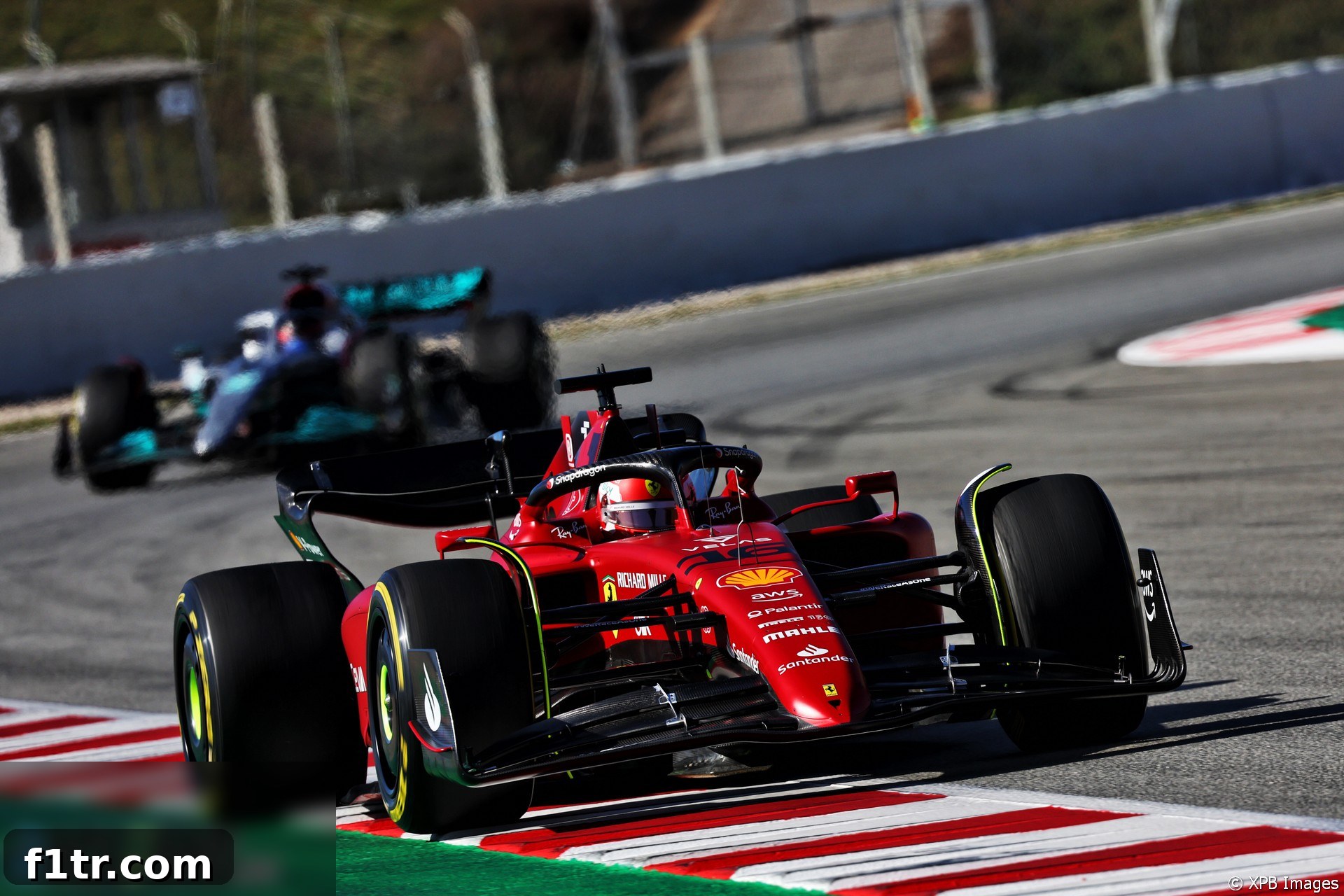
The dawn of a truly revolutionary era in Formula 1 officially commenced at the iconic Circuit de Catalunya in Barcelona, as the highly anticipated first day of pre-season testing for the 2022 season got underway. This momentous occasion marked the public debut of a completely redesigned generation of F1 cars, meticulously crafted under sweeping new technical regulations aimed at fostering closer racing and injecting fresh excitement into the sport. Anticipation was palpable as fans and experts alike eagerly awaited the first glimpse of how these radical machines would perform on track, with the hopes of a more competitive and thrilling championship hanging in the balance.
The morning session proved to be an exceptionally productive period for all participating teams. From the very outset, the paddock buzzed with an electrifying energy as all ten Formula 1 constructors rolled out their brand-new contenders onto the Spanish asphalt. Each team successfully completed at least a segment of their initial testing programmes, a crucial first step in understanding the complex characteristics of their 2022 challengers. Notably, powerhouse teams such as Ferrari, Mercedes, and Red Bull, alongside the resilient Williams squad, demonstrated remarkable early reliability by covering a full race distance in laps, a testament to the extensive off-season development work.
A significant highlight of this opening morning was the remarkable absence of major technical glitches or frustrating red flag interruptions. This unusually smooth start allowed teams to delve deep into their data collection, meticulously logging valuable information without any unwelcome pauses. The uninterrupted running enabled engineers and drivers to begin the arduous process of correlating their simulation data with real-world performance, fine-tuning the foundational setups for what promises to be a challenging season ahead. Such a flawless beginning is often a rare luxury in pre-season testing, underscoring the preparedness of the teams and the robustness of the new car designs.
On the performance front, it was Charles Leclerc who stole the headlines, demonstrating Ferrari’s impressive early pace. Piloting the striking new Ferrari F1-75, Leclerc posted the quickest time of the morning session, a blistering 1’20.165. This commanding performance immediately elevated Ferrari to a position of intrigue, suggesting that their dedicated focus on the new regulations during the off-season might be paying dividends. The F1-75, with its distinctive sidepods and sleek design, appeared poised and responsive on track, giving Scuderia fans genuine reasons for optimism about their championship prospects.
Hot on Leclerc’s heels was Lando Norris, who secured the second-fastest time in the McLaren MCL36. Norris was just three-tenths of a second adrift of the Ferrari, indicating that McLaren too has produced a highly competitive package. The MCL36 looked stable and agile through the Circuit de Catalunya’s demanding corners, signaling a strong start for the Woking-based outfit. McLaren’s consistent performance throughout the session hints at a potential battle for supremacy at the front of the grid, adding another layer of excitement to the nascent season.
Mercedes, the reigning constructors’ champions, showcased their new recruit George Russell behind the wheel of the Mercedes W13. Russell, making his highly anticipated debut as a full-time Mercedes driver, settled in quickly, recording the third-fastest time, approximately six-tenths slower than Leclerc. While Mercedes’ ultimate pace is often understated during testing, their consistent lap times and sheer mileage demonstrated their typical meticulous approach. The W13, an evolution of their championship-winning philosophy adapted to the new regulations, appeared composed, providing Russell with a stable platform to gather crucial early feedback. His adaptation to the team and the new machinery will be a key storyline for the season.
Four-time world champion Sebastian Vettel, driving the new Aston Martin AMR22, posted the fourth-fastest time, just over a second off Leclerc’s benchmark. This was a solid start for Aston Martin, who are keen to make strides under the new regulations. Following closely, Yuki Tsunoda secured the fifth-fastest time in the AlphaTauri AT03, demonstrating a respectable initial showing for the junior Red Bull team.
Perhaps one of the most significant takeaways from the morning session came from reigning world champion Max Verstappen. Despite setting only the sixth-quickest time in the new Red Bull RB18, Verstappen logged an impressive 80 laps – more than any other driver in the morning session. This strategy underscored Red Bull’s clear focus on reliability and understanding the fundamental characteristics of their new car, rather than chasing headline lap times. In pre-season testing, accumulating mileage is often prioritized over outright speed, as it provides invaluable data for long-run performance and durability. The RB18, under Verstappen’s capable hands, looked robust and consistent, hinting at a strong base for development.
The 2022 technical regulations represent a monumental shift for Formula 1. At their core is the reintroduction of ‘ground effect’ aerodynamics, designed to generate downforce from the underbody of the car, rather than relying heavily on complex front and rear wings. This is intended to create less turbulent air for following cars, making it easier for drivers to run closely and overtake. Accompanying this are significant changes to the tires, with larger 18-inch wheels replacing the previous 13-inch ones, along with new low-profile Pirelli rubber. These changes not only impact the visual aesthetics but also profoundly affect suspension setup, car handling, and tire degradation. Simplified front and rear wings, stricter aerodynamic surfaces, and increased safety standards further define this new generation of F1 machinery. The first day of testing was crucial for teams to begin unraveling the complex interactions of these new elements and understand how their theoretical designs translate to real-world track performance.
As the morning session concluded, attention turned to the afternoon, where several driver changes were scheduled across the paddock. Lewis Hamilton took over the Mercedes W13 from George Russell, providing the seven-time world champion his first taste of the new era’s machinery. Lance Stroll replaced Sebastian Vettel in the Aston Martin, eager to continue the team’s data gathering. Alex Albon stepped into the Williams FW44, taking over from Nicholas Latifi, while Valtteri Bottas got his first turn in the Alfa Romeo C42. Mick Schumacher also made his initial appearance in the Haas VF-22, providing crucial feedback for the American team. These rotations are standard practice in testing, allowing multiple drivers to provide their perspectives and acclimatize to the new cars, maximizing the breadth of data collected over the limited pre-season track time.
Overall, the first morning of 2022 pre-season testing in Barcelona offered a tantalizing glimpse into Formula 1’s future. While lap times in testing must always be taken with a pinch of salt, the early pace shown by Ferrari and McLaren, coupled with the methodical approach of Mercedes and Red Bull, suggests a potentially thrilling and unpredictable season ahead. The relative smoothness of the day allowed all teams to make a strong start, laying down solid foundations for further development. The coming days of testing will be critical for refining setups, pushing performance limits, and uncovering the true pecking order before the lights go out for the first race of this exciting new chapter in Formula 1 history.
2022 pre-season test day one – morning times:
| Pos. | Car number | Driver | Team | Model | Best time | Gap | Laps |
|---|---|---|---|---|---|---|---|
| 1 | 16 | Charles Leclerc | Ferrari | F1-75 | 1’20.165 | 78 | |
| 2 | 4 | Lando Norris | McLaren | MCL36 | 1’20.474 | 0.309 | 50 |
| 3 | 63 | George Russell | Mercedes | W13 | 1’20.784 | 0.619 | 76 |
| 4 | 5 | Sebastian Vettel | Aston Martin | AMR22 | 1’21.276 | 1.111 | 51 |
| 5 | 22 | Yuki Tsunoda | AlphaTauri | AT03 | 1’21.638 | 1.473 | 42 |
| 6 | 1 | Max Verstappen | Red Bull | RB18 | 1’22.246 | 2.081 | 80 |
| 7 | 14 | Fernando Alonso | Alpine | A522 | 1’23.317 | 3.152 | 54 |
| 8 | 6 | Nicholas Latifi | Williams | FW44 | 1’23.379 | 3.214 | 66 |
| 9 | 9 | Nikita Mazepin | Haas | VF-22 | 1’24.505 | 4.340 | 18 |
| 10 | 88 | Robert Kubica | Alfa Romeo | C42 | 1’25.909 | 5.744 | 9 |
2022 F1 season
- Mercedes told me “you’re wrong” about 2022 car’s problems – Hamilton
- FIA confirms all 10 F1 teams complied with 2022 cost cap
- Steiner “not ashamed” of panning “slow” Schumacher in Drive to Survive
- Albon believes year out of F1 improved him as a driver
- Hamilton sees diversity gains in F1 years on from his ‘traumatising’ experience of racism
Browse all 2022 F1 season articles