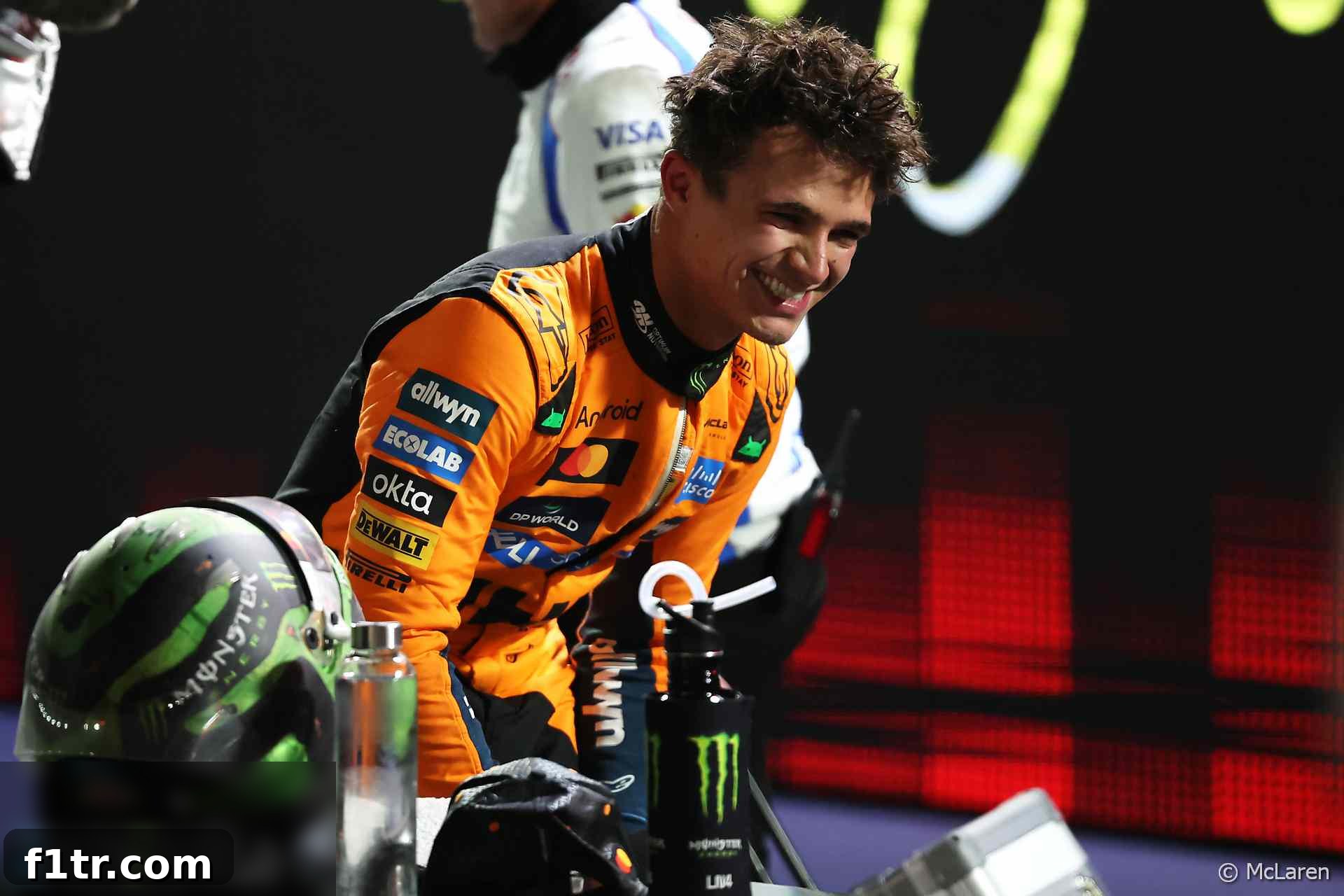
Lando Norris Secures Dramatic Las Vegas Grand Prix Pole Position Amidst Qualifying Scramble
In a truly exhilarating and often bewildering qualifying session for the Las Vegas Grand Prix, Lando Norris found himself utterly astonished to learn he had clinched pole position. The young McLaren star’s immediate reaction, conveyed over his team radio, perfectly encapsulated the unexpected nature of his achievement. “I messed up,” he confessed to his race engineer, Will Joseph, directly after completing his final flying lap in Q3. Joseph’s composed reply, “No, that is pole,” was met with disbelief, highlighting the razor-thin margins and the rollercoaster of emotions experienced during the session.
Norris had a clear understanding that the strategic timing of his ultimate run had worked significantly in his favour. By executing his critical lap after chief competitors like Max Verstappen had already completed theirs, Norris benefited from a progressively drying circuit. On the unique Las Vegas street track, where grip levels can be notoriously inconsistent and track evolution rapid, even a slight improvement in surface conditions can translate into a substantial lap time gain. However, this advantage also carried an inherent risk: drivers trailing him in the order could potentially capitalize even more as the circuit continued to rubber in and dry, threatening his provisional top spot.
The Turn 16 Incident: A Near-Catastrophe That Almost Cost Pole
Despite making impressive gains throughout the initial stages of his decisive lap, Norris encountered a heart-stopping moment at Turn 16 that he was convinced had cost him dearly. Having shown incredible pace and precision through the first two sectors, where he banked valuable tenths of a second, Norris experienced a sudden and dramatic snap of oversteer as he powered out of Turn 16. It was a spectacular recovery drive, demanding instantaneous reflexes and precise car control to prevent the McLaren from spinning. Such a significant correction inevitably sacrifices precious time, and in the highly competitive realm of Formula 1 qualifying, even a minor slip can be the difference between pole and a midfield starting position.
Upon hearing the confirmation that he had indeed secured pole position, Norris’s bewildered response was, “Did no one else get a lap or what?” His engineer, Joseph, quickly provided the crucial context: “No, there was a yellow flag behind you as well.” This revelation was key to understanding the qualifying outcome. Charles Leclerc’s unfortunate error at Turn 12, combined with an incident involving Norris’s own McLaren teammate, Oscar Piastri, had triggered a yellow flag. This regulatory measure mandates drivers to slow down through the affected section, effectively preventing any further improvements for those attempting to complete their laps behind the incidents. This dramatic twist, coupled with Norris’s astute timing on a drying track, inadvertently sealed his pole, even in the wake of his own near-catastrophic mistake.
In-depth Sector Analysis: Where Time Was Gained and Lost
For most Formula 1 drivers, the delta time display on their steering wheel is an indispensable source of real-time feedback, indicating their performance relative to a target lap or their personal best. While Norris had previously made the strategic decision to stop using this display earlier in the season, the visceral experience of his car’s sudden oversteer at Turn 16 would have communicated the scale of his time loss far more powerfully than any digital readout. It was a moment that underscored the fine line between triumph and disaster in high-stakes qualifying.
A closer look at the sector times paints a vivid picture of Norris’s qualifying lap. He demonstrated exceptional aggression and car control in the opening two sectors, gaining three tenths of a second in each, establishing a commanding lead. However, the costly error in the final sector meant he relinquished almost as much time as he had meticulously accumulated earlier. In stark contrast, Max Verstappen, renowned for his unwavering consistency and ability to extract maximum performance, managed to gain two tenths of a second in that very same final sector. This differential is telling: had Norris maintained his earlier momentum and matched Verstappen’s efficiency in the third sector, his pole advantage would have been a staggering eight tenths of a second, an almost unheard-of gap in modern F1 qualifying. Verstappen’s race engineer, Gianpiero Lambiase, promptly highlighted this critical detail to his driver: “So Norris, pole, three tenths – he made a huge mistake as well at turn 16.” This observation from within a rival team confirms the widespread awareness of Norris’s dramatic moment and the unique blend of skill and fortune that contributed to his unexpected pole.
The table below provides a comprehensive overview of the qualifying sector times, offering crucial insights into the performance nuances of each driver and their respective machinery on the challenging Las Vegas Strip Circuit.
| P. | # | Driver | S1 | S2 | S3 | Ultimate lap (deficit) |
|---|---|---|---|---|---|---|
| 1 | 4 | Lando Norris | 30.430 (1) | 36.842 (1) | 40.384 (7) | 1’47.656 (+0.278) |
| 2 | 1 | Max Verstappen | 30.863 (6) | 37.391 (2) | 40.003 (4) | 1’48.257 |
| 3 | 55 | Carlos Sainz Jnr | 30.894 (7) | 37.608 (5) | 39.794 (1) | 1’48.296 |
| 4 | 81 | Oscar Piastri | 30.839 (4) | 37.719 (6) | 40.097 (6) | 1’48.655 (+0.306) |
| 5 | 63 | George Russell | 30.787 (2) | 38.216 (7) | 39.800 (2) | 1’48.803 |
| 6 | 30 | Liam Lawson | 31.385 (9) | 37.593 (4) | 39.968 (3) | 1’48.946 (+0.116) |
| 7 | 6 | Isack Hadjar | 30.846 (5) | 38.325 (9) | 40.078 (5) | 1’49.249 (+0.305) |
| 8 | 14 | Fernando Alonso | 31.379 (8) | 37.563 (3) | 40.524 (8) | 1’49.466 |
| 9 | 16 | Charles Leclerc | 30.789 (3) | 38.239 (8) | 40.781 (10) | 1’49.809 (+0.063) |
| 10 | 10 | Pierre Gasly | 31.827 (10) | 38.721 (11) | 40.693 (9) | 1’51.241 (+0.299) |
| 11 | 27 | Nico Hulkenberg | 32.224 (12) | 38.502 (10) | 41.300 (13) | 1’52.026 (+0.755) |
| 12 | 18 | Lance Stroll | 32.300 (13) | 38.944 (12) | 40.853 (11) | 1’52.097 (+0.753) |
| 13 | 31 | Esteban Ocon | 32.601 (16) | 39.033 (14) | 41.076 (12) | 1’52.710 (+0.277) |
| 14 | 43 | Franco Colapinto | 31.896 (11) | 38.998 (13) | 41.938 (15) | 1’52.832 (+0.851) |
| 15 | 87 | Oliver Bearman | 32.373 (15) | 39.120 (15) | 41.405 (14) | 1’52.898 (+0.196) |
| 16 | 23 | Alexander Albon | 32.318 (14) | 39.564 (16) | 42.503 (18) | 1’54.385 (+1.835) |
| 17 | 12 | Andrea Kimi Antonelli | 32.864 (17) | 39.846 (17) | 43.228 (20) | 1’55.938 (+0.376) |
| 18 | 5 | Gabriel Bortoleto | 33.719 (20) | 39.977 (18) | 42.978 (19) | 1’56.674 |
| 19 | 22 | Yuki Tsunoda | 33.582 (19) | 40.806 (19) | 42.306 (16) | 1’56.694 (+0.104) |
| 20 | 44 | Lewis Hamilton | 33.579 (18) | 40.886 (20) | 42.363 (17) | 1’56.828 (+0.287) |
From the detailed data above, Norris’s exceptional performance in the initial segments of the lap is unequivocally clear. His Sector 1 time of 30.430 seconds and Sector 2 time of 36.842 seconds were the fastest recorded by any driver, underscoring both the raw speed of the McLaren MCL38 and Norris’s masterful command, particularly through the circuit’s more technical and flowing sections. However, his subsequent ranking as seventh fastest in the final sector, with a time of 40.384 seconds, directly illustrates the impact of his Turn 16 misstep. Conversely, Carlos Sainz Jnr notably achieved the fastest final sector time of 39.794 seconds, showcasing Ferrari’s formidable strength in that specific part of the track. Max Verstappen’s consistent performance across all sectors, especially his solid times in the second and third, highlights his persistent threat, even when not matching Norris’s peak bursts of speed. These granular sector times are invaluable for teams, providing critical insights into where performance is gained or lost, and guiding strategy for both future qualifying sessions and the main race.
Team Performance Under the Unpredictable Las Vegas Sky
The build-up to qualifying was far from ideal, adding an extra layer of complexity to the already challenging demands of a new street circuit. Friday’s practice sessions were significantly hampered by wet weather, severely limiting the amount of crucial data teams could collect and preventing optimal car setup refinements. Consequently, no team was able to improve their lap times from the initial Thursday practice, rendering those early benchmarks largely irrelevant for direct comparison with the high-stakes qualifying performances. This scarcity of dry running meant that teams approached qualifying with less-than-perfectly optimized setups and drivers with reduced confidence in pushing the absolute limits of their machinery on an evolving track.
This unique set of circumstances sets the stage for a potentially thrilling race day. Should Sunday’s Grand Prix unfold under dry conditions, it is highly probable that we will witness the rare phenomenon of some drivers recording their fastest laps of the entire weekend during the race itself. As more laps are completed under consistent dry conditions, drivers will build greater confidence, pushing their cars closer to the absolute limit. Simultaneously, teams will have the opportunity to fine-tune their strategies and car settings, unlocking additional pace that was simply inaccessible during the compromised practice and qualifying sessions. The capacity of each team and driver to adapt quickly to these fluid track conditions will undoubtedly be a decisive factor in determining the final race outcome.
This section would typically feature a dynamic chart illustrating overall team rankings and key performance metrics based on the qualifying results, providing a visual summary of the competitive landscape.
A graphical representation showcasing lap time progression and the degree of improvement (or lack thereof, given the challenging conditions) from earlier practice sessions through to qualifying would appear here, highlighting performance trends.
Field Performance and the Elusive Track Record
The Las Vegas Strip Circuit, a dazzling new addition to the Formula 1 calendar and hosting its third Grand Prix this weekend, arrived with high expectations for setting new speed benchmarks. Despite the inherent challenges of any novel street circuit, particularly its initially low grip levels, the incredible power and aerodynamic efficiency of modern F1 cars mean that track records are frequently under threat. This is especially true as a circuit “rubbers in” over a weekend and drivers become more intimately familiar with its unique rhythm and nuances. Had Saturday’s qualifying session been conducted entirely on a dry track, free from the intermittent damp patches and the crucial yellow flags that disrupted many late-lap efforts, it is highly probable that the existing track record would have been unequivocally broken.
The circuit’s unique combination of extended straights, demanding braking zones, and technical corners, all set against the breathtaking backdrop of the Las Vegas night, demands both raw speed and pinpoint precision. Drivers and teams were undoubtedly pushing hard to etch their names into the circuit’s nascent history books with record-breaking times. However, the fickle weather and the dramatic incidents during qualifying collectively meant that the ultimate lap times, while still remarkable, did not fully represent the theoretical maximum pace achievable under truly optimal, consistently dry conditions. This leaves an intriguing question for race day: could the track record finally fall on Sunday if conditions remain stable and perfect, allowing drivers to unleash the full potential of their machines?
Here, a detailed chart would visually compare individual lap times across the entire Formula 1 field, illustrating the subtle differences in performance and the overall competitiveness among drivers and teams.
The Las Vegas Grand Prix qualifying delivered an unforgettable spectacle, rich with the drama and unpredictability that defines Formula 1. Lando Norris’s pole position, a testament to exceptional driving skill, a critical in-lap recovery, perfect strategic timing, and a timely stroke of fortune from the yellow flags, has set the stage for what promises to be an enthralling and fiercely contested race. The unique challenges posed by the evolving track conditions and the inherent demands of this spectacular street circuit will undoubtedly push every driver and team to their absolute limits on Sunday. All eyes will now be fixed on the Grand Prix to see if Norris can convert his surprising pole into a victory, or if formidable rivals like Verstappen and Leclerc, who demonstrated impressive underlying pace despite their qualifying setbacks, can mount a successful challenge for the top step of the podium.
Stay Connected with RaceFans
Don’t miss a single moment of the Formula 1 action, in-depth analysis, and breaking news. Get all our latest stories delivered directly to your inbox with our daily email updates – absolutely no marketing, no ads, just pure F1 content tailored for enthusiasts like you.
Join our passionate community by subscribing to the RaceFans newsletter today and keep up-to-date with every twist and turn of the F1 season!
2025 Las Vegas Grand Prix Coverage
Explore more in-depth analysis, news, and exclusive insights from the 2025 Las Vegas Grand Prix:
- Losing win through strategy error “hurts more” than Las Vegas disqualification – Piastri
- FIA feels McLaren’s Las Vegas GP disqualification is “draconian”, claims Brown
- Why did McLaren’s messages to Norris and Piastri not mention plank problems?
- McLaren explain Las Vegas disqualifications – including their “counterproductive” reaction
- McLaren’s first double disqualification ended their second-longest points streak
Browse all 2025 Las Vegas Grand Prix articles