Welcome to your comprehensive Motorsport Daily Round-up, bringing you the latest headlines and insights from the world of Formula 1, Moto GP, and beyond. From team ambitions and strategic shifts to technological advancements and crucial debates on driver talent, we cover the stories shaping the racing landscape. Stay informed with our detailed analysis and essential updates from the paddock and tracks worldwide.
Motorsport Daily: F1 Ambitions, Controversies & Innovations
Advert | Become a Supporter & go ad-free
McLaren Racing CEO Zak Brown Lowers 2022 F1 Championship Expectations
McLaren Still “Catching Up” – Brown Emphasizes Infrastructure Gap
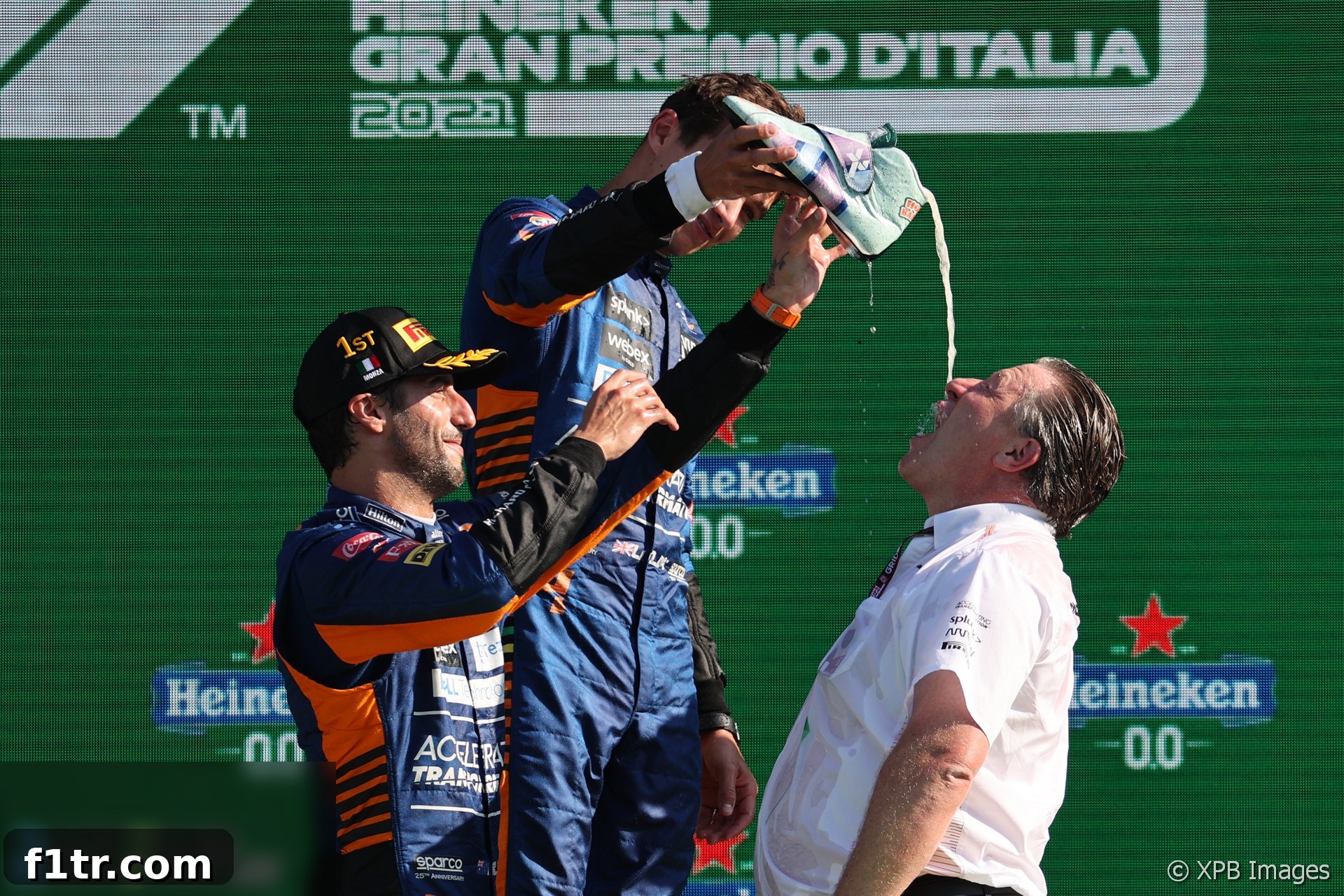
McLaren Racing CEO Zak Brown has delivered a candid assessment of his Formula 1 team’s prospects for the upcoming season, indicating that 2022 is unlikely to see McLaren emerge as championship contenders. Despite a momentous return to the top step of the podium in 2021 – ending a nine-year drought with a memorable one-two finish at Monza – Brown stresses that the team still has significant ground to cover in terms of technical infrastructure to rival F1’s established front-runners like Mercedes and Red Bull.
“Of course, we’re going to give it everything we’ve got,” Brown told Gulf Business. “But we still have a couple of years of technical catch-up that we just can’t accelerate any further or faster than we are.” This statement underscores the deep-seated challenges in modern Formula 1, where success is not solely dependent on driver skill or immediate car performance, but also on the state-of-the-art facilities that underpin development and innovation.
A key area of focus for McLaren is their wind tunnel and other technical infrastructure. “We still have technical infrastructure that we’re catching up on, most notably our wind tunnel,” Brown explained. “I’m not going into next year [2022] thinking we’re going to be a championship contender.” The wind tunnel is a cornerstone of aerodynamic development in F1, a discipline critical to a car’s performance. Upgrading or replacing such facilities is a massive undertaking, requiring substantial investment and time. McLaren’s new factory facilities, including a state-of-the-art simulator and manufacturing capabilities, are gradually coming online, but their full impact will not be immediate. Brown’s realistic outlook serves to manage expectations while highlighting the team’s long-term strategic commitment to regaining championship-winning form through sustained infrastructure development and continuous improvement.
Moto GP Chief Carmelo Ezpeleta Averse to F1’s Controversial 2021 Finale
Sporting Integrity: A Priority for Motorcycle Racing
The head of the motorcycling world championship, Moto GP, has expressed a clear desire to avoid a repeat of the acrimonious and highly debated conclusion to the 2021 Formula 1 season. Carmelo Ezpeleta, CEO of Moto GP promoter Dorna, voiced his concerns in an interview, emphasizing the importance of clear-cut championship deciders in motorsport.
“I would not like to have a Moto GP [season] finish like the one in F1,” Ezpeleta told Marca. The F1 season finale saw Max Verstappen secure the world title by controversially passing Lewis Hamilton on the final lap of the Abu Dhabi Grand Prix. This decisive moment followed a highly questionable application of safety car rules by then-race director Michael Masi, which led to a fierce, though ultimately unsuccessful, protest by the Mercedes team.
The incident ignited a global debate about sporting fairness, the consistency of rule application, and the integrity of the championship outcome. Ezpeleta noted that the finale “caused controversies that are not good,” highlighting the negative impact such events can have on a sport’s reputation. He further articulated his preferred scenario for a championship conclusion: “I like to have a championship, if it can be, until the very disputed end, but I don’t like that after the end they create doubt, that the runner-up doesn’t talk any more.” His comments reflect a widespread sentiment across the sporting world that while tight competition is desirable, the final outcome must be beyond reproach to preserve the credibility and excitement of the sport.
Sauber Group Forms New Division: Sauber Technologies
Leveraging F1 Expertise for Broader Engineering Challenges
Sauber, the Swiss engineering powerhouse behind the Formula 1 team branded as Alfa Romeo, has announced the formation of a new specialized division: Sauber Technologies. This strategic move aims to extend the company’s renowned F1-honed expertise beyond the confines of motorsport, offering advanced engineering and aerodynamic solutions to a diverse range of industries and companies facing complex technical challenges.
Sauber Technologies will incorporate the existing engineering and aerodynamics departments, consolidating their vast knowledge base and cutting-edge capabilities. For decades, Formula 1 teams have been at the forefront of innovation, pushing the boundaries in areas such as lightweight composite materials, advanced computational fluid dynamics (CFD), precision manufacturing, sophisticated data analysis, and high-performance systems integration. By formalizing this division, Sauber is strategically positioning itself to monetize this invaluable intellectual property and technical prowess.
This initiative represents a growing trend within Formula 1, where teams are increasingly diversifying their business models. The rigorous demands of F1 competition foster an environment of rapid development and problem-solving, creating a unique pool of expertise that can be incredibly valuable in sectors like aerospace, automotive, medical devices, and even consumer goods. Companies seeking bespoke solutions for aerodynamic optimization, structural integrity, simulation modeling, or innovative production techniques can now access Sauber’s world-class facilities and highly skilled personnel, thereby benefiting from the intense competitive pressures that drive F1 innovation.
Mercedes Chief Strategist James Vowles to Compete in Asian Le Mans Series
From Pit Wall to Race Track: A Familiar Face Takes the Wheel
James Vowles, the highly influential chief strategist for the Mercedes-AMG Petronas Formula 1 Team, is set to swap the high-pressure environment of the F1 pit wall for the driver’s seat. Vowles will compete in the opening weekend of the Asian Le Mans Series later this month, showcasing the versatility and passion for motorsport that often extends beyond specific roles within the sport.
Vowles has been an integral part of Mercedes’ dominant run in Formula 1, playing a critical role in orchestrating their numerous championship victories. His strategic acumen is widely recognized as one of the best in the paddock. Now, he will experience the thrill of racing first-hand, competing in the GT class. He will be driving a McLaren 720S GT3, a formidable machine in endurance racing, which he will share with two notable co-drivers: Manuel Maldonado and Nicolai Kjaergaard. Manuel Maldonado is the cousin of Pastor Maldonado, the Venezuelan driver who famously won the 2012 Spanish Grand Prix, adding another layer of motorsport lineage to the team. Vowles’ participation highlights the deep connection many F1 professionals have with racing itself, often returning to their roots or exploring new facets of the sport they love.
Advert | Become a RaceFans supporter andgo ad-free
Social Media Pulse: Key Posts from the Motorsport Community
Stay connected with the racing world through these notable posts from Twitter, Instagram, and other platforms, offering glimpses into team activities, game updates, and insightful commentary from leading figures in motorsport:
👀 @GeorgeRussell63 meets the Team in Brackley and Brixworth! 🎥🔥
— Mercedes-AMG PETRONAS F1 Team (@MercedesAMGF1) February 1, 2022
George Russell’s integration into the Mercedes-AMG Petronas F1 Team is well underway, as captured in this exciting post. Fans get a behind-the-scenes look at Russell meeting his new colleagues at the team’s Brackley and Brixworth facilities, signaling the start of a highly anticipated new chapter for the young British driver.
Our first #AMS2 update of 2022 is incoming, and it´s a big one! Should be live in a couple of hours, make sure to check the changelog for info and tips regarding the updates to cockpit camera physics. pic.twitter.com/Su1JVidWtP
— Reiza Studios (@ReizaStudios) February 1, 2022
Gaming enthusiasts and sim racers will be thrilled with the news from Reiza Studios, announcing a major update for Automobilista 2 (#AMS2). This first update of 2022 promises significant enhancements, particularly to cockpit camera physics, aiming to deliver an even more immersive and realistic racing simulation experience.
I probably say this every year, but I like how @scuderiaferrari put more imagination into their #F1 car names than the same two letters at the front and incrementing the final two digits by one every year.https://t.co/GOKzBvpXVD
— Keith Collantine (@keithcollantine) February 1, 2022
Keith Collantine from RaceFans shares an interesting observation about Formula 1 car naming conventions. He praises Scuderia Ferrari for their imaginative approach to naming their F1 cars, a refreshing contrast to teams that often follow a more conventional, sequential alphanumeric system. This highlights the unique identity and heritage that Ferrari brings to the sport.
- Find more official F1 accounts to follow in the F1 Twitter Directory
Motorsport Links of Interest: Diving Deeper into Racing News
Explore more fascinating stories from across the motorsport spectrum with these curated links. From junior categories nurturing future talent to top-tier drivers showcasing their versatility, these articles offer further insights into the dynamic world of racing:
Van Amersfoort Racing signs Filip Ugran for 2022 Euroformula season (Euroformula Open)
This report details the promising career trajectory of 19-year-old Filip Ugran, who joins the Euroformula Open series for his fourth year in single-seater racing. His impressive track record includes a maiden win in the Italian Formula 4 championship, multiple podiums and two wins in Spanish F4, and a campaign in the FIA Formula 3 Championship. His progression highlights the crucial role of junior categories in developing the next generation of motorsport stars.
IndyCar drivers shine in Daytona 24 Hours field full of stars (Miami Herald)
The Miami Herald article shines a spotlight on the exceptional talent of IndyCar drivers, particularly their strong performance at the prestigious Daytona 24 Hours. Colton Herta, a prominent IndyCar star, comments on the physical demands of his primary series: “The IndyCar is a lot more difficult to drive, so we are physically fit enough to drive the IndyCar and it makes it a lot easier when we come here.” This sentiment underscores the rigorous physical and mental preparation required for IndyCar, enabling its drivers to excel across various disciplines.
We always endeavour to credit original sources. If you have a tip for a link relating to single-seater motorsport to feature in the next RaceFans round-up please send it in via the contact form.
Advert | Become a RaceFans supporter andgo ad-free
Comment of the Day: The Enduring Debate on F1 vs. IndyCar Driver Talent
Today’s featured comment from reader Radoye delves into a perennially engaging topic among motorsport fans: the comparison of driver talent between Formula 1 and IndyCar. This insightful analysis challenges common perceptions, arguing that while F1’s top echelon might operate on a different plane, the broader talent gap between the two series isn’t as vast as often assumed, particularly when factoring in car performance.
Jacques Villeneuve came from CART and was immediately battling for the F1 world championship, winning on a second try.
Juan Pablo Montoya in a Williams was the only guy in F1 capable of mixing it with the Ferraris during the dark ages of guaranteed Schumacher-Barrichello one-twos.
Michael Andretti was set up to fail, once Senna’s contract was secured (initially it was Andretti and Hakkinen who were to drive for McLaren that year) he was no longer needed and his salary was seen as a luxury since much more affordable Hakkinen was already available.
Takuma Sato (who I love to pieces, you can’t meet a nicer guy in the paddock) has won a grand total of 6 races in his 12 seasons in IndyCar (granted, two of those were at the 500) – so on average once every two years – with best championship finish of seventh. His best F1 championship finish was eighth.
What Newgarden is saying is if you put Hamilton and Verstappen into a Hass F1 car neither of them would be fighting for the F1 world championship, despite being the best of the best. In F1 too much depends on car performance.
Nobody is arguing that IndyCar drivers are better than Hamiltons, Verstappens and Alonsos of F1 – these guys are simply on another level – but the fact is that beyond the handful of very best in F1 the differences between F1 and IndyCar level of talent aren’t that big.
An F1 backmarker pay driver (looking at you, Max Chilton) remains a backmarker pay driver in IndyCar as well, with an occasional outlier result due to much smaller differences in car performance and random luck. A proven IndyCar champion in a championship winning capable F1 car will be at the sharp end of any F1 field too.
Radoye
Radoye’s argument is meticulously constructed, drawing on historical examples of drivers who successfully transitioned between the two series. He cites Jacques Villeneuve’s immediate impact in F1 after his CART success, and Juan Pablo Montoya’s ability to challenge the dominant Ferraris, as evidence of IndyCar talent translating directly to F1 competitiveness. The case of Michael Andretti, though less successful in F1, is presented as a situation marred by external contractual complexities rather than a lack of talent. Even Takuma Sato’s career, while not reaching F1 championship heights, shows consistent performance across both disciplines.
The core of Radoye’s perspective lies in the influence of machinery in F1. He echoes Josef Newgarden’s hypothetical point: even the likes of Lewis Hamilton or Max Verstappen would struggle for championship glory in a lesser F1 car. This highlights the often-discussed disparity in F1 where car performance can sometimes overshadow raw driver skill. While acknowledging that F1’s absolute elite drivers like Hamilton, Verstappen, and Alonso possess a unique level of talent, Radoye asserts that below this very top tier, the talent gap between F1 and IndyCar drivers is significantly smaller. He concludes that a proven IndyCar champion, given a competitive F1 car, would undoubtedly be a force to be reckoned with, further fueling the discussion about the relative merits and challenges of these two premier single-seater racing series.
Happy Birthday!
Join us in celebrating the birthdays of these special individuals within our motorsport community: Invoke, Oliver Queisser, Sriram, Photozen, Cucamest, Michael Brown, and Noah! We wish you all a fantastic day!
On This Day in Motorsport History
Commemorating significant moments and figures from motorsport’s past:
- Tony Shelly, a New Zealander who participated in a single F1 race in 1962 and made two unsuccessful qualification attempts, was born on this day in 1937.