The Evolving Identities of Formula 1 Teams: A Comprehensive History of Name Changes
Formula 1, a sport renowned for its rich history and relentless pursuit of innovation, also possesses a fascinatingly dynamic characteristic: the identities of its competing teams. While some legendary names have endured for decades, many others have undergone numerous transformations, reflecting shifts in ownership, strategic partnerships, and the ever-present influence of commercial sponsorship. This constant flux means that for some teams, changing identity has become an almost routine occurrence, leaving fans to keep pace with the latest rebranding efforts.
Advert | Become a Supporter & go ad-free
Indeed, four teams on the current grid have altered their names at least twice within the last decade alone, with two of these undergoing changes specifically for the 2024 F1 season. The upcoming season, for instance, marks a notable simplification for fans, as neither ‘Alfa Romeo’ nor ‘AlphaTauri’ will feature. However, the exact replacements aren’t always straightforward. One team has indicated two different names for its operation, while another has only revealed a ‘placeholder’ identity, hinting at further developments.
At the opposite end of the spectrum stand the few teams that have steadfastly retained their original names. These organizations have built a heritage of such immense value that even new owners have wisely chosen to preserve the cherished identity above the factory door. Foremost among these is undeniably Ferrari, the only team to have participated in all 74 Formula 1 seasons to date, an unbroken link to the sport’s inception.
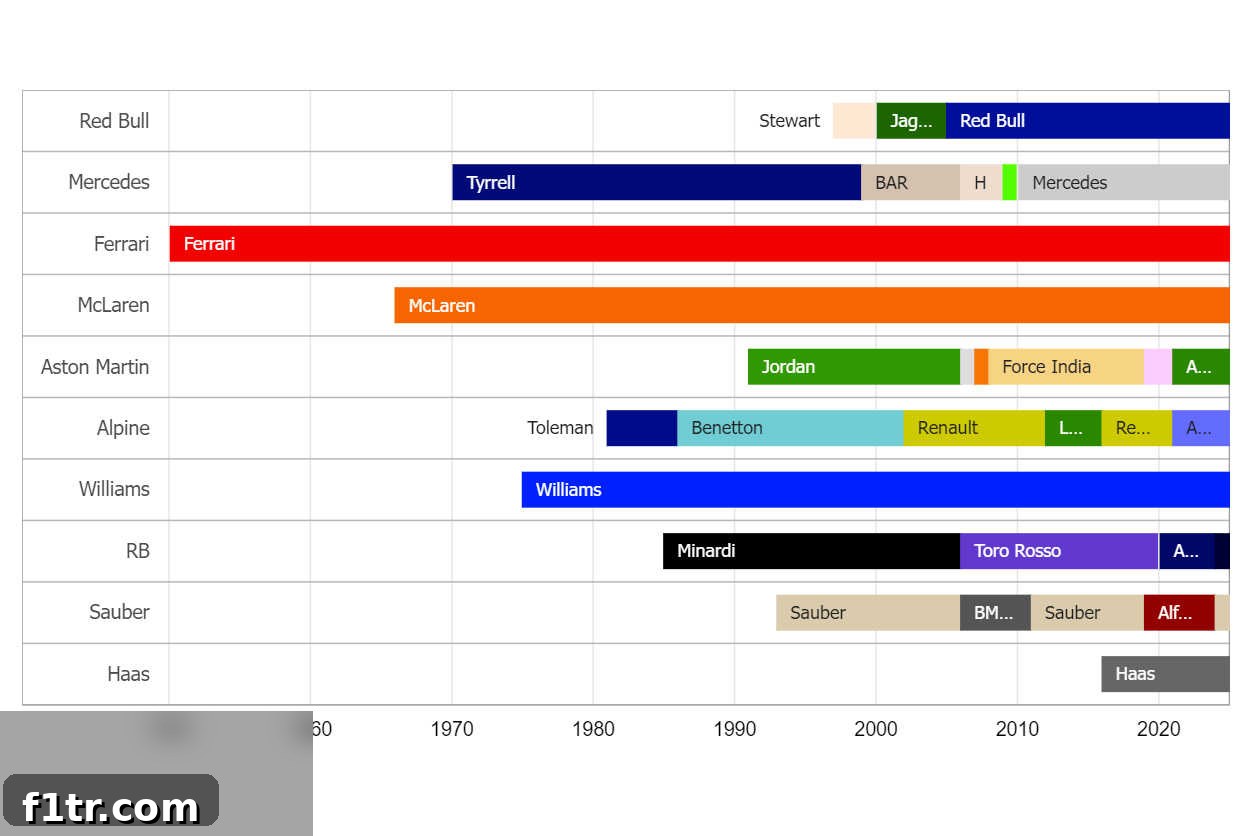
This article delves into the fascinating lineage of each of Formula 1’s current ten teams, exploring their various guises through the years. While four teams have maintained a singular identity, the remaining six have collectively adopted 29 different names, illustrating a captivating history of evolution and transformation.
Timeline: The Previous Identities of F1’s 10 Teams
Below is a summary of the team transitions. While an interactive chart would offer detailed insights, the following notes and individual team histories provide a comprehensive overview of these significant changes:
Notes:
- Teams like Honda, Aston Martin, Alfa Romeo, Renault, and Lotus have all previously competed under other team identities, showcasing the cyclical nature of F1 involvement.
- Force India’s attempted mid-2018 rebranding to Racing Point saw its chassis name officially change the following year, highlighting the complexities and lead times involved in such transitions.
The Steadfast Pillars: Teams with Unchanging Identities
Ferrari: The Eternal Scuderia
Identities: 1
Ferrari occupies a singular and revered position in the annals of Formula 1. As the only team to have contested every world championship since its inception in 1950 – though not every individual race – its presence has been a constant, defining feature of the sport. This unbroken link back to the very first season imbues Ferrari with a special place in F1’s history, transcending mere sporting achievement to represent a cultural icon. The team’s name, derived directly from its visionary founder Enzo Ferrari, has never wavered, a testament to its profound heritage and global brand recognition. Even with significant corporate backing, the Scuderia’s identity remains immutable, cherished by millions worldwide and a symbol of Italian engineering and racing passion.
McLaren: A Enduring Legacy of Innovation
Identities: 1
Another illustrious name that has remained faithful to its original identity is McLaren. Founded by the talented New Zealander Bruce McLaren, the team entered Formula 1 in 1966 and celebrated its 60th anniversary last year. Tragically, Bruce McLaren himself passed away in a testing accident involving one of their Can-Am cars just four years after their F1 debut. Despite this immense loss and a succession of different owners throughout its history, the McLaren name has consistently adorned its entries. This unwavering identity stands in stark contrast to other great names from the sixties and earlier – such as Lotus and Brabham – which, despite their significant contributions to the sport, have sadly long since disappeared from the grid. McLaren’s continued presence and consistent naming reflect a deep respect for its founding principles and a powerful brand equity built over decades of competition.
Advert | Become a RaceFans supporter andgo ad-free
Williams: Preserving a Founder’s Vision
Identities: 1
The team founded by the indomitable Sir Frank Williams has carved an indelible mark in Formula 1 history, securing more constructors’ championships than any other team apart from Ferrari. Given this immense legacy, the thought of their name disappearing from the grid would have been a profound loss to the sport. Thankfully, when Dorilton Capital acquired Williams in 2020, they recognized and valued the significance of preserving this iconic legacy name. While the team has since taken on a more American flavour in its ownership and management, its foundational identity remains proudly intact. This decision ensures that the spirit and achievements of Frank Williams continue to be honored, allowing a new generation of fans and competitors to connect with one of F1’s most storied privateer entries.
Haas F1 Team: A Modern Constant
Identities: 1
The fourth team to have maintained a consistent name since its entry into the sport is Haas F1 Team. While they are a relatively recent addition, having only joined the grid in 2016, their stability in naming is quite remarkable. In the short span of time they have been competing, three of their rivals have undergone name changes twice or even more frequently. This steadfastness in identity, especially in an era of rapid rebranding, is a testament to the vision of its founder, Gene Haas, and the team’s commitment to building a recognizable brand in Formula 1. It’s a significant achievement not to be underestimated in the volatile commercial landscape of modern F1.
The Transformation Saga: Teams with Multiple Identities
Red Bull Racing: From Stewart Grand Prix to Dominance
Identities: 3
The team now known globally as Red Bull Racing has a fascinating lineage that began with three-time world champion Jackie Stewart. He founded the Milton Keynes-based operation as Stewart Grand Prix in 1997. During its relatively brief original incarnation, the team managed to secure its first victory before being acquired by Ford. Ford rebranded it to Jaguar Racing, aiming to promote its performance luxury brand in Formula 1. However, this era also proved short-lived, and by the end of the 2004 season, the team was put up for sale.
In a pivotal moment for the sport, Red Bull brand co-founder Dietrich Mateschitz stepped in, purchasing the team ahead of the 2005 season. He appointed Christian Horner as team principal, a move that would prove instrumental in transforming the struggling outfit. Under their combined vision and relentless investment, Red Bull Racing steadily climbed the ranks, ultimately becoming the formidable powerhouse operation it is today, boasting multiple drivers’ and constructors’ championships and fundamentally reshaping the competitive landscape of Formula 1.
Advert | Become a RaceFans supporter andgo ad-free
Mercedes-AMG Petronas F1 Team: A Journey Through Eras
Identities: 4
The illustrious team now known as Mercedes-AMG Petronas F1 Team traces its roots back to the Tyrrell Racing Organisation, a dominant force in the early seventies, thanks in large part to the same Jackie Stewart who later founded Stewart GP. After Stewart’s retirement at the end of 1973, Tyrrell never quite recaptured its sustained success but still managed to win races a decade later. By the late 1990s, however, Tyrrell was in severe financial distress and was eventually sold to Craig Pollock and British American Tobacco (BAT). They formed British American Racing (BAR), an entirely new team that took over Tyrrell’s entry, ushering in a new era.
As tobacco sponsorship faced increasing global restrictions, BAT’s involvement waned, leading to its engine supplier, Honda, taking full ownership in 2006. The team became Honda Racing F1 Team, but within three years, the global financial crisis of the late noughties prompted Honda to withdraw, joining several other car manufacturers in winding down their F1 operations. The team’s future looked bleak.
It was miraculously rescued through the swift and decisive action of team principal Ross Brawn and a management buy-out. Rebranded as Brawn GP, they secured a last-minute engine supply deal with Mercedes-Benz and, against all odds, stunned the F1 world in 2009 by winning both the constructors’ championship and taking Jenson Button to a fairytale drivers’ title. Recognizing the immense potential of this well-run, championship-winning outfit, Mercedes-Benz acquired the team ahead of the 2010 season, marking their full return as a works team. Within four years, Mercedes had leveraged this foundation to build an unprecedented dynasty, consistently winning titles and dominating the hybrid era of Formula 1.
Aston Martin F1 Team: The Ultimate Rebranding Story
Identities: 6
The team currently known as Aston Martin F1 Team holds the distinction of having undergone more name changes in a shorter period than perhaps any of its competitors. Its roots lie with the effervescent Eddie Jordan, who founded Jordan Grand Prix in 1991. The team quickly gained a reputation for passion and flair, scoring race victories in the late nineties, but struggled to keep pace with the accelerating spending curves of rival teams in the early 2000s.
By 2005, Jordan had sold his operation, initiating a succession of ownership changes. The first buyer was the Russian investment group Midland, whose brief tenure saw the team awkwardly renamed Midland F1 Racing – arguably one of the dullest names ever applied to an F1 team. This was followed by the Dutch sportscar manufacturer Spyker, which briefly rebranded the team before it was acquired by Indian billionaire Vijay Mallya. Under Mallya, the team became Force India, a name under which it frequently defied expectations and punched significantly above its weight, particularly during the V6 hybrid turbo era. However, Mallya’s escalating legal and financial problems ultimately forced him to sell the team.
In 2018, a consortium led by Canadian billionaire Lawrence Stroll, father of F1 racer Lance Stroll, purchased the team. Initially rebranded as Racing Point – a generic name that many considered bland – this was always intended as a temporary identity. It served as a placeholder until Stroll’s broader plans to acquire a significant stake in the iconic British luxury car brand Aston Martin could come to fruition. Once this acquisition was complete, the F1 team proudly adopted the Aston Martin name in 2021, marking a full circle by returning to a distinctive green livery not unlike its original Jordan colours. This move not only brought a prestigious automotive brand back to the F1 grid but also signaled ambitious intentions to compete at the very front of the field, underlined by the recent demolition of the original Jordan factory to make way for state-of-the-art facilities.
BWT Alpine F1 Team: From Toleman to French Performance
Identities: 6
The team now competing as BWT Alpine F1 Team has also journeyed through half a dozen identities, though over a somewhat longer span of time than Aston Martin. Its lineage began with the Formula 2 outfit Toleman, which entered F1 in the early 1980s. Toleman famously came tantalizingly close to winning the 1984 Monaco Grand Prix with a rookie Michael Schumacher at the wheel. In 2002, Renault, which had previously supplied engines, took full ownership of the now struggling Benetton team. Renault reshaped the operation, once again transforming it into championship contenders with Fernando Alonso, securing back-to-back titles in 2005 and 2006. However, the manufacturer controversially quit the sport in disgrace in the late noughties following the infamous ‘Crashgate’ controversy.
Despite Renault’s official withdrawal, the team continued to compete, initially amidst a legal squabble over the rights to use the iconic ‘Lotus’ name. It finally secured this identity in 2012, racing as Lotus F1 Team for several seasons. By 2016, Renault had made a full return to Formula 1 as a works team, re-acquiring its former operation. Three years ago, as part of a strategic push to promote its performance sub-brand, the manufacturer chose to rebrand the team once more, launching it as Alpine F1 Team, complete with a distinctive blue livery and a renewed commitment to French motorsport heritage.
Advert | Become a RaceFans supporter andgo ad-free
Visa Cash App RB Formula 1 Team (formerly AlphaTauri): The Red Bull Junior Squad’s Evolution
Identities: 4
The team now known by its recent placeholder name, RB, has a sentimental history for many F1 fans, originating as the perennial backmarkers Minardi. Giancarlo Minardi’s eponymous team entered F1 in 1985 and, despite rarely challenging for victories, was always regarded with a degree of affection for its underdog spirit and commitment. The Minardi name persisted for over two decades, even after Giancarlo sold the team to Australian businessman Paul Stoddart in 2001, who commendably kept the original identity intact.
By 2005, Stoddart himself was in search of a buyer, and an unexpected opportunity arose. Red Bull, already operating its senior team, decided it required a second outfit specifically for developing young talent from its extensive driver academy. Minardi was therefore acquired and rebranded as Toro Rosso, which is Italian for ‘Red Bull’, ahead of the 2006 season. Ironically, the junior squad would achieve a Grand Prix victory before its senior counterpart, courtesy of an inspired performance by Sebastian Vettel at a rain-soaked Monza in 2008.
Despite Red Bull’s continuous ownership, the team has undergone two further name changes since then. In 2020, it was rebranded as AlphaTauri, aligning with Red Bull’s premium fashion brand, a move intended to give the team a distinct identity beyond just being a junior program. However, for the 2024 F1 season, its name has changed yet again to simply ‘RB’. The team has clarified that this is a “placeholder” name, and its final commercial identity is still to be officially revealed. Documents filed by Red Bull indicate it could potentially become ‘Racing Bulls’, reflecting its heritage while integrating major title sponsors Visa and Cash App to form its official entry name, Visa Cash App RB Formula 1 Team. This ongoing evolution highlights the commercial pressures and branding strategies at play even within a single ownership structure.
Advert | Become a RaceFans supporter andgo ad-free
Stake F1 Team Kick Sauber (formerly Alfa Romeo F1 Team Stake): A Legacy in Flux
Identities: 5
The team that began as Peter Sauber’s independent outfit in F1, arriving with Mercedes power in 1993, has undergone significant transformations, always seemingly on the cusp of a major manufacturer alliance. For years, it was rumoured to be the future works team for the three-pointed star, though that partnership never fully materialized. However, the team has allied with German car manufacturers on two occasions and is poised to team up with a third in the near future.
BMW took over the team in 2006, rebranding it as BMW Sauber F1 Team. The partnership looked incredibly promising, culminating in a memorable one-two finish at the 2008 Canadian Grand Prix, putting them on course to mount a serious title challenge. Unfortunately, their championship bid faded in the latter half of the year, and following an uncompetitive 2009 season, BMW decided to follow Honda’s path and withdraw from the sport amidst the economic downturn. A late snag in the sale process meant that BMW’s name technically remained on the team for the following year, which, combined with an enforced change in engine supplier, led to the bizarre official entry name of ‘BMW Sauber Ferrari’ for 2010.
Following this period, the team reverted to its original Sauber name. From 2019 until last year, Italian marque Alfa Romeo took over the naming rights, bringing a dose of classic motorsport branding to the grid. Looking ahead, another major German car manufacturer, Audi, is set to arrive in 2026, though like BMW, they will also serve as engine suppliers. Until then, the team has revealed its chassis name will be ‘Kick Sauber’ and will be officially entered for the 2024 and 2025 seasons as ‘Stake F1 Team Kick Sauber’, in deference to its primary commercial partners. Despite these evolving official designations, the underlying operation remains firmly within the Sauber Group, meaning many fans and commentators will likely continue to refer to it simply as ‘Sauber’, acknowledging its enduring identity.
The Impact of Evolving Identities
The frequent changes in Formula 1 team identities bring both benefits and challenges. For teams, new names often signal renewed investment, fresh strategic directions, or lucrative sponsorship deals essential for staying competitive in a high-cost sport. For fans, however, this dynamic landscape can sometimes lead to confusion, making it harder to track a team’s historical performance or forge a lasting emotional connection. The tension between commercial necessity and the preservation of heritage is a constant theme, with teams striving to balance financial viability with a recognizable brand.
While the official entry names might change annually due to title sponsors, the core chassis name often provides a thread of continuity (e.g., “Sauber” remaining within “Stake F1 Team Kick Sauber”). Understanding this distinction is key to appreciating the complex layers of identity in modern Formula 1.
Conclusion: A Dynamic Future for F1 Team Names
The history of Formula 1 team identities is a microcosm of the sport itself: a blend of tradition, innovation, and relentless change. From the unwavering legacy of Ferrari to the multi-layered transformations of teams like Aston Martin and Alpine, each team’s naming journey tells a unique story of ambition, survival, and evolution. The 2024 season continues this trend, highlighting that while a stable identity can foster deep loyalty and historical significance, the commercial realities and strategic shifts inherent in modern F1 ensure that team names will likely remain a dynamic and evolving aspect of the sport. As F1 continues to expand its global reach and attract new investors, we can expect the fascinating saga of team identities to unfold with even more twists and turns in the years to come.
Advert | Become a RaceFans supporter andgo ad-free
Formula 1 Insights
- F1 returning to India soon after 2027 sounds like wishful thinking
- Verstappen loathes F1’s new generation of cars – but what do his rivals reckon?
- The ‘throwback weekend’ is back in fashion. But it’s a flawed concept – especially for F1
- Is Formula 1’s double race cancellation a blessing in disguise?
- Todt admits Schumacher crashed on purpose – but did it really cost him two titles?
Browse all Formula 1 articles