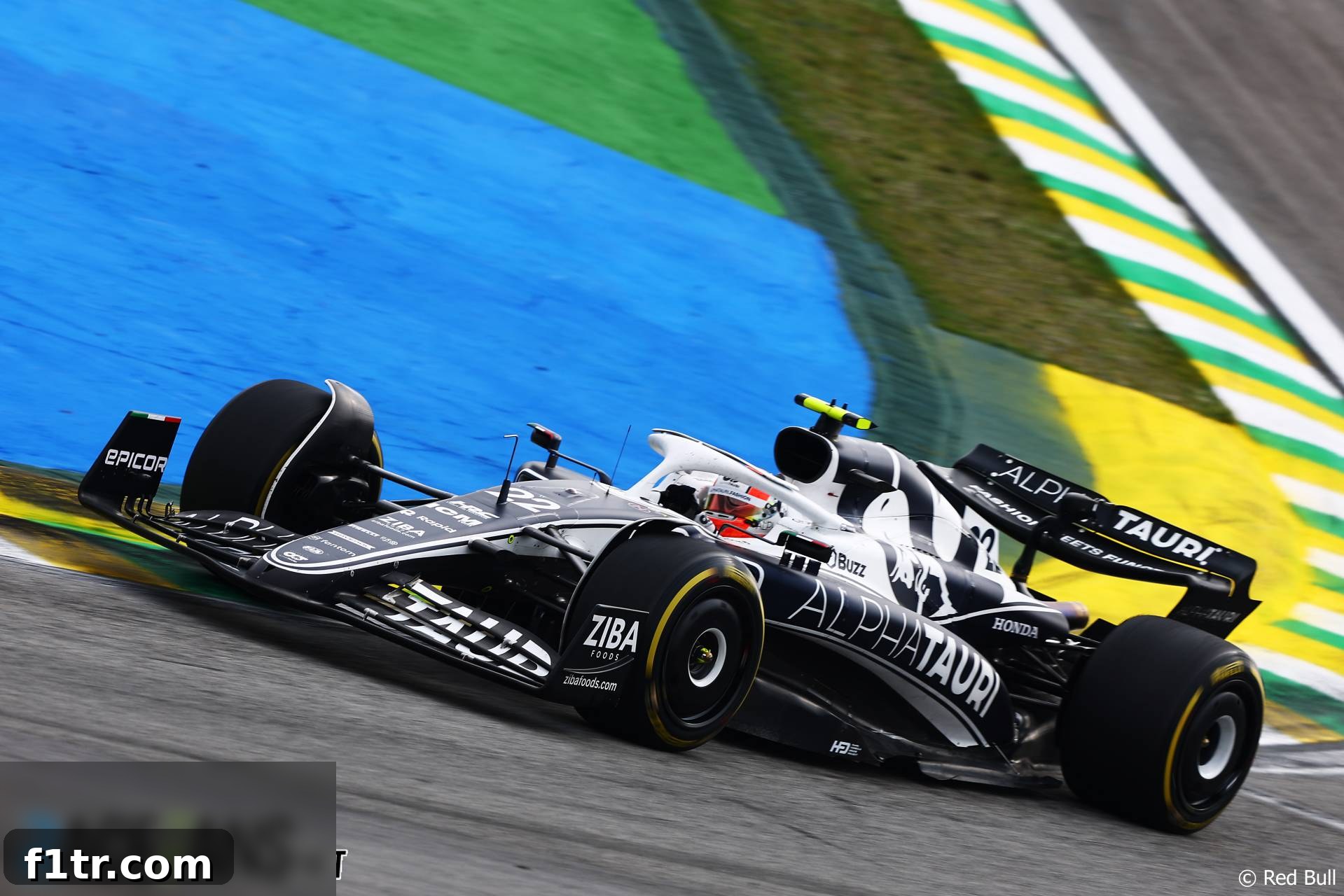
Yuki Tsunoda’s Un-lapping Controversy: A Deep Dive into the Brazilian GP Safety Car Incident
The 2022 Brazilian Grand Prix, a race already packed with thrilling moments and unexpected turns, found itself at the center of a fresh controversy involving AlphaTauri driver Yuki Tsunoda. During the critical final Safety Car period, Tsunoda, who was a lap down, was inexplicably denied the standard opportunity to un-lap himself and rejoin the lead pack. This incident, while seemingly minor in the grand scheme of the race results, reignited discussions surrounding Formula 1’s Safety Car procedures, especially given the tumultuous events of the 2021 Abu Dhabi Grand Prix. The FIA has since provided an explanation, highlighting the unique circumstances at Interlagos that led to this unfortunate outcome for the young Japanese driver.
Advert | Become a Supporter & go ad-free
The Unfortunate Incident: Tsunoda Denied a Key Opportunity
As the Brazilian Grand Prix neared its conclusion, a Safety Car deployment became necessary, bunching up the field. For drivers who find themselves a lap down, the regulations typically permit them to “un-lap” themselves by passing the Safety Car and the entire train of lead-lap cars, thereby rejoining the back of the queue on the lead lap. This procedure is crucial for ensuring a fair restart, as it prevents lapped cars from interfering with the racing leaders. In this particular instance, two other drivers—Williams teammates Alexander Albon and Nicholas Latifi—were correctly waved past the Safety Car to un-lap themselves. However, Yuki Tsunoda, also a lap down, was not afforded the same opportunity, leaving him in a compromised position for the race’s final sprint. His hopes of fighting for a better position were effectively dashed due to this procedural anomaly, drawing immediate attention and questions from fans and pundits alike.
A Rule Forged in Controversy: The Abu Dhabi 2021 Legacy
The rule regarding un-lapping cars under a Safety Car has become one of the most scrutinized and debated aspects of Formula 1 regulations, largely due to the seismic events of the 2021 Abu Dhabi Grand Prix. In that championship-deciding race, then-FIA F1 Race Director Michael Masi made a controversial decision to allow only some lapped cars to un-lap themselves, rather than all, before restarting the race on the final lap. This unprecedented move directly influenced the outcome of the world championship, allowing Max Verstappen to pass Lewis Hamilton for the title. The fallout was immense, leading to a thorough FIA investigation, a restructuring of race control, and ultimately, Masi’s removal from his role. In the wake of this controversy, the FIA committed to implementing more robust and automated systems to manage Safety Car procedures, including the un-lapping process, with the explicit aim of preventing similar human errors and ensuring complete fairness and adherence to the sporting regulations. The incident involving Tsunoda, therefore, instantly brought back painful memories and highlighted the enduring sensitivity surrounding these rules.
Interlagos’ Unique Circuit Layout and the Automated System
The FIA’s subsequent investigation into Tsunoda’s case revealed that the automated system, designed to prevent the very kind of inconsistency seen in Abu Dhabi, had functioned correctly according to the regulations. However, the unique characteristics of the Interlagos circuit layout created an unforeseen complication. An FIA spokesperson clarified that the “unusual situation arose as a result of the idiosyncrasies of the specific circuit and scenario,” emphasizing that the systems themselves were not at fault. This statement pointed towards a technicality in how the circuit’s various control lines interacted with the automated un-lapping protocol, especially concerning the pit lane entry and exit points. Understanding this interplay is key to deciphering why Tsunoda was caught in this unique regulatory trap, while Albon and Latifi were not.
The FIA’s Official Explanation: A Technical Deep Dive
According to the FIA’s detailed explanation, the sequence of events began when the Safety Car was deployed. Yuki Tsunoda was the first driver among the lapped cars to cross “Safety Car Line One” – a designated control point on the track before the pit lane entrance. On the subsequent lap, as the Safety Car continued to circulate, Tsunoda crossed Safety Car Line One for a second time. Ordinarily, this second crossing would signal to the automated system that the driver is eligible to un-lap themselves.
However, a crucial divergence occurred at this point. Instead of remaining on track behind the Safety Car train, Tsunoda opted to enter the pit lane. The spokesperson elaborated, “In doing so, he un-lapped himself when crossing the control line in the pit lane.” This statement is pivotal. By entering the pit lane, Tsunoda was able to maintain a higher speed than the cars queued behind the Safety Car on the main track. When he traversed a specific “control line” within the pit lane, the system registered that he had effectively gained back a lap relative to the Safety Car and the main field. This was a direct consequence of the unique pit lane layout at Interlagos, which allows for such an advantage under certain conditions, even if unintended by the driver as an “un-lapping” maneuver.
Upon rejoining the circuit after his pit stop, the automated systems correctly indicated that Tsunoda was once again a lap down. This might seem contradictory, but the initial “un-lapping” that occurred in the pit lane was a technicality. The system now faced a dilemma: should it grant him a second un-lapping opportunity? The FIA’s position was clear: “as he had already un-lapped himself once, he was not eligible to do so again when the Safety Car period was ending.” Race control confirmed this interpretation with F1 Timing data, which explicitly stated that only Car 6 (Latifi) and Car 23 (Albon) were eligible for the standard un-lapping procedure.
This intricate sequence highlights a complex interaction between driver action (entering the pit lane), circuit design, and the automated regulatory system. While Tsunoda was objectively a lap down when the Safety Car period was about to end, the system’s logic dictated that he had already benefited from an “un-lapping” action, albeit an unconventional one triggered by his pit lane entry and the specific timing of events.
No Immediate Changes, But Future Discussions Inevitable
Despite the controversy and the clear disadvantage for Yuki Tsunoda, the FIA maintains that there were “no systems or procedural errors.” The spokesperson emphasized that it was “one of those unpredictable scenarios that can happen and there are no immediate changes that need to be implemented.” This stance suggests that the FIA views the incident as a rare anomaly rather than a fundamental flaw in their revised Safety Car protocols.
However, the governing body did acknowledge the need for review. “This will of course be discussed at future Sporting Advisory Committees as part of the normal review procedures,” the spokesperson confirmed. This indicates that while no immediate knee-jerk reactions are planned, the incident will certainly be analyzed to determine if any clarifications or minor adjustments to the regulations or system parameters are necessary to prevent such a scenario from recurring. The goal would be to ensure that no driver is unfairly disadvantaged by an obscure technicality, even if the current system technically adheres to the rules as interpreted.
The debate also touches upon the balance between human discretion and automated systems. While automation was introduced to eliminate subjective calls that led to the Abu Dhabi debacle, unique circuit layouts and unforeseen driver actions can still expose edge cases that current automated logic might not fully cover. The incident with Tsunoda serves as a reminder that even the most advanced systems need continuous review and refinement in the dynamic world of Formula 1.
Conclusion: A Continuous Quest for Fairness and Clarity
Yuki Tsunoda’s denial of an un-lapping opportunity at the Brazilian Grand Prix was a curious and unfortunate incident, rooted in a highly specific combination of circuit design and timing. While the FIA asserts that its automated systems functioned precisely as intended, preventing the very human errors that plagued past races, the outcome for Tsunoda underscores the complexity of regulating every possible scenario in a fast-paced sport like Formula 1. The incident, while not deemed a “procedural error” by the FIA, clearly highlights an area ripe for discussion within the Sporting Advisory Committees. It reinforces the ongoing challenge of creating rules and systems that are simultaneously fair, robust, and capable of handling every “unpredictable scenario,” ensuring that every driver has an equal chance, even under the Safety Car. The legacy of Abu Dhabi 2021 continues to cast a long shadow, demanding absolute clarity and consistency in all Safety Car procedures, and this recent event at Interlagos will undoubtedly contribute to that evolving discussion.
Advert | Become a RaceFans supporter andgo ad-free
More on the 2022 Brazilian Grand Prix
- Race Report: Russell Dominates in Brazil for First F1 Win
- Qualifying Analysis: Surprises and Strong Performances Before the Main Event
- Driver Ratings: Who Shone and Who Struggled at Interlagos?
- Team Reactions: Post-Race Comments and Insights from the Paddock
- Strategy Review: Key Decisions That Shaped the Brazilian Grand Prix
Browse all 2022 Brazilian Grand Prix articles