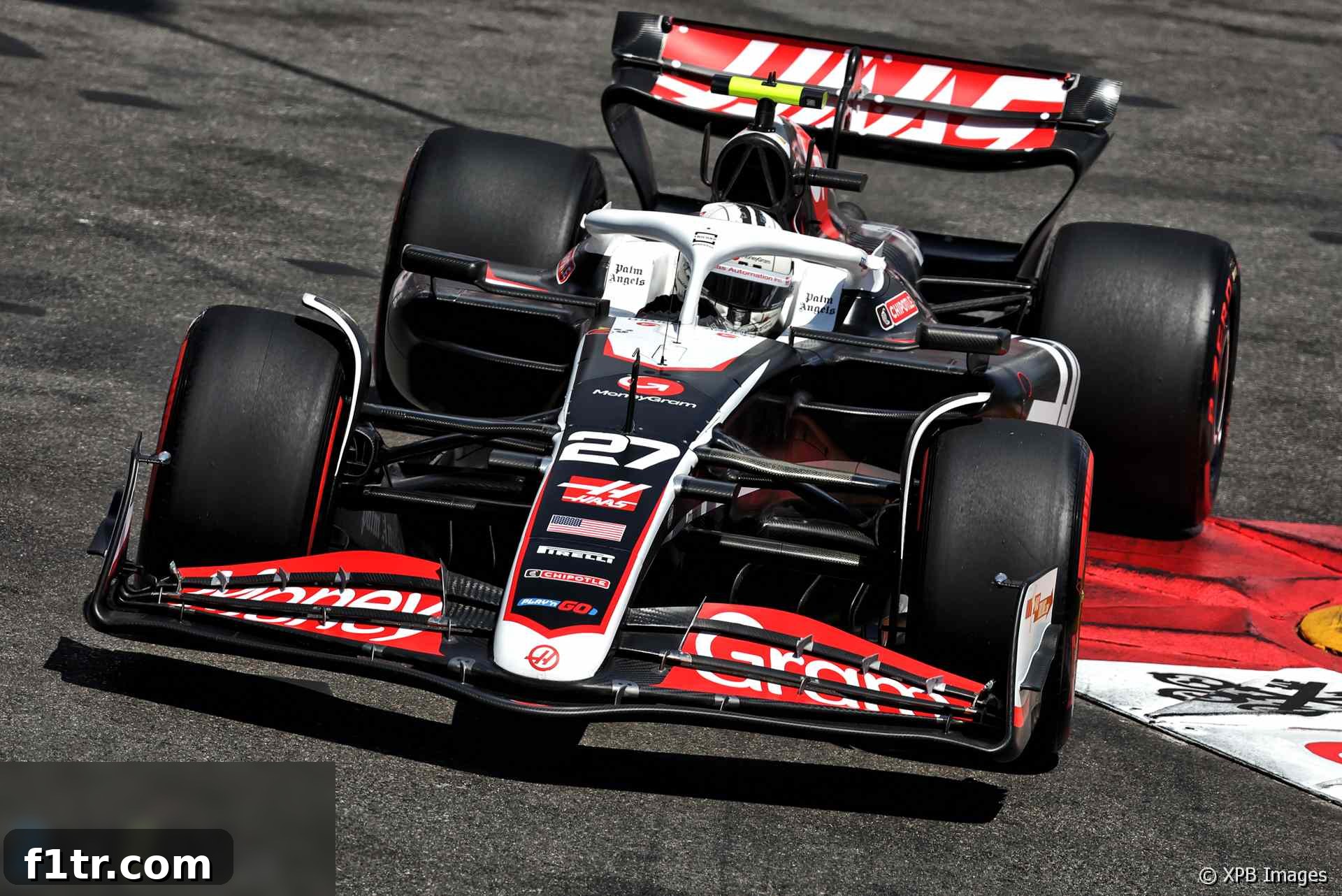
Haas F1 Team Disqualified from Monaco Grand Prix Qualifying Over Rear Wing Infringement
The highly anticipated Monaco Grand Prix qualifying session took an unexpected turn for the Haas F1 Team, as both their drivers, Nico Hulkenberg and Kevin Magnussen, were disqualified following a post-session technical inspection. The decision came after their VF-24 cars failed a crucial legality check concerning the DRS (Drag Reduction System) opening, a ruling that sends significant ripples through their race preparations and grid positions.
Advert | Become a Supporter & go ad-free
The Technical Infringement: A Detailed Look at the DRS Rule
The disqualification stemmed from a direct violation of Formula 1’s stringent technical regulations. Jo Bauer, the FIA’s Formula 1 Technical Delegate, meticulously inspected both Haas cars and promptly informed the stewards that the DRS opening on the VF-24s did not comply with Article 3.10.10.h of the FIA Formula 1 Technical Regulations. This particular article mandates that the outer ends of the adjustable elements of the rear wing must not exceed 85 millimeters when the DRS is open.
Bauer’s precise measurements revealed that both Hulkenberg’s and Magnussen’s cars exceeded this maximum permissible dimension on both the left and right-hand sides of the rear wing. This seemingly minor discrepancy, often measured in mere millimeters, is critical in F1, where every aspect of aerodynamic performance is tightly regulated to ensure fair competition and driver safety. The DRS mechanism, designed to aid overtaking, allows drivers to temporarily reduce drag on straights by opening a flap on the rear wing. Even a slight over-extension can provide an illicit aerodynamic advantage, making such infringements a serious matter.
Haas’s Explanation and the Stewards’ Decision
Following the report, the stewards summoned the Haas representatives to explain the infringement. The team was commendably candid about their mistake, offering a transparent explanation for the error. They attributed the non-compliance to an “inadvertent error” in the precise setting of the wing flap gap. The crucial factor was the introduction of a new rear wing design, specifically developed for the unique high-downforce demands of the Monaco circuit. This new specification was being used for the first time.
Haas elaborated that their previous wing design was configured to meet regulations by ensuring the largest gap was measured from the center of the wing. However, with the new design, the largest gap shifted to the extremities of the wing. Crucially, the team admitted that their mechanics had not been adequately trained or instructed on how to correctly set the gap according to this new design’s specific characteristics. This oversight directly led to the non-compliance detected by the FIA.
The stewards acknowledged Haas’s honesty, noting that the team was “candid” about their error. They also confirmed that the FIA technical team was satisfied with the explanation, indicating that there was no malicious intent to gain an illegal advantage. Despite the team’s transparency and the unintentional nature of the mistake, technical infringements in Formula 1 almost invariably lead to exclusion from the session in which they occurred. Consequently, the stewards had no alternative but to disqualify both Haas cars from the qualifying session.
The Immediate Consequences: Grid Drop and Pit Lane Start
The disqualification has significant ramifications for both drivers and the team. Nico Hulkenberg, who had initially qualified in a respectable 12th position, lost his grid slot, effectively erasing his qualifying performance. Similarly, Kevin Magnussen, who secured 15th place on the grid, also had his result nullified. This outcome is particularly painful for Haas, as Monaco is notoriously difficult for overtaking, making strong qualifying positions vital for any chance of scoring points.
Following the stewards’ decision, Haas confirmed that both Hulkenberg and Magnussen would start the Monaco Grand Prix from the pit lane. Starting from the pit lane in Monaco presents an immense challenge. Not only do the drivers lose their grid advantage, but they also have to navigate the initial chaos of the race start from the very back, effectively beginning their race with a strategic disadvantage. In a race where track position is paramount, recovering from the pit lane to score points is a monumental task, requiring impeccable strategy, faultless driving, and a significant amount of luck with safety cars or retirements.
Monaco’s Unique Demands and Haas’s Strategic Evolution
The decision by Haas to introduce a new rear wing for Monaco highlights the circuit’s unique characteristics. The Circuit de Monaco is a high-downforce track, demanding maximum grip and stability through its tight, winding streets. Teams typically bring bespoke aerodynamic packages to optimize their cars for these specific requirements, often featuring larger, multi-element wings to generate as much downforce as possible, even at the expense of straight-line speed.
Haas team principal Ayao Komatsu had previously expressed satisfaction with the team’s decision to bring this new specification wing. This move marked a departure from previous seasons where the team had been more conservative with in-season aerodynamic upgrades. Komatsu had stated his pleasure that the team had taken “this step,” indicating a more aggressive development strategy for the 2024 season. This ambition to optimize their package for Monaco, while commendable, inadvertently led to their technical breach.
The incident underscores the incredibly fine line teams walk in Formula 1, constantly pushing the boundaries of technical regulations while striving for performance gains. Even with the best intentions and a focus on improvement, a momentary lapse in communication or training, especially with new components, can lead to severe penalties.
Historical Context: The Lewis Hamilton Precedent in Brazil 2021
This is not the first time a major Formula 1 team has faced disqualification for a DRS infringement. A notable precedent occurred at the 2021 Brazilian Grand Prix, where then-championship leader Lewis Hamilton was disqualified from the sprint race qualifying session. His Mercedes W12 also fell afoul of the same regulation concerning the maximum DRS opening.
In Hamilton’s case, Mercedes argued that a part of their rear wing had suffered damage during the session, causing the DRS flap to open beyond the legal limit. While the team provided evidence of the damage and argued it was an uncontrollable consequence rather than an intentional design choice, the FIA stewards ultimately upheld the technical infringement. Hamilton was forced to start the sprint race from the back of the grid, a decision that had significant implications for his championship battle against Max Verstappen that season. Despite the setback, Hamilton famously charged through the field, showcasing the potential for recovery, albeit in a different circuit context than Monaco.
The similarities between the Haas incident and Hamilton’s case highlight the FIA’s consistent and uncompromising stance on technical regulations. Whether due to damage, an honest mistake in setup, or a design flaw, non-compliance is met with strict penalties to preserve the integrity of the sport and ensure a level playing field. These incidents serve as a stark reminder that every component on an F1 car, down to the smallest detail, must adhere precisely to the rulebook.
The Broader Significance of Technical Scrutiny in Formula 1
Technical regulations are the bedrock of Formula 1, designed to promote fair competition, ensure safety, and prevent teams from gaining an unfair advantage through illicit means. The FIA’s role in enforcing these rules through rigorous post-session scrutiny is paramount. While disqualifications are always dramatic and often controversial, they are a necessary mechanism to maintain the sporting integrity of the championship.
Incidents like Haas’s disqualification underscore the immense pressure on F1 teams. They must innovate and push performance limits, all while operating within an incredibly tight regulatory framework. The development cycle for new components is relentless, and ensuring every new part meets all 200+ pages of the technical regulations is a monumental task involving engineers, designers, and mechanics. The slightest miscalculation or oversight can lead to severe consequences, as seen in Monaco.
For Haas, this incident is a significant setback in a season where they have shown flashes of improved performance and consistency. While the honest admission of error may soften the perception of intent, the penalty remains. It will undoubtedly lead to an internal review of their procedures for new part implementation and mechanic training to prevent similar issues in the future.
Looking Ahead: Haas’s Monaco Challenge
Starting from the pit lane, Haas faces an uphill battle in the Monaco Grand Prix. Overtaking opportunities are virtually non-existent on the narrow streets, making it perhaps the most challenging circuit on the calendar from which to recover from the back. Their best hope will lie in strategic prowess, exceptional tire management, and capitalizing on any potential safety car periods or red flags that might bunch up the field. Both Hulkenberg and Magnussen are experienced drivers, but even for them, turning this disadvantage into a points-scoring finish will be a truly Herculean effort.
The Monaco Grand Prix qualifying disqualification serves as a stark reminder of the uncompromising nature of Formula 1. In a sport where milliseconds and millimeters can dictate success or failure, adherence to every letter of the rulebook is non-negotiable. Haas will now have to channel their disappointment into a determined effort to salvage what they can from one of the most prestigious races on the calendar.
Advert | Become a RaceFans supporter andgo ad-free
2024 Monaco Grand Prix – Related Articles
- Formula 1 will fix red flag rule loophole which ruined Monaco GP – Domenicali
- Magnussen ‘could have backed off but didn’t’ in Monaco crash, says team boss
- Ocon defends his driving after ‘hurtful abuse’ over Monaco GP crash with Gasly
- How the midfield’s hottest team mate rivalry boiled over
- “He’s really dangerous”: Unheard driver radio from F1’s slow show in Monaco
Browse all 2024 Monaco Grand Prix articles