The exhilarating spectacle of the Singapore Grand Prix qualifying session once again delivered a cocktail of unexpected twists and thrilling performances. As the floodlights illuminated the iconic Marina Bay Street Circuit, teams and drivers alike braced themselves for one of the most demanding challenges on the Formula 1 calendar. However, for some, the outcome was far from what was anticipated, with Oscar Piastri admitting that McLaren was genuinely “surprised” by their inability to challenge at the sharp end of the grid.
Advert | Become a Supporter & go ad-free
Last year, the McLaren MCL60, with Lando Norris behind the wheel, dominated this very track, securing a comfortable pole position and subsequent victory. This history naturally fueled high expectations for the Woking-based squad. Yet, the 2024 edition of the Singapore Grand Prix presented a significantly altered landscape. Crucially, partial resurfacing across several sections of the track introduced new variables, fundamentally changing the grip levels and, consequently, the car’s behavior. This alteration seemingly caught McLaren off guard, disrupting their previously successful setup philosophy and diminishing their competitive edge.
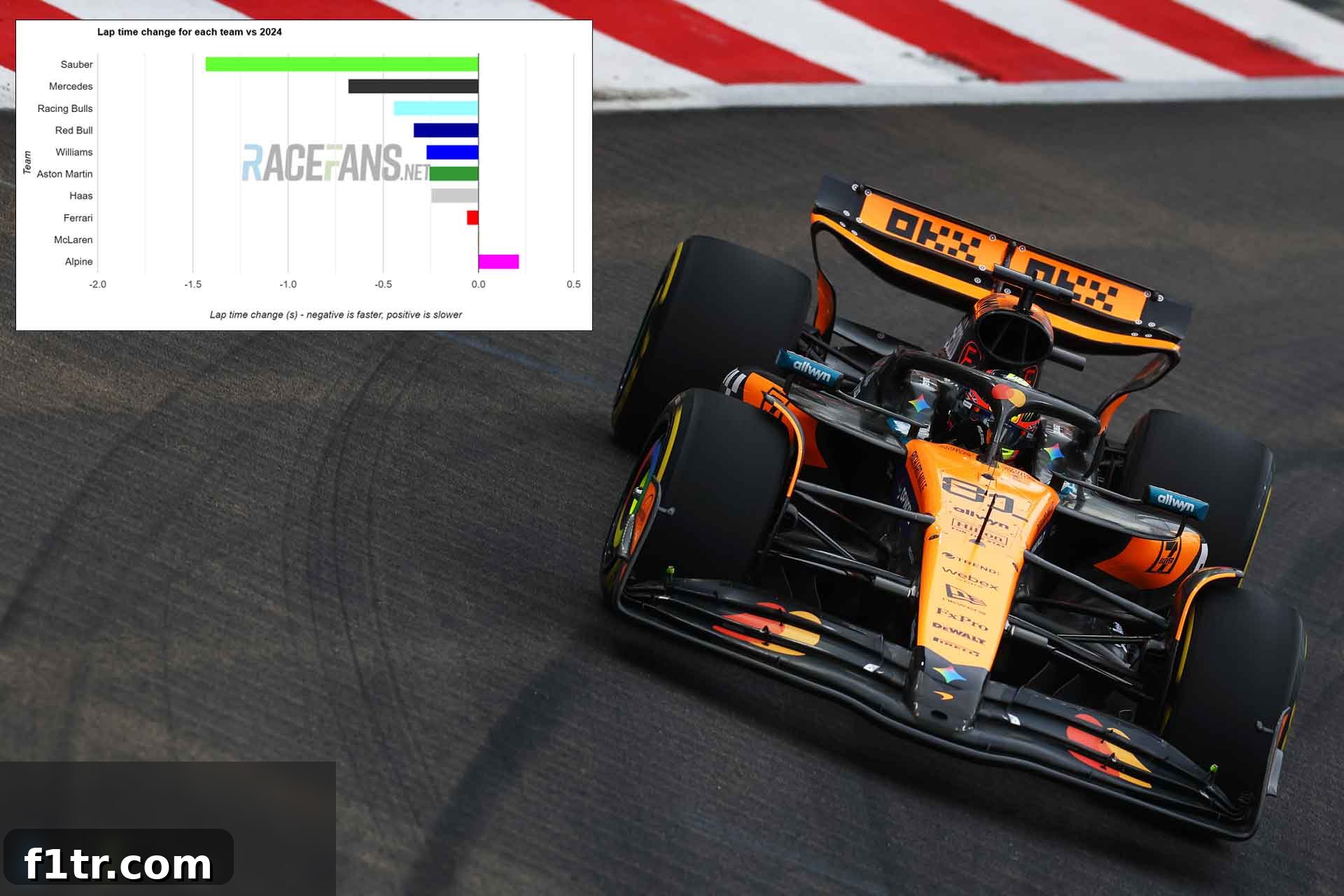
The impact was stark: while nearly every other team on the grid managed to lap the circuit significantly faster than they had in the previous year, McLaren demonstrated minimal year-on-year improvement. This lack of progression, in a sport where marginal gains are paramount, signaled a deep-seated struggle to adapt to the circuit’s updated characteristics, leaving both drivers and the team headquarters puzzled.
Mercedes’ Masterclass: Russell’s Surge from Practice to Pole
Perhaps the most significant and delightful surprise of the weekend came from George Russell, who stunned the paddock by clinching pole position. Mercedes’ performance on Friday had been conspicuously subdued, creating a narrative that belied their true potential. Russell himself contributed to this perception after an uncharacteristic crash prevented him from completing a crucial qualifying simulation run during the practice sessions. This incident left many speculating about Mercedes’ prospects, underestimating the team’s ability to unlock performance overnight.
However, the Silver Arrows executed a remarkable turnaround. By the end of Saturday’s qualifying, Mercedes had found an astonishing amount of pace, with Russell’s car almost three seconds quicker than it had been just 24 hours prior. This dramatic improvement underscored the team’s meticulous engineering, strategic data analysis, and the driver’s exceptional talent in adapting to evolving track conditions. Russell’s ability to extract such significant performance gains in such a short timeframe not only secured him pole but also established it as one of the most memorable and unexpected pole positions of the season, injecting a thrilling dose of unpredictability into the championship battle.
Advert | Become a RaceFans supporter andgo ad-free
The Battle of the Sectors: Verstappen vs. Russell
The qualifying session itself was a nail-biting affair, particularly in the latter stages where the fight for pole position intensified. Early on, Max Verstappen, the reigning world champion, appeared to be the clear favorite. His initial laps in Q1 and Q2 were impeccably fast, prompting his Red Bull team to confidently inform him that his times were sufficient to comfortably progress to the next stages. This strategic decision allowed Verstappen to conserve a full stock of fresh soft tyres, a critical advantage for the decisive Q3 showdown.
However, as qualifying progressed, Russell demonstrated an unwavering pace, subtly outperforming Verstappen. In Q2, the Mercedes driver managed to eclipse Verstappen’s time by a mere hundredth of a second, a tiny margin that foreshadowed the thrilling climax. This trend continued into Q3, where Russell truly shone. Verstappen, ever the competitor, later expressed his belief that he could have snatched pole had he not been impeded by Lando Norris during his crucial final lap. While traffic undoubtedly plays a role in qualifying, a close examination of the sector times reveals that Russell’s superior performance in the first two sectors would likely have been decisive, regardless of Verstappen’s minor delay. Russell’s consistent speed through the demanding twists and turns of Singapore’s initial two sectors provided him with a crucial buffer that proved insurmountable even for a driver of Verstappen’s caliber.
| P. | # | Driver | S1 | S2 | S3 | Ultimate lap (deficit) |
|---|---|---|---|---|---|---|
| 1 | 63 | George Russell | 26.415 (1) | 37.329 (1) | 25.284 (2) | 1’29.028 (+0.130) |
| 2 | 1 | Max Verstappen | 26.512 (3) | 37.419 (3) | 25.220 (1) | 1’29.151 (+0.189) |
| 3 | 12 | Andrea Kimi Antonelli | 26.482 (2) | 37.413 (2) | 25.442 (10) | 1’29.337 (+0.200) |
| 4 | 4 | Lando Norris | 26.629 (6) | 37.451 (4) | 25.332 (4) | 1’29.412 (+0.174) |
| 5 | 81 | Oscar Piastri | 26.556 (4) | 37.609 (6) | 25.359 (8) | 1’29.524 |
| 6 | 44 | Lewis Hamilton | 26.716 (9) | 37.592 (5) | 25.285 (3) | 1’29.593 (+0.095) |
| 7 | 16 | Charles Leclerc | 26.667 (7) | 37.642 (7) | 25.333 (5) | 1’29.642 (+0.142) |
| 8 | 6 | Isack Hadjar | 26.610 (5) | 37.710 (8) | 25.412 (9) | 1’29.732 (+0.114) |
| 9 | 87 | Oliver Bearman | 26.703 (8) | 37.824 (10) | 25.341 (6) | 1’29.868 |
| 10 | 14 | Fernando Alonso | 26.737 (12) | 37.812 (9) | 25.345 (7) | 1’29.894 (+0.061) |
| 11 | 27 | Nico Hulkenberg | 26.721 (10) | 37.864 (11) | 25.533 (14) | 1’30.118 (+0.023) |
| 12 | 23 | Alexander Albon | 26.726 (11) | 38.020 (15) | 25.456 (11) | 1’30.202 |
| 13 | 55 | Carlos Sainz Jnr | 26.806 (14) | 37.945 (14) | 25.477 (13) | 1’30.228 (+0.007) |
| 14 | 22 | Yuki Tsunoda | 26.841 (15) | 37.935 (13) | 25.468 (12) | 1’30.244 (+0.109) |
| 15 | 30 | Liam Lawson | 26.852 (16) | 37.903 (12) | 25.553 (15) | 1’30.308 (+0.012) |
| 16 | 18 | Lance Stroll | 26.911 (18) | 38.102 (16) | 25.699 (18) | 1’30.712 (+0.237) |
| 17 | 5 | Gabriel Bortoleto | 26.952 (20) | 38.250 (18) | 25.618 (17) | 1’30.820 |
| 18 | 31 | Esteban Ocon | 26.931 (19) | 38.352 (19) | 25.593 (16) | 1’30.876 (+0.113) |
| 19 | 43 | Franco Colapinto | 26.776 (13) | 38.248 (17) | 25.885 (20) | 1’30.909 (+0.073) |
| 20 | 10 | Pierre Gasly | 26.875 (17) | 38.521 (20) | 25.718 (19) | 1’31.114 (+0.147) |
Advert | Become a RaceFans supporter andgo ad-free
Unraveling Team Performance Dynamics
The Singapore qualifying session often serves as a revealing barometer of car performance, especially at a circuit that demands maximum downforce and precise handling. This year’s session was no exception, highlighting various team performances and struggles. Surprisingly, only Alpine recorded a slower lap time compared to their performance 12 months prior. However, their potential was severely compromised by Pierre Gasly’s unfortunate loss of power during Q1, which undoubtedly masked their true pace and ability to adapt to the circuit changes.
Yet, the most perplexing outcome belonged to McLaren. Oscar Piastri’s fastest lap of 1’29.524 was a mere one-thousandth of a second quicker than Lando Norris’s pole-winning time from the previous year. This minimal improvement, especially when contrasted with the significant gains made by most other teams, left McLaren as only the third-fastest team, a considerable drop from their dominant showing in the prior season. Piastri’s post-qualifying comments perfectly encapsulated the team’s bewilderment: “My first lap of Q3 felt reasonable. It certainly didn’t feel ‘four tenths off’ bad. So I just don’t think we had the pace tonight, which is a little bit of a surprise for us.” This statement underscores the disconnect between driver feel and objective performance, suggesting a fundamental challenge in understanding how the car was interacting with the updated track conditions. McLaren’s baffling performance will undoubtedly trigger intense analysis back at the factory to pinpoint the exact reasons behind their unexpected step backward.
Advert | Become a RaceFans supporter andgo ad-free
The Evolving Marina Bay Street Circuit: A New Record
George Russell’s blistering pace in qualifying not only secured him pole position but also etched his name into the history books. He set two laps quick enough for pole, ultimately lowering the all-time record for the Singapore circuit to an astonishing 1’29.158. This remarkable time represents a colossal leap of over 15 seconds faster than the inaugural pole position time set at this very track back in 2008. This extraordinary improvement is a testament to the relentless technological advancements in Formula 1 cars over the past decade and a half, showcasing the incredible speed and efficiency modern machinery can achieve.
However, it is crucial to acknowledge that car evolution isn’t the sole factor behind this record. The Marina Bay Street Circuit itself has undergone significant modifications. In 2023, four corners were removed from the track configuration, streamlining certain sections and allowing for higher average speeds. These layout changes undoubtedly contributed to the quicker lap times. The current configuration, with its altered flow, is anticipated to remain in use for next year’s event as crucial construction work continues along the waterfront, shaping the future of this iconic night race. This continuous evolution of both the cars and the circuits ensures that Formula 1 remains a dynamic and ever-challenging sport, constantly pushing the boundaries of speed and engineering.
Miss nothing from RaceFans
Get a daily email with all our latest stories – and nothing else. No marketing, no ads. Sign up here:
Advert | Become a RaceFans supporter andgo ad-free
More from the Singapore Grand Prix
- What are McLaren’s “repercussions” for Norris and why did they wait to apply them?
- Hamilton “had no choice” about cutting corners when brakes failed in Singapore
- Norris reveals he faces ‘repercussions to the end of the season’ over Piastri clash
- Russell denies Verstappen a ‘full set’ of wins, Hamilton breaks Schumacher record
- ‘Good shout on staying out’: Did Verstappen consider a second pit stop in Singapore?
Browse all 2025 Singapore Grand Prix articles