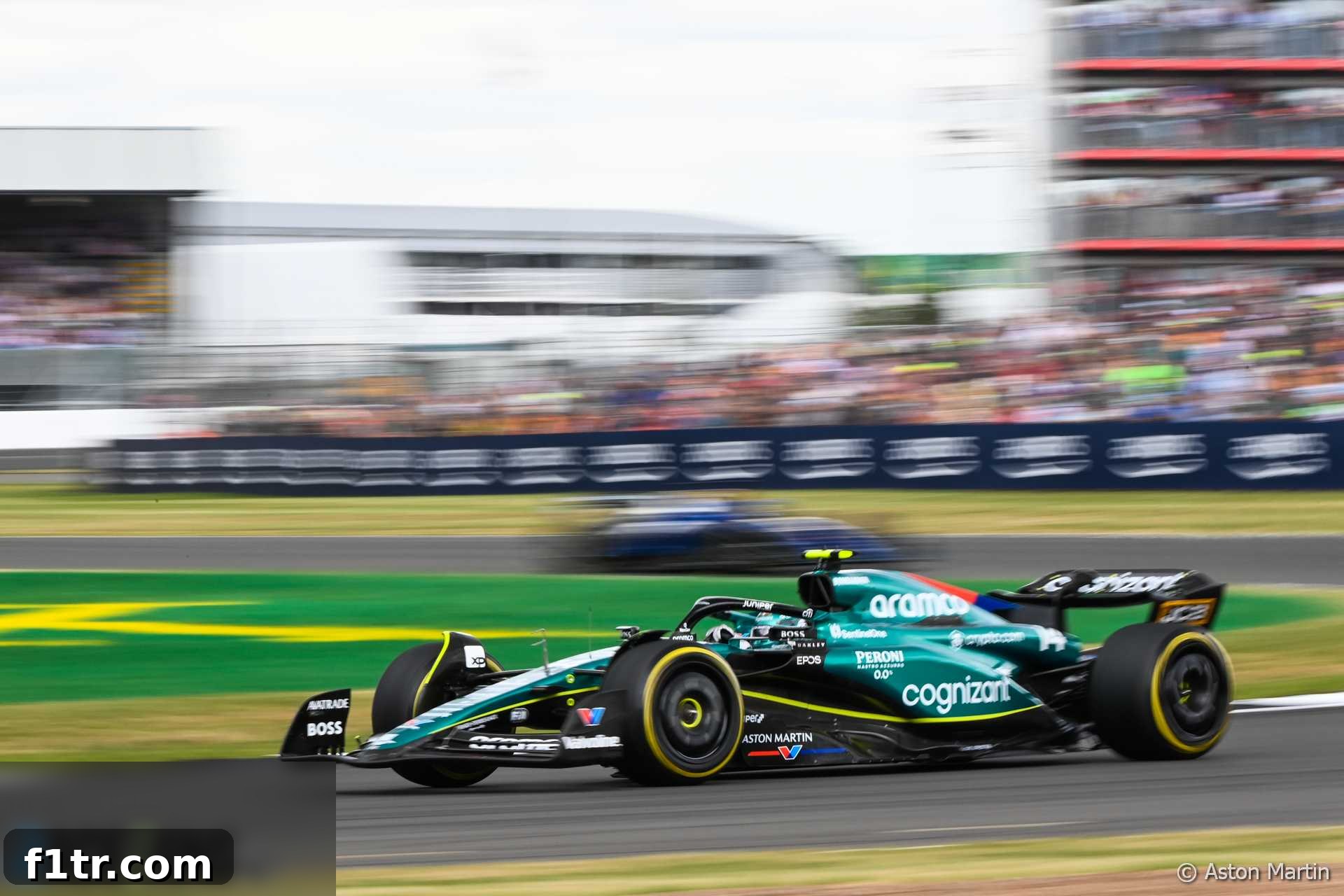
Fernando Alonso Reflects on Aston Martin’s Challenging F1 Weekends and Future Prospects
Fernando Alonso, a seasoned veteran of Formula 1, has openly acknowledged that the past two Grand Prix weekends, specifically Austria and Silverstone, have represented some of the most challenging for Aston Martin throughout the current season. Despite these hurdles, Alonso showcased his characteristic resilience by securing a respectable seventh place at the British Grand Prix, equalling his lowest finishing position of the year. However, the Spanish driver remains optimistic, anticipating a significant upturn in the team’s fortunes as the F1 calendar progresses to circuits that are inherently more suited to the AMR23’s unique characteristics.
Speaking to media, including RaceFans, following the recent British Grand Prix, Alonso stated, “This was, and Austria, one of the worst weekends I think for us so far, and we saved quite well.” This candid assessment underscores the team’s determination to extract maximum performance even when the car’s setup and track conditions are not ideal. The ability to “save” a difficult weekend by still bringing home valuable points speaks volumes about Alonso’s skill and the team’s operational efficiency, especially crucial in a tightly contested championship.
Unpacking the Performance Dip: Key Factors Identified by Alonso
Alonso pointed to a confluence of factors contributing to Aston Martin’s recent sub-par performance, suggesting it was “probably a little bit of everything.” This multi-faceted explanation highlights the complex and dynamic nature of Formula 1, where success hinges on a delicate balance of development, track suitability, and technical regulations.
The Competitive Escalation: Opponent Upgrades
One of the primary reasons cited by Alonso was the rapid development pace of competing teams. “Out-developed a little bit in terms of a few teams brought some significant upgrades lately,” he explained. In the relentless world of F1, stagnation is regression. Teams like McLaren and Mercedes have introduced substantial upgrade packages in recent races, which have evidently narrowed, if not surpassed, Aston Martin’s early-season performance advantage. This constant arms race in aerodynamics, chassis design, and power unit integration means that a team must continually innovate and evolve its car to maintain its competitive edge. The impact of these upgrades is magnified on tracks that reward aerodynamic efficiency and high-speed stability, areas where Silverstone, with its iconic fast corners, places significant demands on the cars.
Track-Specific Challenges: The Silverstone Layout
Another crucial element in the team’s recent struggles is track specificity. Alonso noted, “It’s track-specific, I think here was not our best layout for the package that we have.” Silverstone, with its sweeping, high-speed corners like Copse, Maggotts, and Becketts, requires a car with exceptional aerodynamic balance and efficiency. The AMR23, which demonstrated remarkable performance on more varied circuits and those with heavy braking zones earlier in the season, found itself less at home on the fast-flowing British track. Different car philosophies excel on different types of circuits; some cars might be optimized for downforce at lower speeds, while others prioritize drag reduction for top-end speed or stability through rapid direction changes. Understanding and adapting to these nuances is vital for consistent performance, and sometimes, a car simply doesn’t align perfectly with a particular track’s demands.
The Enigma of New Tire Construction
Furthermore, Alonso highlighted the impact of the new tire construction introduced at Silverstone by Pirelli. “We need to see also the tyres, obviously it’s the first race that we have this new construction so it seems that maybe we need to analyse more in detail,” he commented. The introduction of new tire specifications can significantly alter the competitive landscape. Tires are the sole point of contact between the car and the track, profoundly influencing grip, balance, degradation, and overall performance. A change in construction can affect how a car’s suspension works, how it generates temperature in the tires, and how it manages wear. Some teams might find their car philosophy naturally adapts well to the new tires, while others may struggle to find the optimal operating window, requiring extensive setup changes and data analysis. This element adds another layer of complexity to performance evaluation and future strategy.
Strategic Decisions and the Shifting Pecking Order at Silverstone
While Aston Martin has frequently fielded the quickest Mercedes-powered cars for much of the 2023 season, the British Grand Prix saw a significant shift. The Mercedes works team and the significantly upgraded McLarens demonstrated superior pace, with Lando Norris and Lewis Hamilton both securing podium finishes. Alonso’s candid admission about not aggressively defending against Hamilton early in the race provides a window into his strategic mindset and astute racecraft.
“They’ve been quicker the whole weekend,” Alonso stated, explaining his decision. “So when he was behind I knew that it was not worth spending too much time defending and he had more pace. They were fast this weekend.” This pragmatic approach, characteristic of a two-time world champion, emphasizes intelligent race management over futile battles. Spending excessive time defending against a faster car can compromise tire life, drain energy, and ultimately lead to a slower overall race time. By acknowledging the superior pace of his rivals, Alonso focused on extracting the maximum from his own package and securing the best possible result, rather than engaging in a fight he knew he couldn’t win sustainably.
Alonso also expressed his satisfaction at seeing Lando Norris on the podium, acknowledging the strong performance from McLaren. This highlights the respect among drivers and the dynamic nature of F1, where fortunes can swing rapidly. The resurgence of McLaren, coupled with Mercedes’ consistent strength, signals an increasingly competitive midfield and front-running battle, making every race weekend an intense strategic and developmental challenge.
Long-Term Vision Over Short-Term Stress: A Pragmatic Approach
Despite the recent dip in performance, Fernando Alonso remains remarkably composed and focused on the broader picture for Aston Martin. After securing six podium finishes in the first eight Grands Prix of 2023, he cautioned against alarm should the team struggle to replicate those exceptional early-season results consistently.
“To be honest, I’m not too stressed about the development,” Alonso affirmed. “The car is better than expected this year, we are fighting for things that we could probably never dream of at the beginning of the year.” This perspective is crucial for a team like Aston Martin, which is on a multi-year journey to establish itself as a championship contender. The initial expectations for 2023 were likely more conservative, making the early successes a bonus rather than the baseline. Achieving podiums and consistently challenging the top teams so early in their renewed project represents a monumental achievement and a strong foundation for future growth.
Alonso’s philosophy emphasizes a “pragmatic and relaxed” attitude towards performance fluctuations. “So now if we can keep in the top 10 and fighting with the top guys, it’s great. But I think we have to focus as well on the long-term picture. We cannot get stressed every weekend if we are seventh or if we are fourth or if we are on the podium this year. We need to be very pragmatic and very relaxed about our performance.” This seasoned outlook is vital for maintaining morale, guiding development priorities, and preventing short-term disappointments from derailing long-term objectives. Aston Martin’s strategic focus is not solely on winning individual races immediately but on building the infrastructure, talent, and car development capabilities to consistently compete at the very front of the grid for years to come. This involves careful resource allocation, disciplined development cycles, and a clear understanding of where the team stands in its journey.
Looking Ahead: Hopes for Hungary and Beyond
With the British Grand Prix now behind them, the team’s focus swiftly shifts to the next challenge on the calendar. Alonso expressed hope for improved competitiveness at the Hungaroring, stating, “Hopefully in Hungary we are again competitive.” The Hungarian Grand Prix often presents a different set of demands compared to the high-speed nature of Silverstone. The Hungaroring is a tight, twisty circuit with a lack of long straights, often referred to as “Monaco without the walls.” It places a premium on mechanical grip, high-downforce setups, and excellent handling through a series of slow and medium-speed corners. This layout could potentially play more into the strengths of the Aston Martin AMR23, which has shown impressive performance in such conditions earlier in the season.
The F1 season is a marathon, not a sprint, and a team’s ability to adapt and perform across a diverse range of tracks is ultimately what defines its championship aspirations. While the recent races have been a setback, they offer invaluable data and lessons for Aston Martin’s engineers and strategists. The ongoing development battle, combined with the varying characteristics of upcoming circuits, means that the competitive order is constantly in flux. Alonso’s confidence in the team’s ability to bounce back underscores the internal belief and the methodical approach Aston Martin is taking towards its ultimate goals in Formula 1.
The journey of Aston Martin in Formula 1 is a testament to ambition and perseverance. While the road will inevitably have its challenging turns, the leadership of figures like Fernando Alonso, with his unparalleled experience and calm perspective, provides a steady hand. The team’s early-season success has set a high benchmark, but their pragmatic approach to development and performance management suggests they are well-equipped to navigate the competitive pressures and continue their ascent in the pinnacle of motorsport.
Support Independent F1 Journalism
Access to in-depth analysis and timely news directly from the heart of Formula 1 is invaluable for fans. Publications committed to original journalism rely on the support of their readers to cover the extensive costs involved: from travelling to races, conducting interviews, writing insightful articles, to maintaining robust online platforms. For over a decade, independent F1 coverage has been proudly supported by its readership, ensuring that unbiased and comprehensive reporting remains available.
If you value independent coverage of Formula 1 and wish to contribute to the continuation of high-quality journalism, please consider becoming a supporter today. As a gesture of appreciation, supporters often gain access to an ad-free browsing experience. You can find more information about how to contribute and the benefits of supporting independent journalism through the links below:
- Learn how to become a Supporter
- Supporter Frequently Asked Questions
Related Coverage: 2023 British Grand Prix Insights
Delve deeper into the events and discussions surrounding the 2023 British Grand Prix with these related articles:
- Norris is “growing” closer to the champion who inspired him to race
- Second supplier part failure ‘a frustrating issue we must solve’ – Alpine
- Albon ‘surprised’ to be quicker than Alonso at end of British GP
- Bottas admits Alfa Romeo ‘were expecting to be better than this’ in 2023
- McLaren now “finding performance quicker” after emulating Red Bull’s design
Browse all 2023 British Grand Prix articles