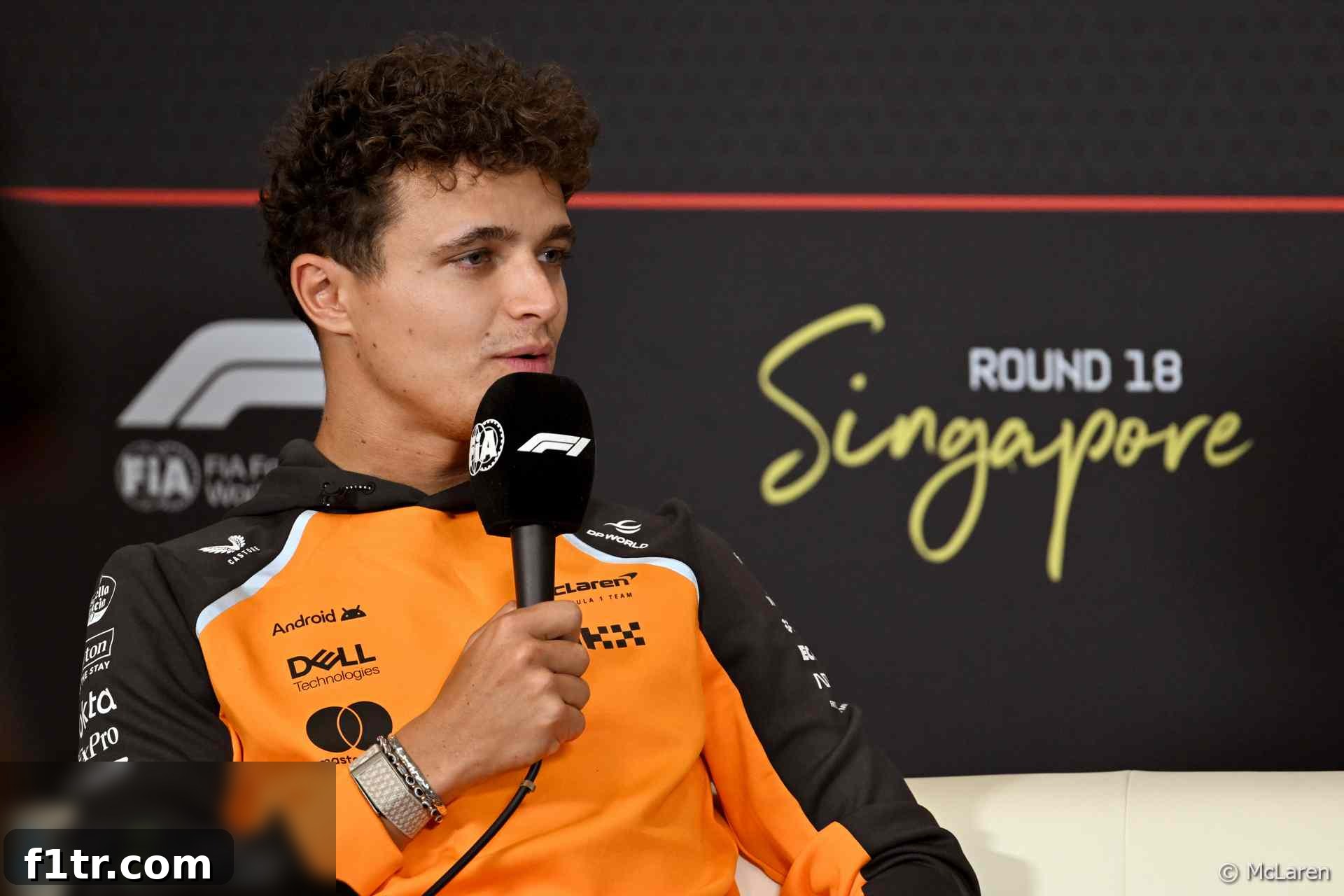
McLaren driver Lando Norris has openly admitted that the clear competitive advantage his team enjoyed over Red Bull earlier in the Formula 1 season has significantly diminished. This shift in the pecking order comes as Red Bull demonstrates a powerful resurgence, fueled by recent aerodynamic enhancements.
The competitive landscape of Formula 1 is in constant flux, a testament to the relentless development race among teams. For much of the season, McLaren appeared to have found a sweet spot, consistently challenging at the front and often outpacing their rivals. However, the narrative has evolved, particularly since the Italian Grand Prix.
Red Bull’s Resurgence: A Game Changer in F1 Dynamics
Since Red Bull introduced a crucial floor upgrade at Monza, the Italian Grand Prix, their performance trajectory has seen a notable upswing. This strategic enhancement has clearly paid dividends, with Max Verstappen securing victories in both races contested since the upgrade package was rolled out. While these particular circuits were known for their low-downforce characteristics, a factor that could theoretically mask some deficiencies or amplify certain strengths, Norris believes that Verstappen and Red Bull are now a formidable threat on any track.
“If you go back to the beginning of the season, they were challenging the first six, seven races [for] race wins and challenging us in the drivers’ [championship],” Norris reflected, highlighting the initial fierce competition. “Then we brought some upgrades, improved a little bit. A couple of weeks ago they brought some upgrades and it seems like that’s put them back on the same level as us.” This statement underscores the cyclical nature of F1 development, where one team’s breakthrough is often met by a rival’s counter-development.
The impact of Red Bull’s floor upgrade cannot be overstated. In modern Formula 1, the floor and diffuser are critical components for generating aerodynamic downforce, essentially sucking the car to the track. Improvements in this area can lead to significant gains in cornering speeds and overall stability, translating directly into faster lap times. The fact that Verstappen has clinched back-to-back victories on varied circuits suggests a fundamental improvement in the RB19’s performance envelope, rather than just a track-specific advantage.
Norris’s assessment of Verstappen as “genuinely a challenger” for more wins beyond low-downforce tracks signals a paradigm shift in McLaren’s strategic outlook. The team now faces the daunting prospect of a revitalized Red Bull, making every race a potentially tighter battle for victory and crucial championship points. The McLaren pit wall will undoubtedly be analyzing Red Bull’s recent form with intense scrutiny, seeking to understand the nuances of their improved pace and strategizing on how to regain an edge.
Singapore GP: A Test of New Dynamics
Looking ahead to the upcoming Singapore Grand Prix, Norris has already predicted that Max Verstappen will be among their most formidable rivals. “We expect battles, especially with him here,” he stated, acknowledging the Dutchman’s talent and the renewed competitiveness of his car. The Marina Bay Street Circuit presents a unique challenge, demanding high downforce, excellent traction, and pinpoint accuracy from drivers. It is a stark contrast to the high-speed layouts of Monza, making it an ideal proving ground for Red Bull’s latest upgrades and a crucial benchmark for McLaren’s continued development.
McLaren’s Foundation: The Synergy of Car and Driver Consistency
Despite Red Bull’s recent surge, McLaren remains a potent force in the constructors’ championship, thanks to a combination of a highly competitive car and two consistently strong drivers. Norris elaborated on this crucial balance, asserting, “You obviously need the best car. I think we’ve had that for 95% of the races.” This confidence in the MCL60’s fundamental speed and adaptability is a cornerstone of McLaren’s strategy. Even in races where outright pace might have been lacking, the team has often managed to extract strong results, highlighting the car’s overall robustness.
However, Norris was also candid about instances where the car wasn’t quite dominant. “I think there’s been a few here and there, like Monza is the most recent one, where I don’t think we were quick enough. In Baku I would say we probably should have been and were fast enough but we just didn’t do a very good job. But in Monza we weren’t quick enough.” This self-critical assessment is a hallmark of top teams striving for perfection. Identifying areas of weakness, whether in car performance or operational execution, is vital for continuous improvement.
More critically, Norris emphasized the indispensable role of a strong driver pairing in the constructors’ battle. “But […] I think the important thing as a constructor [is] we’ve got two good drivers.” He then expanded on this, drawing a comparison with other teams: “There are plenty of other teams with two great drivers but – I kind of hate saying it – but not ones who have delivered every weekend as often as Oscar and myself have done. But it’s also easier for us to deliver because we’re also ahead of the field a lot of the time so in some ways we have an easier job than some others.”
This insight into the dynamic between car performance and driver consistency is profound. A fast car needs drivers who can consistently extract its potential, avoid errors, and bring home valuable points. Norris’s partnership with rookie sensation Oscar Piastri has proven to be a revelation. Both drivers have demonstrated remarkable speed, adaptability, and, crucially, consistency, which is often the differentiating factor in the Constructors’ Championship standings. While other teams might boast individual star drivers, the collective output of McLaren’s duo has been exceptional, particularly given Piastri’s debut season.
“As a constructor, you need two drivers who deliver every weekend, who finish most races, and that’s what we’ve been able to do. Maybe not in the last couple, but until that point we’ve been the best-performing duo as drivers and we’ve clearly had the best car and been the best team,” Norris concluded. This statement encapsulates McLaren’s successful formula: a competitive chassis married with a pair of highly motivated and consistent performers. The slight caveat about “the last couple” of races likely refers to the period where Red Bull began to close the gap, making the challenge even more acute.
Lando Norris’s Outlook for Singapore: Confidence on a Favorite Track
The Singapore Grand Prix holds a special place in Lando Norris’s heart and racing record. The British driver won last year’s Singapore Grand Prix, a memory that undoubtedly fuels his confidence for this weekend’s race. “Last year was a very good one here. We were very strong here last year, I had a good race,” he recalled, reflecting on a standout performance at the demanding street circuit. His past success suggests a strong synergy between his driving style and the characteristics of the Marina Bay track.
“I’ve always enjoyed it since my first year in 2019,” Norris added, emphasizing his affinity for the event. The Singapore Grand Prix is renowned for its thrilling night race atmosphere, its punishing heat and humidity, and the unique challenge of navigating its tight, unforgiving street layout. These factors often favor drivers with exceptional precision, stamina, and mental fortitude – qualities Norris possesses in abundance.
While acknowledging potential variables, “At the minute it looks like a little bit worse weather than what we’ve had over the last few years,” Norris remains unfazed. The prospect of wet weather could introduce an additional layer of complexity, but also create opportunities for strategic gambles and showcase exceptional car control. Regardless of the conditions, his enthusiasm is palpable: “But I’m excited, it’s one of my favourite tracks of the season.”
Norris’s confidence is not merely based on past performance; it stems from a deep understanding of the track and a belief in his team’s ability to provide a competitive package. The street circuit demands maximum downforce and meticulous car setup, areas where McLaren has shown considerable strength this season. The combination of Norris’s proven track record at Marina Bay and McLaren’s solid development progress sets the stage for what promises to be an exhilarating weekend.
The Road Ahead: An Intensifying F1 Rivalry
As the Formula 1 season progresses, the dynamic between McLaren and Red Bull is shaping up to be one of the championship’s most compelling storylines. Red Bull’s recent upgrades have undoubtedly injected a new level of excitement and uncertainty into the competitive order, challenging McLaren to respond with further innovation and impeccable execution. The balance of power at the front of the grid is finely poised, promising a thrilling battle for supremacy in the remaining races.
For McLaren, the goal is clear: to continue pushing the boundaries of performance, refining their car, and leveraging the consistent excellence of Lando Norris and Oscar Piastri. The challenge posed by Red Bull’s resurgence will serve as a powerful motivator, ensuring that no stone is left unturned in their pursuit of stronger results and championship glory. The Singapore Grand Prix will be more than just another race; it will be a crucial indicator of the competitive trajectory for the rest of the season, and a potential showcase for the intensifying rivalry between two of F1’s most iconic teams.