Ferrari’s French Grand Prix Nightmare: Unpacking the Disaster at Paul Ricard
The 2021 Formula 1 season had seen Scuderia Ferrari demonstrate promising progress, securing back-to-back pole positions and accumulating a respectable 36 points in the two preceding rounds. This momentum fueled hopes as the legendary Italian team arrived at Paul Ricard for the French Grand Prix. However, what unfolded over the race weekend was a stark contrast to their recent successes, culminating in one of their most challenging outings of the year. Despite starting from strong grid positions – fifth and seventh – Ferrari ultimately failed to score a single point, with their drivers finishing a dismal 11th and 16th. This dramatic descent through the field highlighted a deep-seated issue with their car’s race performance, particularly in managing tire degradation, which proved to be far more severe than anyone within the team had anticipated.
The Unforeseen Plight: From Pole Potential to Pointless Finish
Ferrari’s struggle with race pace, especially on more traditional circuits, wasn’t entirely a new revelation for the team. Yet, the sheer scale of their performance drop at Paul Ricard caught them off guard. Sporting Director Laurent Mekies had expressed a degree of caution even after a solid qualifying session for Carlos Sainz Jnr and Charles Leclerc. Speaking on Saturday evening, Mekies acknowledged the team’s ongoing challenge as they transitioned from the unique demands of street circuits back to conventional tracks like Paul Ricard.
“We are expecting to suffer on this set of tracks,” Mekies admitted candidly. “We would certainly say that these tracks present a great challenge for us because it’s a way to further check how we correlate, how we prepare and how we understand our car.” He further elaborated on their primary concern: “Talking about weaknesses, the next big topic for us is to find the same sort of consistent pace at the top of the midfield, also in the race – which has been a bit more of a rollercoaster.” This statement, made prior to the race, proved to be an ominous premonition of the events that would unfold, signaling Ferrari’s known vulnerability to certain circuit characteristics.
A Season-Long Pattern Intensifies at Paul Ricard
Throughout the initial phase of the 2021 season, Ferrari had identified a consistent pattern: their impressive single-lap qualifying pace often failed to translate into competitive long-run race performance. Paul Ricard, with its smooth tarmac, long corners, and often high temperatures, would amplify this vulnerability to an extreme degree. It became the most striking example of this season-long trend, exposing a fundamental limitation in the SF21’s design or setup philosophy.
Carlos Sainz Jnr, one of the Scuderia’s drivers, openly confessed to the team’s underlying apprehension. “It’s been a tendency and, I’m not going to lie, it’s been in the back of our minds a bit going into every race,” explained Sainz. “We tend to struggle a bit more in the races than in qualifying.” This candid admission underscored the team’s awareness of their Achilles’ heel, even if the severity of the French Grand Prix’s outcome surpassed their worst fears. The disparity between Saturday and Sunday performance had been a recurring theme, but at Paul Ricard, it became a full-blown crisis.
Race Day Revelation: Tricky Conditions and Pervasive Tire Graining
The treacherous conditions at Paul Ricard began to reveal themselves even before the race officially started. During his reconnaissance lap to the grid, Carlos Sainz experienced a critical moment, locking up his tires while approaching the demanding Beausset corner and momentarily skidding onto the red adhesive run-off strips. This early warning sign hinted at the challenging afternoon ahead for both Ferrari drivers.
“On the laps to the grid, the track was very, very tricky,” Sainz recounted. “I actually had a moment – I nearly lost the car in turn 11. So this already told me that the track was in very, very different condition.” The primary culprit for these altered track conditions was earlier rain, which had washed away the accumulated rubber from two days of running on the newly laid surface. This resulted in a “greener,” lower-grip track, essentially resetting the surface and altering the optimal tire management strategy for many teams.
Despite Mekies’ prior projection that slightly cooler track temperatures might benefit the SF21, the reality proved to be quite the opposite. Team Principal Mattia Binotto elaborated on the adverse effects: “It seems that today the track was slower, less grip. Maybe the rain of the morning, a greener track. So having less grip somehow we’re sliding more and when you start sliding more you create the graining.” Tire graining, a phenomenon where the tire surface cools unevenly, causing small chunks of rubber to tear away and stick to the tire, dramatically reduces grip and accelerates wear, forcing drivers to manage their pace or pit early.
The Tire “Operating Window” and Ferrari’s Unique Vulnerability
While the track conditions were identical for all 20 cars on the grid, and tire degradation was more severe than anticipated across the board, Ferrari clearly suffered more acutely than their rivals. This pointed to a fundamental characteristic of their SF21 car in relation to tire management, especially with the Pirelli compounds that require precise thermal management to extract optimal performance.
Charles Leclerc shed light on this critical aspect: “We have a very narrow window where we managed to make the tyres work. Somehow it’s very difficult for us to always be in that particular window to make them work. And today, we clearly didn’t manage to put them in that window and we just really struggled, especially with degradation from lap five, six of every stint we struggled more than others.” The concept of a “narrow operating window” for Pirelli tires is well-known in Formula 1; teams that can consistently keep their tires within this optimal temperature and pressure range unlock maximum performance and longevity. Ferrari’s inability to do so at Paul Ricard proved disastrous, leading to early degradation and a significant performance deficit against their midfield competitors.
Strategic Battles and Unraveling Performance
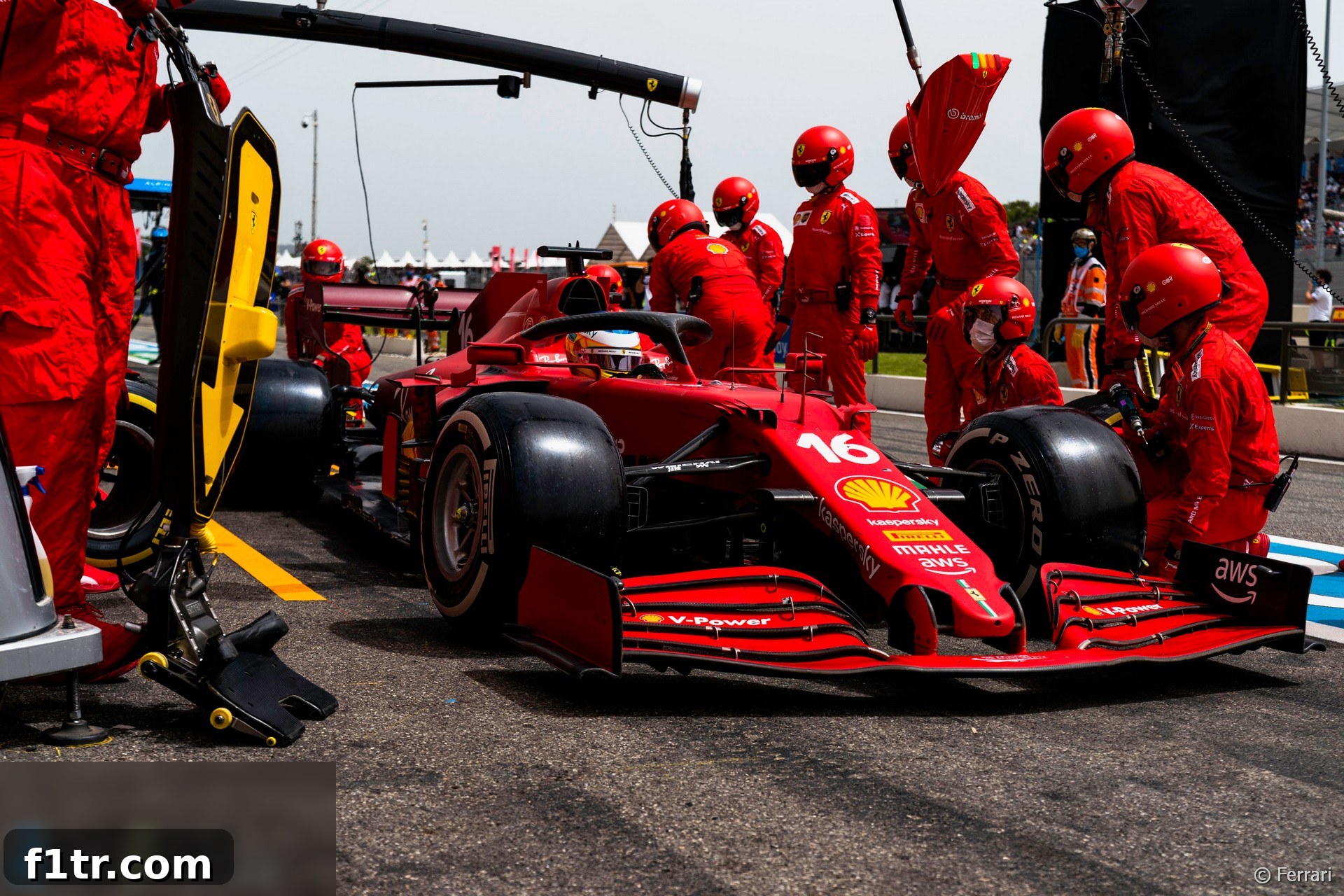
The race unfolded as a relentless battle against rapidly degrading tires. Charles Leclerc was the first among the front-runners to switch to hard tires, making his pit stop at the end of lap 15. This initially appeared to be a brilliant strategic move. The potent “undercut” effect, where a driver pits early for fresh tires and uses their superior grip to gain time before rivals pit, allowed Leclerc to leapfrog both his teammate Sainz and Daniel Ricciardo’s McLaren.
However, the early promise quickly evaporated. Between laps 18 and 53, Leclerc’s initial 1.878-second advantage over Ricciardo dissolved into a staggering 44-second deficit, costing him 10 positions by the chequered flag. The hard tires, meant to offer greater durability, suffered catastrophic degradation. With 14 laps remaining, Ferrari had no option but to bring Leclerc in for a second pit stop, fitting another set of medium tires in a desperate attempt to salvage some pace, though points were already out of reach for the Monegasque driver, who eventually finished 16th.
Leclerc himself confirmed the strategic gamble: “I personally knew and definitely the team knew that [the first stop] was quite early for a one-stop strategy. But we could still make it work if we managed those hard tyres very well. But we were quite surprised that after like six, seven laps, we started to struggle on that. And that’s where it became clearer and clearer that I will go for a two-stop.” The realization that even the hard compound tires were unable to sustain performance for a one-stop race highlighted the severity of Ferrari’s problem.
For Sainz, the primary culprit for their dramatic slide was the severe graining on their front tires. Graining occurs when the tire surface cools unevenly, typically due to excessive sliding, causing small chunks of rubber to tear away. This creates a textured, “grained” surface that drastically reduces grip and exacerbates wear, particularly in high-speed corners like those at Paul Ricard. “On Friday, we had numbers from our tyres from our long runs that had nothing to do with the numbers that we saw today,” Sainz explained, emphasizing the unforeseen change in track conditions and how it directly impacted tire performance.
He further elaborated on the disparity between Ferrari and other teams: “So for me, what caught us by surprise was the track condition changes that have been at the track since Friday until now and I actually heard a lot of other teams on the radio struggling on the first day with completely different balance, much lower grip. The biggest difference is that they didn’t struggle with graining and we did.” This highlights Ferrari’s specific vulnerability to particular track and weather conditions, a critical flaw in a sport where adaptability and consistent tire performance are paramount.
Regulatory Context and Ferrari’s Future Outlook
The topic of tires had been a significant point of discussion throughout the French Grand Prix weekend, particularly in the aftermath of dual failures at the Baku Grand Prix. A new technical directive had been issued, and mandatory minimum tire pressures were raised as a precautionary measure to prevent similar incidents. However, Mattia Binotto was quick to dismiss any connection between these new regulations and Ferrari’s specific struggles at Paul Ricard, indicating that their issues were of a different nature.
“No, I don’t think it had any impact,” claimed Binotto regarding the new directives. “If I look at the prescriptions, it has been raised only on the rear, and I think that today we are having an issue at the front.” This clear distinction confirmed that Ferrari’s woes were an inherent characteristic of their car’s interaction with the front tires under specific conditions, rather than a consequence of recent regulatory changes. It highlighted a specific aerodynamic or mechanical flaw in how the SF21 managed its front axle.
Addressing the Challenge: A Look Towards 2022
With two consecutive races in Austria immediately following the French Grand Prix, and many more front-limited circuits remaining on the calendar, Ferrari faces an urgent need to get on top of this critical problem. However, Binotto’s assessment offered a sobering outlook for the remainder of the 2021 season, suggesting that a complete resolution might be beyond their grasp due to regulatory limitations.
“I think we may improve the situation but to solve it I think we will need some hardware change like, for example, the rims, which is not possible per regulation,” Binotto admitted. This statement is highly significant, indicating that the fundamental design or componentry of the SF21 might be contributing to their tire issues, and without being able to modify these core elements (like the wheel rims, which influence tire temperatures and pressures), only partial mitigation is possible. Such hardware changes are typically restricted mid-season to control costs and maintain competitive balance.
The team’s focus, therefore, shifts strategically towards the long term. “It’s more important for us at that stage to really try to understand and to address it definitely for next year,” Binotto continued. This suggests a comprehensive analysis and design overhaul for the 2022 car, which will operate under vastly different technical regulations. In the interim, Ferrari must brace themselves for similar challenges on circuits that present similar tire demands and environmental conditions.
“In the meanwhile, I think this issue may happen again on some races, but not all the tracks, it is somehow quite track and weather conditions-related,” Binotto concluded. “But we need to prepare ourselves to face such a situation in the future, and at least try to mitigate the problem since [it] will happen again this year.” Ferrari’s disappointing performance at Paul Ricard was a harsh lesson, highlighting a specific area of weakness that the team must manage carefully through the rest of the 2021 season while channeling significant efforts into developing a more robust and adaptable car for the future. The road ahead for the Scuderia is clear: understand, adapt, and build for 2022, all while mitigating the immediate impact of their current vulnerabilities to ensure they remain competitive in the constructors’ championship.
Related 2021 French Grand Prix Articles
- The potentially crucial differences in how Bottas and Perez help their team mates
- How much-maligned Paul Ricard produced “one of the most exciting races for five years”
- Todt would “prefer less controversy” in Formula 1
- Wolff encouraged by ‘real progress’ from Bottas in French GP
- Red Bull’s French GP win disproves accusations over tyres and wings – Horner
Browse all 2021 French Grand Prix articles