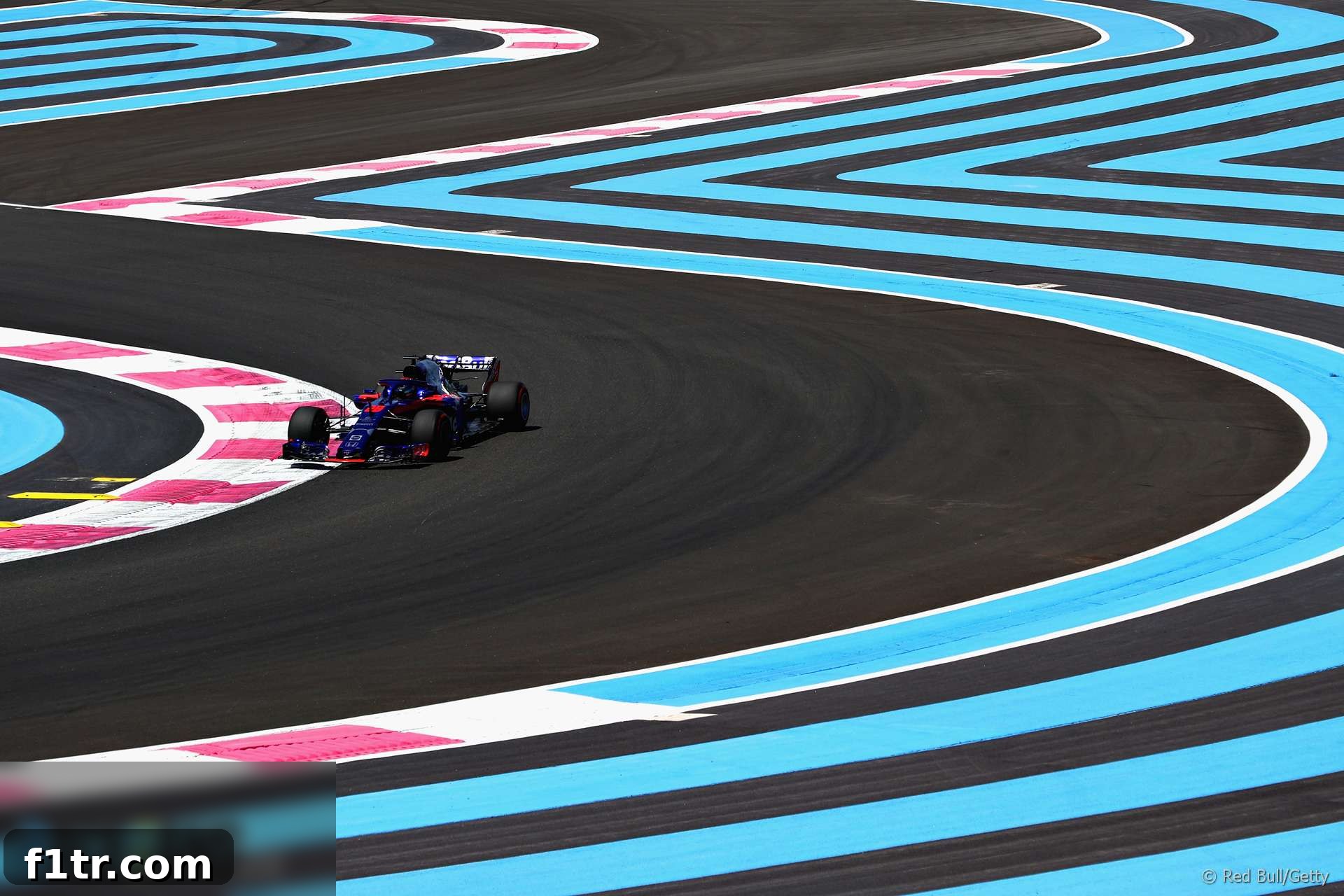
Brendon Hartley, the accomplished former Formula 1 driver and endurance racing champion, has vocalised a strong preference for the Paul Ricard circuit’s original layout, urging French Grand Prix organisers to remove the Mistral chicane when Formula 1 makes its anticipated return to the iconic track. His compelling arguments, rooted in extensive personal experience and a deep understanding of motorsport dynamics, suggest that reinstating the full-length Mistral straight would significantly enhance the racing spectacle, challenge drivers more effectively, and ultimately provide a more engaging experience for fans worldwide.
Hartley, whose career spans top-tier motorsport from the World Endurance Championship (WEC) to Formula 1 with Toro Rosso, is no stranger to Paul Ricard. He has raced on various configurations of the circuit, notably competing on the full, un-chicaned Mistral straight during his time in the European Le Mans Series five years prior. This firsthand experience forms the bedrock of his conviction, as he articulated after a practice session, “I definitely prefer the track without the chicane. I think it’s also the original or one of the original layouts that’s been raced many times before.” His statement highlights not just a personal preference but also a reverence for the circuit’s heritage and its historical challenge.
The Case for a Full Mistral Straight: Enhancing Formula 1 Racing
Hartley’s primary argument centres on the potential for improved racing dynamics. He posits that a longer, uninterrupted Mistral straight would compel Formula 1 teams to adopt car setups with less downforce. In the intricate world of F1 aerodynamics, downforce is king, providing grip through corners but creating drag on straights. Teams constantly seek a delicate balance. A prolonged flat-out section, such as the full Mistral, would heavily penalise cars running high downforce configurations, forcing them to trim their wings and optimise for straight-line speed.
This strategic shift, Hartley contends, would directly translate into more thrilling on-track action. “A long straight line could potentially create more overtakes,” he elaborated. The principle is simple yet profound: lower downforce means higher top speeds on the straight, which in turn amplifies the slipstream effect (towing). Drivers would be able to close the gap more effectively to the car ahead, creating more potent overtaking opportunities at the end of the straight, particularly into the crucial Turn 10. The current chicane, while offering a specific braking zone, can sometimes make overtaking feel more contrived or less strategically earned, interrupting the raw speed build-up that defines classic F1 battles.
Technical Implications and Driver Challenge
The absence of the chicane would not only influence straight-line speed but also profoundly impact the car’s behaviour through subsequent corners. Hartley explained, “It makes things interesting because it’s less downforce with the long straight line. Turn 10 becomes more of a corner and so does the last sector with less downforce because of the long straight line.” This is where the true engineering and driving challenge would emerge. With less aerodynamic grip from lower downforce settings chosen for the straight, these corners, already demanding, would transform into even greater tests of a driver’s skill and a car’s mechanical grip. Turn 10, a fast right-hander, and the sweeping final sector would require a delicate touch, precise steering inputs, and impeccable throttle control from drivers already balancing a compromised setup. This elevates the art of driving, rewarding those who can master a less stable, faster-through-the-air machine.
From a car setup perspective, engineers would face fascinating dilemmas. Achieving optimal straight-line speed would come at the cost of cornering prowess, and vice versa. Teams would have to decide where to make their compromises, leading to a greater diversity in car characteristics across the grid. This could open up strategic avenues, where some teams might sacrifice some corner speed for a significant top-end advantage, potentially leading to varied race strategies and more unpredictable outcomes. The current chicane allows teams to run higher downforce, knowing they have a slower corner to negotiate, which arguably standardises setup choices to a degree.
Paul Ricard’s History and Hartley’s Unique Perspective
Paul Ricard, nestled in Le Castellet, France, has a rich and storied history, originally opening in 1970. It was designed with flexibility in mind, offering over 160 potential track configurations thanks to its innovative network of interconnecting tracks and runoff areas. The circuit quickly gained a reputation for its challenging layout, high-speed sections, and a demanding character that tested both man and machine. The Mistral straight, stretching over 1.8 kilometres (1.1 miles), was for many years one of F1’s longest and fastest sections, a true showcase of aerodynamic efficiency and engine power.
The introduction of the Mistral chicane in 1986, and its subsequent use for F1’s return in 2018, was largely driven by safety concerns and a desire to create additional overtaking opportunities in an era of ever-increasing car speeds. While these intentions are valid, many purists, including Hartley, feel it has diluted the circuit’s original essence. “The good news here is there’s plenty of options. There’s hundreds of different options on this track. I’ve done a lot of testing with the long straight. I prefer it, personally, I think it’s got a bit more character and a bit more history as well,” Hartley stated, underscoring the circuit’s versatility and his personal attachment to its purer form.
Hartley’s experience is not limited to ELMS; he also tested extensively at Paul Ricard during his tenure with Porsche’s highly successful World Endurance Championship team. WEC prototypes, with their immense power and sophisticated aerodynamics, push the boundaries of circuit design in much the same way F1 cars do. His time spent honing these cutting-edge machines on the full Mistral straight provides him with a unique and informed perspective on how a high-performance vehicle interacts with such a layout. This deep understanding lends significant weight to his argument, distinguishing it from mere nostalgic sentiment.
The Global Debate: Chicanes and Circuit Integrity
The discussion around Paul Ricard’s Mistral chicane mirrors similar debates that have played out across other iconic F1 circuits. Monza, the ‘Temple of Speed’, has seen numerous chicane alterations over the decades, designed to curb ever-increasing speeds and enhance safety, often at the cost of its legendary flat-out nature. Spa-Francorchamps’ notorious Bus Stop chicane was introduced for similar reasons, altering the flow into La Source. These modifications, while often necessary for safety in their respective eras, invariably spark discussions about the balance between preserving a circuit’s historic character and adapting to modern safety standards and racing spectacle requirements.
For Paul Ricard, the argument for removing the Mistral chicane extends beyond just a singular corner. It’s about restoring a sense of grandeur to one of F1’s longest straights, allowing the cars to truly stretch their legs and showcase their immense power. It brings back a level of strategic complexity for teams and a heightened challenge for drivers who must manage a less stable car through high-speed corners after a prolonged blast. This, many argue, is what F1 should be about: pushing boundaries, rewarding exceptional skill, and delivering breathtaking moments.
A Discussion Point for the Future
While Hartley acknowledged that changes were unlikely for the immediate future – “So maybe it’s a discussion point for next year but for right now we’re doing this layout” – his comments serve as a powerful call to action for circuit organisers, the FIA, and Formula 1 management. The sport is constantly seeking ways to improve the on-track product and engage its burgeoning global fanbase. Reconsidering circuit layouts, particularly those that have a storied past, could be a key component of this evolution.
The decision to alter a circuit layout is complex, involving rigorous safety assessments, logistical considerations, and commercial implications. However, driver feedback, especially from those with Hartley’s calibre and diverse experience, should carry significant weight. His proposal aligns with a growing sentiment among fans and pundits who yearn for more challenging, less sanitised circuits that truly test the limits of modern F1 machinery and the extraordinary talent of its drivers.
In conclusion, Brendon Hartley’s eloquent plea to revert Paul Ricard to its un-chicaned Mistral straight configuration offers a compelling vision for the future of the French Grand Prix. It’s a vision where raw speed, strategic compromise, and supreme driving skill converge to create a more thrilling and authentic Formula 1 spectacle. As F1 continues to innovate, listening to the insights of experienced drivers like Hartley could very well pave the way for a more exciting and historically resonant era of racing at circuits around the world.
2018 F1 season
- F1 feared “death knell” for Drive to Survive after Ferrari and Mercedes snub
- McLaren staff told us we were “totally crazy” to take Honda engines in 2018 – Tost
- ‘It doesn’t matter if we start last’: How Red Bull’s junior team aided Honda’s leap forward
- Honda’s jet division helped F1 engineers solve power unit problem
- McLaren Racing losses rise after Honda split
Browse all 2018 F1 season articles