Unveiling the 2018 F1 Season: A Deep Dive into Driver Performance Statistics
In the high-octane world of Formula 1, every millisecond, every strategic decision, and every lap matters. While race results often grab the headlines, a closer look at underlying statistics can reveal fascinating insights into a driver’s true performance, consistency, and unique strengths. Who truly excels off the line? Which driver consistently outperforms their machinery? And who is absolutely dominating their teammate in raw pace?
The 2018 Formula 1 season delivered thrilling battles, unexpected triumphs, and moments of high drama. Beyond the championship points, the detailed data collected throughout the year paints a vivid picture of how each of the 20 elite drivers stacked up. From qualifying prowess to race-day consistency and crucial first-lap gains, these telling statistics offer a deeper understanding of individual contributions and the intricate dynamics within each team. Join us as we break down the key performance indicators for every driver, revealing the hidden narratives of the season.
Lewis Hamilton: The Epitome of Consistency
The timeless motorsport aphorism, “To finish first, you must first finish,” perfectly encapsulates Lewis Hamilton’s championship-winning approach during the 2018 season. As the world champion, his remarkable consistency was a cornerstone of his success, completing an astounding 738 out of a potential 747 racing laps. This statistic highlights not just his incredible driving skill but also the unwavering reliability of his Mercedes-AMG F1 W09 EQ Power+ and his ability to avoid incidents that would force retirement or lengthy repairs. His near-perfect completion rate underscored a season defined by meticulous preparation, strategic brilliance, and an unmatched ability to bring the car home in competitive positions, ultimately securing his fifth world title.
Valtteri Bottas: Unlucky Breaks and Resilience
Valtteri Bottas faced a season marked by unfortunate circumstances, reflected in his average finishing position being 0.9 places lower than his starting grid slot – the worst among all drivers. This seemingly stark figure, however, requires crucial context. A significant portion of this discrepancy stems from his heartbreaking classification of 14th in Baku after suffering a late puncture while leading the race. Without this single, defining incident, Bottas would have, on average, gained 0.1 places per race, showcasing a more positive trend in his race-day performance. This demonstrates that despite facing a challenging year, often overshadowed by bad luck, Bottas frequently drove with strong race craft and strategic awareness, positioning himself for better results before external factors intervened.
Sebastian Vettel: Leading but Not Always Winning
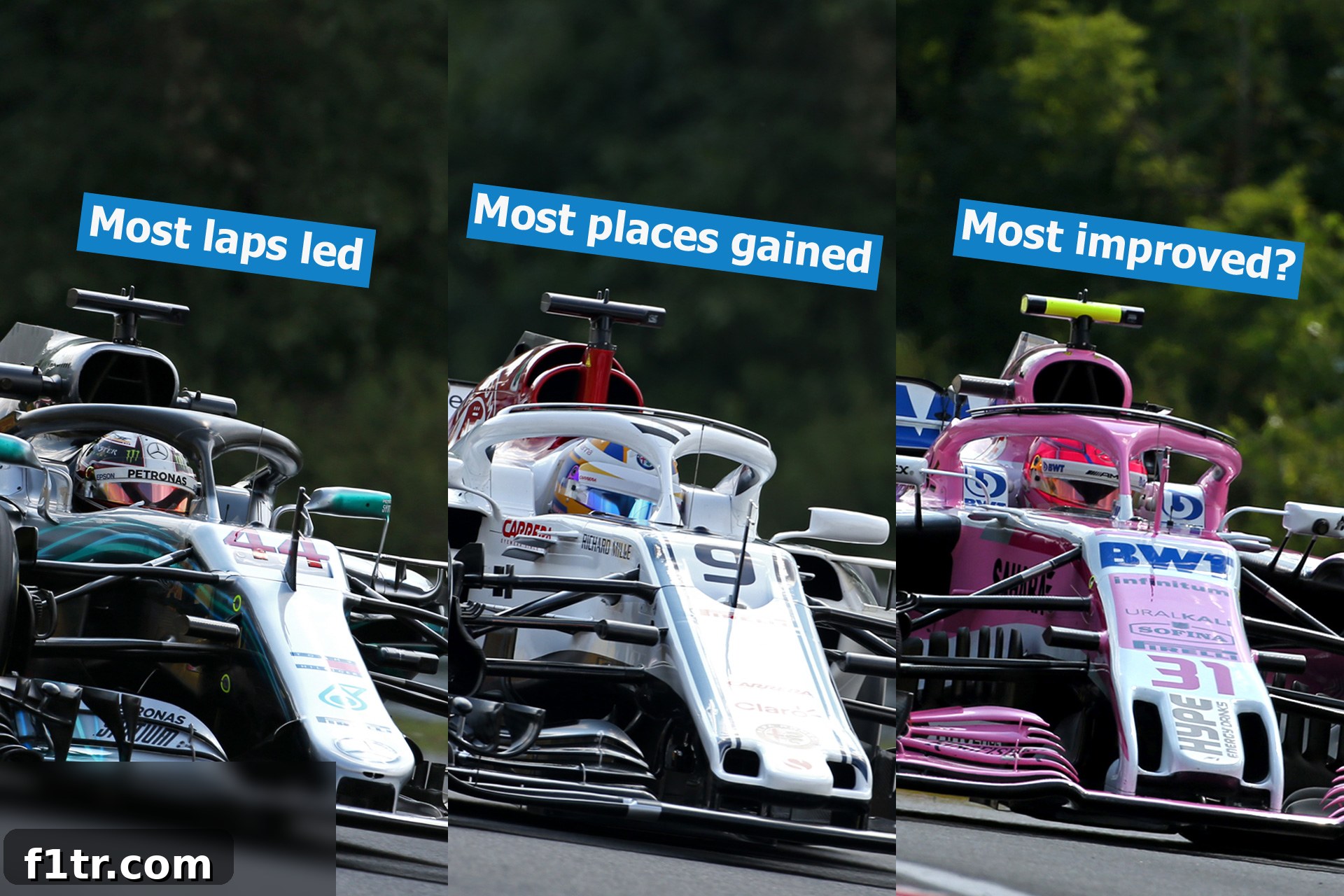
Sebastian Vettel often demonstrated blistering pace and front-running capability throughout the 2018 season, leading more laps than any other driver with a total of 297. This statistic underscores his strong starts and Ferrari’s competitive package, which frequently allowed him to control races from the front. However, despite this impressive lap-leading record, Vettel ultimately secured fewer race victories than his main championship rival, Lewis Hamilton. This disparity highlights the critical difference between leading a race and converting that advantage into a win. Factors such as race strategy, tire management, late-race incidents, or unforced errors occasionally prevented him from maximizing his leading positions, illustrating the razor-thin margins at the pinnacle of Formula 1.
Kimi Räikkönen: The First Lap Paradox
While Ferrari consistently showcased strong starting performance in 2018, often gaining positions off the line, Kimi Räikkönen’s first-lap statistics present a puzzling paradox. Astonishingly, Räikkönen failed to gain a single place on lap one in any race during the season, making him the only driver to consistently finish the opening lap in the exact position he started, or lower. This held true even in races like Austria, where he made an aggressive move from third on the grid, nearly taking the lead but ultimately settling back into his starting slot. This statistic raises questions about his race craft in close-quarters initial combat, or perhaps a preference for a more conservative approach to ensure a clean getaway, even when his car had the potential for early gains.
Daniel Ricciardo: The Overtaking Maestro
Daniel Ricciardo demonstrated his exceptional race pace and opportunistic flair throughout the 2018 season, topping the charts with the most fastest laps, securing four during the year. This statistic is a testament to his ability to push the car to its absolute limit, often delivering scorching lap times even in the midst of intense battles. Furthermore, his two podium finishes were both sensational victories – the Chinese and Monaco Grands Prix. This perfect conversion rate of podiums into wins speaks volumes about his ‘Honey Badger’ mentality; when he gets a sniff of victory, he rarely lets go. It highlights his supreme confidence and ability to deliver under pressure, making the most of every opportunity presented by the Red Bull chassis.
Max Verstappen: Qualifying Prowess and Raw Speed
In a season where the top six grid positions were typically dominated by Mercedes, Ferrari, and Red Bull, Max Verstappen’s qualifying performance stood out. He started inside the top five on an impressive nine occasions, more than double the frequency of his teammate Daniel Ricciardo. This statistic underlines Verstappen’s raw, electrifying single-lap pace and his ability to consistently extract the maximum performance from the Red Bull RB14 in qualifying trim. It showcases his relentless drive for perfection over a single lap, often placing him in prime positions to challenge the front-runners and setting the stage for his aggressive race-day charges, ultimately securing a memorable victory at his home race in Austria.
Sergio Pérez: Strategic Brilliance in the Midfield
Sergio Pérez showcased his veteran race craft and strategic acumen during the 2018 season, becoming the only driver to out-score his teammate, Esteban Ocon, despite frequently starting, finishing, and even lapping behind him. This seemingly counter-intuitive statistic speaks volumes about Pérez’s ability to capitalize on chaotic races, manage tires expertly, and make crucial strategic calls that paid dividends. His standout podium finish in Baku, a race of attrition, perfectly illustrated his capacity to stay clean, consistent, and seize opportunities when they arose, even when his raw qualifying pace or initial race position might have suggested otherwise. His performance highlights the importance of race day execution over single-lap speed in the competitive midfield.
Esteban Ocon: A Significant Performance Surge
Esteban Ocon demonstrated immense progress and a significant performance swing against his highly-rated teammate, Sergio Pérez, during the 2018 season. By the summer break, Ocon had dramatically improved his intra-team battle statistics compared to the previous year. In 2017, he was down 9-2 in qualifying head-to-heads and 8-2 behind on race finishes against Pérez. However, in 2018, he reversed this trend, achieving a 9-3 advantage in qualifying and a 7-2 lead in race finishes. This remarkable turnaround represented the biggest performance swing of any driver who maintained the same teammate, underscoring Ocon’s growing maturity, increased confidence, and enhanced ability to extract performance from the Force India VJM11, solidifying his reputation as a rising star.
Lance Stroll: The First Lap Specialist
As predicted by then-Williams Chief Technical Officer Paddy Lowe pre-season, Lance Stroll continued his reputation as a first-lap specialist in 2018. He gained the most places on lap one of any driver on the grid, a testament to his bravery and aggression in the opening moments of a race. This particular strength is undeniably linked to his challenging qualifying performance, as Stroll recorded the lowest average qualifying position of any driver at 17.08. Constantly starting towards the back of the grid forced him to be assertive from the start, often making significant progress through the midfield chaos. His ability to navigate tricky first laps cleanly and gain positions was a crucial asset for Williams in an otherwise difficult season.
Sergey Sirotkin: A Challenging Rookie Season
Sergey Sirotkin faced an exceptionally tough debut season in Formula 1 with Williams. His struggles were compounded by the fact that he was not only the sole driver yet to score a single championship point by the mid-point of the year, but he also failed to complete a single racing lap inside the top 10. This statistic starkly illustrates the immense difficulties he faced with an uncompetitive Williams FW41 chassis. Despite his best efforts, Sirotkin consistently found himself battling at the back of the field, unable to break into the points-paying positions or even show flashes of top-ten potential due to the car’s inherent limitations. It was a season of learning and perseverance against overwhelming odds.
Nico Hülkenberg: Midfield Leader Despite Setbacks
Nico Hülkenberg demonstrated his consistent leadership within the midfield throughout 2018. Despite completing the fewest racing laps of any driver (578), a statistic largely influenced by retirements, he managed to be the highest-finishing driver outside of the top three teams (Mercedes, Ferrari, Red Bull) on four separate occasions. This was more than any other midfield competitor, showcasing his ability to maximize opportunities and deliver strong results when the Renault R.S.18 was competitive. His knack for placing the car in the best possible position, coupled with solid race management, established him as a key figure in the tightly contested midfield battle, consistently leading the ‘best of the rest’ charge.
Carlos Sainz Jnr: Qualifying Consistency Master
In a similar vein to his teammate, Carlos Sainz Jnr consistently proved his exceptional qualifying prowess throughout the 2018 season. He was the top midfield driver in terms of Q3 appearances, reaching the final qualifying segment in 11 out of 12 occasions. This remarkable consistency highlights his innate ability to extract every ounce of performance from the Renault chassis on a single flying lap. Constantly placing the car within the top 10 gave him a crucial advantage on race day, providing better starting positions and reducing the need for aggressive overtaking in the early stages. Sainz’s qualifying consistency was a clear indicator of his raw speed and technical understanding, making him a formidable competitor in the midfield.
Pierre Gasly: Honda’s Breakthrough Moment
Pierre Gasly delivered a monumental performance at the Bahrain Grand Prix, securing a stunning fourth-place finish. This result was not just a career highlight for the young Frenchman but also a significant milestone for Honda. It marked the best result a Honda-powered car had achieved since the Japanese manufacturer’s return to Formula 1 in 2015, signaling a much-needed step forward in power unit performance and reliability. Gasly’s composed drive, combined with the improved Honda engine, demonstrated the potential of the Toro Rosso partnership and hinted at a brighter future. His performance in Bahrain was a moment of true validation for both driver and engine supplier, proving their capabilities when everything came together.
Brendon Hartley: Battling to Match His Teammate
While Pierre Gasly often led the charge for Toro Rosso, Brendon Hartley found himself in a more challenging position, consistently battling to match his teammate’s pace. This was evident in his statistic of completing the fewest racing laps ahead of his team mate of any driver on the grid, with only 90 laps. This figure underscores the disparity in performance between the two Toro Rosso drivers during the 2018 season. Hartley, a Le Mans winner and WEC champion, faced a steep learning curve in F1, compounded by the competitive nature of the midfield and the nuances of the STR13 chassis. Despite showing flashes of promise, his season was often characterized by struggles to maintain a consistent advantage over Gasly, reflecting a tough adaptation to Grand Prix racing.
Romain Grosjean: A Season of Unfortunate Incidents
The 2018 season proved to be a particularly challenging one for Romain Grosjean, who unfortunately recorded the most retirements due to crashes among all drivers, with three incidents forcing him out of races. This statistic highlights a difficult period for the Frenchman, characterized by a series of unforced errors and unfortunate collisions that hampered his and Haas’s potential. From the infamous safety car incident in Baku to other high-profile mistakes, Grosjean struggled to maintain the clean, consistent performance he was capable of. These incidents not only cost him valuable championship points but also put additional pressure on the team, making it a season of constant uphill battles and missed opportunities for the experienced driver.
Kevin Magnussen: Haas’s Consistent Point Scorer
In stark contrast to his teammate Romain Grosjean, Kevin Magnussen enjoyed a much more consistent and successful 2018 season, serving as Haas’s primary point scorer. He secured seven points finishes for the team, more than double the number achieved by Grosjean. This impressive statistic underscores Magnussen’s ability to consistently extract performance from the VF-18 chassis and convert it into valuable championship points. His aggressive yet controlled driving style, coupled with a knack for staying out of trouble, allowed him to capitalize on opportunities and elevate Haas’s position in the Constructors’ Championship. Magnussen’s reliable point-scoring demonstrated his growing maturity and importance as a key asset for the American team.
Fernando Alonso: Unmatched Teammate Dominance
Fernando Alonso once again demonstrated his legendary talent and unparalleled ability to dominate his teammate, even in an underperforming McLaren chassis during the 2018 season. He was the only driver on the grid who remained undefeated by his teammate in qualifying throughout the entire year, a testament to his consistent single-lap brilliance. Furthermore, he completed more racing laps ahead of his teammate, Stoffel Vandoorne, than any other driver, with a staggering 544 laps. These statistics paint a clear picture of Alonso’s relentless drive and his extraordinary skill in maximizing the performance of his car, regardless of its limitations. His dominance was a constant highlight in a challenging year for McLaren, reinforcing his status as one of Formula 1’s all-time greats.
Stoffel Vandoorne: Struggles in Alonso’s Shadow
Stoffel Vandoorne endured a difficult 2018 season, constantly overshadowed by his illustrious teammate Fernando Alonso. A key indicator of his struggles was the fact that he was the only Renault-powered driver not to reach Q3 during the entire year. This statistic highlighted a significant gap in raw qualifying pace compared to not only Alonso but also drivers from the other Renault-powered teams, Renault and Red Bull. Vandoorne’s inability to consistently extract maximum performance from the MCL33 in qualifying made his race weekends an uphill battle, often starting from further down the grid. The pressure of competing against a generational talent like Alonso, coupled with a challenging car, made for a formidable obstacle in Vandoorne’s F1 career.
Marcus Ericsson: Race Craft Amidst Qualifying Challenges
Similar to Lance Stroll, Marcus Ericsson demonstrated impressive race craft by gaining the most places on average during races in 2018, picking up an average of 4.4 positions per Grand Prix. This statistic highlights his ability to navigate the opening laps, manage races effectively, and capitalize on opportunities to climb through the field. However, this strength in race craft also came with a significant caveat: Ericsson was the only Ferrari-powered driver who had not reached Q3 by the mid-point of the season. This dual reality paints a picture of a driver who could perform well on Sundays but often started from a disadvantageous position due to his qualifying struggles, indicating a need for improved single-lap pace to complement his consistent race performance.
Charles Leclerc: The Emerging Single-Lap King
The 2018 season was a breakthrough year for Charles Leclerc, who rapidly established himself as a future star. Ignoring qualifying sessions affected by incidents, Leclerc showcased an astonishing average advantage of 0.489 seconds over his teammate Marcus Ericsson in terms of single-lap pace. This formidable statistic underscored his immense raw speed and natural talent, demonstrating his ability to extract significantly more performance from the Sauber C37 over a single lap. This dominant qualifying performance not only elevated Sauber’s standing but also caught the attention of the wider F1 paddock, firmly positioning Leclerc as one of the most exciting young prospects on the grid and a strong contender for a top-team seat in the very near future.
Over to you
These statistics provide a fascinating glimpse into the individual performances of the 2018 Formula 1 drivers. While some numbers confirm widely held perceptions, others offer surprising revelations about consistency, raw speed, and strategic acumen. The nuances of F1 performance go far beyond just the final result, delving into every corner, every start, and every lap.
Have you spotted any more telling statistics about the drivers from the 2018 season, or perhaps noticed trends that these numbers might reinforce or contradict? Share your insights and observations in the comments section below – we’d love to hear your analysis!
Go ad-free for just £1 per month>> Find out more and sign up
More from the 2018 F1 Season
- F1 feared “death knell” for Drive to Survive after Ferrari and Mercedes snub
- McLaren staff told us we were “totally crazy” to take Honda engines in 2018 – Tost
- ‘It doesn’t matter if we start last’: How Red Bull’s junior team aided Honda’s leap forward
- Honda’s jet division helped F1 engineers solve power unit problem
- McLaren Racing losses rise after Honda split
Browse all 2018 F1 season articles