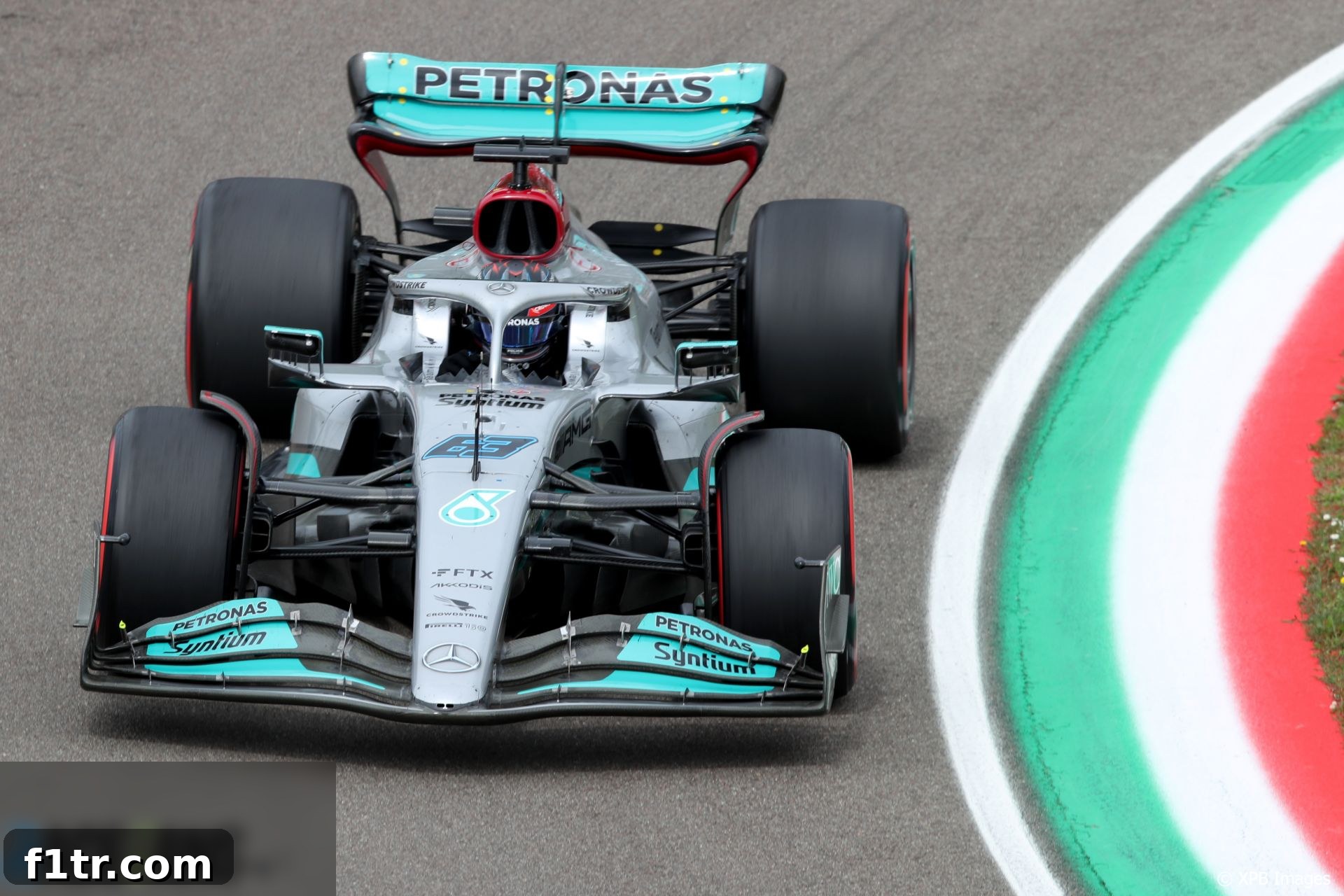
After a challenging start to the 2022 Formula 1 season, Mercedes-AMG Petronas has officially confirmed a strategic plan of action aimed at significantly improving their problematic W13 chassis. Team Principal Toto Wolff revealed that crucial updates are set to be introduced over the course of the upcoming races, signaling a determined effort by the reigning constructors’ champions to address the car’s inherent issues and reclaim their competitive edge.
Advert | Become a Supporter & go ad-free
The team’s immediate focus centered on the Miami Grand Prix, a critical juncture where they intended to verify their comprehensive conclusions regarding the car’s performance deficiencies. Throughout the initial races of the season, the W13 consistently lagged behind its primary rivals, often by as much as a full second per lap, a stark contrast to Mercedes’ accustomed dominance. This performance gap underscored the urgency of their development program, with Miami serving as a pivotal real-world testing ground for their simulated solutions.
Addressing the Porpoising Phenomenon: A Deeper Dive
At the heart of Mercedes’ struggles lies the pervasive phenomenon known as ‘porpoising.’ This aerodynamic issue, characterized by a violent, high-frequency bouncing motion at high speeds, has severely afflicted the W13. While other teams on the grid have also encountered similar problems with their ground-effect cars under the new 2022 regulations, some, notably Ferrari, demonstrated a greater ability to manage and mitigate its impact, preventing it from critically compromising their car’s overall performance. Porpoising not only makes the car incredibly difficult and uncomfortable for drivers but also significantly hinders its aerodynamic efficiency, leading to a loss of downforce and inconsistent handling.
The technical challenge of porpoising stems from the interplay between the car’s aerodynamics and its suspension stiffness. As the car gains speed, the ground effect pulls it closer to the track, increasing downforce. However, if the car drops too low, the airflow underneath stalls, causing a sudden loss of downforce, which in turn lifts the car. This cycle then repeats rapidly, creating the ‘porpoising’ motion. Resolving this requires a delicate balance of aerodynamic design, floor stiffness, and suspension setup, a puzzle Mercedes has been working tirelessly to solve in their pursuit of stability and speed.
Imola’s Tough Lessons and Driver Contributions
The previous race at Imola served as a particularly brutal reality check for the Mercedes team. George Russell, demonstrating remarkable adaptability and resilience, managed to secure a commendable fourth-place finish despite the W13’s limitations. In contrast, seven-time world champion Lewis Hamilton endured a frustrating weekend, finishing a distant 13th. Both drivers have since dedicated extensive hours in the simulator, meticulously working alongside the engineering teams to provide crucial feedback and assist in the development push. Their unique perspectives on the car’s handling and behavior are invaluable in translating theoretical solutions into tangible on-track improvements.
Reflecting on the Italian Grand Prix, Toto Wolff candidly admitted, “It was a very difficult weekend for us in Imola. George did a great job to finish P4 from an unpromising starting position but with Lewis, we didn’t give him the tools or track position to show his true pace.” This statement highlights the team’s acknowledgment of their responsibility to provide competitive machinery, a sentiment echoed throughout the Mercedes garage as they grappled with the uncharacteristic struggles.
The Road to Recovery: Data, Simulation, and Factory Efforts
The process of diagnosing and rectifying an F1 car’s fundamental flaws is an intensive, multi-faceted undertaking. Wolff elaborated on the team’s diligent efforts since returning from Imola: “Since we returned from Italy, we’ve learned as much from the weekend as we can and, in parallel, our learning has continued in the wind tunnel and simulations. We have found several directions for improving the car, and we will be conducting experiments in Miami to correlate those simulations, and hopefully confirm the development path for the coming races.”
This systematic approach involves a continuous loop of data analysis from track performance, detailed computational fluid dynamics (CFD) simulations, and extensive wind tunnel testing. The ‘several directions’ for improvement likely refer to various aerodynamic modifications to the floor, diffuser, and potentially other bodywork elements designed to stabilize airflow and mitigate porpoising. The critical step of ‘correlation’ in Miami means verifying that the performance gains seen in the virtual world and wind tunnel translate accurately to real-world track conditions. This validation is paramount for determining the definitive development trajectory for the W13 for the remainder of the season.
The collaborative effort extends beyond the engineering offices and virtual environments. Wolff confirmed the crucial role of both drivers and the factory workforce: “Both drivers have been working in the simulator ahead of Miami and the factories have been busy producing updates for the next races.” This signifies a rapid and coordinated effort across all departments, from design and manufacturing to logistics, all working against the clock to bring the planned improvements to fruition on the racetrack.
Miami: A Step into the Unknown
Adding another layer of complexity to Mercedes’ mission was the venue itself. The team was set to conduct its latest experiments and validate its findings on a track that was entirely unfamiliar to the entire Formula 1 field – the brand-new Miami International Autodrome. This presents a unique double challenge: not only must they evaluate significant car updates, but they must also contend with the inherent unknowns of a virgin circuit, including grip levels, track surface characteristics, and the precise demands of its layout.
Toto Wolff encapsulated this excitement and uncertainty: “Miami is an exciting new challenge and a complete step into the unknown. The track looks demanding, with a real mix of low and high-speed corners, and it’s set to be a spectacular showcase for the sport to our growing US fanbase. We’re set for a fantastic event, and we can’t wait to see how it all plays out.” The circuit’s design, featuring a blend of technical slow-speed sections and fast, flowing corners, provides a comprehensive test for any F1 car, making it an ideal, albeit challenging, proving ground for Mercedes’ updates.
The strategic importance of the Miami Grand Prix extends beyond just the technical development for Mercedes. It also represents a significant moment for Formula 1’s expanding presence in the United States. A spectacular event, regardless of Mercedes’ immediate performance, helps cement F1’s growing popularity in a key market. However, for Mercedes, a strong showing and clear evidence of progress would undoubtedly be a major boost, not just for their championship aspirations but also for team morale.
The Path Forward for Mercedes
The season presented Mercedes with an unprecedented challenge in the hybrid era. Their dominance since 2014 made their current struggles all the more striking. The success of their development plan hinged entirely on their ability to accurately diagnose the W13’s issues and implement effective solutions that reduce porpoising without compromising other areas of performance. The pressure was immense, not just to return to winning ways but to understand the new regulations better than their rivals. The meticulous testing in Miami, followed by subsequent updates, would be crucial in determining if Mercedes could indeed claw back the performance deficit and re-enter the championship fight.
Ultimately, Formula 1 is a sport of relentless innovation and adaptation. Every team faces design challenges, but how quickly and effectively they respond defines their season. Mercedes’ proactive stance and systematic approach to tackling the W13’s problems underscore their commitment to excellence. The coming races promised to reveal whether their hard work and “several directions” of development would pave the way for a resurgence, or if the 2022 season would remain a learning year for the Silver Arrows.
Advert | Become a RaceFans supporter andgo ad-free
2022 Miami Grand Prix
- Why TecPro barriers weren’t used at Miami chicane where Sainz and Ocon crashed
- Miami’s track surface is ‘a safety issue and does not offer good racing’ – Russell
- Miami Grand Prix draws F1’s largest live US television audience
- Alpine complain they had no say over penalty which cost Alonso points
- Red Bull wary of Ferrari’s high-speed cornering strength in Barcelona
Browse all 2022 Miami Grand Prix articles