Intense Baku Sprint Clash: Max Verstappen’s Fury and Toto Wolff’s Unwavering Defense of George Russell
The thrilling 2023 Azerbaijan Grand Prix sprint race delivered an abundance of drama, none more captivating than the on-track skirmish between two of Formula 1’s brightest stars, Max Verstappen and George Russell. Their early-race collision ignited a heated exchange and fervent criticism from the reigning world champion, leaving Mercedes’ Team Principal, Toto Wolff, entirely unmoved and steadfast in his defense of his young driver.
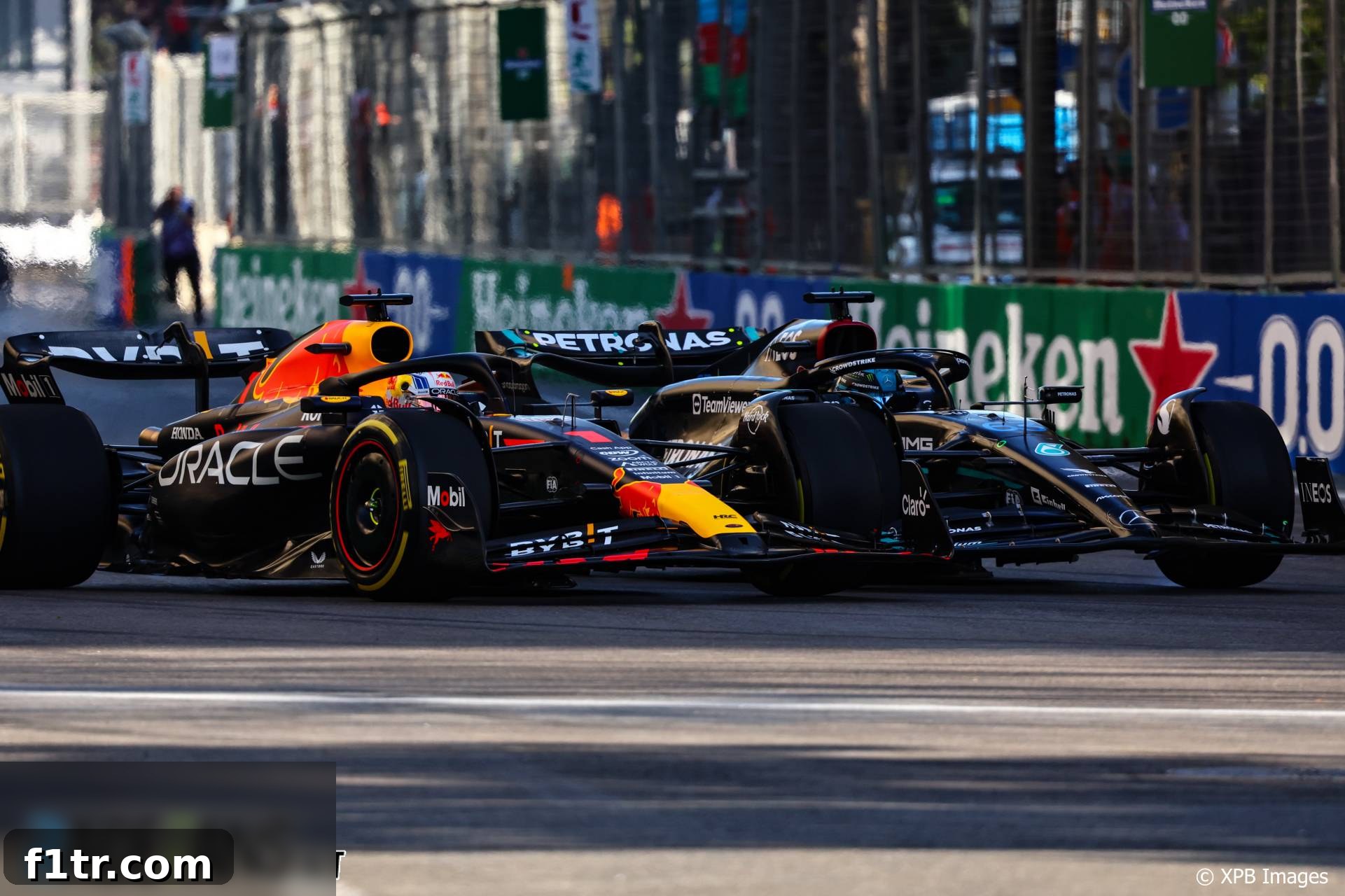
The incident unfolded on the very first lap, a critical juncture in any high-stakes sprint race, as the drivers jostled for position around the demanding Baku City Circuit. Russell, demonstrating his characteristic aggression and ambition, attempted an overtake on Verstappen for third place on the inside of Turn Two. The tight, technical nature of the corner, coupled with the high speeds, created an almost inevitable flashpoint. The two cars made contact, a moment that sent a shockwave through both garages and among millions of F1 fans worldwide.
Although George Russell successfully claimed the position following the initial contact, the drama was far from over. A safety car period temporarily neutralized the race, but upon the restart, the resilient Max Verstappen, renowned for his relentless pursuit of victory, managed to re-overtake Russell, reclaiming his lost ground despite the damage incurred to his Red Bull RB19.
The collision, however, had deeply infuriated Verstappen. His raw emotions were palpable, culminating in a direct confrontation with his rival after the race where he unreservedly called Russell a “dickhead” – an unfiltered outburst that quickly became a major talking point in the F1 paddock and beyond. This candid reaction underscored the intense competitive spirit that defines the Dutchman and highlighted the high stakes involved in every F1 encounter, especially when championship points are on the line in a format as condensed as the sprint race.
Verstappen’s Unfiltered Outburst: The Anatomy of a Champion’s Fury
Max Verstappen’s immediate and unvarnished reaction to the incident was characteristic of his no-holds-barred approach to Formula 1. His post-race confrontation with George Russell, where he used a distinctly derogatory term, revealed the depth of his frustration. This was not merely about losing a position; it was about the perceived unfairness of the contact, the damage inflicted on his car, and the potential impact on his race performance and points tally. For a driver of Verstappen’s caliber, who meticulously strives for perfection and maximum points in every session, any compromise to his car’s integrity or his race outcome is a source of immense irritation.
The damage to his Red Bull, described by Wolff as a “big hole,” undoubtedly hampered Verstappen’s pace, making his subsequent recovery even more impressive but also exacerbating his anger. Such damage affects aerodynamics, balance, and ultimately, lap times, forcing a driver to contend with a suboptimal machine while battling for crucial championship points. Verstappen’s competitive nature means he expects rivals to race hard but fairly, and any contact that he deems reckless or avoidable often draws a fiery response. His “outspoken” nature, as noted by Wolff, means he rarely holds back his true feelings, which, while sometimes controversial, is often seen as a mark of his authenticity in a sport where guarded statements are common.
Toto Wolff’s Unwavering Stance: Defending Russell’s Aggression and Strategic Rationale
In stark contrast to Verstappen’s visible anger, Mercedes team principal Toto Wolff remained steadfast and composed, offering a spirited defense of George Russell’s driving. Wolff’s perspective highlighted the inherent risks and strategic complexities of racing at the highest level of motorsport, particularly when navigating the fine margins of a street circuit like Baku. He unequivocally stated that Russell “defended well,” implying that his driver’s actions were within the acceptable boundaries of aggressive, competitive racing.
Wolff elaborated on the dynamics of the overtake attempt, suggesting that Verstappen had put himself in a “vulnerable position” by attempting to pass on the outside of Turn Two. He explained the inherent dangers associated with such a maneuver: “I think it’s dangerous to overtake from the outside because you could either end up in the run-off or you can end up in the wall.” This observation underscores a fundamental principle of circuit racing, where the outside line often leaves a driver exposed to being squeezed or running out of track, especially in a corner where the inside line is firmly defended.
Conversely, Wolff noted the specific challenges of making an overtake from the inside at Turn Two. “On the inside, it’s quite an angle you need to achieve,” he explained. “And if you try to turn around there tightly, you’re going to lose out on the next straight.” This tactical insight reveals the delicate balance drivers must strike between securing a position and compromising their exit speed, which is crucial for carrying momentum onto the subsequent straights. Russell’s decision to maintain his racing line, even if it led to contact, was therefore framed as a strategic necessity within the context of the race.
Despite his firm defense of Russell, Wolff acknowledged the validity of Verstappen’s anger. “That’s a race situation that is, you’re trying the outside, that’s never going to be an easy position. They collided, he had a big hole in the car and that’s certainly sub-optimal for your race. It’s absolutely understandable that he’s upset.” This pragmatic understanding highlights the human element in Formula 1 – even seasoned professionals will react emotionally when their race is compromised through no perceived fault of their own. Wolff also subtly hinted at the history between the two drivers, stating, “So it’s not the first time, I guess, they had this situation between each other,” alluding to past skirmishes that have often characterized their budding rivalry.
The Stewards’ Verdict and F1’s Racing Standards
Crucially, the race stewards reviewed the incident and ultimately decided not to investigate the collision between Max Verstappen and George Russell. This decision, or rather the lack thereof, sends a clear message regarding what is considered an acceptable “racing incident” within the intense confines of Formula 1. The stewards’ discretion plays a pivotal role in shaping the boundaries of aggressive driving, and their non-intervention in Baku suggests that the contact was deemed a natural consequence of two highly competitive drivers fighting for position on a challenging track.
The absence of penalties often sparks debate among fans and pundits alike, with some arguing for stricter enforcement to prevent dangerous driving, while others advocate for allowing drivers to race hard and settle disputes on the track. In this instance, the stewards’ call leans towards the latter, reinforcing a philosophy that encourages wheel-to-wheel action, even if it sometimes results in minor contact. This ruling impacts not only the drivers involved but also sets a precedent for how similar incidents might be judged in future races, influencing driver behavior and strategic approaches.
The Psychological Battlefield: Rivalry, Teammates, and the Pressure Cooker of F1
Beyond the technicalities of racing lines and car damage, Toto Wolff’s comments delved into the deep psychological undercurrents of Formula 1. He suspected that a significant part of Verstappen’s frustration stemmed from his teammate, Sergio Perez, winning the sprint race, while Max himself finished third with a damaged car. “They are all upset when they lose,” Wolff observed, succinctly capturing the essence of a top-tier athlete’s mindset. “If your team mate [is] winning and you finish third and you haven’t got performance in the car because you have a big hole, absolutely you’re upset.”
This insight sheds light on the internal dynamics of a racing team and the intense rivalry that exists even between teammates. While cooperation is essential, the ultimate goal for every driver is individual success. Watching a teammate triumph while one struggles, especially due to an incident with a rival, can amplify frustration to an immense degree. Verstappen’s “authentic” and “outspoken” personality means he vents these emotions openly, a trait Wolff believes is healthy, suggesting that Max likely “forgets about it one hour later.”
This incident is not an isolated event but rather another chapter in the evolving driver rivalries that continually fuel the sport’s excitement. The clashes between Verstappen and Russell, emblematic of the broader Mercedes vs. Red Bull battle, add layers of intrigue to the championship narrative. Such encounters underscore the immense pressure under which these athletes operate, where every decision, every millimeter on track, can have significant consequences for their individual careers and their team’s championship aspirations. The Baku sprint race incident serves as a stark reminder that Formula 1 is not just a test of engineering and driving skill, but also a relentless psychological battle.
Support Independent F1 Journalism and Go Ad-Free
RaceFans is dedicated to bringing its readers direct, unfiltered news and in-depth analysis from the heart of Formula 1. Our commitment to original, independent journalism is made possible thanks to the invaluable contributions of our RaceFans Supporters.
By contributing a modest sum of £1 per month or £12 per year (or its equivalent in other currencies), you play a crucial role in sustaining the resources required to produce our comprehensive coverage. Your support helps us cover essential costs such as traveling to races, commissioning expert writers, creating engaging content, maintaining robust hosting infrastructure, facilitating vital industry contacts, and continuously developing our platform.
We have proudly served our passionate readership for over a decade, providing unique insights and a truly independent voice in Formula 1 reporting. If you value our in-depth articles, exclusive interviews, and unbiased perspectives, we sincerely invite you to consider becoming a RaceFans Supporter today. As an added benefit, all our esteemed Supporters enjoy an entirely ad-free browsing experience across our site, allowing for uninterrupted access to all our F1 content. You can sign up or discover more about the benefits of supporting us through the links provided below:
- Become a RaceFans Supporter Today
- RaceFans Supporter FAQ – Learn More
More from the 2023 Azerbaijan Grand Prix
Stay updated with all the latest developments and insights from the thrilling 2023 Azerbaijan Grand Prix weekend. Dive deeper into the stories that shaped the race and the ongoing championship battle:
- Aston Martin radio messages reveal how “older brother” Alonso helps Stroll
- How slashing practice to a single hour in Baku tripped up F1 teams
- Bottas: “Rapid improvement needed” at Alfa Romeo
- Red Bull could become first team to score 1,000 points in a season
- Aston Martin hoping DRS fix works in Miami after Stroll manages fault in race
Browse all 2023 Azerbaijan Grand Prix articles