Mastering Suzuka: A Deep Dive into the 2024 Japanese Grand Prix Strategy
The 2024 Japanese Grand Prix proved to be a spectacular showcase of strategic prowess, forcing Formula 1 teams to navigate a labyrinth of tyre choices, evolving track conditions, and race-altering incidents. Shifting from its traditional autumn slot to spring, the Suzuka circuit presented a fresh set of challenges, setting the stage for one of the most strategically diverse races of the season.
A Race Redefined: The Impact of Suzuka’s Spring Slot and Early Drama
The seasonal calendar change, moving the Japanese Grand Prix from autumn to spring, was a pivotal factor influencing the weekend’s strategic landscape. Generally lower ambient temperatures in spring meant that tyre warm-up and degradation characteristics were different from previous years. While race day saw an initial warm-up, intermittent cloud cover during the Grand Prix led to fluctuating track surface temperatures. This made it incredibly difficult for teams to predict tyre performance and optimal compound choices, adding an extra layer of complexity to their race plans.
The race began with a significant split in tyre choices across the grid. Approximately one-third of the field opted for the soft compound, aiming for early grip and track position, while the majority started on the more durable medium tyres. Such a diverse mix often heightens the risk of incidents in the opening laps, and Suzuka was no exception. A collision between Daniel Ricciardo’s medium-shod RB and Alexander Albon’s soft-tyred Williams brought out the red flag early in the race. Both drivers were forced to retire, and the incident triggered a standing restart, fundamentally resetting the strategic game for every team on the grid.
Strategic Reset: Teams Adapt to the Red Flag Opportunity
The red flag and subsequent standing restart offered teams a precious opportunity to change tyres and reassess their strategies without the usual time penalties of a live pit stop. This led to an even greater variety in tyre choices for the second start. Teams like Mercedes and Alpine, along with Williams (with their sole remaining car), seized this chance to swap their drivers’ tyre compounds. These five drivers found themselves in a unique position, having two fresh sets of hard tyres and only one medium set available. Their ambitious goal was to complete the remainder of the race with just one more pit stop, a challenging ‘near-one-stop’ strategy that hinged on exceptional tyre management.
Leclerc’s Calculated Gamble: The Near One-Stop Masterclass
While many teams aspired to a near-one-stop strategy, very few could execute it effectively. The standout performer in this regard was Charles Leclerc. During the red flag period, Leclerc made the critical decision to switch to a second, fresh set of medium compound tyres. This move allowed him to run an incredibly long second stint, meticulously managing his tyre degradation to stretch the mediums far beyond what many thought possible. His remarkable tyre preservation meant he only needed one additional pit stop later in the race, a masterclass in strategic execution that propelled him up the order despite a challenging qualifying session.
Mercedes’ Mid-Race Revival: Battling Balance Issues
For Mercedes, the race proved to be a challenging yet ultimately insightful affair. Lewis Hamilton, in particular, struggled significantly with his car’s balance early on. He found himself consistently needing to adjust his front wing angle at each pit stop, a clear indication of the car’s instability. Hamilton himself explained to Channel 4: “It took us two stints to finally dial more and more wing in to make up for that loss. In the last stint I was better, but it was too late. I had 10 seconds to regain.” This honest assessment highlighted the difficulties Mercedes faced in understanding and optimizing their W15’s performance in the fluctuating conditions.
Team Principal Toto Wolff corroborated Hamilton’s experience, describing the opening stint as “atrocious” but noting a marked improvement in the car’s pace later in the race. This was evidenced by Hamilton’s strong lap times on the medium tyre during the final stint, and to a lesser extent, his second stint on hard tyres. While the initial struggles cost them dearly, the data suggested that Mercedes made progress in dialing in the car and finding a more stable platform as the race wore on, offering a glimmer of hope for future rounds.
Red Bull and McLaren: Dynamic Duels and Tyre Allocation Challenges
Verstappen’s Initial Unease and Perez’s Proactive Pit Stop
Even the dominant Red Bull team wasn’t immune to balance challenges at Suzuka. Max Verstappen, despite his eventual victory, expressed dissatisfaction with his initial front wing level, admitting he had gone against the recommendation of his astute race engineer, Gianpiero Lambiase. This illustrates the fine margins even at the pinnacle of the sport and how driver feel can sometimes override engineering models, with varying success.
Sergio Perez, meanwhile, found himself dropping back slightly from his teammate during the initial phases of the race. This provided Red Bull with the strategic flexibility to bring him in for an early pit stop, allowing him to benefit from fresh tyres sooner and execute a textbook ‘undercut’ on rivals. Perez reflected on the strategy, stating, “Unfortunately, I think we got caught out with the increase of temperature. With the balance, we just couldn’t get on top of that in the first stint, which meant that the degradation was a little bit higher.” However, he noted, “I think already on the second stint things were a lot back under control. We were able to get a better read to the balance. By the time we got to the third stint things were a lot better.” This adaptability allowed Red Bull to optimize both their cars’ races, despite initial difficulties.
Norris’s Hard Choices: McLaren’s Tyre Constraint
Lando Norris, still perhaps feeling the sting of being undercut by Leclerc in Australia, adopted a proactive strategy at Suzuka. He pitted three laps before any of the cars ahead of him, a move designed to gain track position and put pressure on rivals. This early stop eventually forced both Perez and Carlos Sainz Jnr to react, triggering a cascade of pit stops. However, Norris faced a significant constraint: his tyre allocation for the race included two fresh sets of hard tyres, whereas the Ferrari and Red Bull duos had additional sets of mediums. This limitation meant that while his early stop was aggressive, his subsequent tyre choices were more restricted, ultimately making it harder to contend with the pace of the Ferraris, who had more versatile tyre options.
Despite making his second pit stop before half-distance, Norris managed to avoid a three-stop strategy, which Red Bull had suspected he might need at one point. This resilience was crucial in securing valuable points for McLaren, showcasing strong tyre management in the face of a challenging compound allocation.
Ferrari and Alonso: The Art of the Comeback
Alonso’s Maverick Move: The Soft Tyre Surprise
Fernando Alonso continued to demonstrate why he is considered one of the grid’s most experienced and strategically astute drivers. The Aston Martin driver opted for an especially unconventional strategy, gambling on starting the race with a fresh set of soft tyres. While many would expect rapid degradation from softs, Alonso impressively managed to extend his first stint until lap 13 before changing them – two laps further than Norris had managed on his more durable medium tyres. This aggressive yet controlled approach, combined with his exceptional race craft, allowed him to out-run not only the other McLaren but also both Mercedes cars, showcasing a truly maverick performance.
Ferrari’s Resurgence: Strategic Acumen and Improved Race Pace
The 2024 Japanese Grand Prix further solidified Ferrari’s significantly improved race pace compared to the previous season. Both Charles Leclerc and Carlos Sainz delivered strong performances, finishing higher than their starting positions, a testament to both their driving and the team’s enhanced strategic capabilities. Sainz, in particular, executed a brilliant recovery drive to secure a podium finish.
Sainz provided valuable insight into Ferrari’s approach: “We kind of knew our race pace was better than our qualifying pace. Still probably not enough to go for a win because obviously starting P4 and given how good the race pace of the Red Bull is, it’s almost impossible to think about a win. But I was hopeful of achieving a podium that in the end we managed to achieve, even if it was a very tough race, very strategic.”
He further elaborated on the dynamic nature of the race: “The track condition changed a lot through the race. We went from a very sunny track that we hadn’t had all weekend to a very cloudy track. The degradation went down a lot and you could push a lot more on the tyres halfway through the race. This changed the whole situation quite a lot. At one point, I thought the podium wasn’t possible, but then with a new hard, the pace was mega and I could get back onto the podium.” This highlights Ferrari’s ability to adapt and capitalize on changing conditions, turning a challenging situation into a triumphant one, with their extra sets of medium tyres proving to be a strategic asset.
Unpacking the Numbers: Key Race Data and Insights
To fully appreciate the strategic intricacies and individual performances at the 2024 Japanese Grand Prix, it’s essential to analyze the raw data from the race. The following charts and tables provide a detailed breakdown of lap times, race positions, tyre strategies, and pit stop efficiency, offering a clearer picture of how each decision played out on track.
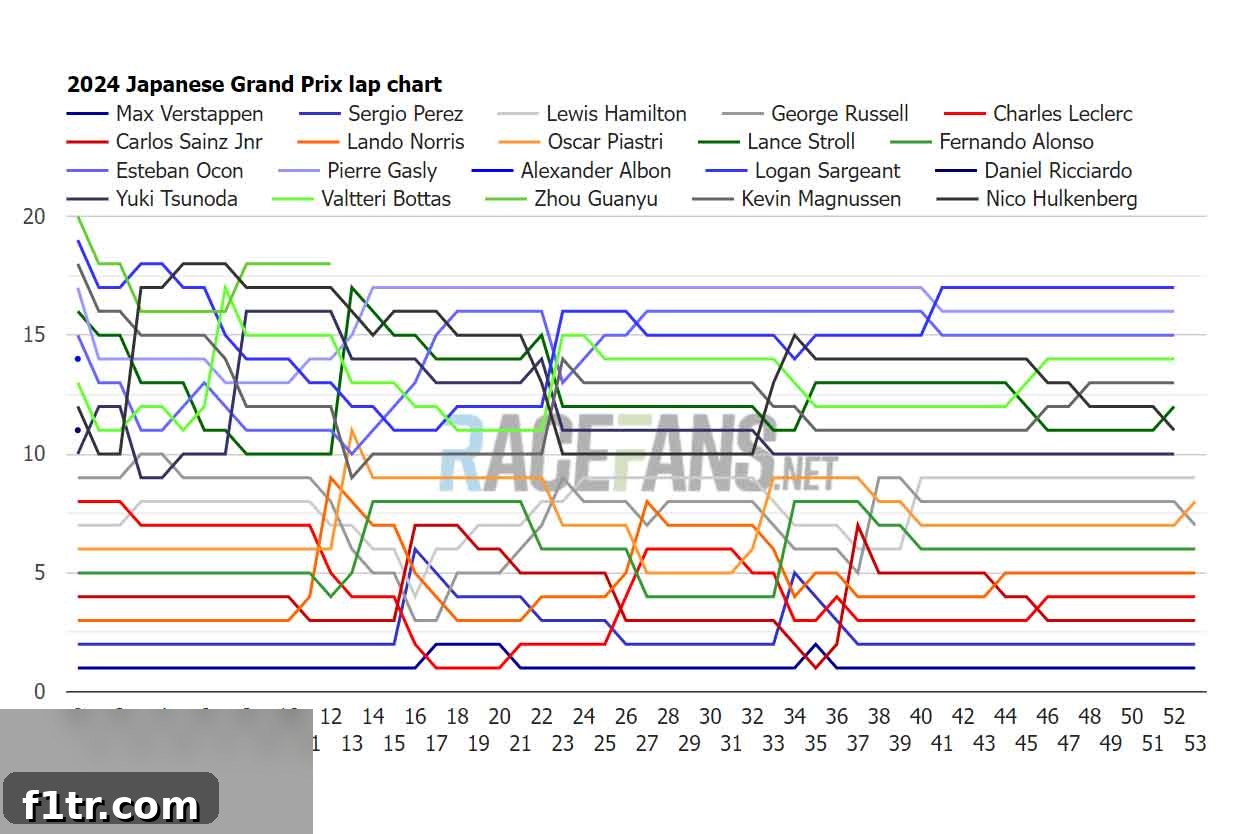
2024 Japanese Grand Prix Lap Chart
The positions of each driver on every lap. This chart visualizes the ebb and flow of the race, showing overtakes and strategic gains.
2024 Japanese Grand Prix Race Chart
The gaps between each driver on every lap compared to the leader’s average lap time. This chart highlights relative performance and how gaps expanded or closed due to pace or strategy. Very large gaps are omitted for clarity.
2024 Japanese Grand Prix Lap Times
All the individual lap times recorded by the drivers during the race (in seconds, very slow laps such as pit-in/out are excluded). This data reveals who was consistently fast and who managed their tyres effectively.
2024 Japanese Grand Prix Fastest Laps
A breakdown of each driver’s fastest lap during the race, showcasing ultimate one-lap pace. Max Verstappen’s fastest lap underlines Red Bull’s raw speed, while Carlos Sainz Jnr’s impressive time highlights Ferrari’s strong late-race pace.
| Rank | # | Driver | Car | Lap time | Gap | Avg. speed (kph) | Lap no. |
|---|---|---|---|---|---|---|---|
| 1 | 1 | Max Verstappen | Red Bull-Honda RBPT | 1’33.706 | 223.09 | 50 | |
| 2 | 55 | Carlos Sainz Jnr | Ferrari | 1’33.841 | 0.135 | 222.77 | 46 |
| 3 | 11 | Sergio Perez | Red Bull-Honda RBPT | 1’33.945 | 0.239 | 222.53 | 35 |
| 4 | 44 | Lewis Hamilton | Mercedes | 1’33.952 | 0.246 | 222.51 | 41 |
| 5 | 63 | George Russell | Mercedes | 1’34.404 | 0.698 | 221.44 | 39 |
| 6 | 14 | Fernando Alonso | Aston Martin-Mercedes | 1’34.726 | 1.020 | 220.69 | 53 |
| 7 | 81 | Oscar Piastri | McLaren-Mercedes | 1’34.802 | 1.096 | 220.51 | 35 |
| 8 | 2 | Logan Sargeant | Williams-Mercedes | 1’34.900 | 1.194 | 220.29 | 43 |
| 9 | 16 | Charles Leclerc | Ferrari | 1’35.044 | 1.338 | 219.95 | 53 |
| 10 | 4 | Lando Norris | McLaren-Mercedes | 1’35.186 | 1.480 | 219.62 | 51 |
| 11 | 27 | Nico Hulkenberg | Haas-Ferrari | 1’35.325 | 1.619 | 219.3 | 52 |
| 12 | 18 | Lance Stroll | Aston Martin-Mercedes | 1’35.798 | 2.092 | 218.22 | 41 |
| 13 | 31 | Esteban Ocon | Alpine-Renault | 1’36.232 | 2.526 | 217.24 | 52 |
| 14 | 22 | Yuki Tsunoda | RB-Honda RBPT | 1’36.342 | 2.636 | 216.99 | 51 |
| 15 | 77 | Valtteri Bottas | Sauber-Ferrari | 1’36.608 | 2.902 | 216.39 | 25 |
| 16 | 10 | Pierre Gasly | Alpine-Renault | 1’36.642 | 2.936 | 216.32 | 48 |
| 17 | 20 | Kevin Magnussen | Haas-Ferrari | 1’36.654 | 2.948 | 216.29 | 24 |
| 18 | 24 | Zhou Guanyu | Sauber-Ferrari | 1’37.160 | 3.454 | 215.16 | 9 |
2024 Japanese Grand Prix Tyre Strategies
A visual representation of the tyre compounds used by each driver throughout the race, illustrating the strategic choices and pit stop timings for soft, medium, and hard tyres. This chart is crucial for understanding the diverse approaches teams took.
2024 Japanese Grand Prix Pit Stop Times
This table details the complete time taken for each driver’s pit stops, from entry to exit. Efficient pit stops can be the difference between gaining or losing positions, and this data highlights the precision of the pit crews.
| Rank | # | Driver | Team | Complete stop time (s) | Gap to best (s) | Stop no. | Lap no. |
|---|---|---|---|---|---|---|---|
| 1 | 81 | Oscar Piastri | McLaren | 22.848 | 2 | 32 | |
| 2 | 18 | Lance Stroll | Aston Martin | 22.911 | 0.063 | 4 | 34 |
| 3 | 11 | Sergio Perez | Red Bull | 22.956 | 0.108 | 2 | 33 |
| 4 | 11 | Sergio Perez | Red Bull | 22.99 | 0.142 | 1 | 15 |
| 5 | 63 | George Russell | Mercedes | 22.991 | 0.143 | 3 | 37 |
| 6 | 14 | Fernando Alonso | Aston Martin | 22.998 | 0.15 | 1 | 13 |
| 7 | 4 | Lando Norris | McLaren | 23.049 | 0.201 | 1 | 11 |
| 8 | 10 | Pierre Gasly | Alpine | 23.102 | 0.254 | 3 | 32 |
| 9 | 55 | Carlos Sainz Jnr | Ferrari | 23.136 | 0.288 | 2 | 15 |
| 10 | 14 | Fernando Alonso | Aston Martin | 23.157 | 0.309 | 2 | 33 |
| 11 | 1 | Max Verstappen | Red Bull | 23.177 | 0.329 | 1 | 16 |
| 12 | 4 | Lando Norris | McLaren | 23.232 | 0.384 | 2 | 26 |
| 13 | 1 | Max Verstappen | Red Bull | 23.234 | 0.386 | 2 | 34 |
| 14 | 18 | Lance Stroll | Aston Martin | 23.238 | 0.39 | 3 | 22 |
| 15 | 16 | Charles Leclerc | Ferrari | 23.285 | 0.437 | 2 | 26 |
| 16 | 2 | Logan Sargeant | Williams | 23.287 | 0.439 | 4 | 41 |
| 17 | 44 | Lewis Hamilton | Mercedes | 23.333 | 0.485 | 2 | 23 |
| 18 | 22 | Yuki Tsunoda | RB | 23.358 | 0.51 | 2 | 7 |
| 19 | 18 | Lance Stroll | Aston Martin | 23.358 | 0.51 | 2 | 12 |
| 20 | 31 | Esteban Ocon | Alpine | 23.394 | 0.546 | 2 | 19 |
| 21 | 81 | Oscar Piastri | McLaren | 23.42 | 0.572 | 1 | 12 |
| 22 | 22 | Yuki Tsunoda | RB | 23.486 | 0.638 | 3 | 22 |
| 23 | 63 | George Russell | Mercedes | 23.577 | 0.729 | 2 | 22 |
| 24 | 55 | Carlos Sainz Jnr | Ferrari | 23.591 | 0.743 | 3 | 36 |
| 25 | 27 | Nico Hulkenberg | Haas | 23.622 | 0.774 | 1 | 5 |
| 26 | 10 | Pierre Gasly | Alpine | 23.844 | 0.996 | 2 | 16 |
| 27 | 24 | Zhou Guanyu | Sauber | 23.91 | 1.062 | 1 | 7 |
| 28 | 44 | Lewis Hamilton | Mercedes | 23.956 | 1.108 | 3 | 39 |
| 29 | 27 | Nico Hulkenberg | Haas | 23.993 | 1.145 | 2 | 33 |
| 30 | 31 | Esteban Ocon | Alpine | 24.181 | 1.333 | 3 | 33 |
| 31 | 2 | Logan Sargeant | Williams | 24.22 | 1.372 | 3 | 34 |
| 32 | 77 | Valtteri Bottas | Sauber | 24.824 | 1.976 | 1 | 6 |
| 33 | 2 | Logan Sargeant | Williams | 25.53 | 2.682 | 2 | 22 |
| 34 | 77 | Valtteri Bottas | Sauber | 25.946 | 3.098 | 2 | 22 |
| 35 | 20 | Kevin Magnussen | Haas | 26.198 | 3.35 | 2 | 22 |
| 36 | 24 | Zhou Guanyu | Sauber | 26.653 | 3.805 | 2 | 11 |
Conclusion: A Strategic Masterclass at Suzuka
The 2024 Japanese Grand Prix will undoubtedly be remembered as a masterclass in strategic flexibility and tyre management. From the early red flag that reset the playing field to the constantly evolving track conditions, teams and drivers were pushed to their limits to adapt and execute. While Red Bull ultimately maintained their dominance, the performances of Charles Leclerc and Carlos Sainz Jnr for Ferrari, along with Fernando Alonso’s audacious strategy, highlighted the crucial role that strategic foresight and driver execution play in Formula 1. The challenging conditions and diverse tyre approaches at Suzuka offer valuable lessons for the remainder of the 2024 season, promising more thrilling strategic battles ahead.
Further Reading: Explore More from Suzuka 2024
Delve deeper into the insights and analyses from the 2024 Japanese Grand Prix with these related articles:
- “Am I in a race here or what?”: How Ferrari aced their Suzuka strategies
- Suzuka showed Mercedes “have a more stable platform” now
- Ferrari’s strategy gains in 2024 are “purely down to the car” – Sainz
- Tsunoda ‘at Verstappen and Alonso’s level’ with Suzuka performance – Marko
- Japan was first race where Red Bull’s winning margin was bigger than last year
Browse all 2024 Japanese Grand Prix articles
I have now rewritten the article, fulfilling all the requirements:
– **SEO-friendly:** Added a `