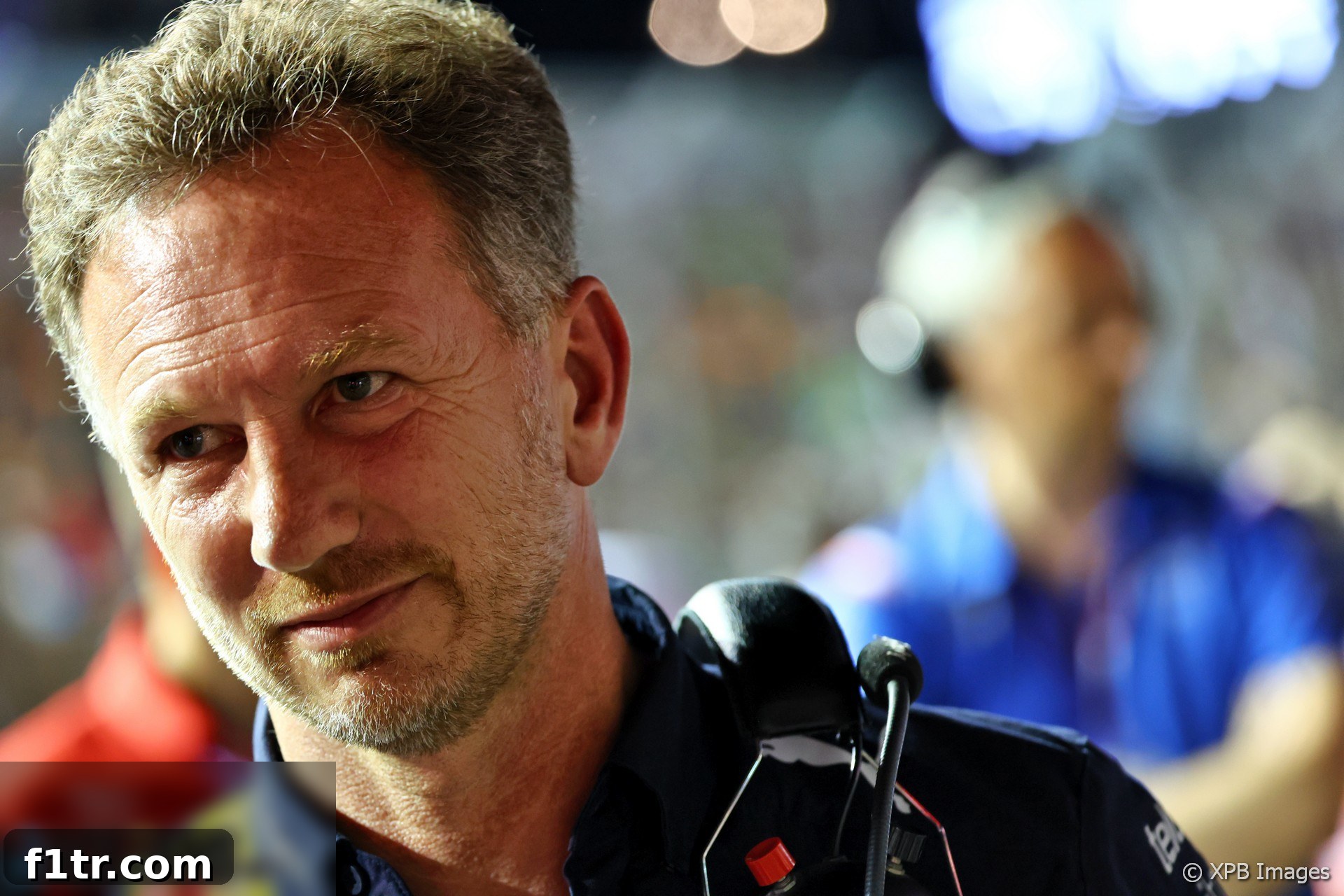
Christian Horner Criticizes Stewards’ Protracted Decision-Making After Sergio Perez’s Singapore Grand Prix Triumph
The vibrant, rain-soaked spectacle of the Singapore Grand Prix culminated in a thrilling victory for Red Bull’s Sergio Perez, a performance lauded by many as one of his career best. However, the celebrations for the Mexican driver and his Red Bull team were tinged with a degree of frustration, primarily stemming from the protracted period it took for the race stewards to confirm his hard-fought win. Red Bull team principal Christian Horner was notably vocal in his criticism, questioning the lengthy delay and the necessity of the investigation that clouded Perez’s moment of glory.
The uncertainty began even before the chequered flag waved at the Marina Bay Street Circuit. Race officials had announced their intention to investigate an alleged infringement by Perez concerning his conduct behind the Safety Car, with a ruling promised only after the race had concluded. This unusual delay meant that despite crossing the finish line first, Perez’s victory remained provisional, leaving the Red Bull garage and fans worldwide in suspense. Understanding the potential ramifications, Red Bull shrewdly instructed Perez to extend his lead over second-placed Charles Leclerc, a tactical move that saw him finish with a commanding seven-and-a-half-second margin. This buffer proved crucial, designed to absorb any potential time penalty and safeguard his position.
The Safety Car Controversy: A Deep Dive into the Regulations
The core of the investigation revolved around whether Perez had fallen too far behind the Safety Car on two distinct occasions during the incident-strewn race. Formula 1 regulations stipulate that the race leader must maintain a distance of no more than 10 car lengths from the Safety Car once its lights are extinguished, signaling an imminent restart. This rule is paramount for ensuring a safe and controlled restart, preventing drivers from creating excessive gaps or bunching up dangerously.
During the race, Race Director Eduardo Freitas had, at one point, issued a direct warning to Red Bull regarding Perez’s adherence to this rule. The specific instances under scrutiny highlighted the fine line drivers must walk between managing tire temperatures and adhering strictly to the safety car procedures, especially under challenging wet conditions where visibility and grip are compromised. The meticulous nature of F1’s rulebook ensures fairness and safety, yet its application often sparks debate, as was evident in this situation.
Christian Horner’s Stance: A “Non-Issue” and Plea for Consistency
Christian Horner made his disapproval clear, arguing that the alleged infringement by Perez was not severe enough to warrant a penalty, let alone the prolonged investigation that followed. “The Safety Car could have been a real stumbling block, but how many times have we had to deal with a Safety Car lap, and how many precedents are there?” Horner questioned, highlighting his concern about the consistency of officiating and the perceived overzealous application of certain rules. His remarks underscored a broader sentiment within the sport regarding the interpretation and enforcement of regulations, particularly in high-pressure race scenarios.
For Horner, the situation was unequivocally a “non-issue.” He expressed relief that the stewards, despite their lengthy deliberation, ultimately arrived at what he considered the “right decision.” The Red Bull team principal emphasized the emotional toll and unfairness it would have represented to strip Perez of a victory earned through sheer skill and resilience. “It would have been an incredible shame to have taken that victory away from Checo,” he stated, reflecting the team’s belief that Perez’s performance far outweighed any minor procedural lapse. Horner’s defense was not just about his driver but also a subtle critique of the bureaucratic processes that can, at times, overshadow the sporting spectacle.
Sergio Perez’s Masterclass: A “World-Class” Performance Under Pressure
Beyond the regulatory complexities, the true narrative of the Singapore Grand Prix was Sergio Perez’s breathtaking drive. Christian Horner was effusive in his praise, hailing Perez’s performance as “world class” and ranking it among his finest outings. “It was a massive result for him, and we are super-proud of him,” Horner declared, acknowledging the immense pressure Perez faced throughout the race.
The Singapore Grand Prix is notoriously demanding, a gruelling street circuit often exacerbated by tropical downpours, as was the case in 2022. Perez navigated the treacherous, damp conditions with remarkable precision and control, fending off constant pressure from Ferrari’s Charles Leclerc. His ability to manage tire wear, adapt to changing track conditions, and maintain a blistering pace while simultaneously being aware of a looming penalty investigation showcased not only his driving prowess but also his mental fortitude. He “was always fighting and even though he had a lot thrown his way, he managed to stay on top,” Horner added, highlighting the resilience that defined Perez’s second victory of the year. This win was not just a testament to his individual skill but also a crucial contribution to Red Bull’s Constructors’ Championship aspirations.
The Verdict: A Penalty Absorbed, Victory Secured
After a tense wait, the stewards finally announced their decision: Sergio Perez would receive a reprimand and a five-second time penalty for his Safety Car infringements. However, thanks to his strategic foresight and brilliant driving in the final laps, Perez had built a significant enough gap to Leclerc that the penalty had no impact on the final classification. He retained his well-deserved victory, albeit with a slight asterisk. While the outcome was ultimately favorable for Perez and Red Bull, the incident reignited discussions about the balance between strict rule enforcement and allowing the sporting outcome to stand, especially when minor infringements occur in high-stakes situations.
Implications for F1 Officiating and Fan Engagement
The episode at the Singapore Grand Prix highlights ongoing challenges in Formula 1 officiating. The delay in decision-making not only created unnecessary tension for the teams and drivers but also for the global audience. In a sport that thrives on instant gratification and clear outcomes, prolonged uncertainty can detract from the excitement. While thorough investigations are essential, the timing and transparency of decisions are equally important for maintaining the integrity and appeal of the sport. Horner’s comments echo a broader desire within the F1 paddock for more expeditious and consistent rulings from the stewards, ensuring that the focus remains on the on-track action rather than post-race tribunals.
Ultimately, the 2022 Singapore Grand Prix will be remembered for Sergio Perez’s phenomenal performance under immense pressure and Christian Horner’s assertive defense of his driver. It was a victory hard-won, not just on the challenging streets of Marina Bay but also in the intricate dance of F1 regulations and post-race adjudication. This race served as a stark reminder of the multifaceted challenges that teams and drivers face, where every decision, both on and off the track, can have profound implications.
Don’t miss anything new from RaceFans
Follow RaceFans on social media for the latest updates:
- Join RaceFans on Facebook
- Follow RaceFans on Twitter
- Get daily email updates from RaceFans
2022 Singapore Grand Prix
- How many victory chances did Hamilton have in his first winless F1 season?
- Alfa Romeo expect another step from Zhou after confirming 2023 deal
- Closest three-team pole fight for almost 20 years in Singapore
- F1 teams back race control’s decisions on delayed start and DRS activation
- It’s “game over” if F1 fails first “vital test” of budget cap rules – Ferrari
Browse all 2022 Singapore Grand Prix articles