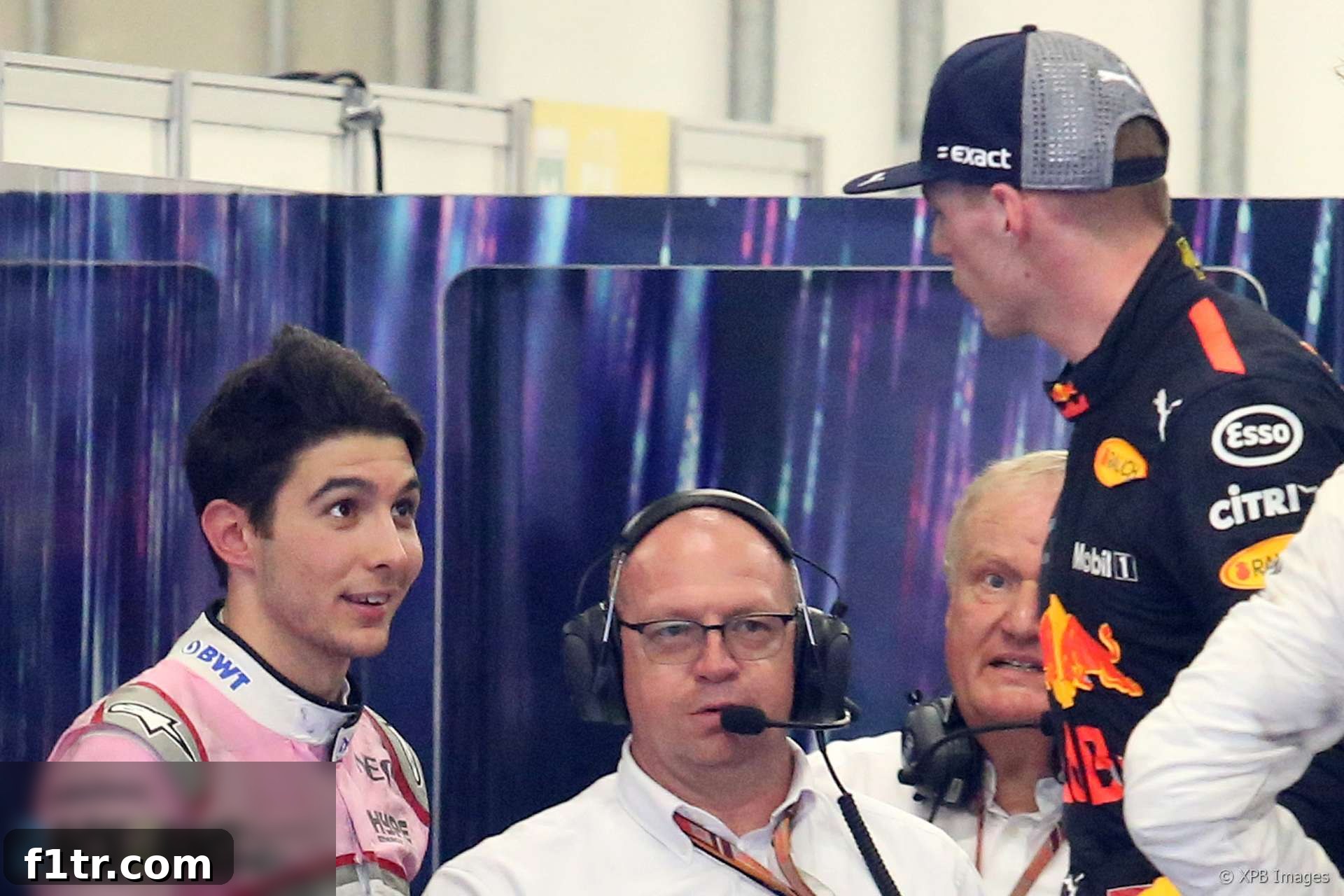
Let’s have a round of applause for Esteban Ocon, though not for the reasons one might initially assume. While his on-track incident with Max Verstappen at the Brazilian Grand Prix last Sunday was certainly regrettable and cost the Dutchman a potential victory, it is Ocon’s exemplary composure in the face of post-race aggression that truly merits commendation.
Advert | Become a Supporter & go ad-free
The 2018 Brazilian Grand Prix was poised to be a landmark moment for Max Verstappen. Having put in a truly superb performance, he was leading comfortably and seemed destined for a victory that would have undoubtedly been hailed as one of the season’s finest, perhaps even rivaling Lewis Hamilton’s masterful German GP triumph. However, his dreams were shattered on lap 44 when, while attempting to unlap himself, Esteban Ocon’s Force India collided with the Red Bull. The resulting spin cost Verstappen the lead and ultimately the win, sparking a furious reaction that would later escalate off-track.
It is in the immediate aftermath of this frustrating race that Ocon demonstrated remarkable restraint. As Verstappen, visibly seething, confronted his former karting and F3 rival in the mandatory FIA weighing area, Ocon remained composed despite being subjected to a clear physical assault. Footage of the incident is stark: Verstappen initiated the confrontation, making an unheard comment to Ocon, before proceeding to shove the Force India driver multiple times. Ocon, still speaking, instinctively raised a hand in a defensive gesture, only for Verstappen to shove him again, forcibly dislodging him from the weighing platform. Even as Verstappen began to walk away, he returned for a third, deliberate push. This was not a minor bump; it was a series of aggressive shoves aimed squarely at Ocon’s chest.
While this incident didn’t escalate to the infamous proportions of F1 bust-ups like Serra/Boesel, Piquet/Salazar, Senna/Irvine, or even Schumacher/Coulthard, Verstappen’s actions were undeniably confrontational and, as subsequent comments revealed, indicative of a desire for a more substantial physical altercation. When asked in the official FIA press conference if Ocon had “antagonised” him, Verstappen’s response was crude and telling: he complained only that his rival was “being a pussy.” Such language, combined with the physical actions, paints a clear picture of a driver unable to control his temper and resorting to base insults when words fail him.
Max Verstappen is, by all accounts, a highly articulate and intelligent individual when he chooses to be. He is quite capable of expressing himself in clear, forthright, and persuasive terms, particularly when advocating for his racing decisions or strategy. Therefore, his decision to stoop to physical aggression and crude verbal abuse is not born out of an inability to communicate, but rather a troubling lack of self-control and respect for his peers. This behavior, unfortunately, finds disturbing echoes in his family background.
Verstappen’s upbringing, particularly through his father Jos, carries a troubling reputation for violence that has frequently attracted legal scrutiny. As far back as 2000, while still an active Formula 1 driver, Jos Verstappen was found guilty of fracturing a 45-year-old man’s skull during a fight at a kart track two years prior. He narrowly avoided a prison sentence following an out-of-court settlement. This was not an isolated incident. In 2008, the elder Verstappen received another suspended jail sentence for breaching a restraining order against his former wife Sophie Kumpen – who is Max’s mother – after being found to have sent her threatening messages. His legal troubles continued, with another brush with the law following an alleged assault of a former girlfriend in 2012. More recently, in 2017, he was arrested again following a fight at a beach club. Given this extensive history, it is difficult to imagine Jos Verstappen providing his son with the standard parental guidance on resolving differences through words rather than violence without it being an exercise in profound hypocrisy. This background undeniably raises questions about the influences shaping Max’s approach to conflict and aggression.
Equally concerning is the lack of proper instruction and perhaps even outright encouragement from his own team. Shamefully, Red Bull team principal Christian Horner appeared on television seemingly to egg his driver on, rather than temper his behavior. Horner infamously stated that Ocon was “lucky to get away with a push,” a remark that can only be interpreted as an endorsement of Verstappen’s aggressive actions. Such comments from a team leader, especially one operating at the pinnacle of motorsport, send a dangerous message. It suggests that physical altercations are not only acceptable but perhaps even a justifiable response to on-track frustrations, undermining the core tenets of sportsmanship and respect.
Advert | Become a RaceFans supporter andgo ad-free
FIA race director Charlie Whiting, speaking after the race but before the stewards delivered their official response to Verstappen’s behavior, largely brushed aside Horner’s remarks. “It’s not a great thing to hear,” he conceded, “But in the heat of the moment and having lost a race that they would probably have won I can understand comments like that.” While understanding the emotional context of a lost victory is reasonable, excusing or rationalizing comments that condone violence from a team principal is a perilous path for motorsport’s governing body to tread. It implies a leniency towards aggressive conduct that flies in the face of the FIA’s broader commitment to safety and fair play.
Ultimately, the stewards did rule on the incident, concluding that Verstappen “made deliberate physical contact” by “starting an altercation, pushing or hitting Ocon forcefully several times in the chest.” They explicitly found that he violated article 12.1.1.c of the International Sporting Code, which strictly forbids “any fraudulent conduct or any act prejudicial to the interests of any competition or to the interests of motor sport generally.” This robust condemnation from the stewards acknowledged the seriousness of Verstappen’s actions, recognizing that his behavior went beyond a simple verbal exchange and constituted a physical assault detrimental to the sport’s image.
However, for all the strong language and clear identification of a rule violation, the sanction handed down was remarkably toothless: performing two days of public service for the FIA. While this might be a tedious exercise for Verstappen, it is hardly an incentive for genuine behavioral change. A few days of public service does little to impress upon a multi-millionaire athlete the gravity of physical assault, especially when compared to the significant sporting penalties applied for on-track infractions. This lenient punishment sends a conflicting message: while the act itself was condemned, the consequences suggest that such behavior is not considered truly damaging enough to warrant a significant deterrent. It indicates a failure to uphold the sanctity of the paddock as a professional environment, where personal safety and mutual respect should be paramount.
Predictably, Verstappen attempted to justify his response with a weak, often-used straw man defense, claiming he is “passionate about the sport” and that “it would be odd if I would shake his hand.” While it is true that we want drivers who are passionate, highly competitive, and driven to win, it is crucial to distinguish between healthy passion and unbridled, aggressive violence. The former is commendable and drives athletic excellence; the latter is unacceptable and erodes the integrity of the sport. Passion does not, and must never, justify physical assault. Tolerating violence, even in its seemingly minor forms, ultimately normalizes it and sets a dangerous precedent for future incidents within motorsport and beyond.
The FIA, as the sport’s governing body, has a fundamental responsibility to ensure the safety and fair conduct of all participants. Alarmingly, it has repeatedly failed to heed the warning signs that Verstappen’s behavior was escalating. Earlier in the season, after being beaten to pole position by Daniel Ricciardo in Mexico, Verstappen himself admitted to a worrying level of anger, stating: “I could literally do some damage to somebody if somebody would say something wrong to me after qualifying, that angry I was.” This was a clear red flag, indicating a driver struggling with anger management and hinting at a potential for physical confrontation. The incident with Ocon, therefore, was not an unforeseen outburst but the manifestation of an unresolved behavioral issue that the FIA had previous opportunities to address.
However angered Verstappen may have been by the collision with Ocon – an incident for which Ocon received a hefty 10-second stop-and-go penalty – the FIA should have unequivocally sent the message that responding with violence is always a more egregious offense than a sporting misjudgment committed in good faith. Ocon paid a significant on-track price for his error. Verstappen’s subsequent actions, which were deliberate and malicious, should have incurred an equally, if not more, severe penalty. By throwing Verstappen out of the race, the FIA would have made a powerful statement that such behavior has no place in Formula 1.
There is clear precedent for such decisive action. In the European F3 championship just two years prior, Nikita Mazepin was banned from a race for punching rival Callum Ilott. If a young driver in a junior category can face such a significant consequence for physical assault, then a senior F1 driver, a global ambassador for the sport, should certainly be held to an equally high, if not higher, standard. The FIA missed a critical opportunity to teach Verstappen a much-needed lesson – one that, regrettably, he appears not to have learned at home. Failing to act decisively on such incidents erodes the very foundation of sportsmanship and respect that Formula 1 claims to uphold, leaving a concerning void in its disciplinary framework.
Advert | Become a RaceFans supporter andgo ad-free
Quotes: Dieter Rencken
Comment
- The shadow of motorsport’s worst tragedy hangs over F1’s latest safety debate
- F1 got lucky three ways. But now it has a difficult and urgent problem to solve
- Verstappen’s overreaction shows he knows he cost himself the 2025 title
- F1’s sticking-plaster fix for Qatar tyre failures is an embarrassment
- The FIA’s stewards grabbed the chance to correct their mistake – unlike last time
Browse all comment articles