When Scuderia Ferrari left the iconic Circuit de Catalunya just two months prior, the prevailing sentiment within the Formula 1 community dubbed them the ‘winter world champions’. Their pre-season testing performance had been nothing short of spectacular, leading many to believe that 2019 would finally be their year to challenge for the championship title. The SF90, their latest contender, appeared fast, balanced, and ready to take the fight to their rivals. However, whether this optimistic assessment was truly accurate, or merely an exaggeration as driver Charles Leclerc candidly suggested later, the reality that unfolded was starkly different. Nobody within the Ferrari camp could have anticipated watching Mercedes-AMG Petronas Motorsport effortlessly secure four consecutive one-two finishes, dominating the opening races of the 2019 Formula 1 season with seemingly unparalleled ease. This unexpected turn of events placed immense pressure on Ferrari to swiftly address the underlying issues plaguing their SF90 and mount a credible challenge.
The urgency to rectify the performance deficit became Ferrari’s top priority. The Baku Grand Prix marked the initial skirmishes in this crucial development war, a critical first step in their arduous journey to regain the upper hand against Mercedes. Now, as the Formula 1 circus returned to the familiar asphalt of Barcelona, further significant developments were unveiled, signaling Ferrari’s unwavering commitment to catching up. In terms of aerodynamic enhancements, these updates appeared to be incremental, subtle refinements designed to eke out marginal gains. However, a more profound strategic move was also confirmed: the team had brought forward a significant engine upgrade by an unprecedented two races. This was not a minor adjustment but a complex, resource-intensive undertaking, indicating the depth of Ferrari’s determination to turn their season around.
Pinpointing the precise ‘crux’ of Ferrari’s problem proved to be a multifaceted challenge, with opinions varying widely across experts and insiders. What was undeniably clear was the SF90’s inherent speed in certain conditions; it possessed raw pace, particularly on the straights. Yet, a fundamental inconsistency emerged: the new, thin-gauge Pirelli tyres, introduced for the 2019 season, were simply not operating optimally on the SF90 under all track conditions. This tire management conundrum could be attributed to a complex interplay of factors, including inadequate downforce, suboptimal suspension kinematics, an elusive ideal setup, or simply a lack of understanding in extracting performance from the specific Pirelli compounds. Ferrari was not alone in this struggle; several other teams, most notably Haas, were also grappling with similar difficulties in bringing the tyres into their optimal operating window and maintaining their performance throughout a race stint.
This critical deficiency manifested itself starkly: while the Ferrari engine, when fully unleashed in its most powerful modes, allowed the SF90 to be incredibly quick on the straights, surpassing its rivals, the car consistently lost time in the corners. This dichotomy became Ferrari’s Achilles’ heel on race day. As engine modes were dialled back to conserve fuel and components, and with tyres becoming the paramount limiting factor for lap time, Ferrari found themselves increasingly vulnerable. The finely balanced Mercedes W10, with its superior aerodynamic efficiency and remarkable ability to work the Pirelli tyres, effortlessly pulled away, leaving Ferrari struggling to maintain pace and often losing valuable positions, highlighting the delicate balance required in modern Formula 1 car design.
Despite their well-documented performance woes, one area where Ferrari was demonstrably not struggling was with their power unit. From the outset, the Ferrari engine, codenamed 064, exhibited immense power. Its initial performance in Melbourne was somewhat pegged back not due to a fundamental lack of power, but rather due to cooling problems affecting the control electronics. This same hardware vulnerability subsequently led to reliability issues in the following rounds, notably sidelining Charles Leclerc during the Bahrain Grand Prix race and impacting Antonio Giovinazzi’s qualifying session in China. However, with these control electronics problems meticulously identified and resolved, it became unequivocally clear that Ferrari possessed an exceptionally powerful engine. Its capability to sustain more aggressive engine modes for extended periods compared to Mercedes often skewed the analysis of practice times, creating an illusion of greater overall performance than what materialized on race day.
The potent engine also provided Ferrari with a strategic flexibility: it allowed them to potentially run higher downforce configurations if they chose to trade some of their straight-line speed advantage for better cornering grip. However, even with this option, the team still struggled to translate raw engine power into race victories, underscoring the severity of their chassis and aerodynamic challenges. It was a testament to the engine’s inherent strength that it could compensate for other areas, yet not enough to deliver consistent wins.
Therefore, the early introduction of the ‘spec two’ power unit at Barcelona came as something of a surprise to many observers. While the pursuit of more power or enhanced reliability is always a desirable objective in Formula 1, the decision to bring forward a power unit update by two races carries considerable risk. Such an aggressive development schedule places immense strain on the manufacturing and testing departments, increasing the likelihood of unforeseen issues or reliability glitches. Furthermore, this strategic choice implies that the team would likely need to reintroduce the older, less powerful, or less reliable engine at two later races in the season, a potential compromise for future performance if not managed meticulously. The complexity and urgency of this upgrade decision highlighted Ferrari’s absolute commitment to addressing their performance deficit.
Limited specific details were officially released regarding the intricacies of this power unit upgrade. However, it was widely speculated that the focus of these enhancements lay primarily within the V6 internal combustion engine and its turbocharger, potentially accompanied by a consequential upgrade to the MGU-H (Motor Generator Unit – Heat). Any power increment achieved would undoubtedly be bolstered by revised Shell fuel and lubricant formulations, meticulously engineered to optimize combustion efficiency and reduce friction within the engine. To mitigate the substantial risks associated with an early upgrade, Ferrari’s engine department would have been tirelessly running the new unit on its dynos for countless hours, rigorously testing to ensure both the anticipated performance gains and, critically, impeccable reliability, leaving no stone unturned to avoid any catastrophic failures that could further derail their championship aspirations.
On the chassis and aerodynamic front, the most visually conspicuous update was a modification to the SF90’s shark fin. Ferrari, like the majority of teams, already maximized the shark fin’s area within the current regulatory limits, which had been revised at the end of 2017 to reduce their overall size. However, Ferrari’s fin often appeared larger than its counterparts because the team did not utilize the area beneath it as extensively for cooling purposes as many other constructors did. The updated fin retained its basic dimensions but featured a distinct section removed at its front-top edge (1), positioned strategically just behind the roll hoop. This seemingly minor alteration was designed to allow a portion of the airflow to pass more smoothly behind the fin when the car experiences lateral sliding at higher speeds. The intended effect was a reduction in pressure on the face of the fin and a dampening of the vortex shedding from its top edge. In practical terms, this modification aimed to lessen the ‘weather-vane’ effect, allowing the car to slide a fraction more gracefully through faster corners, potentially enhancing turn-in stability and reducing drag associated with the fin’s interaction with turbulent air.
This subtle aerodynamic refinement was expected to provide multiple benefits. By improving the car’s ability to turn more effectively at high speeds, it could also help the Pirelli tyres reach and maintain their optimal operating temperature more readily through these critical turns. This aspect could prove particularly valuable if the characteristics of the Catalunya track, with its notoriously abrasive surface and demanding cornering sequences, continued to pose challenges for Ferrari’s specific Pirelli tyre management strategies. Any improvement in tyre heating or stability through fast corners could unlock precious lap time and improve overall race performance.
At the rear of the SF90, the rear wing assembly also underwent subtle but significant modifications. Firstly, a noticeable change was observed in the number of vertical vanes hanging from the crease in the wing’s endplates; these were increased from six to seven, indicating a meticulous effort to refine the airflow characteristics around this crucial aerodynamic device. Secondly, the vertical slits positioned towards the front-lower edge of the endplate appeared marginally shorter. These specific changes were less directly linked to the car’s broader tyre management problems. Instead, they were primarily aimed at precisely adjusting the rear wing’s aerodynamic setup to complement the car’s newly increased power output from the ‘spec two’ engine and to optimize performance along Barcelona’s long main straight. Such adjustments typically aim to strike a better balance between downforce and drag, ensuring the car is efficient without compromising stability, especially with the added horsepower.
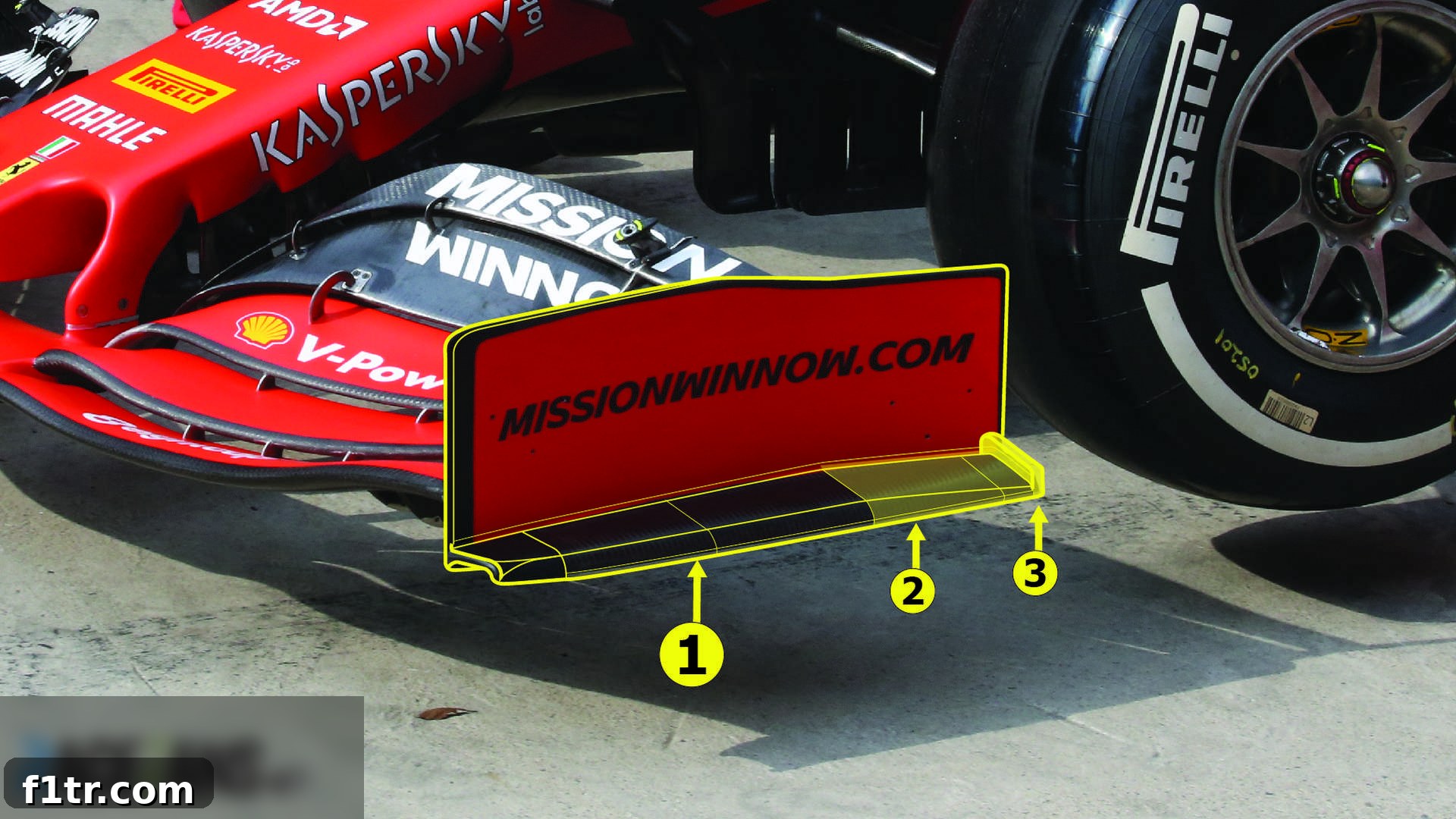
Perhaps the most intricate, yet almost imperceptible, changes were found on the front wing, specifically concerning the footplate (1) that runs along the bottom edge of the endplate. Previously, Ferrari utilized a footplate with a consistent, curved cross-section extending from its very front to its rear. The updated design introduced a modification where this section now visibly flattens (2) towards the rear, culminating in a small, distinct lip (3) on its top edge. This seemingly minor alteration has significant aerodynamic implications. Underneath the curved section of the footplate, a carefully managed vortex typically forms. This vortex plays a crucial role in preventing airflow from being drawn directly underneath the wing, thereby helping to maintain the critical pressure difference above and below the wing that generates downforce. This vortex then travels downstream, strategically pushing airflow around the front tyre, forming an integral part of the car’s sophisticated arsenal of solutions designed to manage the turbulent wake generated by the front tyres. The introduction of the flattened section and lip in the new design is expected to produce a subtly different effect compared to the simpler curved footplate. Most likely, these features will serve to kick the vortex’s direction slightly upwards as it approaches the front tyre, optimizing its interaction with the surrounding airflow. This type of nuanced and highly localized development is characteristic of the relentless aerodynamic refinement undertaken by Formula 1 teams, often derived from exhaustive analysis of real-time aero sensor data collected during extensive testing and practice sessions, aiming to precisely understand and control how the airflow is interacting with every surface of the car.
It was crucial to temper expectations: the array of upgrades introduced this weekend in Barcelona, much like those seen in Baku, were not anticipated to be a magical ‘silver bullet’ that would instantly resolve all of Ferrari’s profound woes. Instead, they represented another meticulously planned, incremental step in a continuous and demanding development cycle, specifically tailored to optimize the SF90’s performance with the very distinct characteristics of the 2019 thin-gauge Pirelli tyres. These tyres proved to be a significant challenge for several teams, and Ferrari’s efforts were clearly focused on understanding and extracting their maximum potential. Furthermore, the inherent variability of Formula 1 means that the specific track layout of Catalunya and the prevailing weather conditions could inherently suit the Ferrari car this particular weekend, regardless of the upgrades. Therefore, any notable jump in performance or improved form observed would need to be critically analyzed within this broader context, rather than being attributed solely and unequivocally to the direct impact of the newly introduced updates. The true measure of their effectiveness would be their consistency and impact across various tracks and conditions throughout the remainder of the demanding 2019 season.
F1 technology
- McLaren, Red Bull and Ferrari bring rear corner updates to Imola
- Ferrari, McLaren and Red Bull bring upgrades again for Saudi Arabian Grand Prix
- McLaren introduce major floor upgrade for Norris’ car at Mexican Grand Prix
- McLaren, Mercedes and Red Bull detail upgrade packages for United States GP
- Red Bull remove engine cover ‘cannons’ in major RB20 update – but they may return
Browse all F1 technology articles