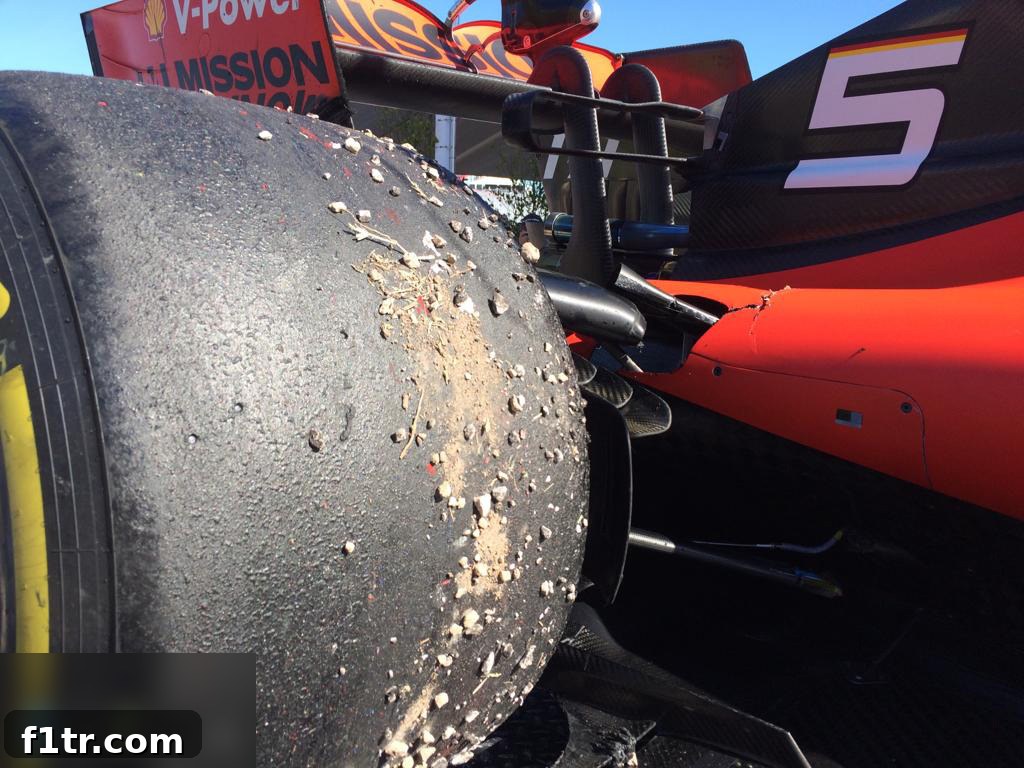
The 2019 United States Grand Prix at the Circuit of the Americas (COTA) delivered an unexpected twist for Sebastian Vettel, whose race ended prematurely and controversially due to a right-rear suspension failure. The incident, occurring on the eighth lap, immediately sparked speculation, particularly concerning a newly installed kerb. However, the four-time Formula 1 world champion steadfastly dismissed any connection between his retirement and the updated track infrastructure, adding another layer of mystery to Ferrari’s challenging season.
Vettel, driving for Scuderia Ferrari, was navigating turn nine when his SF90 suddenly lost stability, its right-rear suspension collapsing dramatically. The unexpected mechanical failure brought his race to an abrupt halt, forcing him to retire from a position he had already struggled to maintain. The immediate aftermath saw Ferrari’s pit wall communicate a critical warning to Vettel’s teammate, Charles Leclerc. “Try to avoid apex kerb turn eight,” Leclerc was advised, quickly followed by the explanation, “just because Sebastian had suspension failure there.” This radio exchange amplified the theory that the new track modification might have played a direct role in Vettel’s misfortune, turning a mechanical failure into a potential track design controversy.
The kerb in question was a fluorescent orange dome, specifically added at the apex of turn eight. Its primary purpose, as with many such track alterations in Formula 1, was to discourage drivers from exceeding track limits and gaining an unfair advantage by cutting the corner. This particular kerb was a very recent addition, having been installed only after Saturday’s qualifying sessions. Consequently, none of the drivers had experienced running over or even near it during any of the practice sessions or qualifying, making the race the first time it posed a tangible element on track. This unfamiliarity naturally fueled suspicions when a car experienced a sudden mechanical failure shortly after passing that section of the circuit.
Despite Ferrari’s immediate suspicion and the evident concern communicated to Leclerc, Sebastian Vettel himself remained unconvinced that the new kerb was the culprit behind his premature exit. When questioned after the race, the German driver stated unequivocally, “No, I didn’t use that.” His assertion contradicted the prevailing theory, suggesting that the root cause of the suspension failure lay elsewhere, perhaps within the car’s components or its setup, rather than an external impact from the kerb.
Vettel’s race had been challenging even before the suspension failure. Starting from a promising front-row position on the grid, his SF90 rapidly lost ground from the very first lap. By the time of his retirement on lap eight, he had already dropped significantly through the field, sinking to seventh place. This rapid decline hinted at underlying issues that transcended a single mechanical failure. “I had no grip in the first lap,” Vettel explained, describing his initial struggles. “I had to let a lot of people by so I couldn’t really resist. I really struggled to get the tyres to work, struggled in right-hand corners.” These comments paint a picture of a car that was not performing optimally, struggling with fundamental handling characteristics long before the dramatic structural collapse.
The specific nature of the suspension failure, occurring after several laps of racing, further complicated the diagnosis. Vettel highlighted that the car had undergone extensive running throughout the weekend, including long runs, without any prior issues. This consistent performance suggested that the failure was not a predictable outcome of chronic weakness but rather a sudden event. “Then the suspension failed. So obviously we’ve done a lot of running the whole weekend, long runs included, and no issues, so I don’t know what exactly happened but obviously something broke,” he concluded. This uncertainty left both the team and analysts pondering the exact trigger for such a critical component failure.
Suspension systems in Formula 1 cars are marvels of engineering, designed to withstand immense forces while providing precise control and optimizing tyre contact with the track. However, they are also highly stressed components, constantly subjected to vibrations, impacts, and aerodynamic loads. A failure can stem from various factors: a material defect, fatigue over time, a poorly executed setup that overstressed a particular part, or indeed, an unforeseen impact. Given Vettel’s denial of hitting the new kerb, Ferrari would have undertaken an exhaustive investigation to pinpoint the exact cause, examining telemetry data, physical remnants of the suspension, and reviewing video footage from multiple angles. Such failures, though rare, underscore the razor-thin margins and extreme demands placed on every component in a Formula 1 car.
The incident added to what was already a rollercoaster 2019 season for Ferrari and Sebastian Vettel. The year had been marked by flashes of exceptional speed, particularly after the summer break, but also by perplexing inconsistencies, reliability hiccups, and strategic missteps. Vettel, in particular, faced intense scrutiny, often overshadowed by the meteoric rise of his younger teammate, Charles Leclerc. Retirements due to mechanical failures, especially when leading or battling for significant points, are always a blow to championship aspirations, even if Vettel was not realistically in contention for the drivers’ title at this stage. They erode confidence, affect team morale, and impact the constructor’s championship standings, where every point is vital.
The broader debate surrounding track limits and kerb design in Formula 1 is a perpetual one. The FIA and circuit designers constantly strive to find a balance between encouraging aggressive, fast driving and enforcing strict adherence to track boundaries for fairness and safety. Different types of kerbs – flat, ‘sausage,’ and dome – are deployed with specific intentions. While ‘sausage’ kerbs are known for their aggressive nature and propensity to launch cars, dome kerbs like the one at COTA are typically seen as less severe but still effective deterrents. The incident highlighted the critical importance of pre-event communication and driver familiarization with any track changes, no matter how minor, to prevent unexpected mechanical stress or safety concerns.
Ultimately, Sebastian Vettel’s retirement at the 2019 United States Grand Prix remained a perplexing event, leaving questions about the precise interaction of car design, component integrity, and track infrastructure. His unequivocal denial of the new kerb as the cause shifted the focus inward, pointing towards a deeper technical issue within the Ferrari SF90. This incident served as a poignant reminder of the relentless technical challenges inherent in Formula 1, where even the most seasoned drivers and advanced machinery can fall victim to unforeseen circumstances, often at the most critical moments.