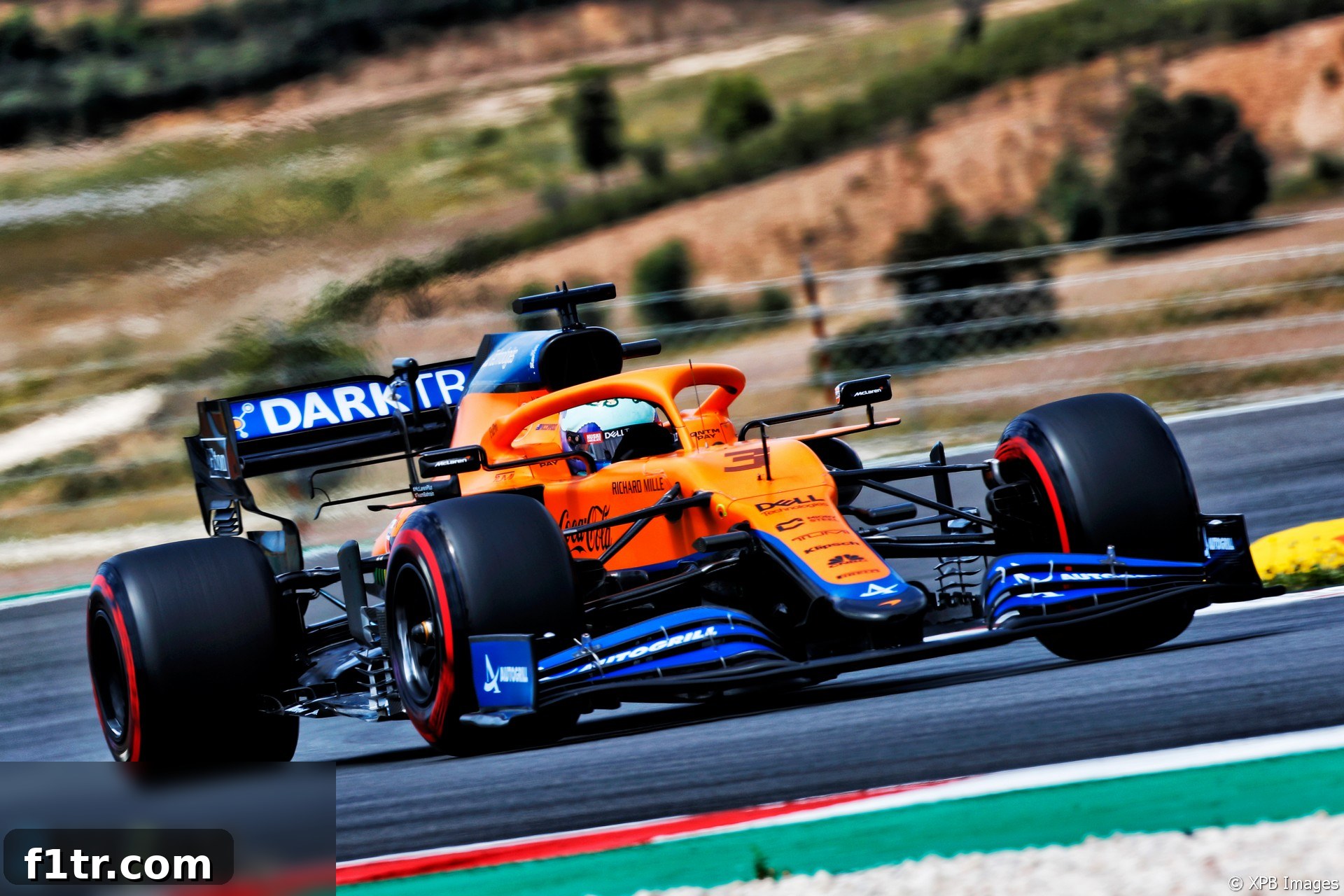
In a surprising turn of events at the Portuguese Grand Prix, McLaren driver Daniel Ricciardo found himself mystified and disappointed after an unexpected Q1 exit during Saturday’s qualifying session. The highly-anticipated weekend at Portimão took a sour turn for the Australian, who struggled to extract pace from his MCL35M, ultimately leading to a P16 start – his worst grid position since the 2019 Japanese Grand Prix. This performance stands in stark contrast to his teammate, Lando Norris, who continued to showcase the car’s potential by comfortably advancing to Q3.
Advert | Become a Supporter & go ad-free
A Puzzling Q1 Exit at Portimão
The qualifying session at the Algarve International Circuit proved to be a perplexing one for Ricciardo. While his teammate, Lando Norris, consistently demonstrated strong pace, Ricciardo lagged significantly. The data showed a deficit of over a second to Norris in Q1, a gap that is monumental in the hyper-competitive world of Formula 1. This considerable difference in performance within the same machinery raised immediate questions, both from the team and the driver himself. Ricciardo’s final effort in Q1 saw him miss the crucial cut-off for Q2 by a mere 91 thousandths of a second, an agonizingly small margin that separated him from Alfa Romeo veteran Kimi Raikkonen and a chance to improve his grid slot.
The frustration was palpable as Ricciardo expressed his bewilderment after the session. “I don’t really know what happened,” a candid Ricciardo told the media. “My laps were tricky, especially towards the last sector. But why? It’s not clear.” This statement underscored a deeper issue than just a single mistake; it hinted at a fundamental struggle to understand the car’s behaviour and extract consistent performance, particularly under pressure during a qualifying run. The unpredictable nature of the Portimão circuit, with its undulating layout and often low-grip surface, can exacerbate such challenges, making it even harder for drivers not fully at one with their machinery.
The Ongoing Adaptation Challenge at McLaren
Ricciardo’s move to McLaren from Renault was one of the most talked-about transfers of the 2021 season. Hopes were high that the charismatic Australian, known for his late-braking prowess and aggressive overtaking, would quickly adapt to the new regulations and the Mercedes-powered MCL35M. Indeed, in the previous two races of the season, Ricciardo had shown promising signs, qualifying sixth in both Bahrain and Imola. These strong starting positions suggested a smoother transition than many drivers experience when switching teams. However, the Portuguese Grand Prix qualifying served as a stark reminder of the complexities involved in integrating with a new F1 car and team.
The McLaren driver openly admitted that he is still grappling with adapting his long-honed driving style to suit the unique characteristics of the MCL35M. “I think I’m trying to get out of my old style,” he explained, shedding light on the intricate process of recalibrating a driver’s muscle memory. “I’m quite conscious about how I approach every corner.” This “old style” refers to the specific techniques and preferences developed over years with different cars, particularly the Renault and Red Bull machinery, which often require distinct approaches to braking, throttle application, and cornering lines. Modifying these ingrained habits is not a quick fix; it requires extensive simulator work, data analysis, and on-track experimentation to fine-tune the synergy between driver and machine.
Ricciardo further elaborated on the mental and emotional toll of this struggle. “I thought I’d made a step towards that yesterday – felt more comfortable. Feels dark to be here today. I’ll sleep it off.” This quote reflects the rollercoaster of emotions an F1 driver experiences, especially when progress seems to be made in practice sessions only to vanish when it counts most. The shift from feeling comfortable to being completely off-pace in less than 24 hours highlights the delicate balance required to master a Formula 1 car and the immense pressure placed on drivers to deliver.
Teammate Comparison: Norris’s Strong Form
The starkest contrast to Ricciardo’s struggles came from the other side of the McLaren garage, where Lando Norris continued his impressive run of form. Norris, who has truly come into his own in the 2021 season, confidently navigated Q1 and Q2 before securing a solid position in Q3. His ability to consistently extract pace from the MCL35M serves as a clear benchmark for Ricciardo, indicating that the car itself possesses the speed to compete at the sharp end of the grid. This dynamic creates an added layer of pressure for Ricciardo, as the performance gap to his teammate is visible and undeniable.
Norris’s seamless integration with the car, coupled with his growing experience and confidence, has made him a formidable competitor. While a direct comparison can be challenging given the unique circumstances of driver adaptation, the fact that Norris is consistently performing well underscores the car’s potential. For McLaren, having both drivers performing at peak levels is crucial for their ambitions in the Constructors’ Championship, especially with a rejuvenated Ferrari and strong showings from AlphaTauri posing significant threats.
Looking Ahead: Race Day and Beyond
Starting from 16th on the grid at Portimão presents a considerable challenge for Daniel Ricciardo. The circuit, while offering some overtaking opportunities, can be tricky to navigate through the field, especially with a congested midfield. Ricciardo will need to rely on his renowned race craft and McLaren’s strategic prowess to salvage points from what has been a difficult weekend so far. His primary goal will be to make clean overtakes, manage his tyres effectively, and avoid incidents that could further compound his woes.
Despite the setback, Ricciardo’s resilient character is well-known. His declaration to “sleep it off” is characteristic of his approach to adversity, suggesting a determination to reset and come back stronger. The McLaren team, too, will be working tirelessly with him, analyzing every data point to understand the root cause of the performance disparity. This collaboration will involve deep dives into telemetry, simulator sessions, and extensive debriefs to pinpoint specific areas where Ricciardo can better exploit the car’s potential and align his driving style with its requirements.
For Daniel Ricciardo, the journey of adapting to McLaren is far from over. While the Portuguese Grand Prix qualifying was a significant bump in the road, it highlights the immense challenge of Formula 1. His ability to overcome this hurdle and consistently perform at the level expected of a multiple Grand Prix winner will be critical not only for his own season but also for McLaren’s aspirations to solidify their position as a top-tier contender in the Constructors’ Championship. The F1 world will be watching closely to see how the Honey Badger responds to this setback in the coming races.
Don’t miss anything new from RaceFans
Follow RaceFans on social media:
- Join RaceFans on Facebook
- Follow RaceFans on Twitter
- Get daily email updates from RaceFans
2021 Portuguese Grand Prix
- Pirelli’s tyre choice for Portuguese GP wasn’t “too hard”, Hamilton concedes
- Who are the top F1 juniors bidding for a grand prix debut in 2022?
- 2021 Portuguese Grand Prix Star Performers
- Race gains encourage Ricciardo after ‘unacceptable’ qualifying performance
- Sainz says top-five finish was possible after first no-score for Ferrari
Browse all 2021 Portuguese Grand Prix articles