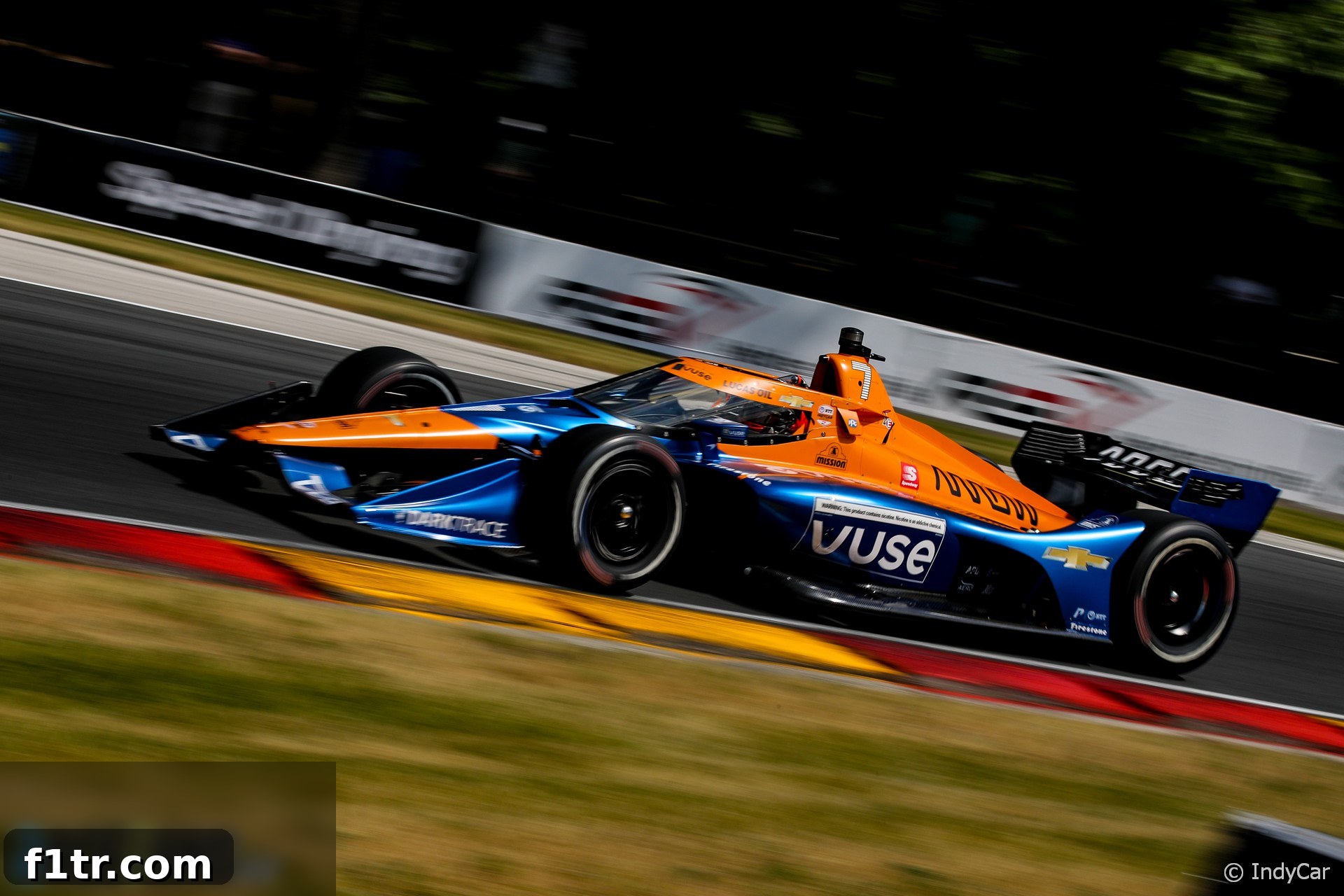
In a dramatic turn of events that sent ripples through the global motorsport community, Kevin Magnussen, a seasoned veteran of Formula 1, made an unexpected and highly anticipated debut in the NTT IndyCar Series. His entry into the high-octane American open-wheel championship at Road America was characterized by an unprecedented level of challenge and minimal preparation, as Magnussen himself candidly admitted to being “the very least prepared I’ve ever been to step into a race.” This candid admission underscored the monumental task ahead for the Danish driver, stepping into one of the most physically demanding racing series in the world with virtually no prior experience.
The call to action came less than 48 hours before the weekend’s proceedings. Magnussen was enlisted by McLaren SP to pilot their distinctive orange and blue number 7 Dallara/Chevrolet, stepping in for the injured Felix Rosenqvist. This eleventh-hour assignment meant Magnussen faced a steep learning curve without the luxury of pre-event testing in an IndyCar. The Dallara IR18, renowned for its raw power and lack of power steering, presents a unique physical challenge that even the fittest drivers take time to master. Despite this daunting prospect, Magnussen did possess some familiarity with the legendary 6.5-kilometre Road America circuit, having driven it during testing, albeit not in competitive conditions. He noted the track’s challenging layout and sweeping corners reminded him of classic European venues such as the iconic Spa-Francorchamps, offering a glimmer of familiarity amidst a sea of unknowns.
Expressing his readiness with a pragmatic outlook, Magnussen stated, “I’m as prepared as I can be with the limits of time, but it will be a steep learning curve for sure when I get in the car for the first time this afternoon.” His path was made slightly smoother by the presence of his new teammate, championship leader Patricio O’Ward, who offered valuable insights and support. Yet, the inherent challenges of adapting to a new car, a different racing philosophy, and a highly competitive field in such a compressed timeframe meant Magnussen was undeniably embarking on a baptism of fire throughout the weekend.
One of the most valuable resources for Magnussen ahead of his IndyCar debut was his former Haas Formula 1 teammate, Romain Grosjean. Grosjean, who successfully transitioned from Formula 1 to IndyCar and found a new home in the series, offered vital advice and shared his experiences. This connection highlighted a growing trend of former F1 drivers finding renewed purpose and excitement in the American open-wheel scene. Magnussen echoed this sentiment, revealing his refreshed perspective on his racing career: “After leaving Formula 1 it’s like a whole new world of opportunity has opened up. It feels very good to be able to look at all sorts of different things and just go and have fun with what I’m doing.”
This sentiment encapsulates Magnussen’s deep-seated passion for racing. “I’m a racing driver and a very passionate one. I love driving race cars, and I love competing,” he affirmed. “Being able to do all these different things and experience all these different cars and tracks around the world is really a privilege, and this weekend is going to be another big privilege.” This pure love for competition and the thrill of diverse motorsport experiences undoubtedly fueled his determination to tackle the immense challenge of his IndyCar debut, despite the overwhelming odds stacked against him.
The learning process was evident from the outset. Throughout Friday afternoon’s first practice session and Saturday morning’s second practice, Magnussen showed consistent improvement, shaving a substantial 3.5 seconds off his best lap time. This rapid adaptation showcased his innate talent and ability to quickly extract performance from unfamiliar machinery. However, the ferociously competitive nature of IndyCar qualifying meant that even significant improvements were not enough to propel him high up the grid. He ultimately finished second-to-last in his qualifying group, a mere four-tenths of a second quicker than NASCAR legend Jimmie Johnson, who was also navigating his own learning curve in IndyCar. Consequently, Magnussen, a veteran of 120 Formula 1 Grands Prix with illustrious teams like McLaren, Renault, and Haas, found himself starting his much-anticipated IndyCar debut from 21st position.
Some observers might have harbored higher expectations for a recently departed Formula 1 driver, especially one seemingly in the prime of his career, fresh off a victory in the IMSA SportsCar Championship on the streets of Detroit just a week prior. Yet, to be just one second off the pace required to advance to the second stage of qualifying, having completed only 31 laps in an entirely alien car, was an accomplishment that should not be understated. It demonstrated his raw pace and potential, hinting at what he might achieve with proper preparation and more seat time.
The race itself proved to be a rollercoaster of challenges and unexpected opportunities. Magnussen struggled to make significant forward progress during the initial laps, grappling with the nuances of IndyCar racing in a full-throttle competitive environment. An early wild off-track excursion through the grass at Turn 13 on lap six saw him briefly drop down the order to 20th, placing him behind Takuma Sato, who was driving a damaged car. Magnussen made his first scheduled pit stop on lap 14, followed by another unscheduled stop on lap 17 during the first full-course caution, triggered by Johnson’s spin at Turn 8. These early incidents underscored the chaotic and unpredictable nature of IndyCar racing, demanding quick reactions and adaptable strategies.
It was during the second caution period, caused by Marcus Ericsson’s spin at Turn 3, that a bold strategic gamble by the McLaren SP team transformed Magnussen’s race. Having just pitted under the previous Safety Car, Magnussen was in a favorable position with a fresh set of alternate compound tires. Billy Vincent, the competition director of McLaren SP and strategist for the number 7 Dallara/Chevrolet, recognized an opportunity. He made the audacious call for Magnussen to stay out on track, while nearly every other car ahead of him rushed into the pit lane for refueling and tire changes. This daring move propelled Magnussen from 22nd all the way up to 18th before the full-course yellow and then, astonishingly, into the lead.
When the race restarted on lap 25, it was Kevin Magnussen who led the field to the green flag, a truly remarkable sight and a significant milestone. This moment marked his first time leading a single-seater race since he clinched the 2013 Formula Renault 3.5 title, offering a poignant reminder of his past triumphs. Fortuitously, the lapped car of Sébastien Bourdais acted as a crucial buffer between Magnussen and second-placed Takuma Sato, who had also opted for a similar pit strategy. This strategic advantage allowed Magnussen to string together a series of consistent laps in clean air, maximizing the performance of his fresh, softer alternate compound tires, and truly showcasing his ability to lead from the front.
Sato, with his veteran experience, eventually managed to navigate his way past Bourdais and then executed a decisive lunge past Magnussen into Turn 5 on lap 31, just before Magnussen headed into the pits for his third and final scheduled stop. The strategy had played out brilliantly, giving Magnussen an invaluable taste of leading an IndyCar race. He was poised to make it to the checkered flag with just one more pit stop, a testament to the team’s foresight and his own efficient driving. However, the motorsport gods had other plans. On lap 33, his car tragically lost drive exiting Turn 7, bringing his sensational IndyCar debut to an abrupt and premature end. He was ultimately classified 24th out of 25 starters, an unflattering result that belied the impressive performance he had demonstrated.
Despite the disappointing mechanical retirement that capped off a challenging yet thrilling weekend, Magnussen left Road America with an overwhelmingly positive outlook. “I’m going to leave here with a big smile on my face although we didn’t finish the race due to a mechanical issue. I’ve had a very fun experience and want to say thank you to everyone involved,” Magnussen graciously stated after the race. He reiterated his gratitude, adding, “All-in-all, this weekend has been a fun experience. I’m very thankful to Arrow McLaren SP for the opportunity. I want to wish Felix a speedy recovery and to be back where he should be in the car.” His sportsmanlike conduct and upbeat demeanor underscored his true racing spirit.
Notably, Magnussen spent a total of six laps leading the field at Road America. This figure is particularly significant when considering his entire Formula 1 career, across which he never led a single lap. Furthermore, it doubled the amount of laps his father, Jan Magnussen, led over 11 starts in the CART series in 1996 (with Penske-Hogan Racing) and 1999 (with Patrick Racing). While his lead was undoubtedly aided by a shrewd strategic call rather than pure merit in terms of raw pace, his ability to maintain that lead once he got to the front made him look like a driver who belonged there, comfortable and composed at the sharp end of the grid.
This tantalizing glimpse of Magnussen’s potential in IndyCar has inevitably fueled speculation about his future. Just a month prior, Magnussen was seen attending practice for the iconic Indianapolis 500, an appearance that sparked considerable discussion about whether the 28-year-old Dane intended to follow Romain Grosjean’s path into the series on a more permanent basis. “The Indy 500 is definitely something that I want to do one day,” Magnussen openly admitted, articulating a dream shared by many top-tier racing drivers. He clarified his immediate focus: “I’m not really actively working towards it at the moment, just kind of taking things one day at a time. I have my season with Chip Ganassi Racing and Cadillac in (IMSA) DPi and that’s my main focus. And then what happens in the future and will happen. I’ve said that IndyCar and especially the Indy 500 – it is a dream to do it, and we’ll see if it happens from there.”
Kevin Magnussen’s Road America debut, orchestrated on such short notice and ultimately cut short by mechanical misfortune, was too brief to draw definitive conclusions about his long-term potential as an IndyCar driver. However, it successfully posed tantalizing unanswered questions about what he could truly achieve with a dedicated full-time drive and adequate preparation. His impressive performance, particularly his six laps in the lead, left a lasting impression. It is clear that ‘K-Mag’ has firmly planted his flag in the IndyCar paddock, and he would undoubtedly be a welcome addition back to the series at any point in the future, whether that be with McLaren SP, Chip Ganassi Racing, or another eager team seeking his blend of experience, speed, and racing passion.
IndyCar
- IndyCar driver McLaughlin cleared of injury after crashing through barrier at Barber
- Schumacher says his IndyCar feels like ‘an F2 car, just with better tyres’
- IndyCar “way faster than Formula 1” in some corners, says Grosjean
- FIA to award more F1 superlicence points to IndyCar drivers from 2026
- Schumacher to race full-time in IndyCar with RLL in 2026
Browse all IndyCar articles