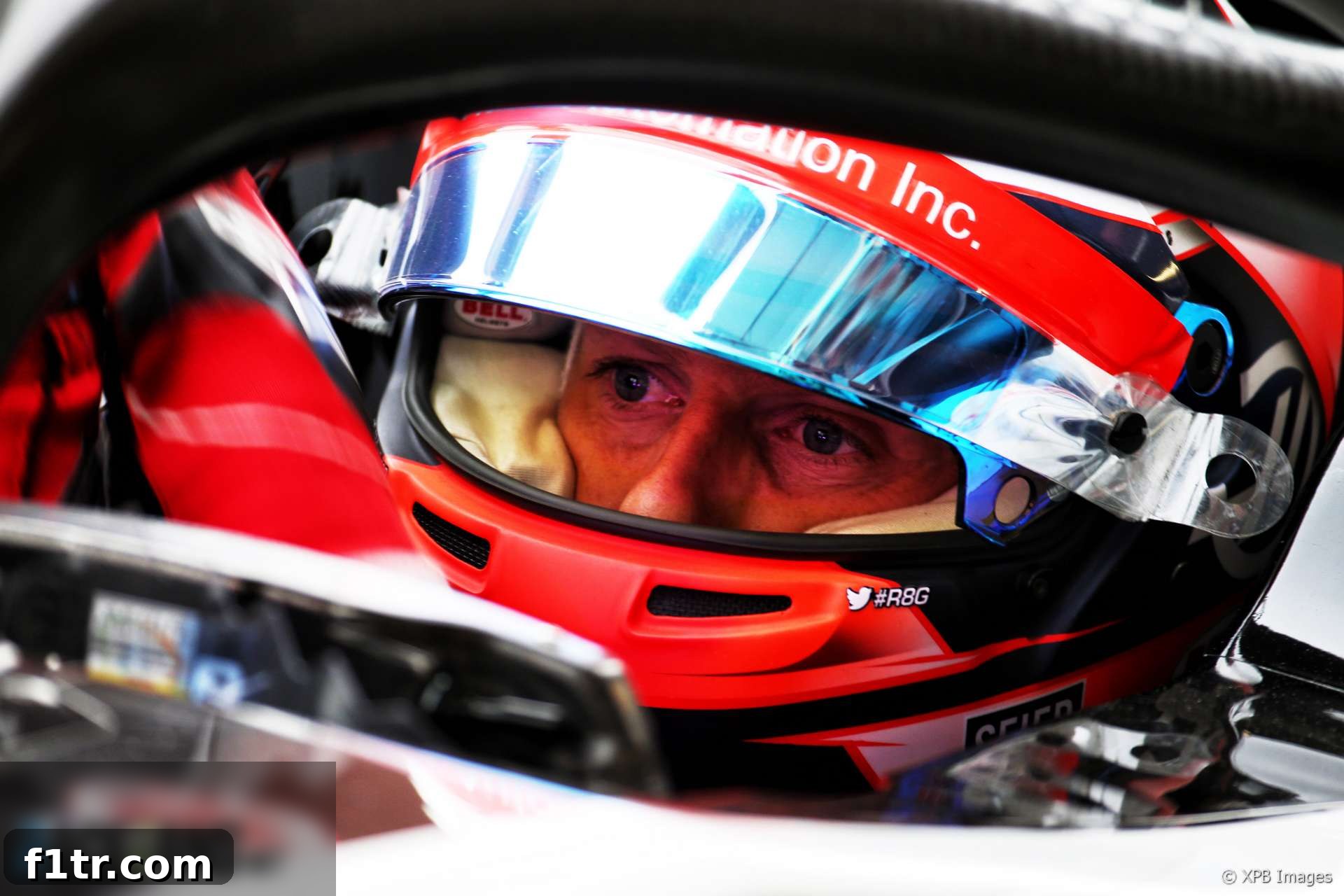
Romain Grosjean has been handed a significant three-place grid penalty for the upcoming Monaco Grand Prix, following his role in a dramatic three-car pile-up on the opening lap of today’s Spanish Grand Prix. The decision by the race stewards casts a shadow over the Frenchman’s preparations for one of Formula 1’s most iconic and challenging races.
The core of the stewards’ investigation and subsequent penalty centered on a crucial decision made by Grosjean after he initially lost control of his Haas F1 machine. On a chaotic first lap, as cars jostled for position into Turn 3, Grosjean found himself in a precarious situation. His car veered across the track, collecting the Renault of Nico Hulkenberg and the Toro Rosso of Pierre Gasly in a high-speed collision that instantly ended all three drivers’ races. The stewards meticulously reviewed the incident, particularly focusing on Grosjean’s controversial choice to accelerate, rather than brake, as his car became unsettled.
Advert | Become a Supporter & go ad-free
Grosjean provided his account to the stewards, explaining that his decision to accelerate stemmed from a perceived inevitability. He conveyed that he felt his car was destined to cross into the path of his rivals regardless, and by applying power, he was attempting to clear the racing line swiftly. This, in his view, was an instinctive reaction aimed at mitigating the potential for a larger accident. However, the stewards highlighted a critical detail that contradicted his defense: video evidence clearly showed his car was almost entirely off the track on the outside, in a seemingly safe position, before he initiated the maneuver to cross back into the racing flow.
The Stewards’ Verdict: A Closer Look at the Incident
The official verdict from the race stewards provided a detailed breakdown of their findings and the rationale behind the penalty. Their investigation involved a thorough review of video evidence from multiple angles, alongside direct testimony from Romain Grosjean and a representative from the Haas F1 Team.
The stewards reviewed video evidence and heard from the driver of car eight, Romain Grosjean and the team representative.
Car eight was following car 20 [Kevin Magnussen] at the exit of turn two when car 20 had a momentary loss of control. Car eight avoided car 20 which caused him to lose control of the car to the left of the track at the entry to turn three. The driver explained to the stewards that he felt that his momentum was going to carry him to the center of the track, and therefore made the decision to apply power in an attempt to cross to the right side of the track and get out of the way of the cars behind. However, while crossing he moved into the line of cars 27 and car 10, and all three cars were involved in a collision that took them out of the race.
The driver stated to the stewards that he made the decision to cross the track, trying to avoid the other cars and that he felt this was his best option. The stewards found that while it is speculation as to where the driver’s car would have ended up had he chosen other alternatives, it is certain that while crossing the track in front of the following pack of cars, which he chose to do, that a collision occurred. Further, in reviewing the video, the stewards found that the car was following the line on the left side of the track and was almost fully off the track, when he made the decision to cross it.
Analyzing the Stewards’ Reasoning
The stewards’ statement underscores the complexity of split-second decisions in Formula 1. While acknowledging Grosjean’s intention to avoid further contact, they ultimately ruled that his chosen action — applying power to cross the track — was directly responsible for the ensuing collision. The crucial point was that his car was already significantly off the racing line to the left, offering a potential path to safety, before he made the ill-fated decision to steer back into the heart of the oncoming pack. This suggests that alternative actions, such as braking and allowing the car to spin out more safely on the run-off area, might have prevented the multi-car incident. The stewards’ position implies that while Grosjean acted on what he believed was his “best option,” it proved to be a misjudgment with severe consequences for himself, Hulkenberg, and Gasly, effectively ending their Spanish Grand Prix prematurely and triggering an early Safety Car period.
Beyond the Grid Penalty: Points and Reputation
The ramifications of the Barcelona incident extend beyond just the three-place grid drop for Monaco. Romain Grosjean was also issued two penalty points on his Super Licence, bringing his current total to five. This accumulation of penalty points is a critical concern for any F1 driver, as collecting 12 points within a 12-month period automatically results in a one-race ban. While five points still leaves a margin, it serves as a stark reminder of the scrutiny on driver conduct and the potential for a forced absence from racing.
This incident, unfortunately, adds to a history of controversial first-lap incidents involving Grosjean, which has at times led to him being labeled as a “first-lap risk” by some observers and fellow drivers. Such incidents not only impact a driver’s immediate race results but can also affect their reputation within the highly competitive and close-knit Formula 1 paddock. For the Haas F1 Team, the early retirement of one of their cars meant a lost opportunity for valuable points, which are crucial in the constructors’ championship battle.
FIA Race Director Charlie Whiting’s Assessment
Prior to the official penalty announcement, FIA Race Director Charlie Whiting offered his initial assessment of Grosjean’s actions, describing them as “unwise.” Whiting, a highly respected figure in the sport known for his deep understanding of racing dynamics and safety, elaborated on his perspective.
“My personal view is he could have done a much better job of that,” said Whiting. “He spun and it’s very unusual to see a car light up its rear wheels like that on the first lap of a race.”
Whiting’s comments highlight a key element of the stewards’ decision: the choice to apply power. In many instances of losing control, F1 drivers are trained to instinctively attempt to gather the car or, failing that, to brake and minimize impact. Lighting up the rear wheels by applying throttle while out of control suggests an aggressive, albeit perhaps panicked, attempt to regain command or escape the situation, which in this case, proved counterproductive and dangerous. This official sentiment underscores that while mistakes happen, the specific nature of Grosjean’s reaction was deemed outside the bounds of appropriate driver conduct in such a scenario.
Looking Ahead to Monaco
The three-place grid penalty for the Monaco Grand Prix is particularly significant. Monaco’s street circuit is notoriously difficult to overtake on, making qualifying position paramount. Starting three places further back than his qualifying performance dictates will severely hamper Grosjean’s chances of scoring points, or even making significant progress, in one of the season’s most prestigious races. This penalty could force a conservative approach from Grosjean in qualifying, or conversely, an even more aggressive one to try and claw back positions before the grid penalty applies. Regardless, it sets a challenging precedent for his performance at the iconic street race.
The incident at the Spanish Grand Prix serves as a potent reminder of the fine margins and immense pressures F1 drivers face, particularly during the frantic opening laps. While Grosjean undoubtedly acted under extreme duress, the stewards’ decision reaffirms the sport’s commitment to holding drivers accountable for actions that demonstrably increase the risk of collision, even if well-intentioned. This judgment will continue to be a talking point as the Formula 1 season progresses, especially as the paddock prepares for the unique challenges of Monaco.
2018 F1 season
- F1 feared “death knell” for Drive to Survive after Ferrari and Mercedes snub
- McLaren staff told us we were “totally crazy” to take Honda engines in 2018 – Tost
- ‘It doesn’t matter if we start last’: How Red Bull’s junior team aided Honda’s leap forward
- Honda’s jet division helped F1 engineers solve power unit problem
- McLaren Racing losses rise after Honda split
Browse all 2018 F1 season articles